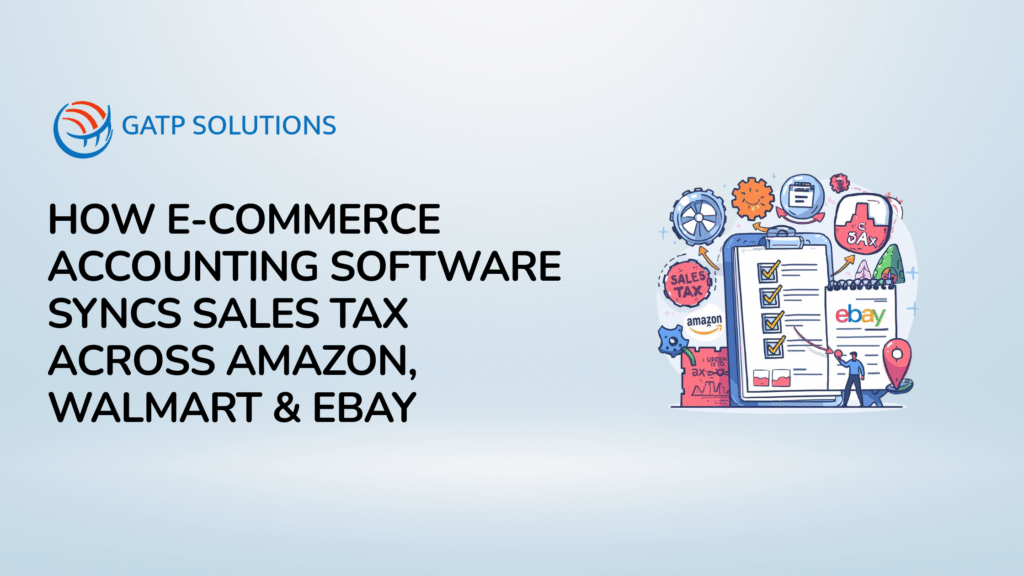
You made 200 sales last Tuesday. Across Amazon, Walmart, and eBay. Different states. Different tax rates. Different rules. Now your spreadsheet has 14 tabs and none of them agree. Sound familiar? The right e-commerce accounting software does not just track your numbers. It syncs your sales tax automatically, so you stay compliant without losing your mind. Multi-channel selling is one of the fastest ways to grow an online business. But it also creates one of the messiest accounting problems: sales tax. Every platform collects it differently. Every state has its own rules. And one missed nexus filing can cost you thousands.
Why E-Commerce Accounting Software Is Essential for Multi-Channel Sellers
Managing finances across multiple marketplaces is one of the biggest challenges in e-commerce accounting. Each platform has its own payout schedule, fee structure, and tax reporting format. When you sell on Amazon, Walmart, and eBay at the same time, your books quickly turn into a mess of mismatched data.
E-commerce accounting software brings all of that data into one place. It connects each platform, maps your revenue, and tracks sales tax by state, automatically. Without it, you are reconciling three platforms by hand every month, which means more errors and more risk.
Multi-channel sellers who use dedicated e-commerce accounting software report saving up to 12 hours per month on manual reconciliation alone.
Learn more: See how GATP Solutions handles e-commerce brand for multi-state sales tax nexus.
The Real Challenges in E-Commerce Accounting
Before we talk about solutions, it helps to understand what makes multi-channel accounting so difficult.
Platform Payout Timing Does Not Match Your Sales Dates
Amazon pays every two weeks. eBay pays weekly. Walmart pays within three business days of delivery. None of these match your actual sale dates. This makes revenue recognition a headache when you are trying to close your books each month.
Real-world example: A small electronics seller on all three platforms noticed a $4,200 discrepancy in their Q3 revenue report. The issue was not missing sales. It was Amazon’s mid-month payout crossing into the next reporting period. Their e-commerce accounting software caught it by matching sale dates to payout dates automatically.
Multi-State Sales Tax Nexus Is Confusing
After the 2018 South Dakota v. Wayfair ruling, economic nexus laws changed everything. You no longer need a physical presence in a state to owe sales tax there. If you cross a sales threshold, say $100,000 in revenue or 200 transactions in a state, you have nexus and you must collect and remit tax.
Selling across Amazon, Walmart, and eBay means you could be hitting nexus thresholds in 10 or more states without realizing it. Cloud-based accounting software for e-commerce tracks this in real time and alerts you before you cross a threshold.
Marketplace Facilitator Laws Add Another Layer
Amazon, Walmart, and eBay are now marketplace facilitators in most states. This means they collect and remit sales tax on your behalf. But not in every state. And the rules keep changing. Your e-commerce accounting software must know which states are covered and which ones require you to file separately.
Real-world example: A skincare brand selling on eBay assumed all their sales tax was handled by the platform. They were partially right. eBay remits tax in 47 states. But three states still required the seller to file independently. The brand received a $1,800 penalty notice before catching it with a software audit.
See our real time case study on “How a Global E-Commerce Brand Built a Scalable, Multi-Currency Bookkeeping System.”
Essential Features of E-Commerce Accounting Software for Multi-Channel Sellers
Not all accounting tools are built for e-commerce. Here is what your software must be able to do.
Automatic Platform Integration
Your software should connect directly to Amazon Seller Central, Walmart Marketplace, and eBay without manual exports. Software integration in e-commerce accounting means your sales, fees, refunds, and payouts sync automatically every day.
Real-Time Sales Tax Tracking by State
Look for tools that track sales tax by state and flag nexus thresholds. AI e-commerce accounting software goes a step further by predicting when you are likely to cross a threshold based on your current sales trajectory.
Reconciliation Across All Channels
The software should match every payout to every sale, even when they land in different months. This is the core of accurate financial reporting for multi-channel sellers.
Costs of the Leading Accounting Software
Here is a quick comparison of popular tools used by e-commerce sellers:
- QuickBooks Commerce: Starts at $30 per month. Good for small sellers but limited in multi-channel tax automation.
- Xero + A2X: Combined cost starts around $60 to $80 per month. Strong Amazon and eBay integration.
- Avalara: Pricing varies by transaction volume. Best-in-class for sales tax automation across all states.
- Taxjar: Starts at $19 per month. Good for nexus tracking and AutoFile features.
The right choice depends on your volume, your platforms, and how much you want to automate. A qualified e-commerce accounting partner can help you choose and configure the right stack.
Learn more from our case study on “how we achieve clear profitability visibility for a direct-to-consumer e-commerce brand.”
How AI E-commerce Accounting Software Is Changing the Game
AI e-commerce accounting software does more than record transactions. It learns your business patterns. It flags unusual activity. It predicts cash flow based on seasonal trends. And it can automate your entire sales tax workflow from calculation to filing.
Real-world example: A home goods brand selling on all three platforms used AI-powered software to identify that their eBay refund rate was 8%, compared to 2% on Amazon. The software flagged this automatically. The seller found a fulfillment issue that had been draining profit for six months. Fixing it saved them over $6,000 in the next quarter.
Cloud-based accounting software for e-commerce also means your data is accessible from anywhere, updated in real time, and never stuck on a single machine. Your accountant, bookkeeper, and CFO can all work from the same live data.
See our blog on “Cloud Accounting Software vs Traditional.”
Mistakes to Avoid as a Multi-Channel E-Commerce Seller
- Assuming all platforms handle sales tax in all states. They do not.
- Using a single bank account for all three platforms. This makes reconciliation nearly impossible.
- Waiting until tax season to review your nexus exposure. Do it monthly.
- Ignoring platform fee deductions. Amazon, Walmart, and eBay fees are tax-deductible. Missing them costs you money.
- Not separating marketplace payouts in your chart of accounts. Each channel should have its own revenue line.
Multi-Channel Sales Tax Compliance Checklist for E-Commerce Sellers
- Connect Amazon, Walmart, and eBay to your e-commerce accounting software
- Set up separate revenue lines for each platform
- Confirm which states each platform covers as a marketplace facilitator
- Track nexus thresholds across all active states monthly
- Match every payout to its original sale date
- Reconcile platform fees, refunds, and chargebacks each month
- Set filing deadlines for all active nexus states
- Generate and review monthly financial reports per platform
- Enable AI-powered alerts for threshold breaches and unusual activity
- Review your software plan annually as your sales volume grows
Read more from our blog on “The Ultimate Small Business Tax Checklist for 2026.”
Compliance Guarantee and On-Time Delivery: What GATP Solutions Promises You
At GATP Solutions, we do not just set up your e-commerce accounting software and walk away. We take full ownership of your compliance.
- Regulatory Compliance Assurance: We ensure all tax filings, payroll, and financial reports meet compliance standards at the state and federal level. If an error on our part results in a financial penalty, we will cover the cost. No exceptions.
- On-Time Delivery Guarantee: Your monthly, quarterly, and annual financial reports are delivered on schedule. If we miss a compliance deadline due to our fault, we pay a 50% fee refund. We hold ourselves accountable because your business depends on it.
Conclusion
Multi-channel selling on Amazon, Walmart, and eBay is a powerful growth strategy. But without the right e-commerce accounting software, the sales tax complexity alone can undo your margins. From multi-state nexus to marketplace facilitator rules, the landscape is too complicated to manage manually. The right software, paired with the right accounting team, keeps you compliant, accurate, and growing.
Book your free 30-minute strategy call and let us show you exactly what can be automated and fixed before your next tax deadline.
Frequently Asked Questions – E-Commerce Accounting Software
Q. How Can E-Commerce Accounting Software Improve Your Business Efficiency?
E-commerce accounting software removes manual data entry, reduces reconciliation errors, and automates your sales tax calculations across every platform. Instead of spending hours exporting reports from Amazon, Walmart, and eBay, your software pulls all data automatically and organizes it into clean financial reports.
Q. Which Accounting Software Is Best for E-commerce?
The best e-commerce accounting software depends on your business size and the platforms you sell on. For small to mid-size multi-channel sellers, a combination of QuickBooks Online or Xero paired with a connector tool like A2X works well for Amazon and eBay integration.
Q. What Is Multi-State Sales Tax Nexus and Why Does It Matter?
Sales tax nexus means you have a legal obligation to collect and remit sales tax in a specific state. After the 2018 Wayfair ruling, most states adopted economic nexus laws. If you cross a threshold, usually $100,000 in sales or 200 transactions in a state, you owe tax there even without a physical location.