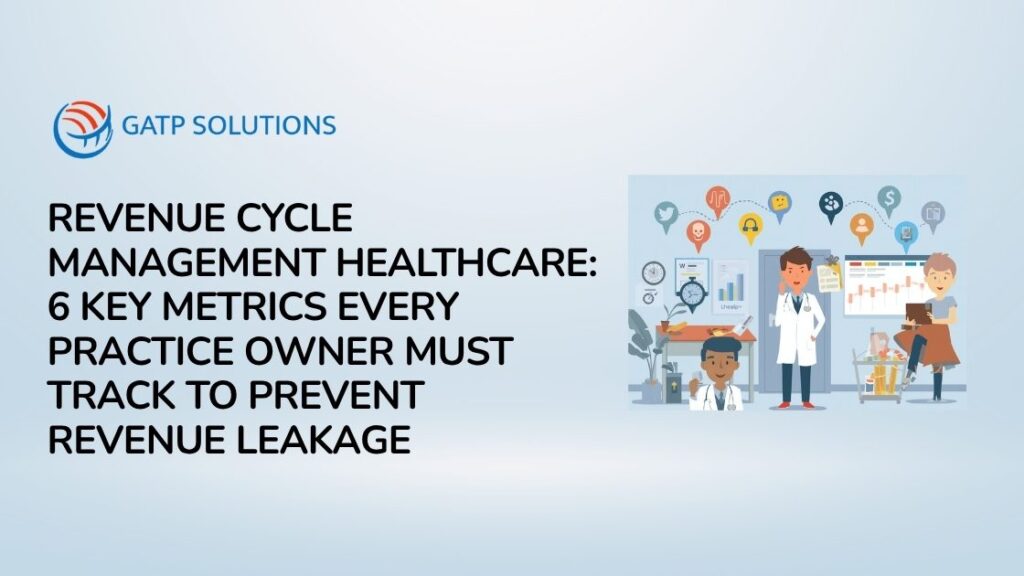
A mid-sized clinic in Texas submitted 400 claims last month. Over 60 were denied. The billing team refiled some. Others were forgotten. That is not a billing problem. That is a revenue cycle management healthcare failure that cost the practice thousands of dollars in a single month. Revenue leakage does not show up as one dramatic loss. It drips quietly through coding errors, missed follow-ups, and ignored denial trends. Most practice owners do not notice until the cash flow tightens. The good news? The right revenue cycle management metrics catch these leaks early. This blog shows you exactly which numbers to watch and why they matter. Every one of them also belongs in your monthly healthcare financial reporting KPIs, right next to cash and margin.
What Is Revenue Cycle Management Healthcare?
Revenue cycle management healthcare is the end-to-end financial process that covers everything from patient registration to final payment. It includes eligibility checks, charge capture, coding, claim submission, payment posting, denial management, and collections. When one step breaks down, money walks out the door.
Healthcare revenue cycle management services help practices manage this entire process with greater accuracy and speed. Whether handled in-house or by healthcare revenue cycle management companies, the goal is the same: get paid correctly, and get paid on time. Then that money has to be recorded correctly, which is where healthcare accounting services take over.
Why Revenue Leakage Is Increasing and How to Stop It
Payer rules are changing faster than most billing teams can keep up with. Prior authorization requirements have grown 22% over the past three years. At the same time, staffing shortages mean fewer people are chasing claims. These two forces together push denial rates higher and collections lower.
What Causes Healthcare Revenue Leakage – Revenue Cycle Management Healthcare?
The most common causes include:
- Incorrect or incomplete patient registration data.
- Missed charge capture at the point of care.
- Upcoding or under coding on claims.
- Failure to follow up on denied or underpaid claims.
- Lack of real-time visibility into accounts receivable.
- Poor coordination between clinical and billing teams
Real-world example: A behavioral health group in Florida found that 18% of its revenue leakage came from one issue alone: insurance eligibility was not re-verified at follow-up visits. Adding a simple re-verification step at check-in recovered over $90,000 in the first quarter.
Learn more for revenue cycle management healthcare from our case study where you can see the real world solution with healthcare industry.
6 Revenue Cycle Management Healthcare Metrics Every Practice Owner Must Track
Tracking the right revenue cycle management healthcare metrics is how you move from guessing to knowing. Here are the six numbers that matter most.
1. Days in Accounts Receivable
Days in A/R measures how long it takes to collect payment after a service is delivered. The industry benchmark is under 40 days. If your practice sits above 50 days, cash flow suffers and write-off risk climbs. Weekly aging reviews through accounts receivable management services keep that number from drifting.
Example: An orthopedic practice in Ohio reduced its days in A/R from 58 to 34 days after implementing automated claim tracking with healthcare revenue cycle management software. That single change freed up operating cash that was previously stuck in limbo.
2. Clean Claims Rate
A clean claim is one that gets accepted and paid on the first submission. Your clean claims rate should be above 95%. Anything lower means your team is spending time and money on rework that should not be necessary.
Techniques and tools for improving revenue cycle management healthcare, such as AI-powered claim scrubbers, can raise your clean claims rate significantly by catching errors before submission.
3. Denial Rate
Your denial rate should stay below 5%. A denial rate above that signals systemic issues, whether in coding, documentation, or eligibility verification. Denial management is not just about fixing what went wrong. It is about finding the pattern so the same error stops happening. GATP Solutions audits denial patterns across your claims history and builds a corrective action plan tailored to your practice.
4. Net Collection Rate
The net collection rate shows the percentage of collectible revenue you actually received. A healthy rate is 95% or above. If yours is lower, you are leaving money on the table that is legitimately owed to you.
5. Cost to Collect
This metric tells you how much it costs to bring in every dollar of revenue. For most practices, the benchmark is between 3% and 7% of net collections. A high cost to collect often means too much manual work. This is where healthcare revenue cycle management software and automation provide the biggest return.
6. Patient Collection Rate
As patient responsibility for costs rises, this metric becomes more critical. Patient collections now represent up to 30% of total practice revenue. Collecting before or at the point of service dramatically improves this number.
Explore the full range of healthcare revenue cycle management services that support patient collections.
Revenue Cycle Management Metrics – Benefits of Revenue Cycle Management Healthcare
When revenue cycle management healthcare runs well, the benefits go beyond better cash flow. Here is what practices consistently report after optimizing their RCM process:
- Fewer claim denials and faster reimbursements.
- Better patient satisfaction through transparent billing.
- Reduced compliance risk and audit exposure.
- Lower administrative overhead.
- Stronger financial forecasting and planning capability.
The benefits of revenue cycle management healthcare are only fully realized when the right processes, people, and tools work together. That is exactly what healthcare revenue cycle management companies like GATP Solutions are built to deliver.
Techniques and Tools for Improving Healthcare Revenue Cycle Management
Knowing your metrics is the first step. Acting on them is where practices actually recover lost revenue. These are the most effective techniques and tools for improving revenue cycle management healthcare used by high-performing practices across the USA.
Automate Front-End Workflows
Most revenue leakage starts at patient intake, not the billing stage. Automating front-end tasks removes human error from the process before it can cause a denial.
- Use automated eligibility verification tools to confirm insurance coverage before every visit.
- Set up real-time alerts for prior authorization requirements by payer and procedure.
- Automate patient demographic capture through digital intake forms to reduce registration errors.
- Schedule automatic re-verification for returning patients at follow-up appointments.
Use the Right Healthcare Revenue Cycle Management Software
Healthcare revenue cycle management software has moved well beyond basic billing. Today’s platforms offer predictive analytics, AI-driven claim scrubbing, and denial pattern tracking that manual teams simply cannot match.
- AI-powered claim scrubbers that catch coding errors before submission and increase clean claims rate.
- Denial management dashboards that track denial reasons by payer, provider, and procedure code.
- Real-time accounts receivable aging reports to flag high-risk balances before they become write-offs.
- Integrated payment portals that make it easier for patients to pay balances at or before the point of service.
- Automated remittance posting to reduce manual payment entry errors and speed up reconciliation.
Real-world example: A multi-specialty group in California switched to an AI-integrated RCM platform and reduced its denial rate from 11% to 4.2% within six months. The software identified that 68% of its denials came from just three procedure codes billed incorrectly for a specific payer.
Train Staff on Revenue Impact, Not Just Process
Your front desk team makes financial decisions every day, even if they do not realize it. Training them on the revenue impact of their actions is one of the most cost-effective techniques for improving revenue cycle management healthcare.
- Train registration staff to understand how incomplete data directly causes claim denials.
- Educate coders on annual CPT and ICD-10 updates to stay current with payer requirements.
- Hold monthly RCM performance reviews with billing teams using real metric data.
- Create clear escalation paths for denied claims so nothing sits unresolved past payer appeal windows.
Common Mistakes That Hurt Your Revenue Cycle
- Skipping eligibility verification for returning patients.
- Letting denied claims age past the payer’s appeal window.
- Using outdated CPT or ICD-10 codes after annual updates.
- Not training front desk staff on the financial impact of their data entry.
- Relying on manual processes when automation tools are available.
Avoiding these mistakes is easier when you have a proven system and expert support behind you. See how GATP Solutions help in revenue cycle management healthcare to build that system.
The GATP Solutions Guarantee: Compliance and On-Time Delivery
Revenue cycle management healthcare is only as strong as the compliance framework behind it. At GATP Solutions, we back our work with two guarantees that protect your practice.
Regulatory Compliance Assurance
We ensure all tax filings, payroll, and financial reports meet compliance standards. If an error on our part results in a financial penalty, we cover the cost. No excuses, no fine print.
On-Time Delivery Guarantee
Monthly, quarterly, and annual financial reports are delivered on schedule, every time. If we miss a compliance deadline due to our fault, we pay a 50% fee. That is how seriously we take your financial calendar.
Conclusion
Revenue cycle management healthcare is not a back-office function. It is a frontline driver of your practice’s financial survival. Tracking the right metrics, stopping common errors, and working with expert healthcare revenue cycle management services gives you real control over your revenue. Every dollar you leave uncollected is a dollar your practice earned and did not keep. With the right techniques and tools for improving healthcare revenue cycle management, that does not have to happen.
Ready to Stop the Revenue Leak?
Book a free 30-minute Revenue Cycle Audit with GATP Solutions. We will review your current RCM process, identify the top three areas where you are losing money, and show you exactly what can be improved within 30 days. No obligation. Just clarity.
Frequently Asked Questions – Revenue Cycle Management Healthcare
Q. What is the importance of revenue cycle management healthcare?
Revenue cycle management healthcare ensures that practices get paid correctly and on time for every service they provide. Without it, coding errors, missed claims, and untracked denials quietly drain revenue. Strong RCM also protects against compliance violations that can result in audits and penalties.
Q. How can a healthcare organization improve its revenue cycle management?
Start by tracking the six core metrics in this blog. Then, identify the top denial reasons and build a correction plan. Use healthcare revenue cycle management software to automate eligibility checks and claim scrubbing. Partner with healthcare revenue cycle management companies that offer ongoing monitoring, not just a one-time fix.
Q. Where are my healthcare revenue leaks coming from?
The most common sources are missed eligibility verifications, incomplete charge capture, high denial rates with no follow-up workflow, and patient balances that go uncollected. An RCM audit from a firm like GATP Solutions can identify the exact sources in your practice within days.
Q. Why is healthcare revenue leakage increasing and how do you stop it?
Leakage is increasing because payer rules are growing more complex, staff turnover disrupts billing continuity, and many practices still rely on manual processes. You stop it by tracking key metrics consistently, using automation tools, and working with experienced healthcare revenue cycle management services that stay current on payer changes.
Q. What causes healthcare revenue leakage?
Coding errors, outdated charge masters, poor denial management, lack of patient pre-authorization, and delayed claim submissions are the main culprits. Each on its own may seem small. Together, they can cost a mid-sized practice tens of thousands of dollars every year.