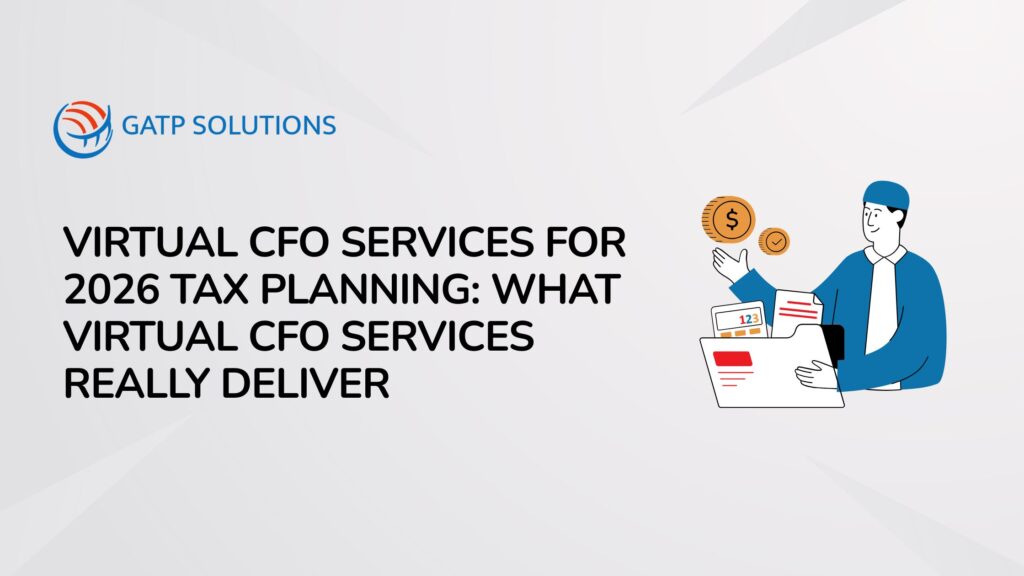
Financial leadership expectations for US businesses are changing faster than many businesses realize. As companies move closer to 2026, tax planning is no longer a once-a-year activity handled in isolation or just with internal teams. It has become an ongoing leadership function, closely tied to cash flow management, compliance responsibilities, growth decisions, and risk control.
This shift is one of the main reasons virtual CFO services are gaining traction across businesses. What initially emerged as a flexible alternative to full-time CFO hiring is now being used more deliberately. Companies want access to CFO-level thinking without the rigidity, cost, and long onboarding cycles associated with traditional executive roles.
At the same time, interest rates remain elevated, regulatory scrutiny continues to increase, and investors expect stronger financial discipline even from privately held businesses. In this environment, relying only on bookkeeping support and year-end tax filing often leaves leadership reacting to outcomes instead of planning ahead.
In this blog, we explore what virtual CFO services actually deliver in 2026, how they support tax planning throughout the year, and how businesses should think about engaging the right level of financial leadership as their needs change.
What Virtual CFO Services Actually Mean in 2026
Foundationally, virtual CFO services provide CFO-level financial leadership on a flexible basis. Instead of hiring a full-time CFO, businesses hire experienced finance professionals who guide strategy, oversee financial systems, and support planning without being embedded in daily operations.
This role is often confused with a virtual accountant or teams that outsource bookkeeping, but the responsibilities are very different.
Bookkeeping focuses on recording transactions accurately. Accounting ensures compliance, reconciliations, and reporting. A virtual CFO works above both layers, using that information to help leadership anticipate what is coming next.
In 2026, this difference matters more than ever. Businesses face tighter margins, evolving tax rules, and greater pressure to justify decisions to lenders and investors. Clean books are the baseline. Strategic financial oversight is what enables confident planning.
Virtual CFO Services vs Traditional Accounting Support
A common misconception is that CFO services simply add another layer to accounting. In practice, the difference lies in purpose, time horizon, and decision impact. Traditional accounting focuses on accuracy and compliance, while outsourced CFO services focus on foresight and leadership.
Key Differences at a Glance
| Area | Traditional Accounting | Virtual CFO Services |
|---|---|---|
| Primary Focus | Historical accuracy and compliance | Forward-looking planning and decision support |
| Time Horizon | Past performance | Future outcomes and scenarios |
| Tax Approach | Year-end filing and reporting | Ongoing tax planning and forecasting |
| Cash Flow View | Recording inflows and outflows | Anticipating liquidity needs and risks |
| Role in Decisions | Support function | Strategic advisor to leadership |
This distinction becomes especially important for tax planning. Without CFO-level oversight, tax exposure is often identified only after the year closes, when flexibility is limited. With virtual CFO services, tax implications are evaluated before decisions are finalized.
Why 2026 Tax Planning Requires Ongoing CFO-Level Oversight
Tax planning in 2026 seems to be more complicated than before. Companies are dealing with more regulatory updates, increasing multi-state exposure, and tighter enforcement around estimated tax payments.
Virtual CFO services support tax planning as a continuous process rather than a year-end task. This approach enables businesses to review tax exposure earlier, align payments with real-time performance, preserve liquidity, and avoid rushed decisions as deadlines approach.
What Virtual CFO Services Deliver for 2026 Tax Planning
The real value of virtual CFO services lies in how they connect financial strategy, tax planning, and execution into a single, coordinated framework.
Proactive Tax Strategy and Forecasting
- Embed tax planning directly into financial forecasts
- Evaluate revenue, expense, and operational decisions for tax impact before execution
- Forecast annual tax liability with greater accuracy
- Plan quarterly estimated tax payments with predictability
- Adjust timing decisions as tax exposure shifts
Entity Structure Review and Optimization
- Assess whether current entity structures align with projected profits
- Identify inefficiencies as revenue scales or ownership changes
- Flag restructuring considerations early
- Support informed discussions with tax and legal advisors
Cash Flow Planning Aligned With Tax Obligations
- Align tax forecasts with operating cash flow
- Build tax reserves gradually
- Improve visibility into upcoming tax-related cash requirements
- Reduce dependence on short-term financing
Coordination Across Finance Functions
- Coordinate leadership, tax advisors, accounting teams, and providers that outsource bookkeeping
- Ensure financial data is decision-ready
- Maintain shared assumptions and timelines across teams
The 2026 Tax Planning and Compliance Roadmap
Planning for 2026 requires understanding both deadlines and strategic opportunities. Following are the points companies need to focus on for their 2026 tax planning and compliance:
Entity-Specific Filing Requirements
- S-Corporations and partnerships with earlier filing deadlines
- C-Corporations managing quarterly estimated payments
- Sole proprietors balancing personal and business tax exposure
Key 2026 Changes to Track
One notable update is the increased Form 1099 reporting threshold. While this reduces filing volume, it does not eliminate the need for accurate tracking. Virtual CFOs help businesses adjust processes without losing deduction visibility.
Strategic Tax Planning Opportunities
- Timing of income and expenses
- Retirement contributions
- Deduction capture
- Cash flow alignment with tax obligations
This ongoing review prevents rushed decisions late in the year.
Technology and Systems That Enable Modern Virtual CFO Services
Technology is a critical enabler of effective virtual CFO services, but tools alone do not create value.
Modern CFO environments typically include cloud accounting platforms, automated reconciliations, integrated payroll and expense systems, KPI dashboards, and forecasting tools.
For example, rolling cash flow forecasts can surface liquidity gaps months before tax payments are due. Scenario modeling can show how hiring, expansion, or pricing decisions affect cash flow and tax exposure.
Virtual CFOs use these systems to deliver insight at the right time. The value comes from interpretation, not just access to data.
When Businesses Should Consider Virtual CFO Services
Many businesses assume they need a virtual CFO only when something breaks. In reality, the stronger signal is complexity rather than crisis.
Increasing Tax Exposure Year Over Year
As revenue grows, tax obligations often rise faster than expected due to new revenue streams, multi-state activity, or changes in expense structure. Businesses commonly notice this when tax bills spike despite steady margins or when estimated payments feel reactive.
Limited Cash Flow Visibility Beyond the Near Term
Knowing today’s bank balance is not the same as understanding next quarter’s liquidity. Businesses often delay hiring, expansion, or investment decisions because cash visibility is limited.
Growth Decisions Made Without Financial Modeling
Hiring, expansion, pricing changes, or new product launches often move faster than financial planning. Without modeling, margins compress quietly and cash strain appears later.
Leadership Spending Excessive Time Interpreting Reports
When leadership spends too much time trying to interpret financial reports, it signals that insight is missing, not data.
Why Earlier Engagement Matters
Engaging virtual CFO services early allows businesses to put structure in place before pressure builds. Forecasts become reliable, tax planning becomes integrated, and decisions improve across the board.
GATP Solutions: Your Trusted Virtual CFO Partner
GATP Solutions step in as a virtual CFO partner for businesses that have outgrown reactive financial management but are not yet ready for a full-time CFO hire. Rather than operating as an external advisor, we work closely with leadership teams to provide ongoing CFO-level oversight that adapts as the business grows.
Our approach to virtual CFO services includes:
- Integrating tax planning into ongoing financial strategy
- Building clarity around cash flow, tax exposure, and decision timing
- Working in coordination with existing accountants and tax advisors
- Designing finance structures that scale cleanly without unnecessary complexity
As a virtual CFO partner, we help leadership teams move from hindsight-driven reporting to forward-looking financial control.
Key Takeaways: Preparing for 2026 With the Right Financial Leadership
- Tax planning in 2026 requires ongoing forecasting, not year-end fixes
- Cash flow, tax exposure, and growth decisions must be evaluated together
- Virtual CFO services bridge the gap between accounting data and leadership decisions
- Forward visibility reduces financial and compliance risk
- Rising complexity is often the first signal CFO support is needed
- Flexible CFO models lower long-term hiring risk
- Technology enables insight only when paired with financial leadership
- Firms like GATP Solutions act as virtual CFO partners, helping businesses prepare for 2026 with clarity, structure, and confidence