
Accountants for small business cost USD 3,300 to 4,200 per business return on average, per IRS figures for companies with USD 10 million or less in assets. Ongoing monthly accounting adds a second cost, from a few hundred dollars a month for an outside firm to about USD 123,919 a year for a full-time hire.
The wrong choice costs more than either. A four-partner firm that files its next return three months late owes at least USD 3,120 in penalties.
Most owners start with professional bookkeeping services and add tax, payroll and advisory work as revenue passes USD 1 million. This guide explains each job an accountant does, which type you need, what it costs in 2026, and how to find, hire and onboard the right one.
What Does an Accountant Do for a Small Business?
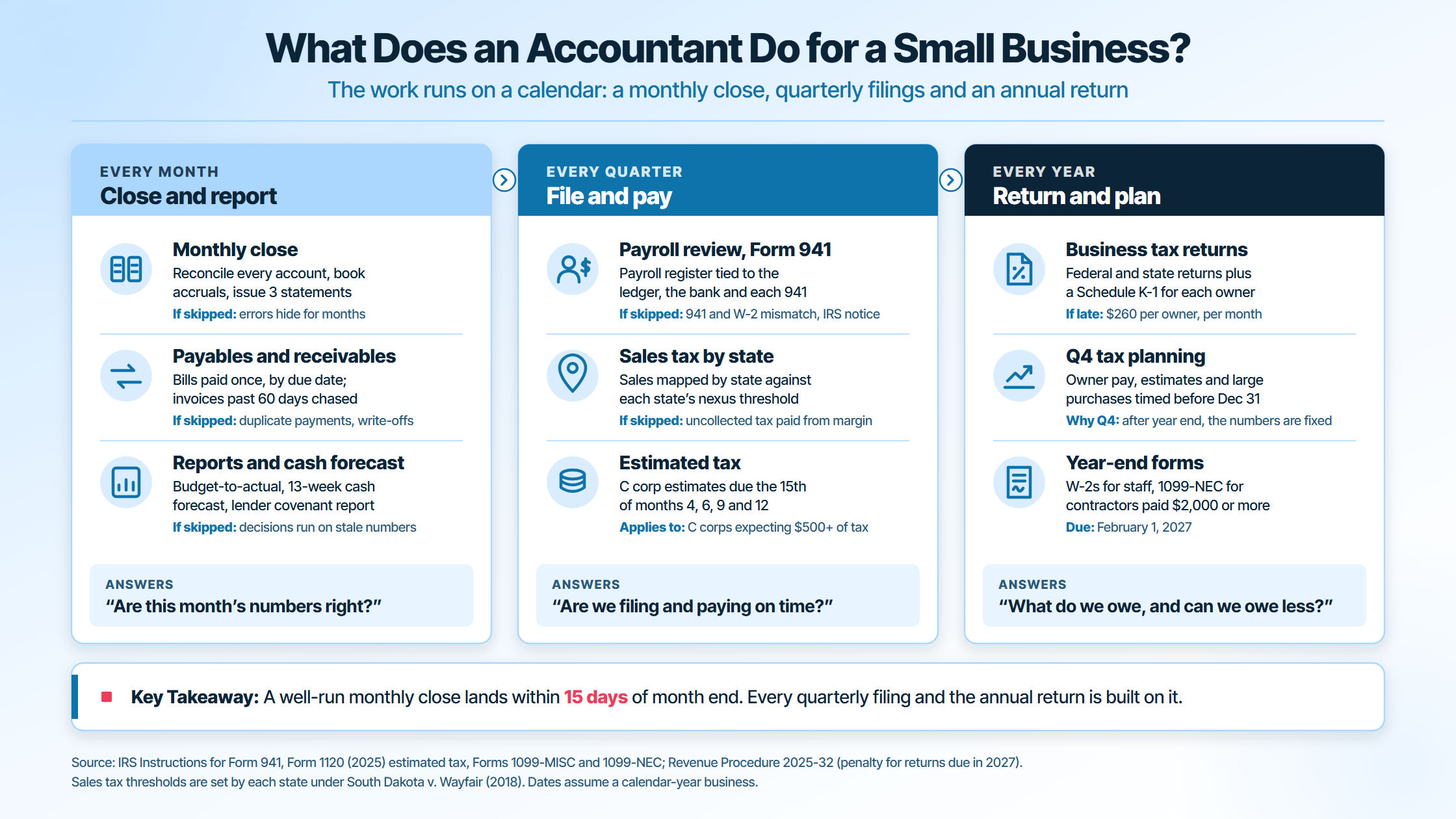
An accountant for a small business is a finance professional who turns daily transactions into financial statements, tax returns and decisions. The work runs on a calendar: a monthly close, quarterly payroll and estimate deadlines, and an annual return. For a company doing USD 1 million to 10 million a year, six jobs make up that calendar.
Each job below shows what the accountant actually does, step by step, and what breaks when nobody does it.
The Monthly Close: Reconciliations, Accruals and Statements
The monthly close is the process of locking one month’s books so the numbers can be trusted and compared. A well-run close lands within 15 days of month end. Late closes are the most common reason owners make decisions on numbers that are already wrong.
The accountant works through the close in a fixed order:
- Collect statements. Every bank, credit card, loan and payment processor statement for the month.
- Reconcile each account. Match every ledger entry to the statement, so the book balance equals the bank balance.
- Record accruals. Book expenses incurred but not yet billed, and revenue earned but not yet invoiced.
- Review the balance sheet. Clear suspense accounts, check loan balances and confirm inventory or fixed assets.
- Issue the reports. A profit and loss statement, a balance sheet and a cash flow statement, with notes on what moved.
Skip step 2 and errors hide for months. Skip step 3 and profit swings with the timing of bills instead of the real business.
Payables and Receivables: Bills Out, Cash In
Payables and receivables are the two sides of working capital: what the business owes vendors and what customers owe the business. On the payables side, the accountant checks each bill against a purchase order or contract, schedules payment by due date and records it once. That stops duplicate payments and missed early-payment terms.
On the receivables side, the accountant issues invoices, applies customer payments and runs an aging report each month. Any invoice past 60 days gets a follow-up before it becomes a write-off. Many firms run accounts payable on the same calendar as the ledger, so bills and books close together.
Payroll Review and Quarterly Form 941 Filings
Payroll review is the check that every paycheck, tax withholding and deposit matches what the law and the employee records require. A payroll provider runs the checks. The accountant confirms the totals tie to the ledger, that benefit deductions post to the right accounts and that tax deposits went out on time.
Form 941, the quarterly federal payroll return, is due April 30, July 31, October 31 and January 31. The accountant reconciles each 941 to the payroll register and the bank before it is filed. A mismatch between the four 941s and the year-end W-2 totals is a common trigger for a payroll notice.
Sales Tax Tracking Across States
Sales tax tracking is the work of knowing where the business must collect tax, collecting the right rate and filing each state on its own schedule. Since the Supreme Court’s 2018 Wayfair decision, a state can require a remote seller to collect once its sales into that state cross the state’s threshold. Each state sets its own threshold.
The accountant maps sales by state every quarter, flags any state close to its threshold and confirms the tax collected matches the tax filed. A business that registers late in a state can owe the uncollected tax out of its own margin.
Tax Returns, Estimates and Year-End Planning
Tax work for a small business is two jobs: filing the returns on time and planning the year so the tax bill is known before it is due. Filing covers the business return, state returns and the Schedules K-1 each owner needs. Planning covers estimated payments, owner pay and the timing of large purchases before December 31.
Under the Instructions for Form 1120, a C corporation that expects USD 500 or more of tax must pay estimates. They are due by the 15th day of the 4th, 6th, 9th and 12th months of its year. Pass-through owners make their own quarterly estimates based on the K-1 income they expect.
A planning meeting in the fourth quarter is where most of the saving happens, because after year end the numbers are fixed.
Reporting, Cash Flow Forecasts and Lender Packages
Management reporting is the step where the accountant turns closed books into decisions. The core pieces are a monthly budget-to-actual review, a rolling 13-week cash forecast and any covenant report a lender requires. Each answers a different question: are we on plan, will we have cash, and are we still inside the loan terms.
Strong accountants also set one reporting standard from the start. A lender or buyer will ask for statements built on GAAP accounting in 2026, and fixing the method later costs far more than setting it up once.
Types of Accountants for Small Business: Which One Fits Your Stage?
The type of accountant a small business needs depends on the work: recording, reporting, tax, assurance or strategy. Titles overlap, so the safer test is what each role signs or delivers. For most companies between USD 1 million and 10 million, the answer is a mix of three roles, often inside one firm.
The table compares the roles owners most often confuse:
Role | What it delivers | When a USD 1 million to 10 million business needs it |
Bookkeeper | Recorded transactions, categorized and reconciled | Every month, from day one |
Staff or general accountant | Accruals, the monthly close and financial statements | Once statements go to a bank, investor or partner |
Management accountant | Budgets, cost analysis and performance reports for internal use | When margins differ by product, location or job |
Public accountant or CPA | Tax returns, tax planning, reviews, audits and representation | Every year at filing, and when a lender wants reviewed statements |
Forensic accountant | Investigation of fraud, disputes and missing funds | Only when something has gone wrong |
Controller or fractional CFO | Oversight of the whole finance function, forecasts and strategy | Multiple entities, outside investors or a planned sale |
The BLS describes management accountants as preparing information for internal use by managers, while public accountants handle the tax forms and statements a business must disclose. That split is the practical one. A business with one entity and clean books usually needs a bookkeeper plus a CPA firm. A business with several locations adds management reporting first and a controller later.
Should I Hire an Accountant or CPA?
A certified public accountant is the right hire when the business needs reviewed or audited statements, audit support or IRS representation. For most companies, what type of accountant is best for a small business comes down to IRS representation rights, set out on an IRS page updated in January 2026. Every paid preparer needs a PTIN. Only some may speak for you in an audit.
The IRS grants representation by credential, not by job title:
Credential | Licensed by | IRS representation |
Certified public accountant | State board of accountancy | Unlimited: audits, collections and appeals |
Enrolled agent | IRS, after a three-part exam and 72 hours of education every 3 years | Unlimited |
Attorney | State bar or court | Unlimited |
Annual Filing Season Program participant | IRS record of completion | Limited: only returns they prepared, no appeals or collections |
PTIN holder with no credential | IRS registration only | None |
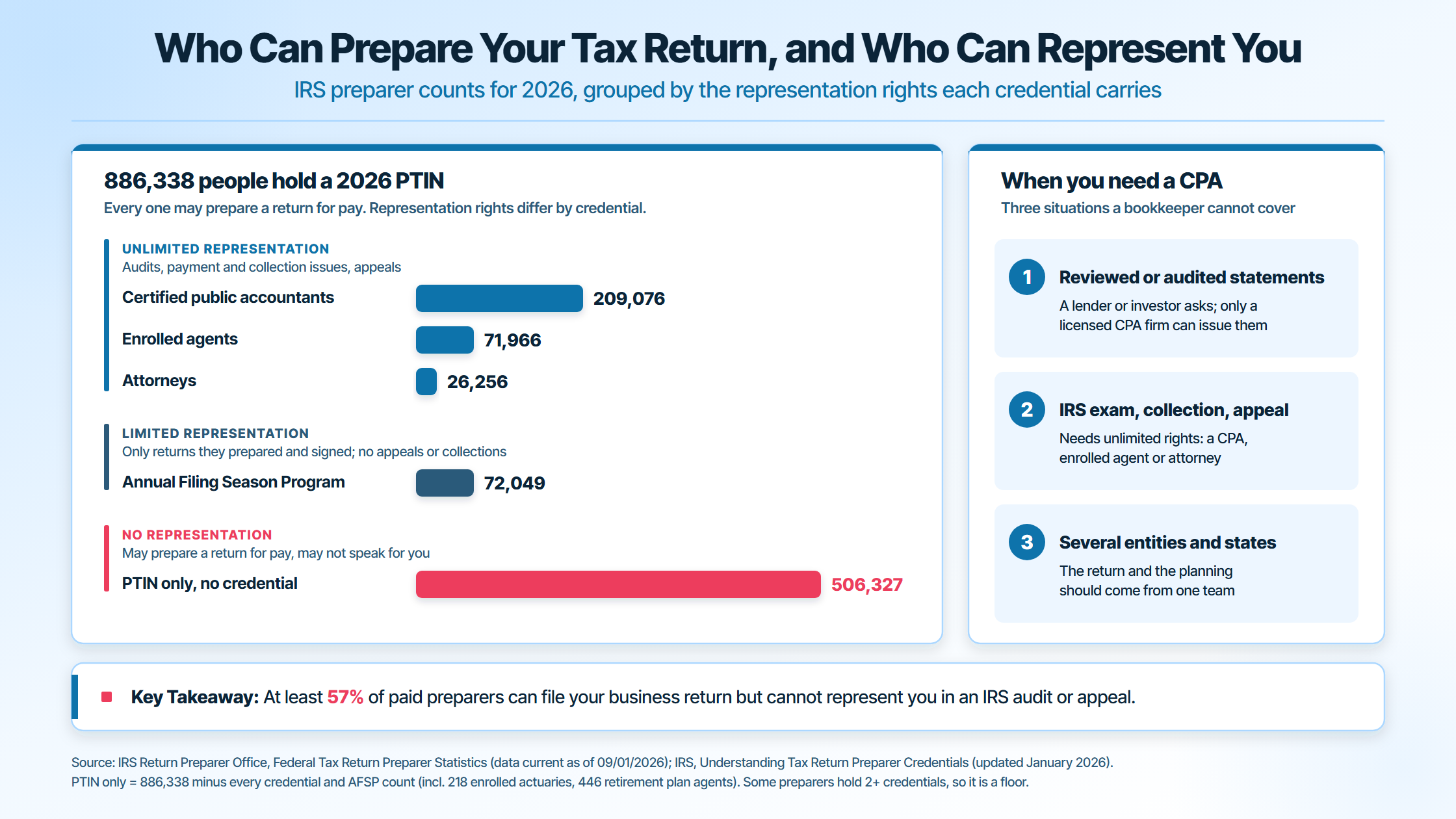
Three situations call for a CPA specifically. A lender or investor asks for reviewed or audited statements, which only a licensed CPA firm can issue. The business faces an IRS exam, a collection matter or an appeal. Or the tax position involves several entities and states, where the return and the planning must come from the same hands.
Enrolled agents complete 72 hours of education every 3 years, which makes them a strong choice for return work alone. A CPA firm adds statements, reviews and advisory on top. GATP Solutions is a CPA firm, so the books, the return and the representation sit with one team.
Do I Need an Accountant for a Small Business?
A small business needs an accountant once its tax filings, payroll or lenders require numbers one owner cannot check alone. Most owners ask “should I hire an accountant for my small business” only after a notice arrives. Revenue is a weak signal on its own. Complexity is the real trigger.
Five signals say it is time, and each one carries a specific risk:
- You file a partnership or S corporation return with Schedules K-1 for two or more owners. Every owner’s personal return now depends on yours, and each late K-1 carries its own penalty.
- You run payroll for 10 or more people, or in more than one state. Each state adds withholding, unemployment and new-hire rules, and the 941 must tie out every quarter.
- You collect sales tax in more than one state. Each state sets its own threshold, rate and filing schedule.
- A bank, investor or buyer wants monthly statements or a covenant report. Owner-prepared numbers rarely survive their first review.
- Your books close more than 30 days after month end, or not at all. Every decision in that gap runs on stale numbers.
Knowing when to hire an accountant for a small business matters because delay compounds. A year of unreconciled accounts must be rebuilt month by month before a return can be filed. If your bookkeeping software for small business already captures every transaction, the accountant starts from clean data and the first month costs less.
Is It Worth It to Hire an Accountant in a Small Business?
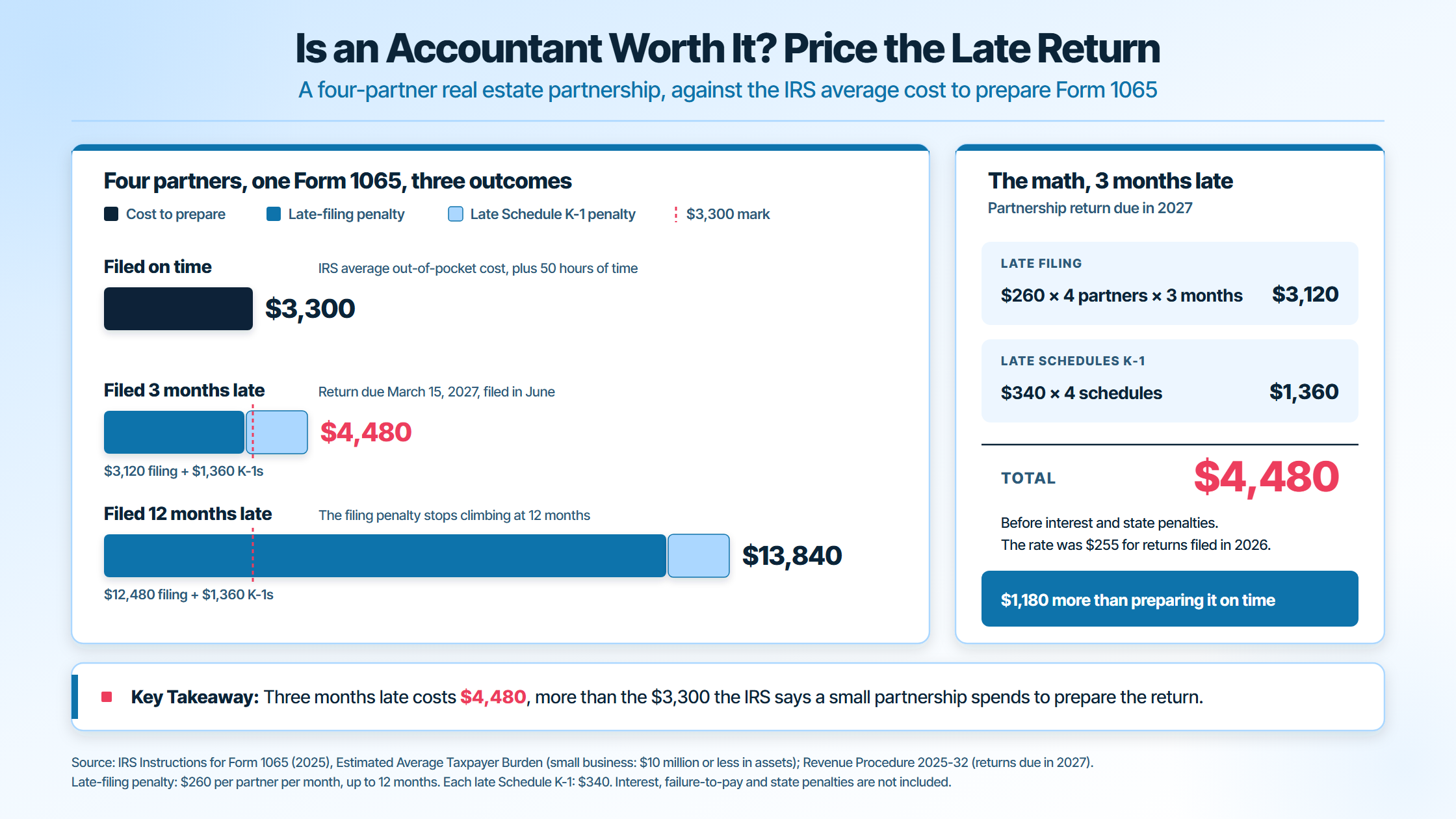
Hiring an accountant is worth it when the fee costs less than the errors, penalties and owner hours it removes. Both sides can be priced from IRS numbers. The IRS estimates a small partnership spends 50 hours on its return, and a small C corporation 40 hours, before any post-filing work.
The penalty side is easy to price too. For returns due in 2027, a late partnership return costs USD 260 per partner for each month, up to 12 months. The rate was USD 255 for returns filed in 2026. Each late Schedule K-1 adds USD 340. Take a four-partner real estate company that files its next return three months late:
- Late filing: 260 x 4 partners x 3 months = USD 3,120
- Late Schedules K-1: 340 x 4 = USD 1,360
- Total: USD 4,480, before interest or state penalties
That total is higher than the USD 3,300 the IRS says a small partnership spends to prepare the return. At the 12-month cap, the filing penalty alone reaches USD 12,480. Add 50 owner hours at your own hourly value, and outside help pays for itself on the first return.
How Much Is the Average Accountant for a Small Business?
How much does an accountant cost for a small business depends on one choice: a salaried hire or an outside firm. A salaried hire is a fixed annual cost whether the work fills the year or not. An outside firm is a monthly fee tied to volume and scope.
Each option is priced below from the newest federal and published 2026 data, followed by the four ways firms bill and the factors that move the quote.
The Cost of an In-House Accountant in 2026
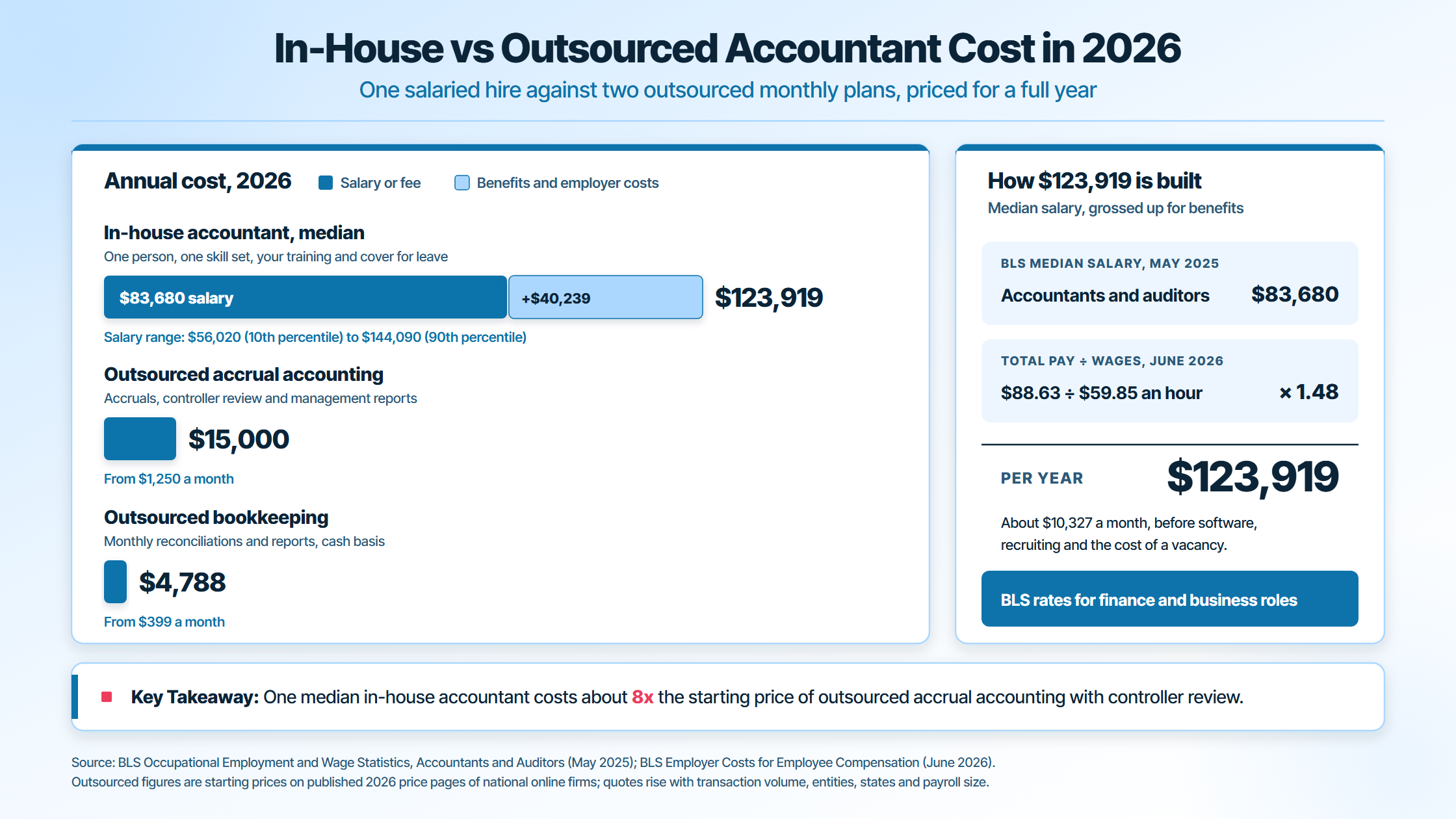
An in-house accountant costs salary plus benefits, payroll taxes and the tools the role needs. In the BLS Occupational Employment and Wage Statistics for May 2025, the median accountant and auditor earned USD 83,680 a year. The 10th percentile earned USD 56,020 and the 90th percentile USD 144,090.
The BLS Employer Costs for Employee Compensation for June 2026 puts management, business and financial roles at USD 88.63 an hour in total pay. Wages are USD 59.85 of that. Applied to the median salary, one in-house accountant costs about USD 123,919 a year, or USD 10,327 a month.
The Cost of an Outsourced Accounting Firm Each Month
An outsourced accounting firm charges a monthly fee that covers the bookkeeping, the close and the reports, with tax work priced in or added. Published 2026 price pages of national online firms start at about USD 399 a month for monthly bookkeeping. Accrual accounting with controller review starts near USD 1,250 a month, and a business tax return is often added from USD 1,000 a year.
GATP fixed-fee plans start under USD 250 a month, and federal and state tax filing sits in the Premium plan. The comparison that matters is scope against scope:
Option | Annual cost | What you get |
In-house accountant, median | About USD 123,919 with benefits | One person, one skill set, your training and cover for leave |
Outsourced bookkeeping plan | From about USD 4,788 (USD 399 x 12) | Monthly reconciliations and reports, cash basis |
Outsourced accrual accounting | From about USD 15,000 (USD 1,250 x 12) | Accruals, controller review and management reports |
Hourly, Monthly, Per-Return and Project Pricing Compared
Accountants bill in four ways, and the model shapes what you pay as much as the rate does:
- Hourly: you pay for time used. It suits small, unpredictable jobs, but every question costs money, so owners stop asking.
- Fixed monthly fee: one price for a defined scope. It suits ongoing books and reporting, because the cost is known and questions are included.
- Per return: a set price for each tax return. It suits companies whose books are already clean before filing season.
- Project fee: a set price for one job, such as a catch-up, a system move or an entity change.
Most companies between USD 1 million and 10 million land on a fixed monthly fee with the return included or quoted separately.
What Raises or Lowers an Accountant’s Quote
An accountant’s quote moves with six factors, in roughly this order of weight:
- Transaction volume: the number of bank and card lines to reconcile each month.
- Entities: each company needs its own books, close and return.
- Method: accrual books take more work than cash books.
- States: each state adds payroll, sales tax and income tax filings.
- Payroll size: more employees means more reconciliations and year-end forms.
- Condition of the books: months behind means a catch-up project before the monthly fee starts.
How Much Does It Cost to Hire an Accountant for Business Taxes?
How much do accountants charge for small business taxes is a question the IRS answers itself. The Instructions for Form 1065 (2025) publish the average out-of-pocket cost and time per business return. The cost includes preparer fees, software and filing costs. Small means USD 10 million or less in year-end assets.
Business return | Small business average cost | Small business average time | Large business average cost (over USD 10 million in assets) |
Form 1065, partnership | USD 3,300 | 50 hours | USD 29,400 |
Form 1120-S, S corporation | USD 4,200 | 50 hours | USD 42,600 |
Form 1120, C corporation | USD 3,900 | 40 hours | USD 69,400 |
These are national averages for 2026 filing season returns, not fee quotes. A tax accountant for small business prices above or below them based on entity count, states filed and the condition of the books. Clean monthly closes pull a quote toward the low end, because the preparer is not rebuilding the year.
A business return engagement usually covers four pieces of work:
- The federal return with every schedule it needs, including Schedules K-1 for each owner.
- State income or franchise returns for each state where the business has nexus.
- An extension on Form 7004, filed by the original due date, when the books are not final.
- A year-end planning review with next year’s estimate schedule.
The Tax and Payroll Calendar a Small Business Accountant Owns, October 2026 to April 2027
A small business tax accountant owns a fixed set of federal deadlines every year. Missing any one of them triggers its own penalty, so the calendar should be in your engagement letter, not in the accountant’s head. When a due date falls on a Saturday, Sunday or legal holiday, the IRS moves it to the next business day. The next 7 months for a calendar-year business:
Deadline | Filing or payment | Who it applies to |
November 2, 2026 | Form 941 for the third quarter (October 31 falls on a Saturday) | Every employer |
December 15, 2026 | Fourth 2026 corporate estimate | C corporations expecting USD 500 or more of tax |
February 1, 2027 | Form 1099-NEC filed and furnished; Form 941 for the fourth quarter (January 31 falls on a Sunday) | Any business paying contractors USD 2,000 or more; every employer |
March 15, 2027 | Form 1065 and Form 1120-S, or a Form 7004 extension | Partnerships and S corporations |
April 15, 2027 | Form 1120 and the first 2027 corporate estimate | C corporations |
April 30, 2027 | Form 941 for the first quarter of 2027 | Every employer |
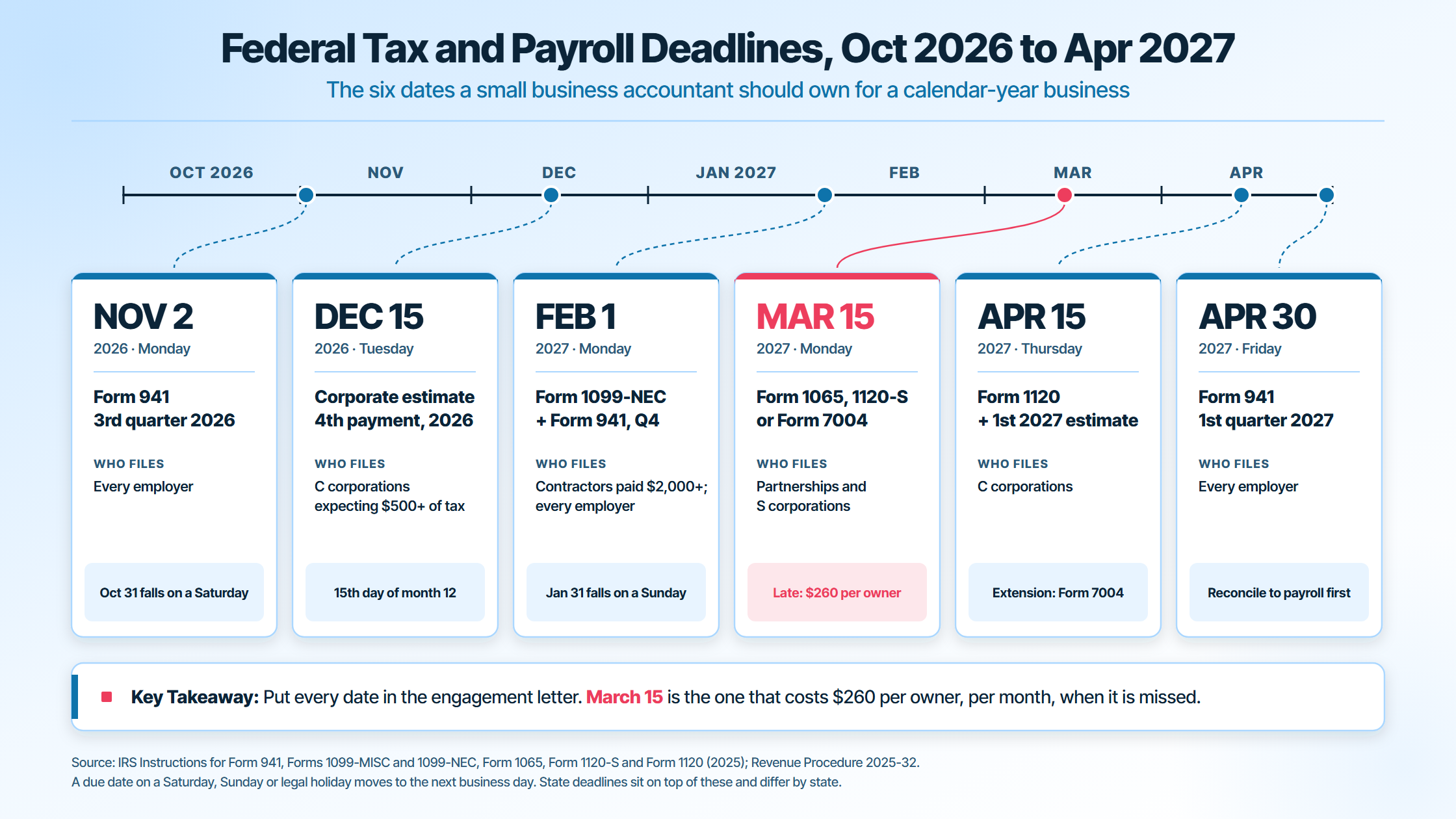
State deadlines sit on top of this list and differ by state. Ask any accountant you interview to show you the calendar they will run for your entities before you sign.
What Changed in 2026 for a Small Business Tax Accountant
The 2026 rule changes, and the inflation adjustments the IRS published for returns due in 2027, move work your accountant does in January and at filing time. A small business tax accountant should already have adjusted for five of them:
- Form 1099-NEC threshold: payments made after 31 December 2025 are reportable at USD 2,000, up from USD 600, per the Instructions for Forms 1099-MISC and 1099-NEC. It indexes for inflation from 2027.
- Late-filing minimum: a corporate return due in 2026 and filed more than 60 days late carries a minimum penalty. It is the tax due or USD 525, whichever is smaller, per the Instructions for Form 1120-S. For returns due in 2027 the minimum rises to USD 535.
- Partnership and S corporation late-filing penalty: USD 260 per owner per month for returns due in 2027, up from USD 255, under Revenue Procedure 2025-32.
- Cash method threshold: for tax years beginning in 2026, the limit is USD 32 million, up from USD 31 million. A business under it, on 3-year average gross receipts, may use the cash method.
- PTIN renewals: every paid preparer needed a valid 2026 PTIN before preparing returns, at a USD 18.75 fee, under the IRS PTIN requirements.
The 1099 change needs action now. A vendor list still set to the old USD 600 rule will produce forms the business no longer has to file. Ask your accountant to reset the threshold in your payables software before January, and to confirm W-9s are on file for every vendor likely to cross USD 2,000.
How to Find an Accountant for Small Business in Six Steps
Finding the right firm is a 6-step screen, and each step blocks one common hiring mistake. The same steps work for a local firm or an online one. This is how to choose an accountant for small business filings, payroll and planning.
Step 1: Write the Scope Before You Call Anyone
A written scope is a one-page list of what the accountant must handle. Include each entity, the states you operate in, payroll headcount, monthly transaction volume and every return you file. Note your software and how far behind the books are, if at all.
Without a scope, every firm quotes a different job, and the cheapest quote is usually the one that left things out. With it, you can compare three quotes line by line.
Step 2: Build a Shortlist From Referrals and IRS Directories
A good shortlist comes from people who run businesses like yours. Ask two or three owners in your industry who closes their books, and ask your banker which firms send clean statements. Then check each name in the IRS Directory of Federal Tax Return Preparers, which lists CPAs, enrolled agents and attorneys with valid PTINs.
Advertising and review sites are a starting point, not a filter. Three to five names is enough for the next step.
Step 3: Verify the License and the 2026 PTIN
License verification confirms the person can legally do the work they are selling. Check a CPA with the state board of accountancy where they are licensed, and an enrolled agent on IRS.gov. Ask for the PTIN that will appear on your return.
A preparer with only a PTIN can prepare returns but cannot represent you in an IRS exam. If representation matters, this step decides the shortlist.
Step 4: Confirm Experience in Your Industry and Size
Industry experience means the accountant already knows where your sector hides its errors. Ask for two current clients of your size in your industry, and ask what they changed in those clients’ books in the first 90 days. A real answer names accounts and reports.
Without this step, you pay for the learning curve: an e-commerce brand taught to reconcile processors, or a clinic taught to match insurance payments.
Step 5: Test Their Software and Systems
Systems fit means the firm works inside the tools you already run. Ask which ledger, payroll, bill pay and sales tax tools they support, and who owns the logins. Your business should own every account, with the accountant added as a user.
A firm that insists on its own ledger forces a migration you did not budget for, and makes leaving harder later.
Step 6: Put the Fee, Scope and Calendar in Writing
An engagement letter is the contract that names the work, the price and the deadlines. It should list the monthly scope, the close date, each return and its due date, and what is billed outside the fee. It should also name who signs the return.
Without it, deadlines belong to nobody, and every extra question becomes an invoice.
Questions to Ask and Red Flags Before Hiring an Accountant for Small Business
Before you hire an accountant for small business work, ask every candidate the same five questions, and listen for specific answers:
- Who prepares our return, and who signs it? You want a named person, not “the team”.
- Which credential gives your firm IRS representation rights? You want CPA, enrolled agent or attorney.
- What day of the month will our close land? You want a date, such as the 15th.
- How many clients our size do you serve today? You want a number and an industry.
- What does the fee include, and what is billed by the hour? You want a written list.
Three answers should end the conversation. One is a promised refund before anyone has seen your books. The others are a preparer who will not sign the return or enter a PTIN, and no written engagement letter. Most of what to look for in an accountant for small business sits in the first two answers.
How to Hire an In-House Accountant for Your Business
An in-house accountant makes sense when the work fills a full-time role and needs someone on site every day. That point usually arrives with several entities, inventory or a large payroll. Even then, most companies keep an outside CPA firm for the tax return and any review or audit.
The BLS Occupational Outlook Handbook projects accountant and auditor jobs to grow 5 percent from 2025 to 2035, with about 115,300 openings a year. Strong candidates have choices, so a clear role and a fair salary matter. The hiring process runs in five steps:
- Pick the level. A staff accountant runs the close. A senior accountant reviews it. A controller owns the whole function. Price each against the BLS range of USD 56,020 to USD 144,090.
- Write the job description from your scope. List the close date, the reports, the systems and the deadlines the role owns.
- Post where accountants look. Use job boards, your state CPA society’s career page and referrals from your outside firm.
- Test, do not just interview. Give finalists a short bank reconciliation with planted errors and see what they find.
- Check credentials and references. Confirm any CPA license with the state board and call two former managers.
The BLS notes that accountants typically hold at least a bachelor’s degree in accounting or a related field. A CPA license is a plus for a controller, but rarely required for a staff role.
How to Onboard a New Accountant in the First 30 Days
Onboarding is the handover that turns a signed engagement into a working close. Done well, the first full monthly close lands inside 30 days. Done badly, the new accountant spends three months finding what the last one left behind.
The handover runs in six steps, in this order:
- Sign the engagement letter. Confirm scope, fee, close date and the return calendar in writing.
- Grant system access. Add the accountant as a user on the ledger, payroll and bill pay, and set read-only bank feeds. Never share the owner’s login.
- Sign the IRS authorizations. Form 8821 lets the accountant receive your IRS records and notices. Form 2848 lets an eligible practitioner represent you before the IRS.
- Hand over the history. Send the last 2 business returns, depreciation schedules, loan agreements, entity documents and any open IRS or state notices.
- Tie out the opening balances. The accountant matches the balance sheet to bank, loan and payroll records before posting anything new.
- Run the first close together. Review the first month’s reports in a meeting, agree on the format and set the recurring review date.
Step 5 is the one most often skipped, and it is where inherited errors are caught. Any difference found there is fixed once, before it reaches a return. For step 3, the IRS pages for Form 8821 and Form 2848 explain who may be named on each.
Local Accountant for Small Business or Online Accountants: Which Fits?
A local accountant for small business, often a practice of 1 to 3 people, suits owners who want in-person meetings in one town. An online firm suits owners on cloud ledgers who want a team, not one person. The best accountant for small business is the one whose model matches how your books already run.
Factor | Local accountant | Online accounting firm |
Meetings | In person, often quarterly | Video, often monthly |
Staffing | One owner and a small team | Bookkeepers, accountants and a CPA reviewer |
Software | Varies, sometimes desktop | Cloud ledgers such as QuickBooks Online and Xero |
Capacity in March and April | Tight, one preparer per return | Spread across a team |
Pricing | Hourly or per return | Fixed monthly fee |
When a Local Accountant Is the Better Choice
A local accountant is the better choice when the work depends on being in the room. Examples are a business with paper-heavy records, an owner who wants face-to-face planning, or a company whose taxes turn on one state’s local rules. A local firm also knows the county assessor and the state revenue office by name.
The tradeoff is capacity. A small practice with one preparer per return has little slack in March and April, when every client wants the same week.
When an Online Accounting Firm Is the Better Choice
An online firm is the better choice when the business already runs on cloud tools and operates in more than one state. The work happens inside your ledger, so location stops mattering. A team also covers vacations and filing-season peaks that a sole practitioner cannot.
When you compare the best online accountants for small business, ask who actually works your file during the 2026 filing season. A firm offering outsourced bookkeeping in Denver can close a Colorado contractor and a Texas retailer on the same calendar. The same holds for outsourced bookkeeping services in Seattle.
How Accountants for Small Business Work in Three Industries
Industry accounting is where a generalist and a specialist split, because each sector hides its errors in a different account. A generalist closes the books. A specialist knows which reconciliation fails first. Three examples from the sectors GATP serves follow, each with the process the accountant runs.
E-Commerce: Shopify and Stripe Payouts Against Form 1099-K
An e-commerce accountant ties every payout back to gross sales, because processors report gross. The Instructions for Form 1099-K define the box 1a amount without any adjustment for fees, refunds or discounts. Books that record only net deposits start below the figure the IRS already holds.
In one GATP ecommerce payment reconciliation engagement, the fix was one clearing account per processor. The monthly process looks like this:
- Record gross sales from the storefront report, not from the bank deposit.
- Post processor fees, refunds and reserves as separate entries in each clearing account.
- Match each payout to the bank, so every clearing account returns to zero.
- Compare the year’s gross sales to each processor’s Form 1099-K before filing.
The USD 20,000 and 200-transaction floor applies only to payment apps and marketplaces, not to card processing. A store below that floor can still receive a 1099-K from its card processor.
Real Estate: Rent Roll Mapped to Property Expenses
A real estate accountant ties the rent roll to the ledger by unit and by building, then maps every expense to the property that incurred it. A partnership that owns rentals reports them on Form 8825, one column per property. A 40-unit owner with 3 buildings therefore needs 3 expense maps, one per column.
The monthly process has three checks:
- Rent billed on the rent roll matches rent recorded in the ledger, unit by unit.
- Repairs, utilities and management fees post to the right building, not to a shared bucket.
- Tenant security deposits stay on the balance sheet as a liability, not as income.
Clinics: Insurance Payments and Payroll Compliance
A clinic accountant matches each insurance payment to the claim it pays, then ties payroll to Form 941 every quarter. Payer deposits arrive net of adjustments, so deposits alone misstate collections. The accountant records the billed amount, the contractual adjustment and the payment separately, so collections and write-offs are both visible.
Payroll is usually the largest cost in a clinic. IRS rules on how long to keep records require employment tax records for at least 4 years, which covers every payroll register and Form W-4 behind each 941.
A clinic group or a property portfolio with several locations needs one more layer. That layer is Virtual CFO services: forecasts, lender packages and a monthly budget review by location.
Conclusion: Choosing Accountants for Small Business in 2026
Accountants for small business cost about USD 3,300 to 4,200 per return under IRS 2026 filing season averages. A median in-house hire costs roughly USD 123,919 a year. Three things move the decision: the returns you file, who holds IRS representation rights and whether your books close every month.
Find out what your books and returns really need. Send us your last two business returns and your current chart of accounts. We map your entities, state filings and K-1 count to a monthly scope and a filing calendar. You get back one fixed fee and the dates each deadline will be met for your next business return.
Frequently Asked Questions About Accountants for Small Business
Can Accounting Software Replace an Accountant?
Accounting software replaces data entry, not judgment. It imports bank feeds and categorizes routine items. It cannot decide how to treat a USD 50,000 equipment purchase, file a multistate return or answer an IRS notice. Most owners use both: the software for capture, the accountant for review.
Should a Small Business Use Cash or Accrual Accounting?
Most small businesses may use cash accounting for tax if average gross receipts for the prior 3 years are USD 32 million or less. That is the test for tax years beginning in 2026. Lenders and buyers usually want accrual statements anyway. Many companies keep accrual books for management and file tax on the method that suits them.
How Often Should You Meet With Your Accountant?
Meet monthly once revenue passes USD 1 million, and quarterly at minimum below it. A monthly review covers the close, cash and any open tax items. Add one planning meeting in the fourth quarter, before year-end spending and owner pay decisions are locked.
How Long Should a Small Business Keep Records?
Keep most tax records for 3 years from filing, employment tax records for at least 4 years and bad debt or worthless securities records for 7 years. Property records stay until the limitation period ends for the year you sell the asset. Your accountant should hold digital copies.
Can You Hire an Accountant Part Time or by the Project?
Yes, many firms take project work such as a catch-up, a tax return or a system move. Project fees suit a one-time job. Ongoing monthly work is usually cheaper on a fixed fee, because the accountant keeps context instead of relearning the books 12 times a year.
Do Accountants for Small Business Owners Prepare Personal Returns Too?
Many do, and one firm for both returns cuts delays. An owner of a partnership or S corporation files a personal return using the Schedule K-1. A late K-1 can carry a USD 340 penalty per schedule and holds up the owner’s own filing. One preparer controls both dates.
Can an Accountant Help a Small Business Get a Loan?
Yes, an accountant prepares the statements, tax returns and cash forecast a lender reviews. Lenders commonly ask for recent business returns and current statements. Clean monthly closes shorten underwriting, and a covenant report keeps the loan in good standing after funding.
Can You Switch Accountants in the Middle of the Year?
Yes, and the cleanest point is right after a month-end close. The new accountant ties the opening balances to that close and takes over from the next month. Sign Form 8821 for the new firm and revoke the old firm’s authorizations at the same time.

