
Since 2012 • Australia
Virtual Accounting and Bookkeeping Services in Australia
The books are behind, the BAS is due next month, and the person who was across it left in March. GATP runs the whole day to day finance function for Australian businesses, so you get a virtual bookkeeper Australian owners can actually reach on a weekday morning, on fixed fee plans with no lock-in contract.
What You Get Every Month
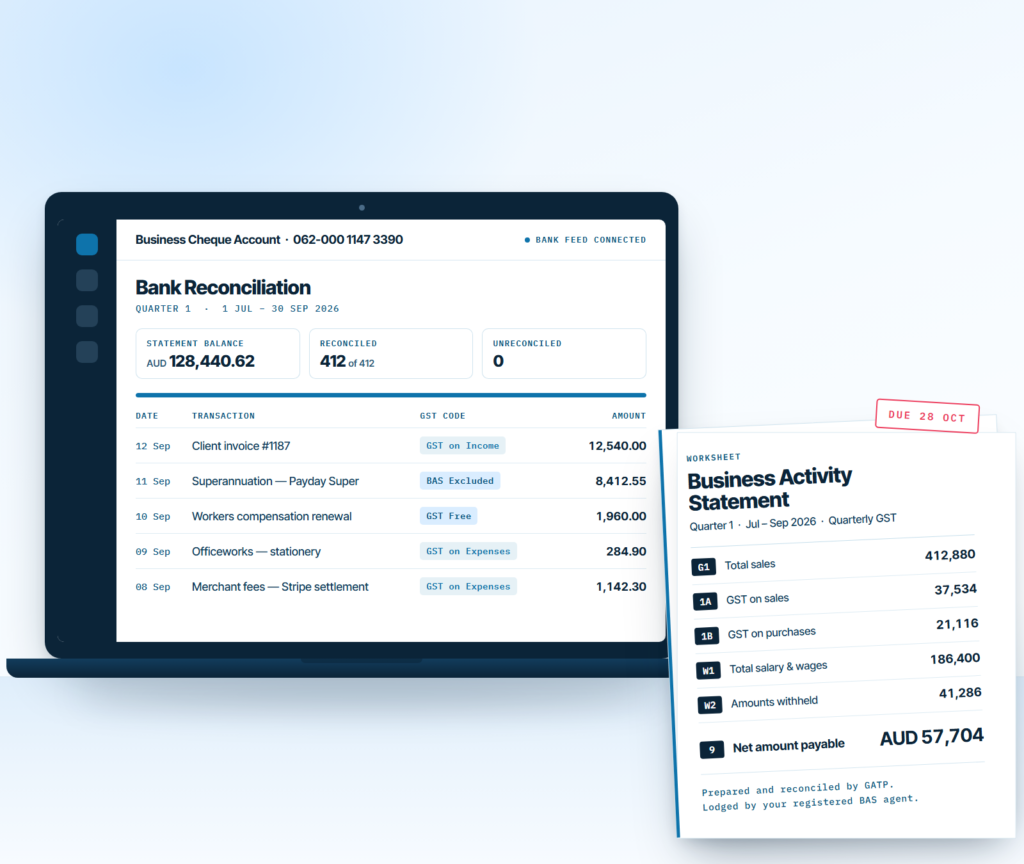
A virtual bookkeeper does the same work as one sitting in your office, inside your own Xero, MYOB or QuickBooks file, without the desk, the salary or the recruitment. Doing the bookkeeping online is the default now rather than the exception, and the file stays yours. Every engagement covers the same ground. Transactions coded and reconciled, payroll run and reported through Single Touch Payroll, superannuation calculated to the Payday Super timetable that started on 1 July 2026, and a BAS pack prepared and handed to your registered agent. Most companies buying bookkeeping services in Australia need exactly that and nothing more elaborate, which is why it is sold as a fixed monthly fee rather than an hourly meter that punishes a messy month.
What Bookkeeping Costs in Australia
Hourly and Monthly Rates
Published bookkeeping rates Australian providers put on their own pages run from about AUD 30 to AUD 160 an hour, and fixed monthly packages from roughly AUD 100 to AUD 5,000 depending on transaction volume, payroll headcount and whether tax work is bundled in. A few price per transaction instead. The bookkeeping rates per hour Australian bookkeepers quote tell you very little on their own, because the number of hours is the part nobody prices honestly, and an hourly meter charges you most in the months your books are worst.
An In House Bookkeeper Against a Virtual Team
Jobs and Skills Australia reports median weekly earnings of AUD 1,442 for Accounting Clerks and Bookkeepers, the classification that covers the role. That annualises to AUD 74,984. Add the superannuation guarantee at 12 per cent and you are at AUD 83,982 before payroll tax, workers compensation, leave loading, software licences and the cost of covering the desk when the person resigns.
| Cost line | One in-house bookkeeper |
|---|---|
| Base salary, median | AUD 74,984 a year |
| Superannuation guarantee at 12 per cent | AUD 8,998 |
| Subtotal | AUD 83,982 |
| Still to add | Payroll tax, workers compensation, leave loading, software, recruitment |
Built for Australian Compliance, Not Adapted to It
Payday Super
From 1 July 2026 superannuation stopped being a quarterly job. A contribution is only on time if the fund has received it, with the information needed to allocate it to the member account, within 7 business days of the payday. A first contribution for a new employee or a new fund gets 20 business days. Out of cycle payments such as bonuses and back pay attach to the due date of the next regular payday. A public holiday anywhere in any state or territory is not a business day, so a Northern Territory show day moves the deadline for an employer in Perth. Miss it and the ATO assesses the superannuation guarantee charge straight off your Single Touch Payroll data.
The Superannuation Guarantee Ceiling
The rate is 12 per cent. For 2026 to 2027 the maximum contribution base is AUD 270,830, which is the concessional contributions cap of AUD 32,500 multiplied by 100 and divided by 12. Once an employee’s qualifying earnings for the year reach that figure you stop paying, and payroll caps the amount it reports for the rest of the year. Stopping in the wrong place is the most common superannuation error in a bonus month.
BAS Cycles and Due Dates
Reporting frequency follows GST turnover. Under AUD 20 million you report quarterly, due 28 October, 28 February, 28 April and 28 July, and the February date already carries a one month extension so no further extension applies to it. At AUD 20 million or more you report monthly, due on the 21st of the following month. A voluntary registration under AUD 75,000 can report annually, due 31 October.
Who Lodges Your BAS
We prepare it, your registered agent lodges it. Under the Tax Agent Services Act only an agent registered with the Tax Practitioners Board may provide BAS services for a fee, and offshore work sits under that agent’s supervision and control with the arrangement disclosed in your engagement letter. GATP is not a registered BAS agent and does not lodge. We build the pack, reconcile the GST accounts and hand your agent a file they can sign without rework. Any provider vague about this line is worth a second question.
The Work We Take Off Your Desk
Five things make up the business bookkeeping services Australian small companies actually buy, and all five run inside your own file rather than in a system you cannot see.
Bookkeeping and reconciliation
Daily or weekly transaction coding, bank and credit card reconciliation, and GST treatment decided at the point of entry rather than repaired in a panic at quarter end. Most bookkeeping services for small business come unstuck here first, because a mis-coded expense only announces itself when the BAS refuses to balance.
Payroll and superannuation
Pay runs, PAYG withholding, Single Touch Payroll reporting, leave accruals, and superannuation calculated and scheduled to land inside the Payday Super window. Since 1 July 2026 this is the part of the month carrying a hard deadline, and it is the one owners running their own books most often underestimate.
Debtors & Creditors
Supplier bills entered, approved and scheduled so nothing is paid twice or paid late, invoices raised the day the work is finished, and someone actually chasing the debtors sitting past sixty days instead of letting them age quietly into a write off.
Management reporting
A profit and loss, balance sheet and cash position each month, delivered on a date you can plan around, with the two or three numbers that moved explained in plain English. Online accounting services that stop at a reconciled file leave the useful half of the job undone.
Catch-Up Bookkeeping
Three quarters behind or three years behind, the file gets rebuilt before anything else starts. Online bookkeeping services Australian businesses switch to almost always begin here rather than at the reporting, because there is no point reporting on a ledger nobody trusts.
Xero, MYOB & QuickBooks Setup
Industries We Already Know
We work with owners in New South Wales, Victoria, Queensland and Western Australia. The small business bookkeeping Australian operators need is rarely generic, and a small business bookkeeping service that works in one industry often fails in the next. Three break in predictable places.
Real Estate
Trust account discipline is the compliance risk and holding structures are the bookkeeping one. A developer running four entities needs four clean sets of books plus a consolidated view, which is why real estate accounting lives or dies on intercompany loans that actually reconcile at year end instead of being estimated.
Healthcare
Practitioner payments blur the line between employee and contractor, and that single classification drives superannuation, payroll tax and workers compensation at once. It is the most expensive error a clinic makes and it compounds quietly, so healthcare accounting starts with getting every engagement classified correctly rather than consistently.
E-commerce
What lands in the bank is already net of fees, refunds, chargebacks and ad spend, so revenue gets recognised at the net figure and real costs disappear. A small business bookkeeper who codes a platform settlement as one line hides the real margin, which is the first thing e-commerce accounting has to unpick. Bookkeeping for small business Australia wide fails here more than anywhere else.
Why Owners Move Their Books to Us
Named people, not a ticket queue
The same team holds your file month after month, so nobody re-learns your chart of accounts each quarter. A virtual accountant Australian owners can email directly beats a shared inbox and a reference number.
Hours built around the Australian day
A question asked on Tuesday morning is answered on Tuesday, not overnight. Offshore support only works when the overlap is real, so the working day is set against Australian hours rather than against ours.
A fixed fee set before the month starts
You know the number in advance and a difficult month does not arrive as a larger invoice. Bookkeeping packages for small business are priced on scope, not on however many hours the file happens to consume.
A clean handover to your registered agent
Your BAS or tax agent receives a file that reconciles, with working papers attached and the GST accounts already agreed. Their time then goes on advice rather than repair, which is usually where the real saving sits.
What We Guarantee
Every one of these sits in your engagement letter, not in our marketing. They are the three things that go wrong most often when a business hands its books to someone else, so they are the three we put in writing before you pay anything.
Reports On An Agreed Date
Your file is reconciled and your reports are with you by an agreed date each month, and if we miss it we tell you before you notice. The date is one you pick and one you can plan a board meeting around, not a vague “after month end”. You get a profit and loss, a balance sheet, a cash position, and the two or three numbers that actually moved, explained in plain English. Coding and reconciliation run weekly, so the close is a review rather than a rebuild. If a bank feed breaks or we are waiting on paperwork from your side, you hear it while there is still time to fix it.
BAS Pack Before The Due Date
Your BAS pack reaches your registered agent with time to review it, never on the due date. Quarterly lodgers work to 28 October, 28 February, 28 April and 28 July, monthly lodgers to the 21st, and the pack is built to land well inside those dates rather than against them. GST accounts are already reconciled and working papers are attached, so your agent’s time goes on review instead of repair. To be clear about the line: GATP is not a registered BAS agent and does not lodge. Lodgement stays with your agent registered with the Tax Practitioners Board, and the arrangement is disclosed in your engagement letter.
Your File Stays Yours
Your data stays in your own Xero, MYOB or QuickBooks file under your ownership, so if you ever leave you take everything with you and nothing has to be rebuilt. The subscription sits in your name and on your billing. We work inside it as named users with access you grant and can revoke in a minute. That means leaving is a permissions change, not a migration, and every transaction, attachment, reconciliation and working paper stays exactly where it is. No proprietary middle layer, no export fee, no renting your own history back from us.
Payroll And Super Inside The Window
Since 1 July 2026 superannuation is only on time once the fund has received it within 7 business days of the payday, which makes payroll the hardest deadline in your month. Pay runs, PAYG withholding and Single Touch Payroll reporting are scheduled against your pay cycle, and contributions are timed to land inside the window rather than on the last day of it. Public holidays in any state or territory are checked against your cycle, because a show day in one state moves the deadline for an employer in another.
Common Questions About Bookkeeping in Australia
How much do bookkeepers charge per hour in Australia?
Most published hourly rates start around AUD 40 an hour plus GST and rise with complexity. Fixed monthly packages are more common now and run from roughly AUD 149 to AUD 995 depending on transaction volume, payroll headcount and whether the file needs catch up work first. An hourly rate only tells you the price of an hour, not how many hours your books take.
How much should you pay someone to do your bookkeeping?
Benchmark it against the alternative rather than against another quote. One in house bookkeeper costs AUD 74,984 at the median wage plus AUD 8,998 of superannuation, so AUD 83,982 before payroll tax, workers compensation, leave and software. If a fixed monthly fee lands well under a twelfth of that and covers payroll and BAS preparation, it is priced sensibly.
How much does a virtual bookkeeper cost per month in Australia?
Fixed monthly packages across the Australian market run from roughly AUD 100 for a sole trader with light volume up to AUD 5,000 where there is payroll, multiple entities and high transaction counts. Published mid tier packages mostly sit between AUD 200 and AUD 500 a month. Compare them on scope rather than headline price. Ask how many accounts are reconciled, whether payroll and BAS preparation are included, and whether catch up work is quoted separately or billed as a surprise in month one.
How do I switch bookkeepers without losing my history?
You should not have to move anything. If your file already sits in your own Xero, MYOB or QuickBooks subscription, switching is a change of user access rather than a migration, and every historical transaction stays exactly where it is. Ask two questions before signing anywhere. Who owns the subscription, and what happens to the file if you leave. If the provider holds it, you are renting your own history back from them.
Is virtual bookkeeping legitimate?
Yes, and the test is not whether the team is in the room. It is who holds the file, who lodges, and what your engagement letter says. Your accounting file should stay in your own Xero, MYOB or QuickBooks subscription under your ownership. Lodgement must go through an agent registered with the Tax Practitioners Board. Offshore support is expressly contemplated by the TPB provided it operates under a registered agent’s supervision and control and the arrangement is disclosed to you.
What is the current award rate for bookkeepers in Australia?
There is no single bookkeeper award rate. A bookkeeper employed in a clerical role is generally covered by the Clerks Private Sector Award, and the pay point depends on duties and experience rather than job title. Rates are set by the Fair Work Commission and change on 1 July each year, so check the current instrument before you benchmark. Treat the award as a floor rather than a market rate. Median earnings for Accounting Clerks and Bookkeepers sit well above it at AUD 1,442 a week.
Start Bookkeeping in Australia With GATP
Send us your most recent file and we will tell you what shape it is in, what it would take to bring it current, and what the monthly fee would be. No obligation and no charge for the review.