
Catch Up Bookkeeping Services for Businesses Months or Years Behind
- Written by: Palak Soni
- Reviewed by: Nikhar Mathur
- Updated on:
Key Takeaways:
- Catch up bookkeeping brings outdated, incomplete, or disorganized financial records up to date.
- A bookkeeping backlog can affect tax preparation, cash flow visibility, financing, and everyday business decisions.
- Catch-up work typically includes transaction entry, categorization, account reconciliation, error correction, and financial statement review.
- The total catch up bookkeeping price depends on factors such as the backlog length, transaction volume, number of accounts, payroll complexity, and record condition.
- Businesses should compare the scope of catch up bookkeeping services instead of choosing a provider based only on the lowest quote.
- A structured eight-step process can help businesses clear their backlog while reducing the risk of creating new errors.
- AI and automation can speed up repetitive bookkeeping tasks in 2026, but human review remains important for unusual transactions, historical corrections, and tax-related decisions.
- Software changes and data migrations can create bookkeeping disruptions that require careful review of converted financial records.
- Choosing a provider with relevant industry experience, clear pricing, strong data security, and ongoing bookkeeping support can make the transition easier.
- Once the books are current, consistent monthly bookkeeping, regular reconciliations, organized records, and financial statement reviews can help prevent another backlog.
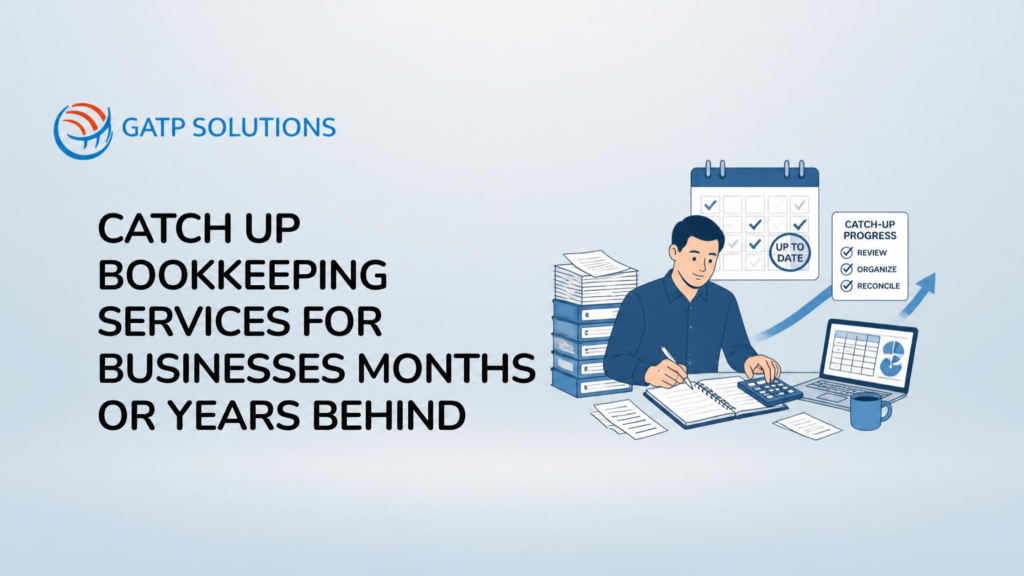
Your books are six months behind, tax season is getting closer, and you are not even sure what your business actually made. Catch up bookkeeping services can help turn that mess into clear, usable financial records. Catch up bookkeeping is not just about entering old transactions. It is about finding what is missing, fixing errors, reconciling accounts, and getting your financial records back on track. Falling behind can happen to any business, especially during rapid growth, staff changes, software switches, or busy periods when bookkeeping keeps getting pushed aside. Most of that backlog ends up sitting inside the accounting file itself, which is why a QuickBooks file cleanup is often where the work actually starts.
The longer the backlog sits, the harder it can become to prepare taxes, understand cash flow, apply for financing, or make confident business decisions. The good news is that a large backlog can be handled step by step. This guide covers what catch-up bookkeeping includes, the risks of staying behind, tax preparation, how to catch up quickly, pricing, AI and automation in 2026, how to choose the right provider, and how to keep your books current once the backlog is gone.
What Are Catch Up Bookkeeping Services?
Catch up bookkeeping services help businesses bring old, incomplete, or disorganized financial records up to date. For businesses dealing with a larger backlog, understanding the bookkeeping clean up process can also help clarify what needs to be fixed first. If your books are months or years behind, the work usually starts by finding missing transactions and checking existing records for errors. From there, the goal is to create accurate books that can support taxes, financial reports, and day-to-day business decisions.
What Does Catch-Up Bookkeeping Include?
Depending on the condition of your records, bookkeeping catch up services may include:
- Entering missing income and expense transactions
- Categorizing income and expenses correctly
- Reconciling bank and credit card accounts
- Reviewing accounts payable and accounts receivable
- Checking payroll records
- Reconciling loan accounts
- Reviewing fixed assets
- Clearing uncategorized transactions
- Finding and correcting bookkeeping errors
- Updating profit and loss and balance sheet reports
Catch-Up Bookkeeping vs. Catch-Up Accounting
The difference between bookkeeping and accounting matters because a backlog may require more than simply entering missing transactions into your accounting system.
Catch-Up Bookkeeping
Catch-up bookkeeping focuses on bringing outdated records current. It may include entering missing transactions, categorizing income and expenses, reconciling accounts, fixing errors, and updating financial records. The goal is to create clean, organized books that accurately show the business’s financial activity.
Catch-Up Accounting
Catch-up accounting goes beyond transaction entry and basic bookkeeping cleanup. It may involve reviewing account balances, making necessary adjustments, preparing financial statements, analyzing financial information, and resolving broader accounting issues. The work needed depends on how far behind the business is and the condition of its existing records.
The Core Risks of Falling Behind on Your Books
Being behind on bookkeeping can affect more than your financial records. Old or incomplete books can make it harder to understand your business, meet tax responsibilities, manage money, or plan your next move. Here are the main risks to consider.
You Cannot See Your Real Cash Position
A bank balance does not show everything happening with your business. Bills waiting to be paid and customer invoices still outstanding can make your available cash look better or worse than it really is.
- Unpaid bills can reduce future cash.
- Outstanding invoices may not be collected yet.
Profit Numbers May Be Wrong
Incomplete records can change how your business performance appears. If transactions are missing or placed in the wrong categories, your reported revenue, expenses, and profit may not reflect what actually happened during the period.
- Missing income can understate revenue.
- Incorrect expenses can distort profit.
Tax Preparation Gets Harder
Tax filing becomes more difficult when financial records are incomplete. You may spend extra time finding documents, checking transactions, and supporting amounts reported on your return. Good records also help support business income and deductible expenses.
- Missing receipts can create documentation problems.
- Unclear transactions may need additional review.
Financing Can Become More Difficult
Lenders may ask for recent financial statements when reviewing a business for financing. If your books are outdated, producing reliable reports can take longer and may delay the application process.
- Current reports can show recent business performance.
- Outdated numbers may not reflect present conditions.
Old Errors Can Affect New Periods
A mistake in one accounting period does not always stay there. Incorrect balances, unreconciled accounts, or duplicated transactions can carry forward and make later records harder to understand or correct.
- Unresolved balances can keep appearing.
- Earlier mistakes may require historical corrections.
Business Decisions Become Guesswork
Current financial information gives owners a stronger basis for deciding what to do next. Without it, important choices may rely on incomplete numbers rather than a clear view of revenue, expenses, obligations, and available resources.
- Hiring decisions need realistic financial information.
- Expansion plans should account for actual business performance.
Catch Up Bookkeeping Services for Tax Preparation
Being behind on bookkeeping for taxes can turn tax season into a stressful search for missing numbers and documents. Getting your books current first makes it easier to prepare a return using financial records that are complete, organized, and supported.
Why Your Books Should Be Updated Before Tax Filing
Tax returns depend on accurate income and expense information. Missing transactions can change reported income, while missing receipts or other records can make business deductions harder to support. Reconciliation also helps find errors before financial figures are used for tax preparation.
- Check income against sales records.
- Match expenses with supporting documents.
- Reconcile accounts before tax figures are finalized.
What Tax Records Should You Gather?
Having the right documents makes catch-up work faster and reduces time spent tracking down old information. Gather both financial records and tax-related documents, including:
- Previous federal and state tax returns
- Bank, credit card, and merchant processor statements
- Invoices, receipts, deposit records, and canceled checks
- W-2 and 1099 records and payroll tax documents
- Loan agreements and amortization schedules
- Sales tax records and inventory reports
- Fixed asset purchase details for equipment, vehicles, or property
How Long Should Business Records Be Kept?
The IRS generally says records should be kept as long as they may be needed to administer federal tax laws. Different situations have different rules, so the following periods should not be treated as one universal retention schedule:
- 3 Years: The IRS generally has three years to assess additional tax after a return is filed, subject to exceptions.
- 4 Years: Employment tax records generally must be kept for at least four years after the tax becomes due or is paid, whichever is later.
- 6 Years: The assessment period can extend to six years when more than 25% of gross income is omitted from a return.
- 7 Years: Seven years generally applies to claims for a loss from worthless securities or bad debt.
- Property Records: Records related to property should generally be kept until the period of limitations expires for the year in which the property is disposed of, with additional rules applying to depreciation and other tax matters.
- No Time Limit: In cases involving a fraudulent return or failure to file a return, the IRS generally has no time limit for assessment.
These are federal tax rules, and state requirements can differ, so businesses should review applicable recordkeeping requirements before deciding how long to keep their financial documents.
How to Catch Up on Bookkeeping Quickly: An 8-Step Blueprint
Wondering how to catch up on bookkeeping quickly without creating more errors? The best approach is to follow a clear chronological process instead of trying to fix everything at once. A structured plan helps you clear the backlog, verify old records, and keep new transactions from creating another problem.
Step 1: Find the Last Reconciled Baseline
Start by finding the last month when your books were fully reconciled with your actual bank balances. Check your previous reconciliation report instead of relying on memory. This gives your catch up bookkeeping work a reliable starting point.
Step 2: Map the Total Backlog
Determine exactly how many months need attention and identify every account involved. Create a simple list before you begin:
- Checking and savings accounts
- Credit cards and lines of credit
- Merchant accounts such as Stripe or PayPal
- Months with missing or incomplete records
This gives you a clear picture of the bookkeeping catch up services required.
Step 3: Gather All Financial Records
Collect your source documents before entering transactions. For older periods, download records directly from your financial institutions instead of relying only on current bank feeds.
- Bank, credit card, and loan statements
- CSV or QBO files for missing periods
- Invoices and receipts
- Sales tax records
- W-2 and 1099 payroll records
Step 4: Work From Oldest to Newest
Start with the earliest incomplete month and move forward one period at a time. This keeps account balances connected and makes it easier to find errors that could affect later months.
Step 5: Categorize Transactions and Review Unknowns
Use bank rules to speed up repetitive transactions such as regular software payments or utilities. Review unusual transactions carefully instead of guessing.
- Match invoices to deposits where applicable.
- Account for payment processing fees.
- Keep unclear transactions separate until they can be verified.
Step 6: Reconcile Every Account
Run a formal payment reconciliation for each statement period. The ending balance in your accounting records should match the statement balance. This helps identify missing, duplicated, or incorrectly entered transactions.
Step 7: Review Your Financial Statements
After reconciliation, review your key reports for obvious problems.
- Profit and loss: Check for unusual expenses, negative balances, or large uncategorized amounts.
- Balance sheet: Review asset, liability, and loan balances for accuracy.
Step 8: Set Up a Monthly Closing System
Once your catch up bookkeeping services are complete, create a fixed monthly routine. Set a deadline for recording transactions, completing reconciliations, reviewing reports, and closing each month. The goal is not only to catch up, but to stay current.
How Much Do Catch Up Bookkeeping Services Cost?
The catch up bookkeeping price varies because no two backlogs are the same. A business that is three months behind with clean digital records needs far less work than one dealing with several years of missing documents and unreconciled accounts. Pricing usually depends on transaction volume, account complexity, the condition of the records, and how many historical issues need to be corrected.
What Determines the Catch Up Bookkeeping Price?
A bookkeeping professional will usually review the backlog before giving a final quote. Common factors include:
- Timeline: The number of months or years that need to be brought current.
- Transaction volume: The number of checks, deposits, invoices, payments, and expenses recorded each month.
- Account complexity: The number of bank accounts, credit cards, loans, and lines of credit requiring review and reconciliation.
- Mixed personal and business spending: Separating personal transactions from business activity can require additional research.
- Payroll and entities: Multiple locations, businesses, or complex payroll records can increase the workload.
- Record quality: Missing documents, broken bank feeds, or disorganized accounting software can make catch up bookkeeping more time-consuming.
- Industry needs: eCommerce inventory, real estate transactions, and other specialized business activity may require additional review.
Common Pricing Models Explained
Different providers use different pricing structures for catch up bookkeeping services:
- Initial assessment: Some providers charge a separate fee to review the books and determine the scope of work.
- Fixed project pricing: A set fee covers a clearly defined backlog, accounts, and services.
- Hourly pricing: Useful when the amount of research needed is difficult to predict.
- Monthly catch-up fee: Ongoing bookkeeping may be combined with an additional monthly charge until the backlog is cleared.
Hidden Costs to Anticipate
The service fee may not be the only expense. Missing bank statements, inactive accounting software subscriptions, document retrieval, or additional corrections outside the agreed scope can increase the total cost. Ask about these charges before work begins.
Why the Cheapest Quote May Not Be the Best Choice
When comparing catch up bookkeeping services, look at the scope rather than choosing the lowest price. A cheap service may only import transactions without reconciling accounts or correcting historical errors. Ask whether the quote includes account reconciliations, corrections, financial statement reviews, and research into missing records.
The Modern Approach: How Human Expertise and AI Mix in 2026
Catch up bookkeeping is changing as accounting software adds more AI-powered features and automation. In 2026, these tools can reduce repetitive work during large bookkeeping cleanups, but they do not remove the need for human review. The strongest approach combines technology for routine processing with human judgment for transactions that need context, verification, or correction.
How AI Accelerates Historical Bookkeeping Cleanups
Modern accounting tools can reduce manual work when processing large volumes of older financial data. Depending on the software, AI and automation may assist with:
- Receipt and invoice processing: OCR can extract information from receipts and invoices and help match them with transactions.
- Transaction categorization: Software can suggest categories for recurring expenses such as rent, software, utilities, and other regular costs.
- Duplicate detection: Automated checks can flag transactions that may have been imported more than once.
- Unusual activity alerts: Systems can identify transactions that differ from normal patterns for further review.
- Data organization: Automated tools can help sort and organize financial information so large backlogs are easier to review.
These features can make catch up bookkeeping services more efficient, but automated suggestions still need to be checked before records are finalized.
Why Cleanups Still Require Human Oversight
AI works from the information and patterns available in the records. It does not automatically understand the full story behind a business transaction. A human reviewer may need to determine whether a large payment is a repair expense, a fixed asset, a loan payment, or another type of transaction.
Historical records can also contain mistakes that software may repeat if they are not identified first. Tax treatment, account reconciliations, unusual transactions, and corrections to older periods may require professional judgment.
The 2026 AI Adoption Reality
The shift toward AI-powered business tools is no longer limited to early adopters. According to the 2026 Intuit QuickBooks AI Impact Report, 77% of U.S. small and midsize businesses use AI regularly, up from 48% in July 2024. The report surveyed more than 34,000 small and midsize business owners across the U.S., Canada, the UK, and Australia and combined those responses with anonymized data from more than 5.3 million QuickBooks businesses.
The report also found that 78% of U.S. businesses using AI said it improved their productivity. This shows why automation can be useful during repetitive bookkeeping work, while human oversight remains important for decisions that require business context.
Legacy Software Transitions Can Create Extra Cleanup Work
Software changes can also disrupt established bookkeeping workflows. For example, Intuit states that QuickBooks Desktop 2023 was discontinued after May 31, 2026. Users of affected 2023 versions lost access to services such as online banking, payroll, payments, live support, and other connected services.
For businesses handling catch up accounting after a software change, the important step is to review migrated or converted data rather than assuming everything transferred correctly. Account mappings, opening balances, historical transactions, and other records should be checked before relying on the updated books. This makes software transitions another area where careful review can help prevent a new backlog from developing.
Catch Up Bookkeeping Services Near Me: How to Choose the Right Provider
Searching for catch up bookkeeping services near me is only the first step. The right provider should understand your business, clearly define the cleanup work, explain the cost, protect your data, and support you after the backlog is cleared.
Step 1: Check Experience With Your Business Type
Look for a provider familiar with the way your business operates. For example, businesses in healthcare may benefit from working with professionals who understand medical practice accounting and the financial records common in healthcare. Industry experience can make it easier to understand your transactions and identify records that need closer review. It shows most on multi-entity work, where a four-entity salon group catch up meant getting four separate sets of books current and agreeing with each other.
Look for experience with:
- Real estate
- eCommerce
- Healthcare
- Service businesses
- Multi-location businesses
- Multi-entity businesses
Step 2: Ask What the Service Covers
Before agreeing to catch up bookkeeping services, get the scope in writing. Ask:
- How many months are included?
- Are all bank and credit card accounts reconciled?
- Are historical errors corrected?
- Are financial statements reviewed?
- How are missing documents handled?
Step 3: Understand the Pricing
Ask how the catch up bookkeeping price is calculated and whether the quote is fixed or based on hours worked. Confirm which accounts, periods, corrections, and reports are included. Also ask about extra charges for missing records or work outside the agreed scope.
Step 4: Ask About Ongoing Bookkeeping
Catch-up work should not be the end of the process. Ask what happens after the backlog is cleared and whether the provider can continue with monthly bookkeeping, reconciliations, and financial reporting. A provider running full clean up and catch up services should be able to move straight into monthly work once the backlog is closed.
Step 5: Check Data Security
Financial records contain sensitive business information. Ask how documents are shared, where financial data is stored, who can access your accounting software, and what security measures are used to protect your information.
What to Do Once Your Books Are Fully Caught Up
Getting your books current is a major step, but the real goal is to keep them that way. A simple monthly routine can prevent small delays from turning into another large backlog.
- Set a Monthly Bookkeeping Schedule: Choose a fixed date each month to record transactions, review accounts, and close the books. Treat this date as a regular business task.
- Reconcile Accounts Regularly: Compare bank and credit card records with your books each month. Finding missing or incorrect transactions early makes them easier to fix.
- Keep Documents Organized: Store receipts, invoices, statements, payroll records, and other financial documents in one organized system for easy access.
- Review Financial Statements Monthly: Check revenue, expenses, profit, and cash flow regularly so you can spot changes and make informed decisions.
- Separate Business and Personal Spending: Use separate accounts for business activity to keep financial records cleaner and reduce unnecessary confusion.
- Create a Tax-Ready Record System: Save tax-related documents throughout the year instead of waiting until filing season to gather everything.
- Stay Consistent: Catch-up bookkeeping solves the backlog, but consistent monthly bookkeeping prevents another backlog from building.
Get Your Books Current With Catch Up Bookkeeping Services
Catch up bookkeeping services can help turn months or even years of unfinished records into organized, reliable financial information. Start by identifying the full backlog, gathering financial records, reconciling accounts, correcting errors, and reviewing your financial statements. Once your books are current, a consistent monthly routine can help prevent another backlog.
Accurate records also make tax preparation easier and give you clearer information for everyday business decisions. Falling behind does not mean your books cannot be fixed. With a structured approach and the right support, catch up bookkeeping services can help you get back on track. If the backlog is bigger than the time you have, talk to our team about what it would take to get current.
FAQs
How much does catch-up bookkeeping cost?
The cost depends on how far behind the books are, transaction volume, number of accounts, missing records, and the amount of correction needed. Providers may charge hourly, use fixed project pricing, or combine a catch-up fee with ongoing monthly bookkeeping.
How do you catch up on bookkeeping?
Start by finding the last accurate month, then measure the backlog and gather bank statements, invoices, receipts, payroll records, and other documents. Work from the oldest period forward, categorize transactions, reconcile accounts, correct errors, review financial statements, and establish a monthly routine.
How much should you pay someone to do your bookkeeping?
There is no single appropriate price for bookkeeping. Cost depends on transaction volume, business complexity, number of accounts, reporting needs, and whether the work is routine or catch-up bookkeeping. Compare providers based on their scope, experience, reconciliation work, reporting, and overall service rather than price alone.
Why do bookkeepers turn down catch-up work?
Catch-up work can require significant research, historical corrections, missing-document recovery, and account reconciliation. Some bookkeepers focus only on ongoing monthly work and may not have the capacity or systems needed for large backlogs. Highly disorganized records can also make the project’s time and scope difficult to estimate.
What is catch-up bookkeeping?
Catch-up bookkeeping means bringing incomplete or outdated financial records up to date. It can involve entering missing transactions, categorizing income and expenses, reconciling accounts, correcting errors, reviewing balances, and updating financial statements. The exact work depends on how long the books have been behind and their existing condition.
How long does catch-up bookkeeping take?
The timeline depends mainly on the size and condition of the backlog. A few clean months may be completed relatively quickly, while several years of records with missing documents or errors can take much longer. Transaction volume, account count, payroll, and business complexity also affect the timeline.
What is the average cost of catch-up bookkeeping for a year?
There is no reliable universal average because one year of bookkeeping can represent very different workloads. A small business with low transaction volume may need much less work than a multi-entity business with complex accounts. A provider should review the backlog before giving a meaningful project estimate.
What is the hourly rate for catch-up accounting?
Hourly rates vary by provider, experience, location, and the complexity of the accounting work. Catch-up accounting can require more specialized review than routine bookkeeping, particularly when historical corrections or complicated balances are involved. Ask what the hourly rate covers and request an estimated scope before work begins.
Can you catch up bookkeeping for past months only?
Yes. Catch-up bookkeeping can focus specifically on past months that are incomplete or outdated. The work typically starts from the last accurate period and moves forward until the desired end date. Afterward, ongoing monthly bookkeeping can keep new transactions current and prevent another backlog.
Is catch-up bookkeeping worth it?
For many businesses, catch-up bookkeeping is worthwhile because accurate records support tax preparation, financial reporting, cash-flow planning, financing, and better business decisions. The value depends on the size of the backlog and the problems it is creating. Once caught up, maintaining the books monthly is essential.

Written By: Palak Soni, CA
Palak is a Chartered Accountant with 5+ years managing US GAAP accounting for 7-figure businesses at GATP Solutions. She runs month-end close, prepares audit-ready financial statements, and owns account reconciliations and internal controls across QuickBooks and Xero — the same work behind GATP's book clean-ups and outsourced-accounting engagements in real estate, e-commerce, and healthcare. Her focus is turning messy books into numbers founders can actually trust.

Reviewed By: Nikhar Mathur, CPA
Nikhar is a CPA and co-founder of GATP Solutions, an AI-powered accounting firm serving 200+ founders across the US, Canada, and Australia since 2012 and named to Future Firm's Top 50 Modern Accounting Firms (2025). He specializes in end-to-end accounting systems, cash-to-accrual conversions, and CFO-level reporting for real estate, e-commerce, and healthcare businesses. He reviewed this article for technical accuracy and US compliance.
Table of Contents
Books Behind? Start With the Backlog
Tell us your last reconciled month and which accounts are still open. We map the backlog, flag the missing statements and payroll records, and quote the catch-up work before anything starts. No guessing at the scope.
You can subscribe to our newsletter and get notified about new articles
Not Sure How Far Behind Your Books Actually Are?
Send us your last reconciled month, your open bank and credit card accounts, and whatever statements you still have. We will tell you how many periods need work, which documents are missing, and what has to be corrected before your next return is prepared. That review is where our catch up bookkeeping and monthly bookkeeping work starts.