

Property management accounting is the system an Australian real estate agency uses to receipt, hold, pay out and reconcile money it holds for landlords, tenants and buyers. It also covers the agency’s own books: commission, fees, payroll and GST. In Queensland the trust account must be reconciled within 5 business days of every month end.
Miss that window, or the 30 September audit date in New South Wales, and the problem stops being bookkeeping. It becomes a licence matter. In the worked example below, a 400 property rent roll holds AUD 400,000 in trust at month end, and every dollar must tie to a named owner.
Many principals hand the daily work to outsourced accounting services and keep the licensee sign-off in house. This guide explains each job, the trust account rules state by state, the three way reconciliation, the audit, the 2026 changes and what the work costs.
What Is Real Estate Bookkeeping?
Real estate bookkeeping is the daily recording of every dollar an agency receives and pays, split between money it holds in trust and money it earns. For a property management business, the trust side is the larger and riskier set of books. Rent, bonds, sales deposits and owner disbursements all pass through it.
The agency side looks like any other business. It records commission, management fees, wages, rent on the office and GST. The two sets of books never mix, and that separation is the first thing a trust account auditor tests.
Here is how the work divides inside an agency.
The Trust Ledger: Money Held for Landlords, Tenants and Buyers
A trust ledger is a separate running account for each owner, tenant or buyer whose money the agency holds. Every receipt and payment posts to one named ledger. A 400 property rent roll can carry up to 400 owner ledgers, plus tenant, buyer and creditor ledgers. The total of all ledgers must equal the trust cash book at all times.
- Rent receipts. Each payment is receipted, banked into the rental trust account and posted to the owner’s ledger.
- Owner disbursements. Rent less fees and approved bills is paid to the owner, usually monthly or twice a month.
- Creditor payments. Tradespeople, strata levies, council rates and water bills paid on the owner’s behalf.
- Sales deposits. Buyer deposits held until settlement, then released to the vendor less commission.
The Agency Operating Books: Commission, Fees, Payroll and GST
The operating ledger is the agency’s own profit and loss. It starts when the agency’s fees leave trust and land in the business account. From there, the work is standard bookkeeping for real estate agents: wages, contractor commission splits, marketing costs, office rent and the quarterly or monthly BAS.
Most agencies run property management trust accounting inside dedicated software and the operating ledger in Xero, MYOB or QuickBooks. The monthly fee transfer is the bridge between the two systems.

Who Does the Work: Principal, Trust Account Officer and Real Estate Bookkeeper
The licensee in charge carries the legal duty for the trust account under the state Act. A trust account officer or real estate bookkeeper usually does the daily receipting, payments and reconciliations. The principal reviews and signs off.
That split matters when work is outsourced. A provider can prepare every receipt, payment and reconciliation. The licensee still owns the audit result and must keep control of who can authorise payments out of trust.
Real Estate Trust Account Rules by State: New South Wales, Victoria, Queensland and Western Australia
Real estate agent trust account regulations are state law, so the deadlines change at the border. A rental trust account in Brisbane runs on a different monthly clock from one in Sydney. Each state sets its own reconciliation window, audit period and lodgement date.
The table compares the four largest states, checked against the legislation in October 2026.
State | Governing law | Monthly reconciliation deadline | Audit period | Audit report due |
New South Wales | Property and Stock Agents Act 2002 and Regulation 2022 | Cash book reconciled at month end; ledger trial balance within 21 days | Year ending 30 June | 30 September |
Victoria | Estate Agents Act 1980 and Estate Agents (General, Accounts and Audit) Regulations 2018 | Reconciliation statement verified within 14 days | Financial year to 30 June | Audit within three months of 30 June; copy lodged within 10 business days of receipt |
Queensland | Agents Financial Administration Act 2014 and Regulation 2014 | Within 5 business days of month end | 12 months ending on the agency’s audit month | Within 4 months after the audit month |
Western Australia | Real Estate and Business Agents Act 1978 | Monthly bank reconciliation, tested at audit | Calendar year, 1 January to 31 December | 31 March, lodged by the auditor |
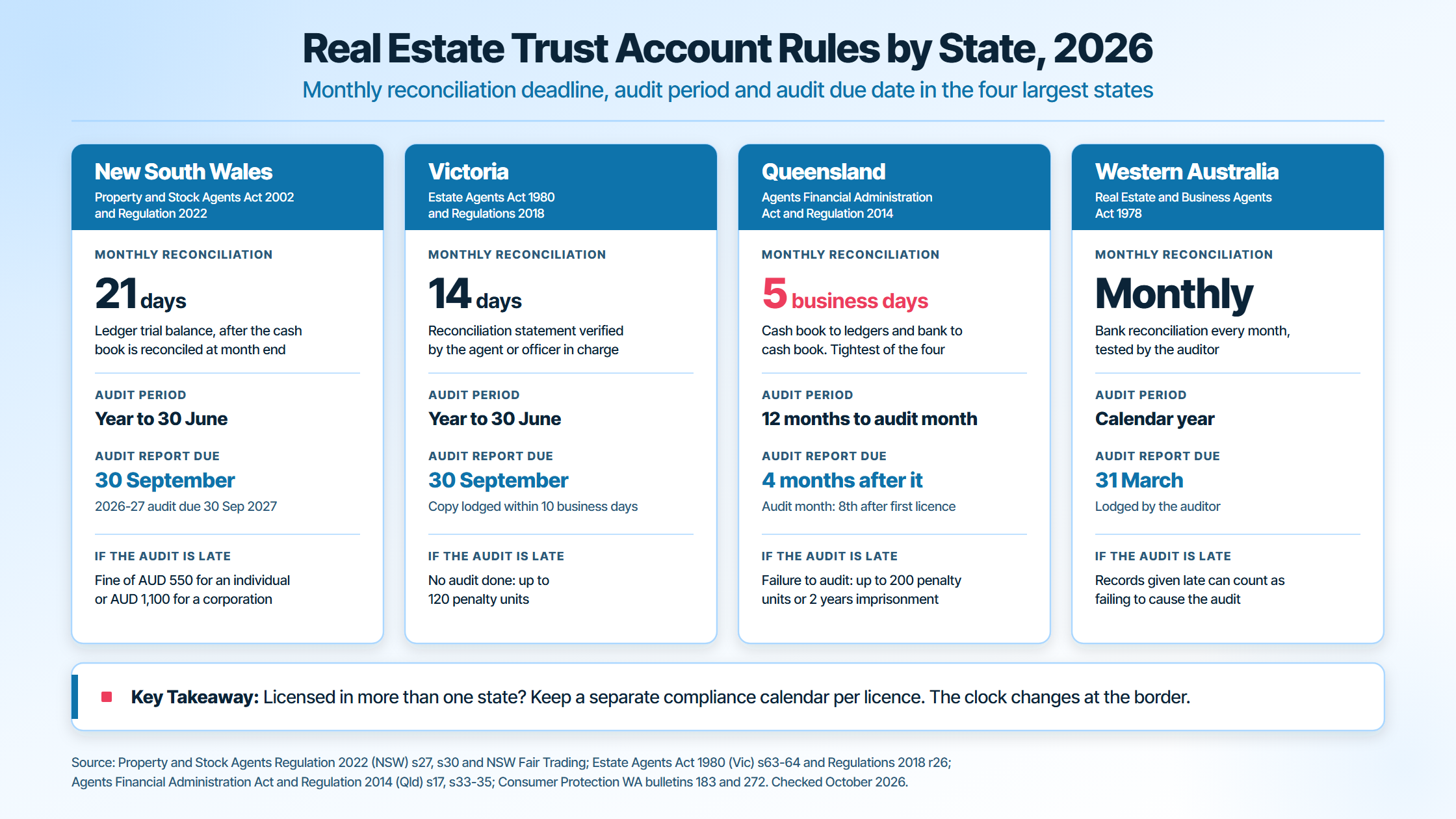
South Australia, Tasmania, the Australian Capital Territory and the Northern Territory each run their own Act and audit calendar. An agency licensed in more than one state keeps a separate compliance calendar for each licence.
Opening and Closing a Real Estate Trust Account
A real estate trust account is opened by the licensee at an authorised deposit-taking institution, in the name required by the state Act. In New South Wales, the licensee must give the bank a unique identifying number issued by NSW Fair Trading.
Closing an account has its own deadline. A New South Wales licensee sends a closure notice to Fair Trading within 14 days and keeps the confirmation for 3 years. Plan any bank change around a month end, so the final reconciliation and the opening ledger balances in the new account agree.
New South Wales: 21 Day Trial Balance and 30 September Audit
Under the Property and Stock Agents Regulation 2022, a licensee balances the cash book at the end of each month and reconciles it to the trust bank account. Within 21 days, the licensee prepares a trial balance of every ledger. The trial balance must show the cash book reconciled to the bank.
The audit period ends on 30 June. NSW Fair Trading requires the audit by 30 September and can fine AUD 550 for a late individual audit or AUD 1,100 for a corporation. Trust money held for more than 2 years counts as unclaimed money.
Victoria: 14 Day Verification and the Three Month Audit Window
The Victorian Estate Agents Regulations 2018 require a monthly reconciliation statement covering three balances: the trust journals, the bank against the cash journal, and the ledger against the cash journal. The agent or officer in effective control verifies it within 14 days.
The Estate Agents Act 1980 requires the audit within three months after 30 June. The agent lodges a copy within 10 business days of receiving it and keeps the signed report for 7 years.
Queensland: The 5 Business Day Monthly Reconciliation
Queensland runs the tightest monthly clock of the four states. The Agents Financial Administration Regulation 2014 requires the cash book reconciled to the ledgers, and the bank to the cash book, within 5 business days of month end. Receipts and payments must be entered and posted within 2 business days. Records are kept for at least 5 years.
Audit timing is personal to each agency. Under the Agents Financial Administration Act 2014, the audit month is the eighth month after the licence was first issued. The report is due within 4 months after that month. A licence issued in January has a September audit month and a January due date.
Western Australia: Calendar Year Audit Due 31 March
Western Australia audits the calendar year. Consumer Protection WA requires the auditor to lodge the report with the Commissioner by 31 March. An agency that held no trust money lodges a declaration instead.
The agency must give the auditor every record in time. If the records arrive late, the Commissioner can treat the agency as having failed to cause the audit. In an earlier audit recap, Consumer Protection named failure to perform monthly bank reconciliations as the most common problem in auditors’ reports.
What Is Three Way Reconciliation in a Rental Trust Account?
Three way reconciliation is the monthly check that three separate records of trust money show the same balance. The first is the bank statement, adjusted for timing items. The second is the trust cash book. The third is the total of every individual trust ledger.
Two matching figures are not enough. A bank that agrees with the cash book can still hide a ledger in debit, which means one owner’s money paid someone else. The worked example shows why each check exists.
Worked Example: A 400 Property Rent Roll at Month End
This example is illustrative. It uses round figures for a mid-sized residential agency.
Check | Calculation | Balance |
1. Adjusted bank balance | Bank statement AUD 412,600, plus deposit not yet credited AUD 8,400, less unpresented payments AUD 21,000 | AUD 400,000 |
2. Trust cash book | Opening balance plus receipts less payments for the month | AUD 400,000 |
3. Total of trust ledgers | Owner rent ledgers AUD 286,500, plus sales deposit ledgers AUD 95,000, plus creditor and prepaid rent ledgers AUD 18,500 | AUD 400,000 |
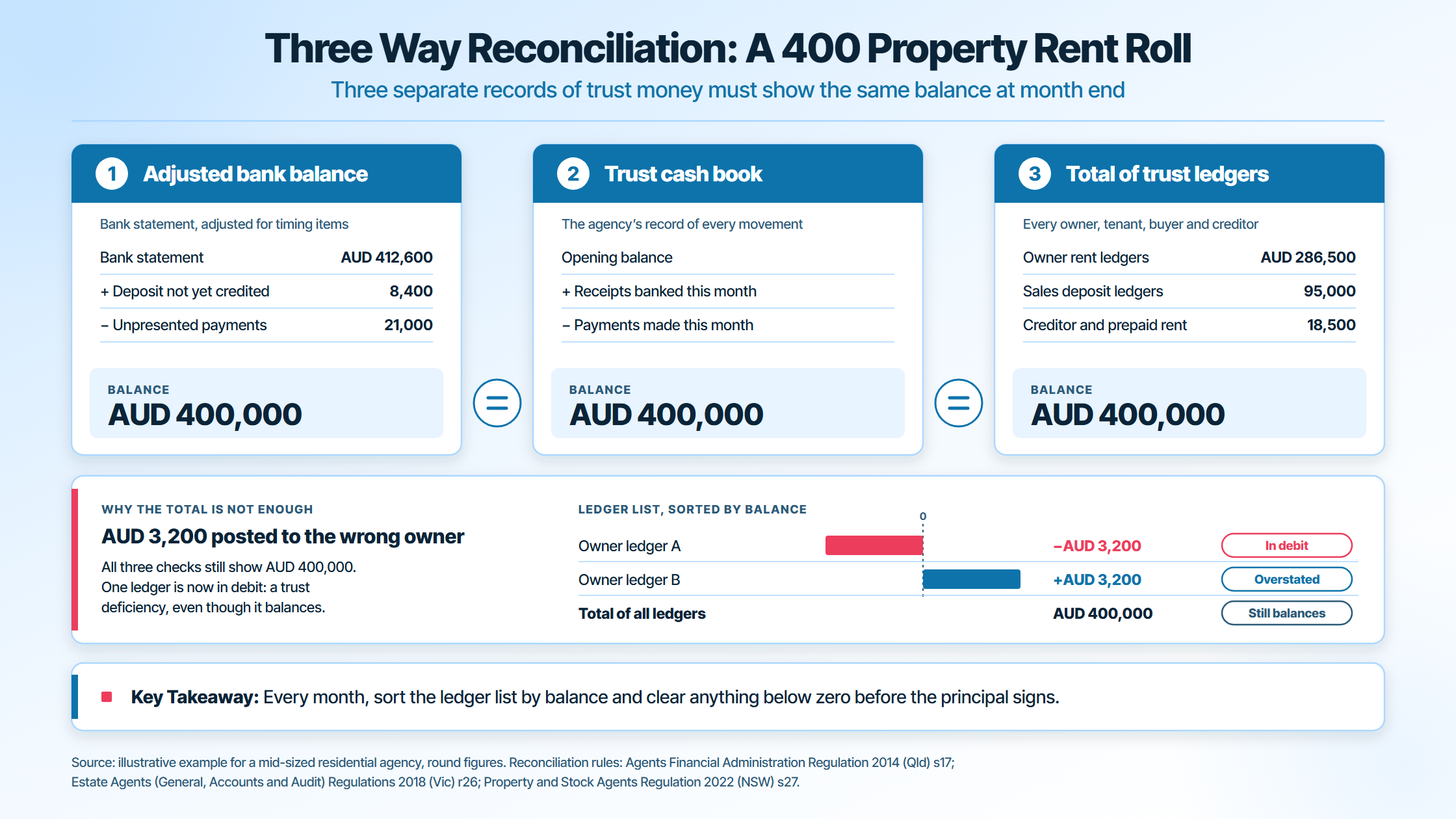
All three agree, so the reconciliation balances in total. Now suppose an owner payment of AUD 3,200 was posted to the wrong owner’s ledger. The totals still show AUD 400,000. One ledger now sits at minus AUD 3,200 and another is overstated by the same amount.
That is why the ledger list matters more than the total. A ledger in debit is a trust deficiency, even when the reconciliation balances. Every month, sort the ledger list by balance and clear anything below zero before sign-off.
The Five Step Monthly Three Way Reconciliation Process
- Close receipting for the month. Bank every receipt and post it to a ledger. This prevents unreceipted deposits sitting in the bank with no owner.
- Reconcile the bank to the cash book. List deposits not yet credited and payments not yet presented, by date and amount. This prevents a timing item hiding a missing deposit.
- Run the ledger trial balance. Total every owner, tenant, buyer and creditor ledger. This proves the money in trust is fully owned by named people.
- Clear debit and stale balances. Investigate every negative ledger and every balance untouched for months. This catches misposted payments and money heading toward unclaimed status.
- Sign, date and file under the correct month. The principal signs inside the state deadline. This prevents the audit finding that a reconciliation was late or missing.
Step five sounds clerical, and it is where a correct reconciliation can still fail an audit. In one GATP review of a rental operator’s books, all 7 months balanced to the cent. Two of them, February and March, had been saved under a 30 April date. A reconciliation filed under the wrong month reads as a missing month to anyone who checks the dates.
The Monthly Property Management Bookkeeping Cycle
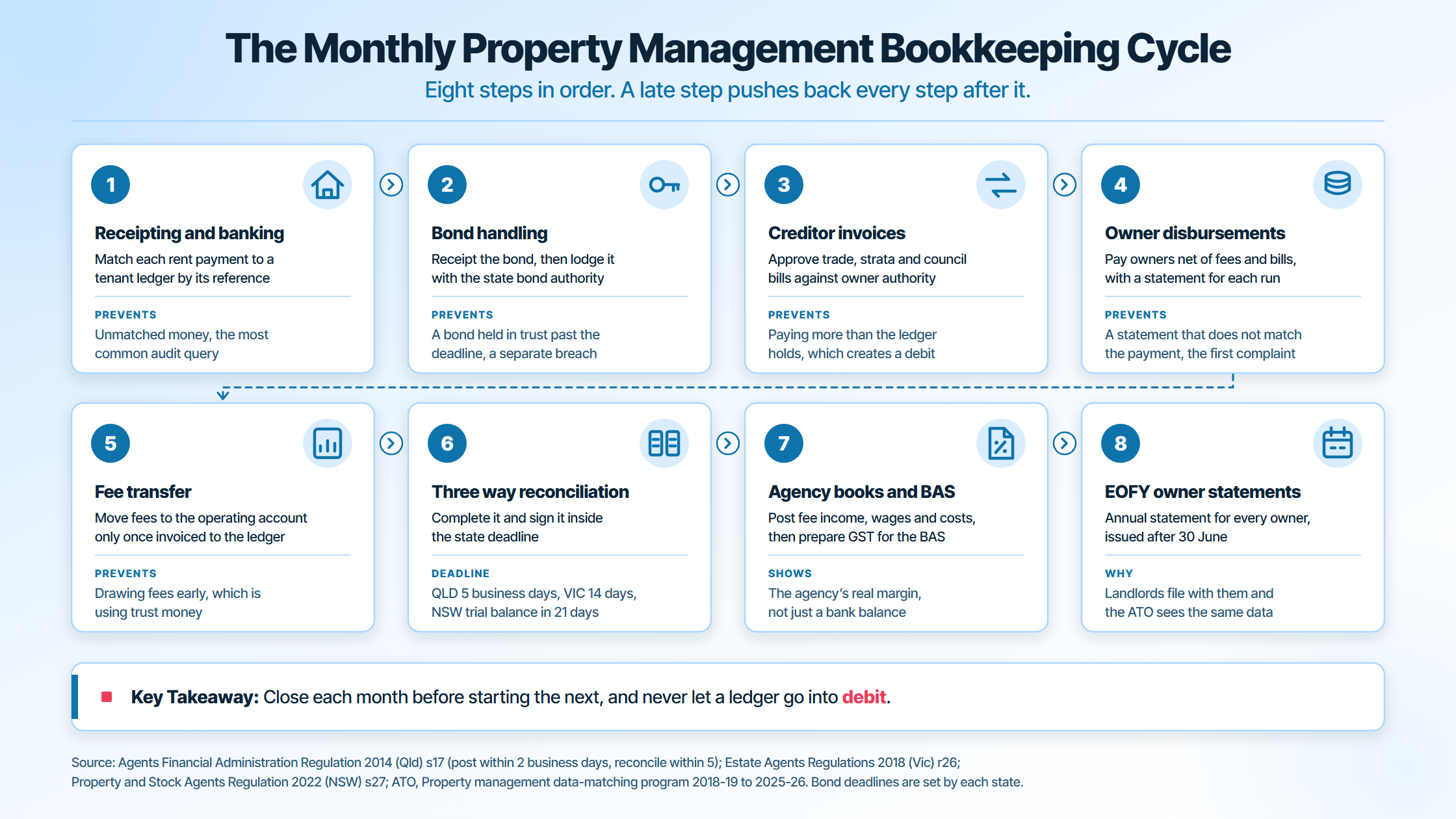
Property management bookkeeping follows the same cycle every month, and each step feeds the next. A late receipt delays the owner payment. A late owner payment delays the fee transfer, which leaves the agency’s own cash short. The order below is the one most compliant agencies follow.
These are the steps, with what each one prevents.
- Daily receipting and banking. Match each rent payment to a tenant ledger by reference. Under the Queensland regulation of 2014, the cash book entry is due within 2 business days. Unmatched money is the most common audit query.
- Bond handling. Receipt the bond, then lodge it with the state bond authority within its deadline. A bond left in trust past the deadline is a separate breach.
- Creditor invoices. Approve trade, strata and council invoices against the owner’s authority and the ledger balance. Paying an invoice larger than the ledger balance creates a debit ledger.
- Owner disbursements. Pay owners net of fees and approved bills, with a statement for each run. A statement that does not match the payment is the first complaint an owner makes.
- Fee transfer to the operating account. Move earned commission and fees out of trust only after they are invoiced to the owner’s ledger. Drawing fees early is using trust money.
- Month end three way reconciliation. Complete and sign inside the state deadline, as described above.
- Agency books and BAS. Record the fee income, wages and costs in the operating ledger and prepare GST. This is where the agency sees its real margin.
- End of financial year owner statements. Issue annual statements after 30 June. Landlords use them for their tax returns, and the ATO sees the same data.
Property management accounting best practices come down to two habits. Close each month before starting the next, and never let a ledger go into debit.
Trust Account Audit: How to Get a Real Estate Trust Account Audit Ready
A trust account audit is an annual compliance check of an agency’s trust records by a qualified auditor. It tests whether the money held matches the ledgers and whether every rule was followed. It is not a financial statement audit of the agency’s profit.
The real estate trust account audit is where a year of monthly work is graded. Auditors look at the whole period, so one bad month shows up even if the rest are clean. The preparation below starts in July, not in September.
The Documents a Trust Account Auditor Requests
- Trust bank statements for every month of the audit period.
- Signed monthly reconciliations and ledger trial balances, filed by month.
- Receipt and payment registers, with numbered receipts and payment references.
- Transfer journals and any adjustment journals, with the reason for each.
- Owner authorities for payments, and management agreements.
- Bond records and evidence of lodgement.
- Any deficiency reported to the regulator during the year.
Who Can Audit a Real Estate Trust Account
Each state names who may audit. In New South Wales, auditors must be qualified under section 115 of the Act. That covers registered company auditors and members of a professional accounting body holding a public practice certificate.
The auditor cannot have been employed by, or a partner of, the agency in the last 2 years of the audit period. In Victoria, an auditor who finds a suspected deficiency during an inspection must notify the agent and the Director within 3 business days. GATP prepares audit-ready records. A registered auditor signs the audit.
The Audit Findings That Cost Agencies the Most
- Late or unsigned reconciliations. The statutory window is short, so a reconciliation finished a week late is still a breach.
- Debit ledgers. An owner ledger below zero means another owner’s money covered the shortfall.
- Fees drawn before they were earned. Commission moved to the operating account before the owner was invoiced.
- Unidentified deposits. Money in the bank with no ledger, often from a tenant paying the wrong reference.
- Stale balances. Small amounts left on ledgers for years. In New South Wales they become unclaimed money after 2 years, with penalties up to AUD 5,500.
Is Real Estate Bookkeeping Hard?
Real estate bookkeeping is not hard in its single steps, but it is unforgiving. Each task is simple. The difficulty is volume, deadlines set by state law and the fact that a small error in trust affects a client’s money, not the agency’s.
Four areas cause most of the trouble for an Australian agency.
GST on Commission Versus Input Taxed Residential Rent
Residential rent is input taxed, so the landlord charges no GST on it. The agency’s fees are different. The ATO states that agency commissions are taxable even when they relate to input taxed residential property.
So every management fee carries 10 percent GST in the operating ledger, while the rent it came from carries none. The landlord cannot claim that GST back on a residential property. Coding both sides correctly is a core part of accounting for property management company books.
Cash or Accrual for the Agency’s GST
Agencies with aggregated turnover under AUD 10 million can choose cash or accrual GST, according to the ATO accounting method rules. Cash basis reports GST when the fee is actually received. For an agency paid out of trust each month, cash basis usually matches the fee transfer and keeps the BAS simple.
ATO Property Management Data Matching
The ATO property management data-matching program takes data straight from property management software. It covers about 2.3 million individuals each financial year, for the 2018-19 to 2025-26 years. The data includes rent, expenses and ledger balances.
Your end of year owner statements are therefore the ATO’s reference figures. A miscoded repair or a missing disbursement now shows up as a mismatch on the landlord’s return, and the landlord calls the agency.
Payday Super for Commission-Based Sales Staff
Payday Super started on 1 July 2026, per the ATO employer guidance. Super is now paid with each pay run, not quarterly. Agencies paying salary plus commission must calculate super on each commission payment as it is paid.
The compulsory superannuation rate is 12 percent for 2026-27, up to a maximum contribution base of AUD 270,830. Many agencies move this work to payroll outsourcing because commission timing makes each pay run different.
What Is the Best Property Management Accounting Software?
The best property management accounting software for an Australian agency is a platform built for state trust account rules, not a general ledger. Trust accounting software has to issue numbered receipts, keep a ledger per owner and produce the monthly reconciliation reports each state requires.
Platforms that rank in Australia for trust accounting software include PropertyMe, MRI Property Tree, Reapit, Rex, REI Cloud and Inhabit Guardian. Rather than a ranking, use this checklist when choosing real estate bookkeeping software.
- State reconciliation reports. The software should print the three way reconciliation and ledger trial balance in the format your state auditor expects.
- Sales trust and rental trust in one system. Agencies doing both need separate trust accounts and separate registers.
- Audit trail on every change. Edits to a closed month should be locked or logged with the user and reason.
- Bank feed matching. Automatic matching of tenant payments by reference cuts unidentified deposits.
- Owner statements and end of year summaries. These are the documents landlords and the ATO both rely on.
- An export to Xero or MYOB. The fee transfer should land in the operating ledger without retyping.
These platforms matter beyond the agency. Since 2018-19, the ATO has collected property management data directly from property management software companies. Switching platforms mid-year is the riskiest time for a trust account. Every ledger balance must carry across and reconcile on day one in the new system.
Can QuickBooks Be Used for Trust Accounting?
QuickBooks, Xero and MYOB can record a trust bank account, but they are not built to run Australian real estate trust accounting on their own. The state regulations expect numbered receipts, a cash book, a ledger for every owner and a signed monthly reconciliation of all three balances.
A general ledger tracks the agency’s money by account, not by each landlord. That is why most Australian agencies keep trust in dedicated property management software. QuickBooks, Xero or MYOB then hold the operating books.
The Queensland Agents Financial Administration Regulation 2014 also expects specific records from any software used, including a hard copy of the reconciliations within 5 business days. Whatever system you use, the test is the same. Can it produce the state’s required records, on time, for the auditor?
How Much Does Trust Accounting Cost?
Trust accounting in an Australian agency costs either a salary or a monthly service fee. An in-house bookkeeper on the median wage costs about AUD 81,536 a year before payroll tax, leave cover and software. An outsourced provider usually charges a fixed monthly fee based on rent roll size and transaction volume.
The in-house figure is built from public data, shown below.
Cost line | Basis | Annual cost |
Median wage | AUD 1,400 a week multiplied by 52 weeks | AUD 72,800 |
Compulsory superannuation | 12 percent of AUD 72,800 | AUD 8,736 |
Total before other costs | Wage plus super | AUD 81,536 |
The wage is the Jobs and Skills Australia median for Bookkeepers, an occupation of 91,800 people. Payroll tax, workers compensation, leave and cover for holidays sit on top of it. A trust account cannot stop for two weeks while one person is away.
GATP’s outsourced accounting in Australia starts at less than USD 250 a month, per the live service page. The price of getting trust wrong is the other side of the sum. A late New South Wales audit can draw a AUD 1,100 fine for a corporation, and a Queensland failure to audit carries up to 200 penalty units or 2 years imprisonment.
Outsource Real Estate Bookkeeping Services: What Moves and What Stays
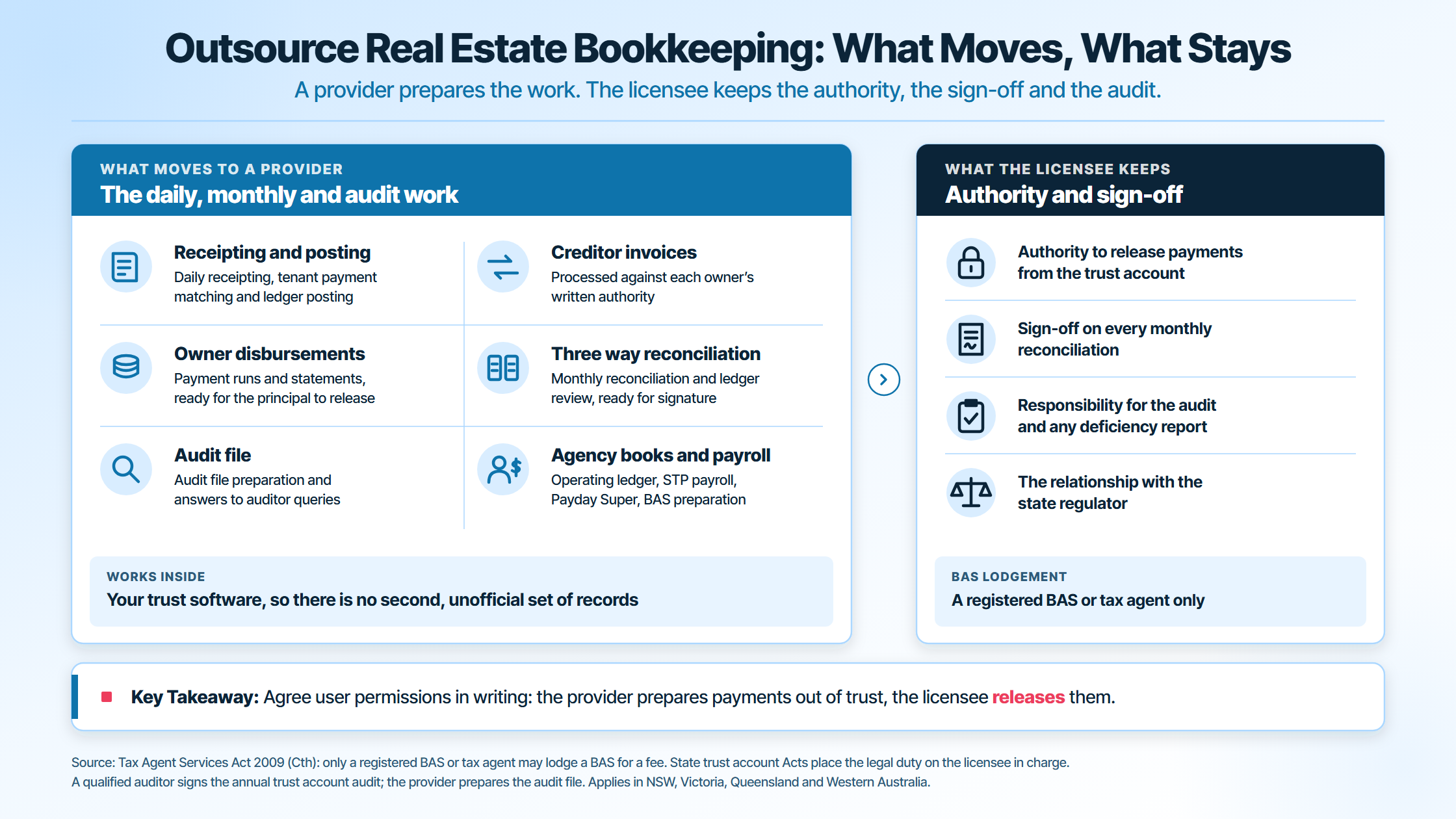
Outsourcing real estate bookkeeping services means a specialist team does the receipting, payments, reconciliations and agency books, while the licensee keeps control. Property management accounting services cover the same work from the owner’s side: statements, disbursements and audit files. It suits agencies where the principal spends evenings on reconciliations, or where one staff member holds all the trust knowledge.
Before you sign, decide exactly which jobs move and which stay.
The Jobs a Real Estate Bookkeeper Can Take Over
- Daily receipting, tenant payment matching and ledger posting.
- Creditor invoice processing against owner authorities.
- Owner disbursement runs and statements, for the principal to release.
- Monthly three way reconciliation and ledger review, ready for signature.
- Audit file preparation and auditor queries.
- Operating ledger, payroll with Single Touch Payroll reporting, Payday Super and BAS preparation for a registered agent to lodge.
What the Licensee Must Keep
- Authority to release payments from trust.
- Sign-off on every monthly reconciliation.
- Responsibility for the audit and any deficiency report.
- The relationship with the state regulator.
Under the Tax Agent Services Act 2009, only a registered BAS or tax agent can lodge a BAS for a fee. A good provider prepares it and hands it to your registered agent. Ask any provider which of these lines they draw before you compare prices.
A Checklist for Choosing Real Estate Accounting Services
- Ask for a sample month end pack. It should include the three way reconciliation and ledger list. This prevents hiring a general bookkeeper who has never closed a trust account.
- Confirm they work inside your trust software. This prevents a second, unofficial set of records.
- Check their calendar against your state. A provider must know whether you work to 5 business days or 21 days. This prevents late reconciliations.
- Agree user permissions in writing. They prepare payments and you release them. This prevents unauthorised withdrawals from trust.
- Agree who answers the auditor. This prevents audit queries waiting on a contact who left.
Property Management Accounting Examples From Three Agency Types
The same rules play out differently depending on what the agency does. These three examples show where the accounting effort really goes. Each one names the account that causes the most work.
Residential Rent Roll Agency
A residential agency managing several hundred homes lives in its rental trust account. The volume is in rent receipts, small maintenance invoices and twice monthly owner runs. The pressure point is the 30 June cut-off, when every owner’s annual statement must agree with the ledger that the ATO will later see.
Sales and Property Management Under One Licence
An agency that sells and manages runs two trust accounts with different rhythms. Sales deposits are large and few, and they sit until settlement. Since 1 July 2026, the sales side also brings AUSTRAC customer due diligence, which the rental side does not. Records for the two must stay separate.
Multi-Stream Property Business
GATP rebuilt the books of an Australian property business with five income streams: short stay rentals, buyer’s agency fees, property management, renovations and referrals. Its bank feeds had stopped in June 2024, and all income sat in one account. Short stay income was recorded net, hiding the platform fees.
The fix was structural. Each stream got its own income account, short stay revenue was booked gross with fees split out, and a director loan account separated owner money. Only then could the owner see which stream earned the margin, and the books could support a loan application.
What Changed for Australian Real Estate Agencies in 2026
Three changes in 2026 reach directly into property management accounting. Two affect the agency’s own books and one affects the sales trust account. Each has a hard date that has already passed.
AML/CTF Obligations Started on 1 July 2026
Real estate professionals have been regulated by AUSTRAC since 1 July 2026. A business must enrol no later than 28 days after it starts providing a designated service. AUSTRAC counted 18,350 real estate enrolments as of 17 September 2026.
The scope matters for property managers. The real estate designated service is brokering a sale, purchase or transfer. Leases of 30 years or less are excluded from the definition of real estate. A residential tenancy is a short lease, so the rent roll on its own does not create the obligation. The sales desk does.
Payday Super and the 12 Percent Rate
From 1 July 2026, super is due with each pay run instead of each quarter. The rate is 12 percent for 2026-27. For agencies with commission-based staff, every commission payment now carries its own super calculation.
The Last Year of the Current ATO Data-Matching Window
The ATO program collects property management data up to the 2025-26 financial year. That means the owner statements issued after 30 June 2026 are inside it. Treat this year’s end of year statements as documents the ATO will compare line by line.
Conclusion: Property Management Accounting Is a Monthly Compliance Job
Property management accounting in Australia in 2026 is two sets of books, with the trust set reconciled three ways every month inside a state deadline as short as 5 business days. Three things decide whether it holds up: a signed reconciliation every month, no ledger ever in debit, and audit records filed by month before 30 June.
Find out if your trust account would pass audit. Send us your last three month end reconciliations and your ledger trial balance. We check them against your state’s deadline, flag any debit or stale ledgers and show you what a monthly virtual bookkeeper would take off your desk. You get a written summary within a week.
Frequently Asked Questions About Property Management Accounting
What is property management accounting?
Property management accounting is the recording, holding, paying and reconciling of money an agency manages for property owners, plus the agency’s own books. In Australia it is built around a statutory trust account. Every receipt, payment and ledger balance must reconcile monthly, inside a deadline set by state law, such as 5 business days in Queensland.
What is a trust account in real estate?
A trust account in real estate is a separate bank account an agency must use for money that belongs to other people. That includes rent, sales deposits and money held to pay bills for owners. The agency cannot use it for its own costs. Fees move out only once they are earned and charged to an owner’s ledger.
What is trust accounting?
Trust accounting is the set of records that tracks money held for others, by person and by transaction. It includes receipts, a cash book, individual ledgers and monthly reconciliations. In property management it is regulated by each state, and an annual audit by a qualified auditor tests whether the records meet the state Act.
Does a real estate trust account earn interest?
A real estate trust account can earn interest, but the agency usually does not keep it. In New South Wales, a prescribed share of interest on agents’ general trust accounts is paid to the Property Services Statutory Interest Account. Queensland law allows interest on general trust accounts to be paid to the state’s consolidated fund under an agreement with the bank.
How long must real estate trust records be kept?
Retention periods vary by state, so keep records for the longest period that applies to you. Queensland requires trust records to be kept for at least 5 years. Victoria requires duplicate receipts and the signed audit report to be kept for 7 years. A New South Wales licensee keeps a trust account closure notice for 3 years.
What does property accounting do for an agency principal?
Property accounting gives an agency principal three things: proof that trust money is intact, a clean audit and a true picture of agency profit. The trust side protects the licence. The operating side shows which fees, offices or staff actually make money, which a combined bank balance never shows.
What is the best accounting method for a property management business?
A property management business with aggregated turnover under AUD 10 million can use cash or accrual for GST. The trust account itself always runs on actual receipts and payments. Many agencies use cash basis GST on the operating side because fee income arrives through a predictable monthly transfer from trust.
What happens if a real estate trust account audit is late?
A late audit is a breach of the state Act and can lead to fines or licence action. In New South Wales, Fair Trading can fine AUD 550 for an individual or AUD 1,100 for a corporation. In Victoria, failing to have the audit done carries a maximum of 120 penalty units.

