
NDIS accounting is the claiming, bookkeeping, payroll and GST work that turns delivered supports into cash for a registered NDIS provider. GATP runs that work for established Australian providers inside your own Xero or MYOB file. It sits beside our medical bookkeeping services and our wider bookkeeping services in Australia.
What Is NDIS Accounting and How Is It Different From Regular Bookkeeping?
NDIS accounting is accounting for a business whose main customer is the National Disability Insurance Scheme. The NDIS is the federal scheme that funds supports for people with disability through individual plans. The ledger looks familiar, but four rules change how every transaction is recorded.
Regular bookkeeping assumes you set your price and invoice a customer. NDIS bookkeeping assumes the opposite. The NDIA sets the maximum price, and the participant’s plan decides who pays you.
- Revenue is claimed, not invoiced. For NDIA-managed funding, you submit a payment request in the myplace provider portal. The NDIA pays it into your bank account.
- Price limits cap revenue. The 2026-27 NDIS pricing schedule sets maximum prices for each support item. A claim above the limit is rejected.
- GST treatment is decided per supply. Most supports are GST free, but only when four ATO conditions are met for that participant.
- Payroll runs under the SCHADS Award. Shift loadings, sleepovers and broken shifts drive labour cost, and the price limit is built on that award.
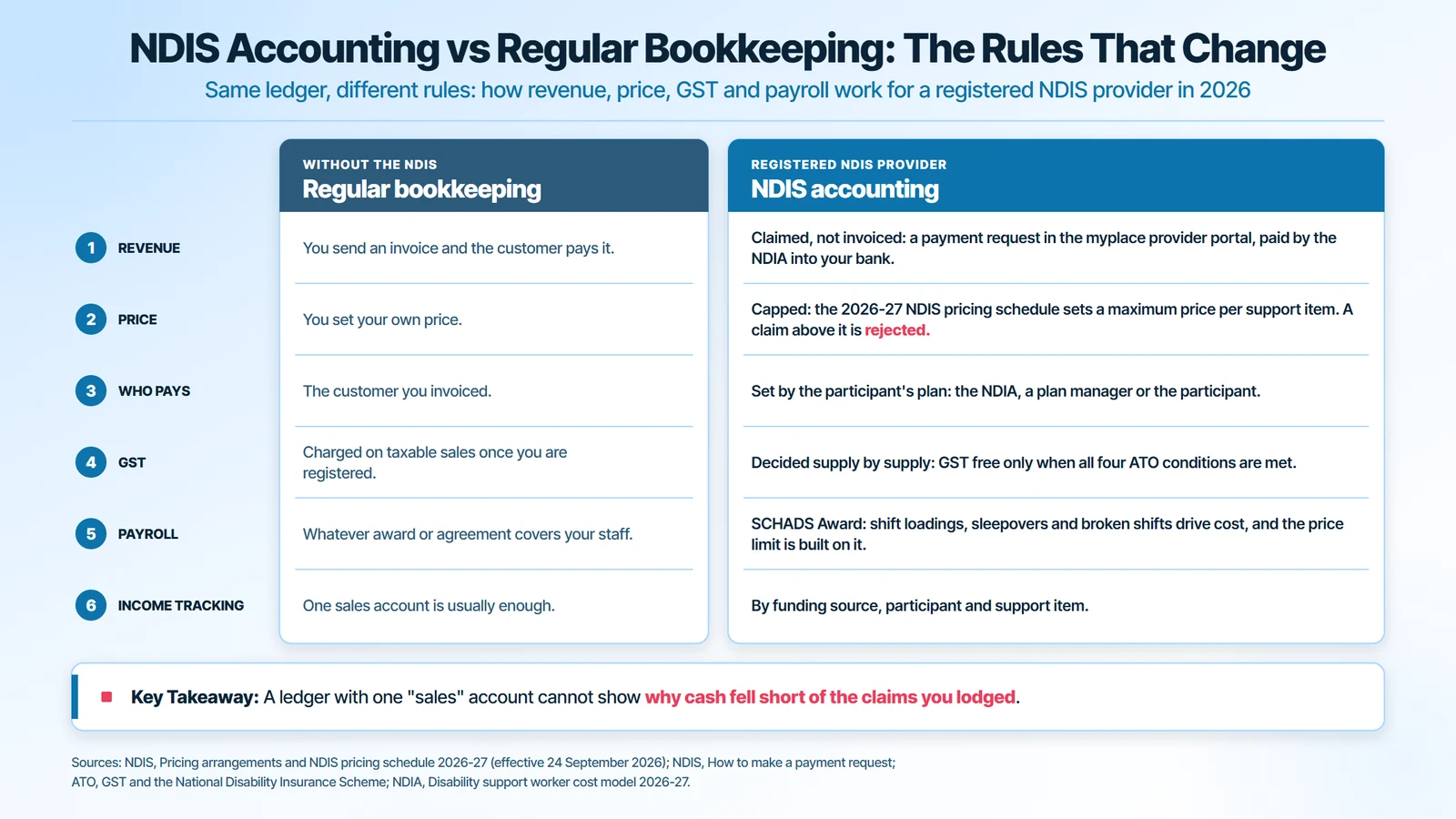
Because of those rules, NDIS accounting services track your income by funding source, participant and support item. A general ledger with one “sales” account cannot show you why cash fell short of the claims you lodged.
Our NDIS Accounting Services
Our NDIS accounting services cover the bookkeeping for NDIS providers that sits between your roster and your bank account. Each job below runs weekly or monthly, and each one closes a gap that costs NDIS providers cash.
- Claims-to-bank reconciliation. Every bulk payment request is matched line by line to its deposit, so a rejected claim shows up as a receivable instead of disappearing into revenue.
- Rejected claim follow-up. Rejected lines are logged weekly, sent back to your team for correction and tracked until paid, well inside the 2-year claim limit.
- Accounts receivable for plan-managed and self-managed participants. Invoices to plan managers and participants are aged by funding type and followed up each week.
- GST-free coding. Each support is tested against the four ATO conditions before it is coded GST free, including hours delivered beyond the plan.
- SCHADS payroll and Payday Super. Pay runs are processed under the award, and super is paid inside the 7 business day window.
- Accounts payable and monthly management accounts. Bills are paid on schedule, and each month closes with your cost per billable hour and margin by support type.
- BAS preparation for your registered agent. Workpapers reach your BAS or tax agent each quarter with time to review.
Three jobs sit outside our scope. We do not offer plan management, we do not act as an NDIS quality auditor, and we do not lodge your BAS or tax return. Lodging either for a fee is a tax agent service under the Tax Agent Services Act 2009, so your registered agent signs and lodges.
How Switching Your NDIS Bookkeeping Works
Switching your NDIS bookkeeping does not mean moving your data. Your file stays in your own subscription, and the change is who has access to it. The handover runs in 4 steps, and each one prevents a specific failure.
- Access to your own file. If your books sit in your own Xero or MYOB subscription, switching is a change of user access, not a migration. Every historical transaction stays where it is, and you can remove our access at any time.
- Clean up before reporting. Whether you are behind by a quarter or by a year, the ledger is brought up to date first. Unreconciled deposits and open rejected claims are cleared before any report goes out.
- Mapping every support item and funding type. Each support item in the 2026-27 pricing schedule, each funding type and each income stream gets its own place in the chart of accounts. That mapping turns every later reconciliation into a check.
- The weekly claim and monthly close rhythm. Deposits are reconciled as they land, rejected lines are resubmitted inside the NDIA’s 90-day window, and the month closes by the date we agree with you.
Which NDIS Providers We Work With
We work with established NDIS providers whose claim volume has outgrown one in-house bookkeeper. The NDIA’s pricing review shows the scale: a disability support worker company averaged AUD 525,600 in claims over six months.
- Supported independent living providers with several houses, large rosters and high fixed labour cost.
- Disability support worker companies billing thousands of hours a month at or near the price limit.
- Support coordination and community participation providers carrying NDIA-managed, plan-managed and self-managed participants at once.
- Therapy and allied health providers claiming capacity building supports alongside private client billing.
A sole trader delivering supports personally can usually run the books alone. The services above fit once claims, payroll and GST all need weekly attention.
A Checklist for Choosing NDIS Bookkeepers
Use these checks before you outsource NDIS bookkeepers. Each one prevents a specific failure.
- Ask how they reconcile bulk deposits. This prevents rejected claims hiding inside revenue.
- Ask how they track the 90-day claim window. This prevents late claims going into a 28-day review.
- Ask how GST-free status is tested per participant. This prevents GST errors when a plan or written agreement changes.
- Ask how SCHADS loadings are checked. This prevents underpayment claims from staff.
- Ask who lodges your BAS. This confirms a registered agent signs off on lodgement.
Want your NDIS claims matched to your bank every week?
Tell us how many participants you serve and which software you run, and we will map out what moving your NDIS bookkeeping involves. Talk to our team.
How Much Do NDIS Providers Get Paid Per Month?
NDIS providers do not get a fixed monthly payment. They are paid per support delivered, at or below the price limit, from each participant’s plan. Your monthly revenue therefore depends on your support type, the hours you deliver and how many participants you serve.
The best current benchmark is the NDIA’s Annual Pricing Review for 2026-27 prices, published in June 2026. It reports average claims per provider for the six months from July to December 2025. The monthly column below divides each six-month figure by 6.
Provider segment | Average claims, July to December 2025 | Approximate monthly average |
Registered supported independent living providers | AUD 1.42 million | AUD 236,700 |
Disability support worker companies | AUD 525,600 | AUD 87,600 |
Registered community participation providers | AUD 328,900 | AUD 54,800 |
All support coordination providers | AUD 55,500 | AUD 9,250 |
Disability support worker sole traders | AUD 22,800 | AUD 3,800 |
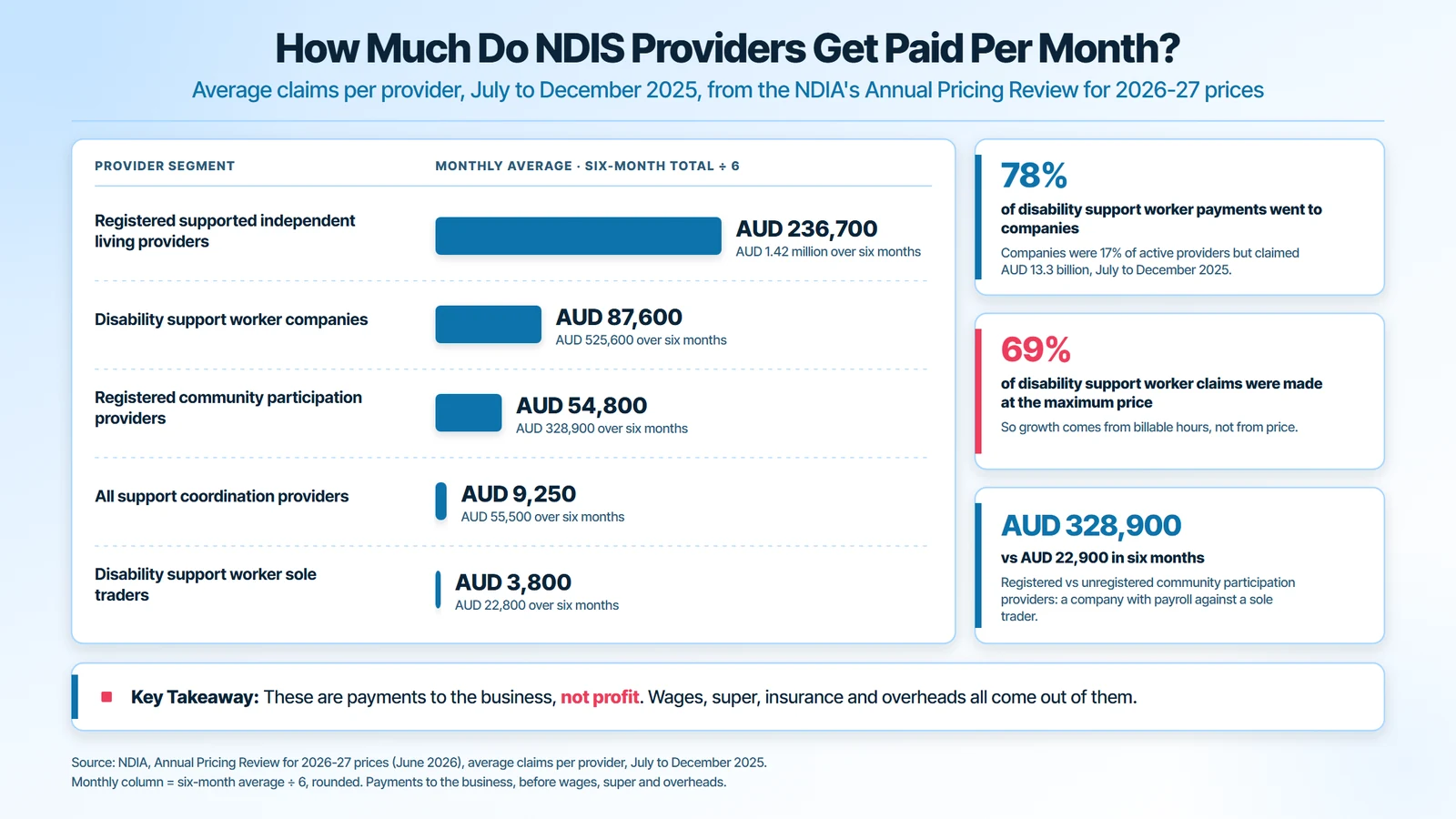
These are payments to the business, not profit. Your wages, superannuation, insurance and overheads come out of them. The three segments below show how your books change by provider type.
Supported Independent Living Providers
Supported independent living, or SIL, funds help with daily tasks in shared homes, often around the clock. Registered SIL providers averaged AUD 1.42 million in claims each over the six months to December 2025, down from AUD 1.55 million a year earlier. Track each house as its own cost centre, so a vacancy shows as a margin problem in the month it happens.
Disability Support Worker Companies
Disability support worker companies made up 17 percent of active providers but claimed AUD 13.3 billion, or 78 percent of payments for these supports, in the six months to December 2025. The NDIA found 69 percent of these claims were made at the maximum price, so growth comes from billable hours. Your bookkeeping job is to match every rostered shift to a claim line, then every claim line to cash.
Support Coordination and Community Participation Providers
Support coordination providers averaged AUD 55,500 each in the six months to December 2025, across 11,129 active providers. In community participation, registered providers averaged AUD 328,900 while unregistered providers averaged AUD 22,900, which is a company with payroll against a sole trader working alone. At the larger end, payroll, GST and claim reconciliation need doing every week.
NDIS Claims and Payment Requests: How Do NDIS Providers Get Paid?
NDIS providers get paid by submitting a payment request for each support, either to the NDIA, a plan manager or a self-managed participant. Which one depends on how the participant’s funding is managed. For NDIA-managed funding, the NDIA’s guide to getting paid sets the timelines.
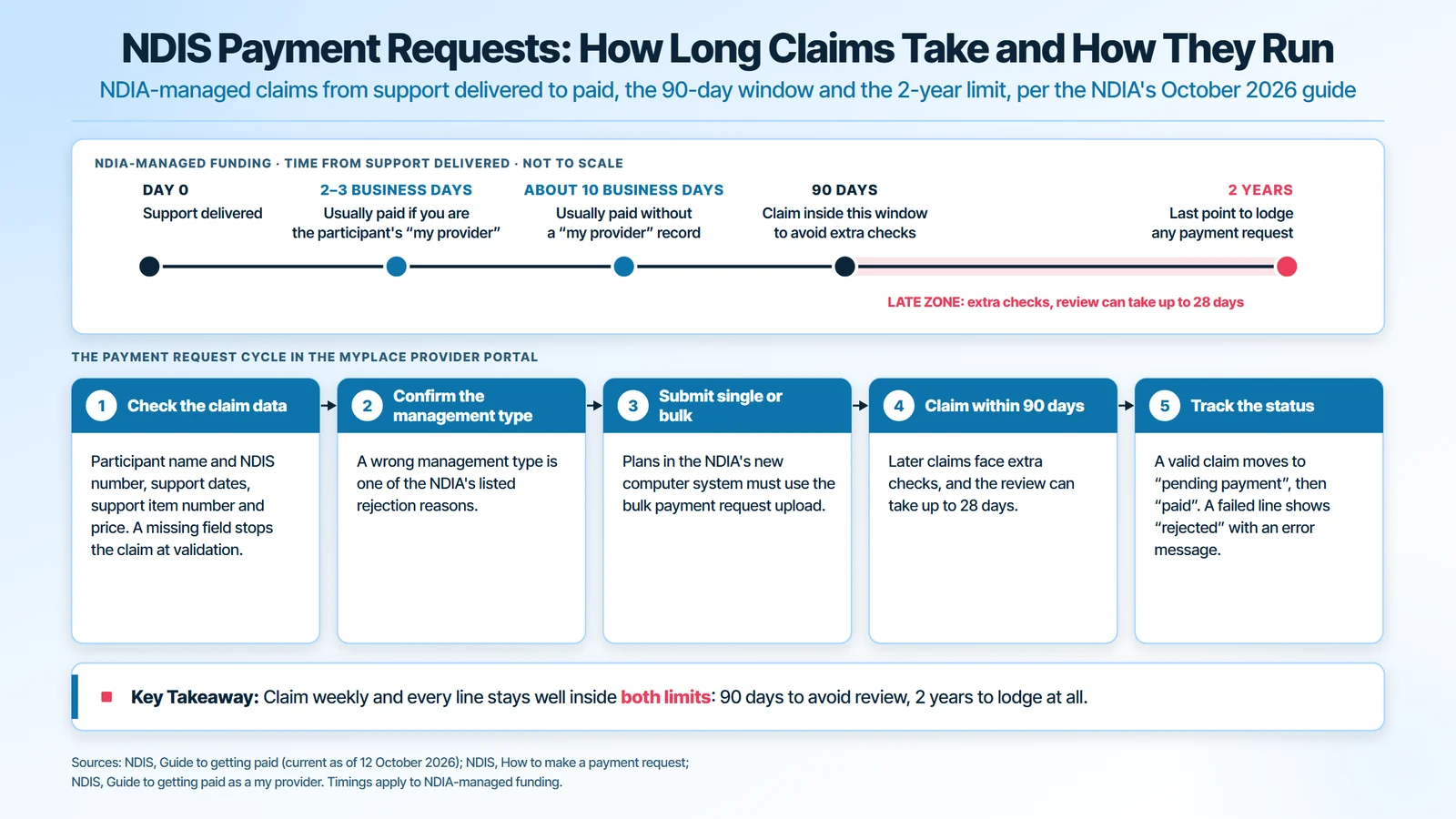
If you are recorded as a participant’s “my provider”, the NDIA usually pays your valid claims within 2 to 3 business days. Without that status, you can wait about 10 business days. You must lodge every claim within 2 years of the support being delivered.
The Payment Request Cycle in the Myplace Provider Portal
A payment request is a claim against a participant’s plan for a support already delivered. All claims are submitted in the myplace provider portal, as the NDIA’s page on how to make a payment request explains.
- Check the claim data. Each line needs the participant’s name and NDIS number, the support dates, the support item number and the price. A missing field stops the claim at validation.
- Confirm the management type. A wrong management type is one of the NDIA’s listed rejection reasons.
- Submit a single or bulk request. Providers claiming for plans in the NDIA’s new computer system must use the bulk payment request upload.
- Claim within 90 days. If you claim later, you face extra checks, and the review can take up to 28 days.
- Track the status. A validated claim moves to “pending payment”, then “paid”. A failed one shows “rejected” with an error message.
Why Was My NDIS Payment Request Rejected?
An NDIS payment request is rejected when the claim data does not match the participant’s plan or the pricing rules. The NDIA’s guide for my providers lists the main reasons:
- A unit price above the maximum in the pricing schedule.
- Wrong dates, duplicate claims, or missing bank or ABN details.
- Insufficient funds left in the participant’s plan.
- The wrong management type on the claim.
- The participant or nominee did not authorise the claim, or says the support was not received.
- No “my provider” record for supports that require one, such as specialist disability accommodation.
Each rejection is cash that has not arrived. Log rejected lines weekly, resubmit them and report the dollar value still open, before any line drifts toward the 2-year claim limit.
Worked Example: Reconciling a Bulk Payment Request to the Bank
Bulk claims arrive as one deposit, so your books must split it back into claim lines. Here is a month-end example for a disability support worker company.
- Bulk upload: 2,400 standard weekday daytime hours at AUD 73.58 = AUD 176,592.
- Rejected: 40 two-hour shifts, or 80 hours, coded to the wrong management type = AUD 5,886.40.
- Deposit received: AUD 176,592 minus AUD 5,886.40 = AUD 170,705.60.
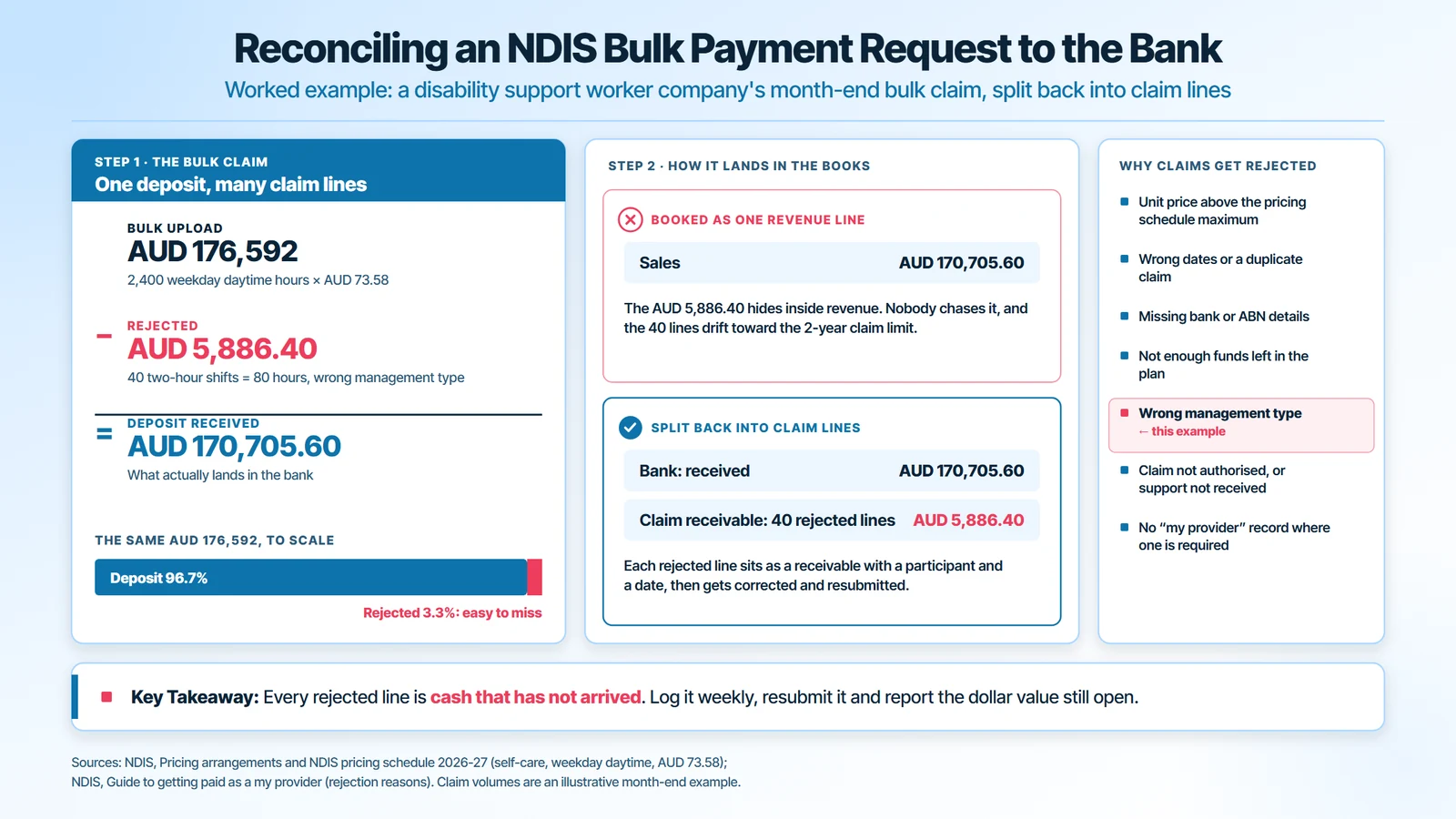
Your bookkeeper records AUD 170,705.60 as received and holds AUD 5,886.40 as a claim receivable against the 40 rejected lines. Without that split, the AUD 5,886.40 hides inside your revenue and nobody chases it.
GATP Accountant’s Note: The gap we see most often on an NDIS file is a bulk deposit booked as one revenue line. We rebuild it claim by claim from the payment request export, so every rejected line sits as a receivable with a participant and a date.
Plan-Managed, Self-Managed or NDIA-Managed: Who You Invoice Changes Your Cash Flow
The funding management type is the setting in a participant’s plan that decides who pays the provider. There are three types, and each one creates a different receivable in your books. If you serve 200 participants, you may carry all three at once.
- NDIA-managed. You claim in the myplace provider portal and the NDIA pays you directly. Price limits apply.
- Plan-managed. You invoice the participant’s plan manager, who claims from the NDIA and then pays you. The invoice must carry a valid ABN. Price limits apply.
- Self-managed. You invoice the participant, who pays you and records the payment in the participant portal. The NDIS pricing schedules say maximum prices apply only to NDIA-managed and plan-managed participants.
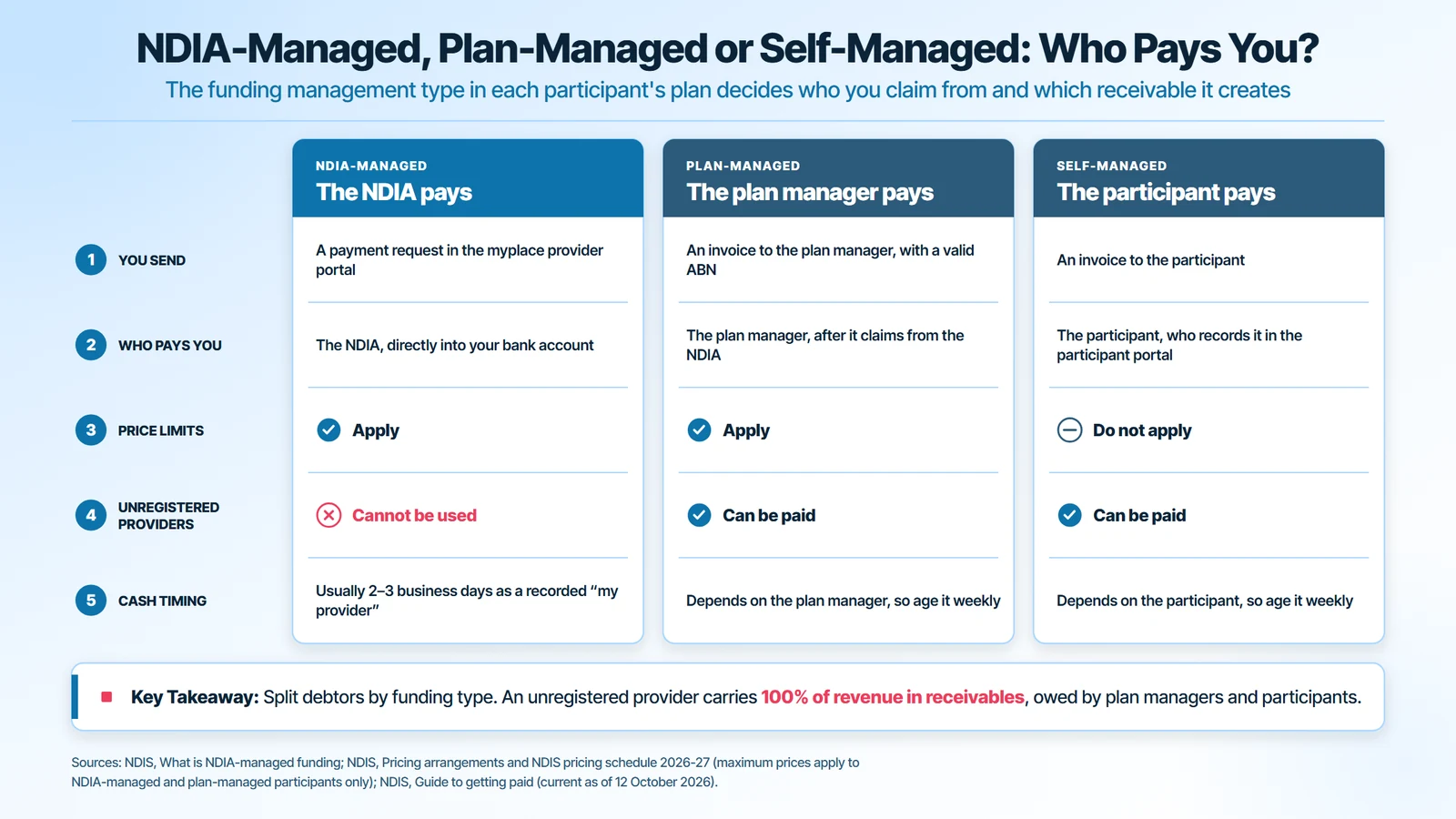
In your accounts, split debtors by funding type. NDIA-managed claims usually settle in days. Plan-managed and self-managed invoices depend on a third party, so their ageing needs its own weekly follow-up.
How Do Unregistered NDIS Providers Get Paid?
Unregistered NDIS providers get paid by plan-managed or self-managed participants, never from NDIA-managed funding. The NDIA’s page on NDIA-managed funding states that participants cannot use unregistered providers for supports funded that way.
If you are unregistered, 100 percent of your revenue runs through accounts receivable, owed by a plan manager or a participant, so debtor days become your cash flow measure. Registration is also tightening: the 2026-27 Budget funded mandatory registration for all high-risk supports from 1 July 2027.
Do NDIS Providers Charge GST? When NDIS Supplies Are GST Free
Most NDIS providers do not charge GST on supports, because a supply to an NDIS participant can be GST free. It is GST free only when all four conditions on the ATO’s NDIS GST page are met:
- The participant has an NDIS plan in effect.
- The supply is a reasonable and necessary support specified in the plan’s statement of supports.
- A written agreement exists with the participant or another person, such as the plan manager.
- The supply is covered by a table in the NDIS GST-free determination made in 2021.
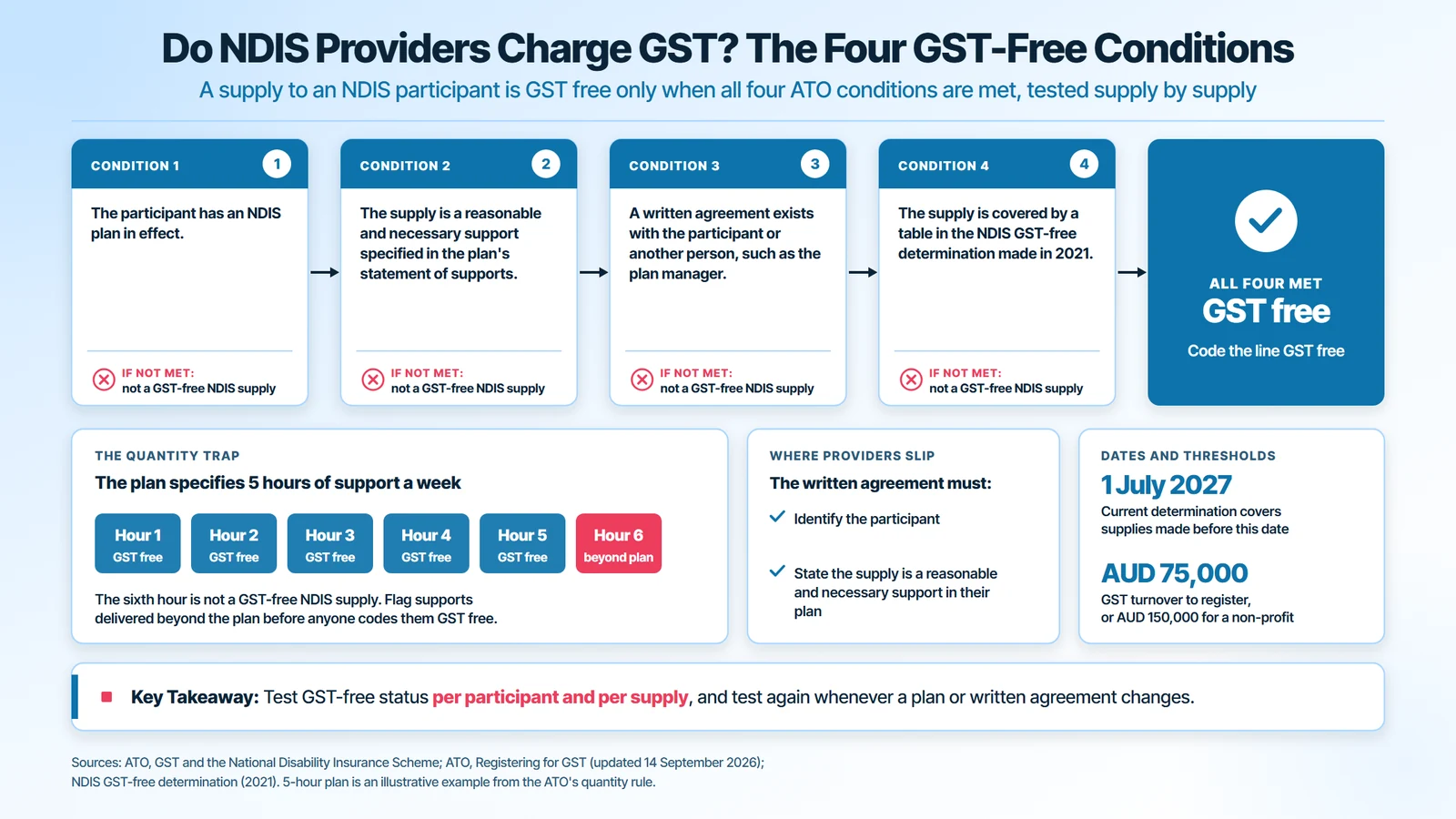
The written agreement is where you are most likely to slip. It must identify the participant and state that the supply is a reasonable and necessary support in their plan.
Quantity matters too. If a plan specifies 5 hours of support a week, a sixth hour is not a GST-free NDIS supply. Your books should flag supports delivered beyond the plan before anyone codes them GST free.
The current determination applies to supplies made before 1 July 2027, so watch for its replacement. You still must register for GST once your GST turnover reaches AUD 75,000, or AUD 150,000 for a non-profit, under the ATO’s registration rules.
NDIS Payroll Under the SCHADS Award and Payday Super
NDIS payroll is the weekly or fortnightly pay run for support workers employed under the Social, Community, Home Care and Disability Services Industry Award, known as SCHADS. Labour is usually your largest cost. The NDIA’s own cost model assumes these SCHADS rates from 1 July 2026:
- Level 2.3: AUD 38.50 an hour, used for a Level 1 disability support worker.
- Level 4.4: AUD 50.25 an hour.
Loadings change what each shift costs you. The model applies 50 percent on Saturday, 100 percent on Sunday, 150 percent on public holidays and 12.5 percent on evening shifts.
Super timing changed this year. Under Payday Super, 12 percent of qualifying earnings must reach each worker’s fund within 7 business days after payday. If your fortnightly pay run has AUD 120,000 of qualifying earnings, you now pay AUD 14,400 of super inside that window, not at quarter end.
It often pays to combine claiming with payroll outsourcing, because your roster drives both the pay run and the claim file.
How Profitable Is an NDIS Business?
An NDIS business can be profitable, but the price limit leaves little room for waste. The NDIA’s disability support worker cost model 2026-27 builds the AUD 73.58 weekday price from the award wage up, and it allows a margin of only 2.00 percent.
Cost layer (Level 1 worker, weekday) | Rate applied | Running cost per billable hour |
SCHADS base wage | Level 2.3 | AUD 38.50 |
Leave, super at 12 percent and allowances | 37.51 percent | AUD 52.94 |
Operational overheads, including supervision and unbilled time | 21.65 percent | AUD 64.41 |
Corporate overheads, including accounting and HR | 12.00 percent | AUD 72.13 |
Margin | 2.00 percent | AUD 73.58 |
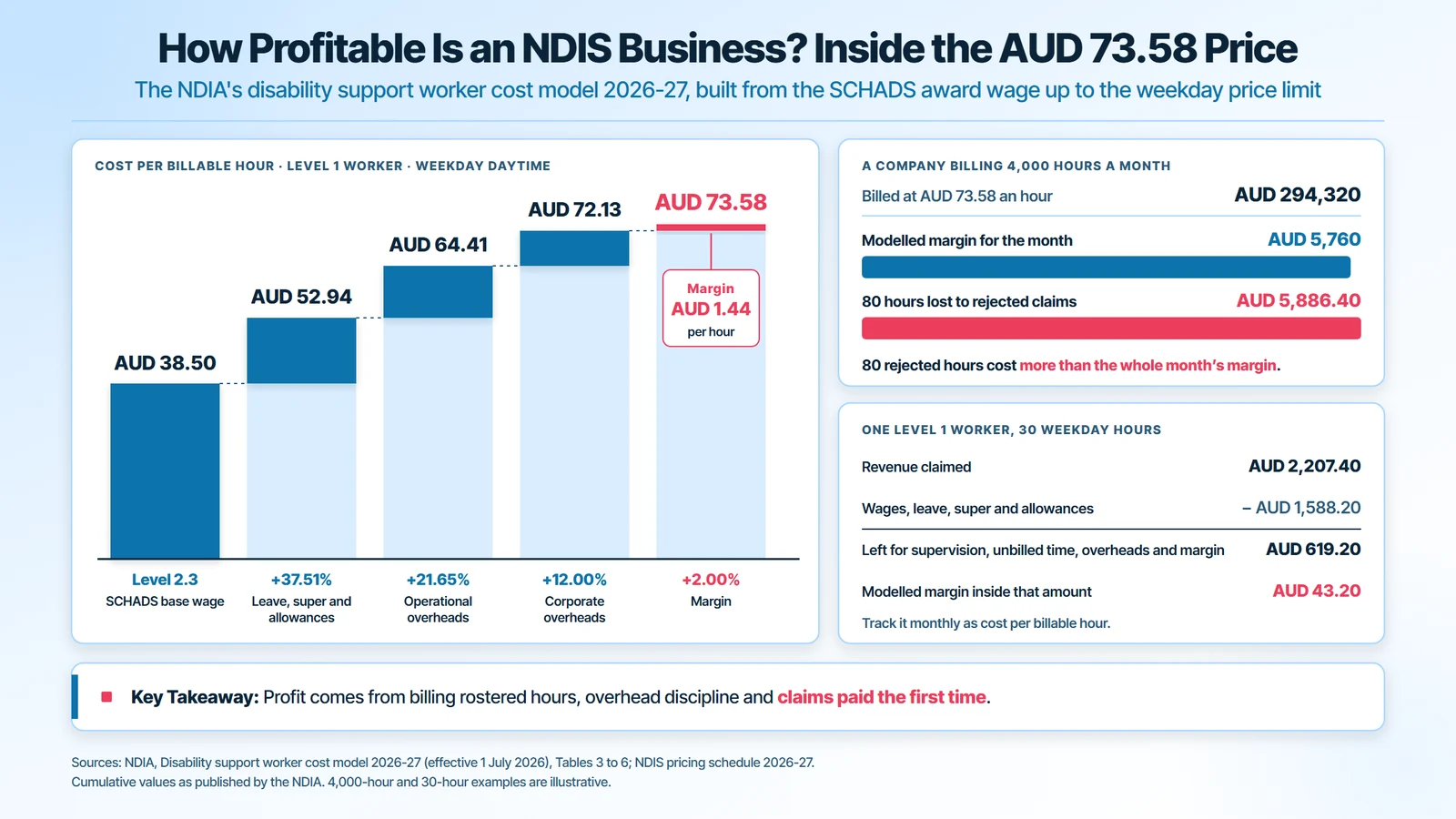
The margin is AUD 1.44 per billable hour. If your company bills 4,000 hours a month, you earn AUD 294,320, and your modelled margin on that is AUD 5,760.
Compare that with the reconciliation example: 80 hours lost to rejected claims costs AUD 5,886.40, more than the whole month’s modelled margin. Profit comes from three controls: the share of rostered hours you bill, overhead discipline and claims paid the first time.
The NDIA’s consultation on 2027-28 prices, open until 1 November 2026, asks providers about these compliance and overhead costs.
How Much Does an NDIS Provider Earn?
An NDIS provider earns the gap between what it claims at the price limit and what it costs to deliver the support. The amount claimed is revenue, not income. Here is one Level 1 support worker billing 30 weekday hours in a week:
- Revenue: 30 hours at AUD 73.58 = AUD 2,207.40.
- Wages, leave, super and allowances at the cost model rate: 30 hours at AUD 52.94 = AUD 1,588.20.
- Left to cover supervision, unbilled time, corporate overheads and margin: AUD 619.20.
- Modelled margin inside that amount: 30 hours at AUD 1.44 = AUD 43.20.
A sole trader keeps more of the AUD 2,207.40, because no employee wage sits in between. A company earns through scale and tight control of the costs inside the AUD 619.20, which monthly management accounts track as cost per billable hour.
Why Are NDIS Providers Closing Down?
NDIS providers are closing down because tighter price limits, stronger claim controls and wider registration rules have raised the cost of staying compliant. Many stop one support type or leave the scheme by choice. The NDIA’s 2026 figures show the pressure:
- More than 135,000 high-risk claims were rejected over the past 2 financial years, per the NDIA’s integrity update of 23 September 2026.
- Unregistered SIL providers had to apply by 1 October 2026 or stop providing SIL, per the NDIA’s registration announcement of 30 June 2026.
- The cost model allows a 2.00 percent margin, so weak claim controls can make a busy provider unprofitable.
Audit-Ready Financial Records: NDIS Invoice Requirements and Claim Evidence
Audit-ready NDIS records are the documents that prove every claim was delivered, priced correctly and agreed. The NDIA’s record keeping requirements list invoices, support logs, rosters, case notes and service agreements.
Every record you keep should carry 5 identifying details: the participant’s name, NDIS number, the dates of support, the amount or hours delivered and the support type. NDIS invoice requirements add more fields:
- Your business name and ABN.
- The support item number from the NDIS support catalogue.
- The claim type and total invoice amount.
- The GST component, if any applies.
- One participant per invoice, though one invoice can carry several supports.
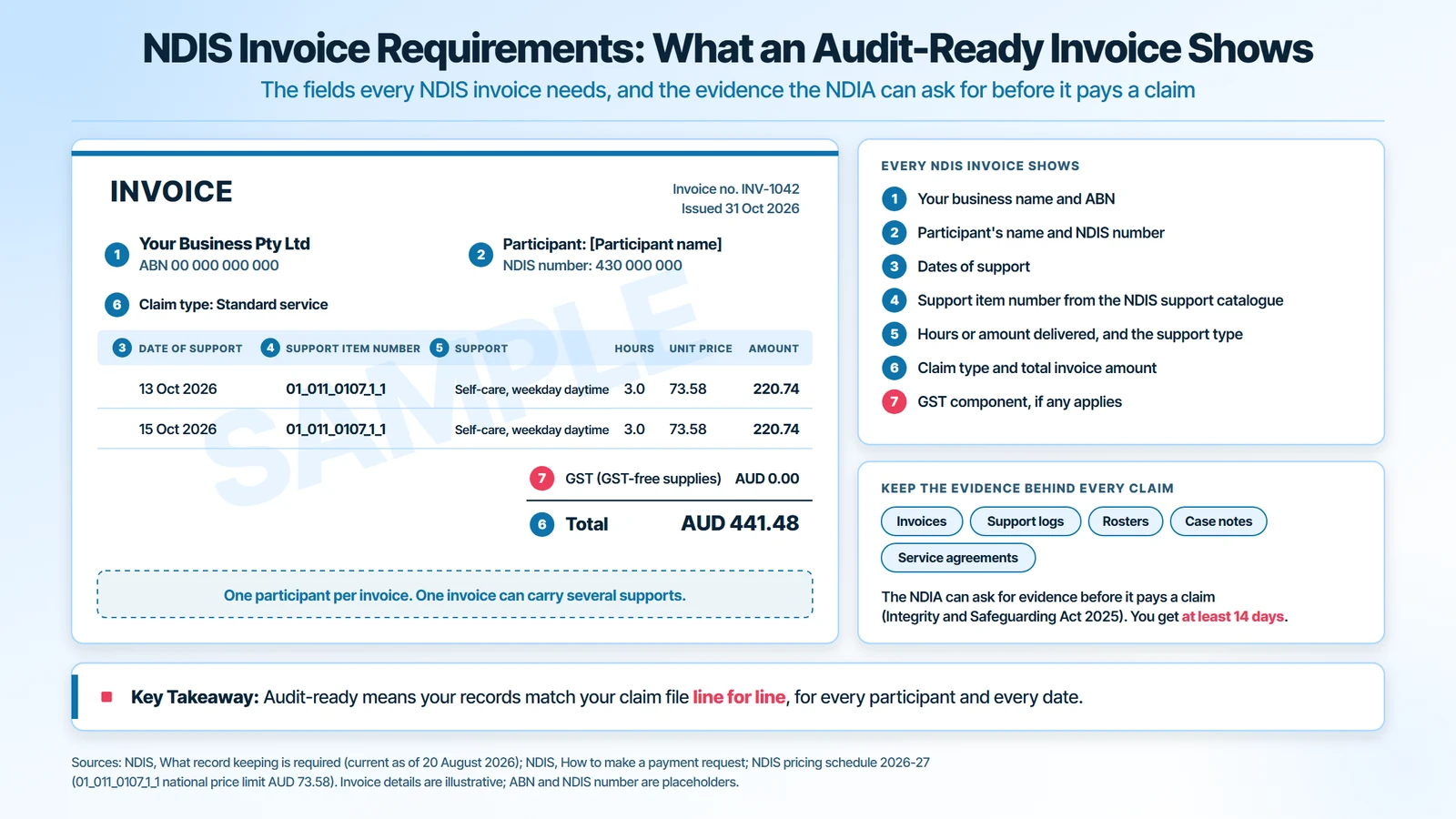
The Integrity and Safeguarding Act 2025 gave the NDIA power to request evidence before it pays a claim. When the NDIA reviews a claim, you get at least 14 days to provide it. NDIS audit preparation on the finance side means your records match your claim file line for line.
NDIS Accounting Software: Xero, MYOB and the Claiming Stack
NDIS accounting software is the set of tools that carries a support from the roster to the claim to the general ledger. No single product does all three jobs well, so you will likely run a stack. The NDIA assesses over 700,000 claims a day, and clean data is what gets yours through.
- Rostering and NDIS claiming software. This records shifts against support items and builds the bulk payment request file for the myplace portal.
- The general ledger. Xero and MYOB are the common choices in Australia. An NDIS Xero integration posts claims and invoices by participant and funding type.
- SCHADS loadings and Payday Super reporting through Single Touch Payroll need a payroll system that handles both.
How Can GATP Help With NDIS Accounting?
GATP helps registered NDIS providers by running claims reconciliation, payroll and the monthly close as one weekly routine. Our outsourced accounting services for Australian businesses cover bookkeeping, accounts payable, management accounts and BAS preparation, all inside your own Xero or MYOB file.
On an NDIS file, that work is built around the payment request. Each bulk deposit is split back into claim lines, rejected lines are tracked to payment, supports are tested for GST-free status, and SCHADS pay runs feed super inside the Payday Super window. Your registered agent receives a reconciled file for lodgement.
The Short Version
- A valid claim from a recorded “my provider” is usually paid in 2 to 3 business days, and every claim must be lodged within 2 years.
- The 2026-27 price limit for a weekday daytime self-care hour is AUD 73.58, with a modelled margin of 2.00 percent.
- Payday Super puts 12 percent of qualifying earnings in each worker’s fund within 7 business days of payday.
- GATP prepares the books, payroll and BAS workpapers, and your registered agent lodges.
Conclusion: NDIS Accounting Comes Down to Claims, Payroll and Margin
NDIS accounting works when every rostered hour becomes a valid claim, every claim becomes cash, and payroll and GST follow the 2026 rules. If rejected claims, late super or unbilled hours are eating a 2.00 percent margin, the next decision is whether one in-house bookkeeper can still keep up.
Find out where your NDIS claims are leaking cash
We review your last three bulk payment requests against your bank deposits, your rejected claim list and your SCHADS pay runs. You get back the dollar value of unpaid or rejected claims, any GST-free coding at risk, and the steps to close the gap before the next claim cycle. Thirty minutes, one clear answer.
Frequently Asked Questions
How much does an NDIS bookkeeper cost in Australia?
The cost of an NDIS bookkeeper depends on your claim volume, participant numbers and payroll headcount. The NDIA’s cost model funds corporate overheads at 12.00 percent of direct costs, which is AUD 7.73 per Level 1 weekday hour. That allowance covers accounting, HR, legal, marketing and IT together. Price any quote against your billable hours, not against a flat hourly rate.
Can you handle NDIS bookkeeping and payroll together?
Yes, NDIS bookkeeping and payroll work best together because the roster feeds both. The same shift drives the SCHADS pay calculation and the claim line. When one team runs both, you see unbilled hours and paid-but-unclaimed shifts in the same weekly report. Since 1 July 2026, Payday Super also ties your super payments to each pay run.
Is outsourced NDIS bookkeeping better than hiring in-house?
Outsourced NDIS bookkeeping is usually better once your claim volume outgrows one person. A single in-house bookkeeper creates key-person risk around your claim deadlines, and the 2-year claim limit does not pause for leave. An outsourced team covers claiming, reconciliation and payroll together. Your in-house staff still approve rosters and payments.
Can I do my own accounting for my NDIS business?
You can do your own NDIS accounting while the business is small, but it gets risky as claims grow. Support workers’ wages, SCHADS loadings, GST-free tests and claim reconciliation all need weekly attention. With 69 percent of support worker claims made at the maximum price, any error comes straight out of margin. Many owners hand it over once payroll starts.
What is the difference between an NDIS bookkeeper and an NDIS accountant?
An NDIS bookkeeper records and reconciles your daily transactions, while an NDIS accountant reports on them and advises you on tax, structure and profit. Your bookkeeper matches claims to deposits and runs payroll. The accountant prepares financial statements and management reports. Lodging a BAS or tax return for a fee requires a registered BAS or tax agent.
Do NDIS providers need to register for GST?
You must register your NDIS business for GST once your GST turnover reaches AUD 75,000, or AUD 150,000 for a non-profit. Registration matters even when most of your supports are GST free. Once registered, you can claim GST credits on your business purchases. You still report GST-free sales on each BAS.
How long do NDIS providers have to submit a payment request?
You have 2 years after a support is delivered to submit an NDIS payment request. The NDIA asks for claims within 90 days of delivery to avoid processing delays. Late claims get extra checks and may sit in review. If you claim weekly, every line stays well inside both limits.
What changed for NDIS providers in 2026?
Five dated changes in 2026 affect how NDIS providers keep their books. Payday Super started on 1 July 2026, with super due within 7 business days of payday. New SIL providers must be registered from 1 July 2026. The NDIS Integrity Portal opened in June 2026 to collect claim evidence before payment. The 2026-27 NDIS pricing schedule took effect on 24 September 2026.