
Bookkeeping for construction companies is the recording of income and costs by job, including progress claims, variations, retentions, subcontractor payments and payroll, so each project shows its own margin and cash position. In Australia it also feeds the BAS, the Taxable payments annual report and Payday Super. GATP runs this work inside your own Xero or MYOB file as part of our bookkeeping services in Australia.
What Is Bookkeeping for Construction Companies?
Construction bookkeeping is job-based bookkeeping. Every bill, wage, claim and retention is coded to the project that caused it. General bookkeeping asks whether the business made money. Construction company bookkeeping tells you which jobs made money and which ones paid for the losers.
The ledger also has to carry money that is earned but not yet received. A head contractor can hold 5 percent of each claim as retention until defects are fixed. So if you are a subcontractor, your profit and your bank balance rarely match.
The work changes with the type of construction business:
Bookkeeping for Builders and Home Builders
If you are a residential or commercial builder, you carry the most moving parts: a head contract, ten or more trades, variations and a work in progress schedule. Bookkeeping for builders centres on cost to complete per job and the retention owed to each subcontractor.
Bookkeeping for home builders adds the deposits and progress stages your building contract fixes. Developers who build through a separate project entity keep each entity’s books apart, the same discipline we apply in real estate bookkeeping.
Bookkeeping for Trade Subcontractors
If you run an electrical, plumbing, concreting or carpentry business, you are usually the party with retention held against you. Their books centre on getting claims out on time, tracking retention receivable and paying labour-only workers correctly. Payday Super gives you 7 business days to get super to the fund after each payday.
Bookkeeping for Civil and Commercial Contractors
Civil, fit-out and commercial contractors run fewer, larger contracts with longer claim cycles. One contract can run 18 months, so work in progress and over-claimed revenue matter more than daily coding.
Construction Bookkeeping vs Construction Accounting: What Is the Difference?
Construction bookkeeping records the transactions, and construction accounting interprets them. The bookkeeper codes bills to jobs, reconciles the bank, issues claims and prepares the BAS figures. The accountant reviews work in progress, signs off year-end accounts and handles tax.
Accounting for builders also covers structure and tax planning, which is regulated work. The split looks like this in practice:
| Task | Bookkeeper | Accountant or registered agent |
| Job and cost code coding | Yes | Reviews |
| Progress claims and retention ledger | Yes | Reviews |
| BAS figures | Prepares | Registered agent reviews and lodges |
| TPAR file (due 28 August) | Prepares | Lodges |
| Work in progress review and year-end accounts | Supplies the schedule | Signs off |
| Income tax return | No | Yes |
What Does a Bookkeeper Do for a Construction Company?
A construction bookkeeper keeps every job’s numbers current so you can price, claim and pay on time. The weekly and monthly work runs in this order:
- Codes every supplier and subcontractor bill to a job and a cost code.
- Issues progress claims and variations on the dates the contract sets.
- Keeps retention receivable and retention payable by job.
- Checks each subcontractor’s ABN and contractor status before the first payment.
- Reconciles bank, card and loan accounts every week.
- Prepares the BAS figures, the TPAR file and a monthly job profit report.
Can I Do Bookkeeping Without Being a BAS Agent?
Yes. Recording transactions, reconciling accounts and running reports are bookkeeping, and anyone can do them. Under the Tax Agent Services Act 2009, providing a BAS service for a fee requires registration with the Tax Practitioners Board.
A BAS service includes advising on or lodging BAS amounts for a client. So an outsourced bookkeeper prepares the BAS and a registered agent signs and lodges it. GATP works that way across all 4 quarterly lodgements.
Why Is Bookkeeping Different for Construction Companies?
More Australian construction companies go into external administration than companies in any other industry. ASIC’s October 2026 insolvency update reports that 14,153 companies entered external administration for the first time in 2025-26. Construction was the most common industry, at 24.5 percent of appointments.
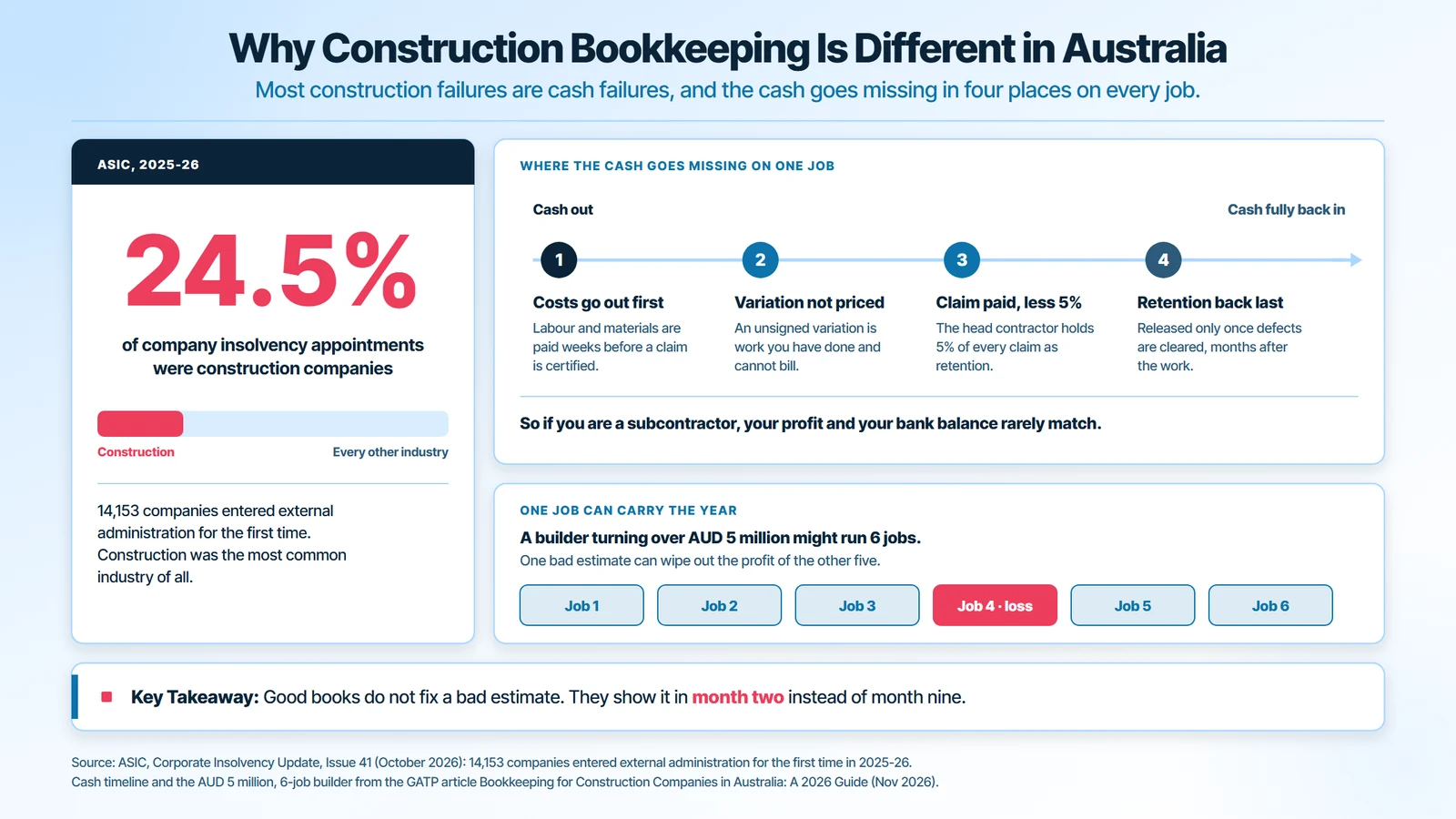
Most of those failures are cash failures, not sales failures, and your books are where you see them coming. Four features of construction work explain why:
- Costs arrive before revenue. Labour and materials are paid weeks before a claim is certified and paid.
- Retention holds back margin. 5 percent of every claim can sit with the head contractor until defects are cleared.
- Variations get done before they get priced. An unsigned variation is unbilled work.
- One job can carry the year. A builder turning over AUD 5 million might run 6 jobs, so one bad estimate wipes out the profit of the rest.
Good bookkeeping does not fix a bad estimate. It shows the problem in month two instead of month nine.
What Changed for Construction Bookkeeping in 2026
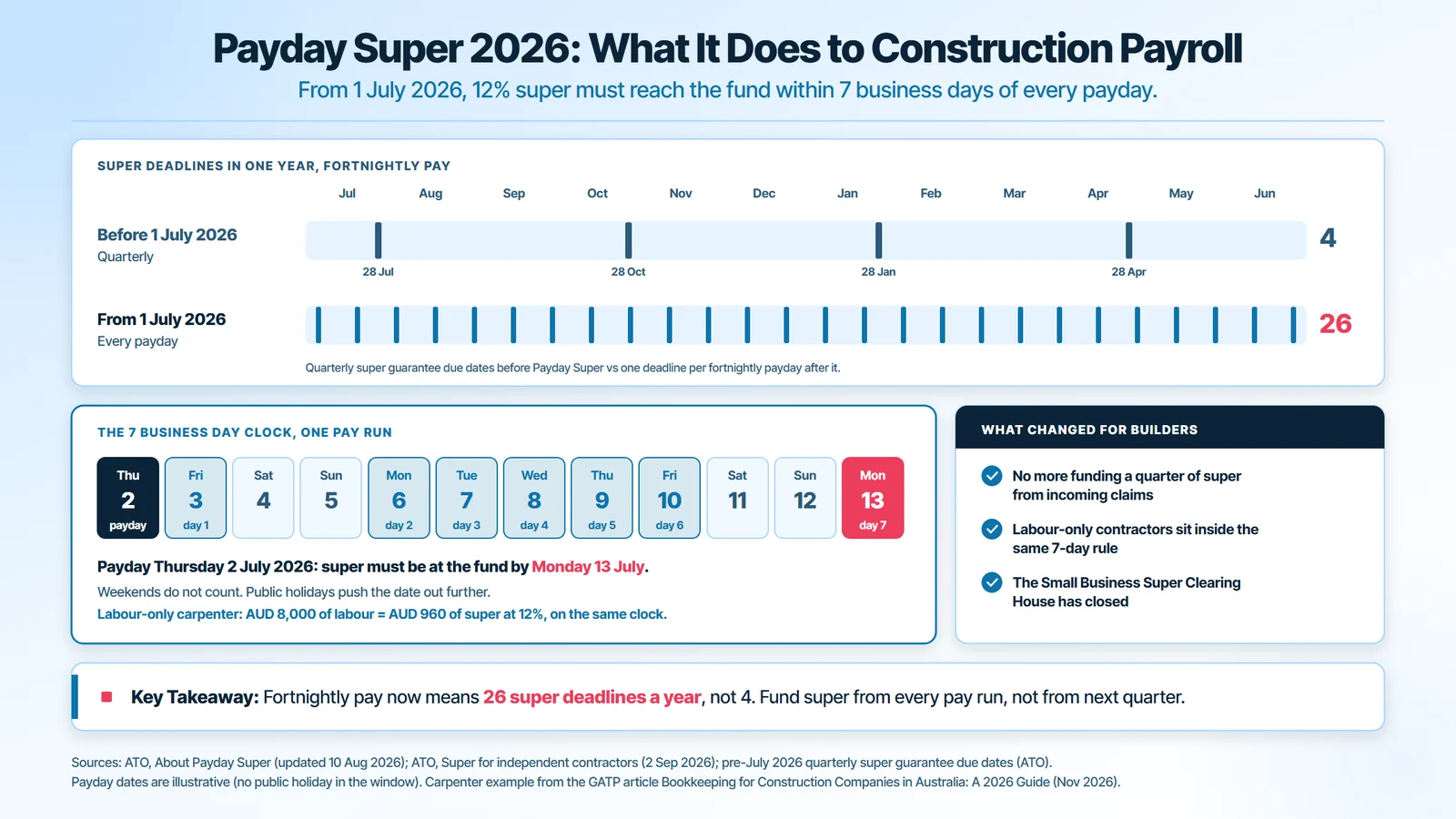
Payday Super is the change that hits construction payroll hardest. From 1 July 2026, the ATO’s Payday Super rules require super to reach the fund within 7 business days after each payday. The rate is 12 percent of qualifying earnings.
- The quarterly super cycle that builders used to fund from incoming claims is gone.
- Labour-only contractors sit inside the same 7 business day rule.
- The Small Business Super Clearing House has closed, so contributions run through payroll software or a commercial clearing house.
How Do You Do Bookkeeping for a Construction Company?
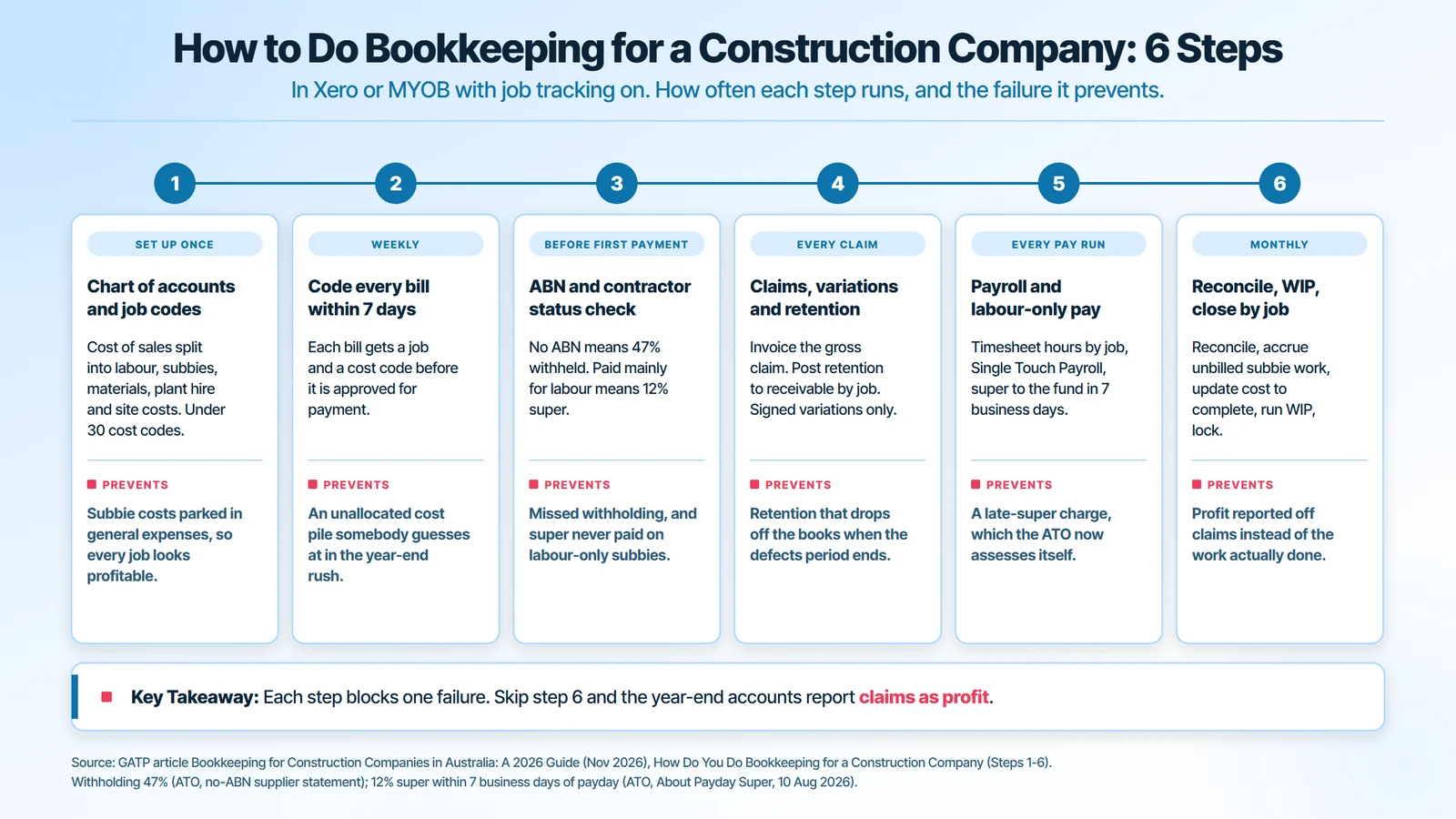
Bookkeeping for a construction company runs in six steps, and each step prevents a specific failure. The steps assume Xero or MYOB with job or project tracking turned on.
Step 1: Set Up a Construction Chart of Accounts and Job Codes
A construction chart of accounts splits cost of sales into labour, subcontractors, materials, plant hire and site costs. Overheads such as the office, vehicles and insurance sit below gross profit.
Create one job per contract and a short list of cost codes, for example site works, structure, services and finishes. Keep it under 30 codes or nobody will code consistently. The failure this prevents: subcontractor costs parked in general expenses, which makes every job look profitable until year-end.
Step 2: Code Every Bill to a Job and Cost Code Within 7 Days
Give every supplier and subcontractor bill a job and a cost code before you approve it for payment. Bank rules can suggest the supplier, but the job allocation needs a person who knows the site.
Code within 7 days of the bill arriving, while the site supervisor still remembers which job the timber went to. The failure this prevents: an unallocated cost pile that someone guesses at during the year-end rush.
Step 3: Check the ABN and Contractor Status Before You Pay a Subcontractor
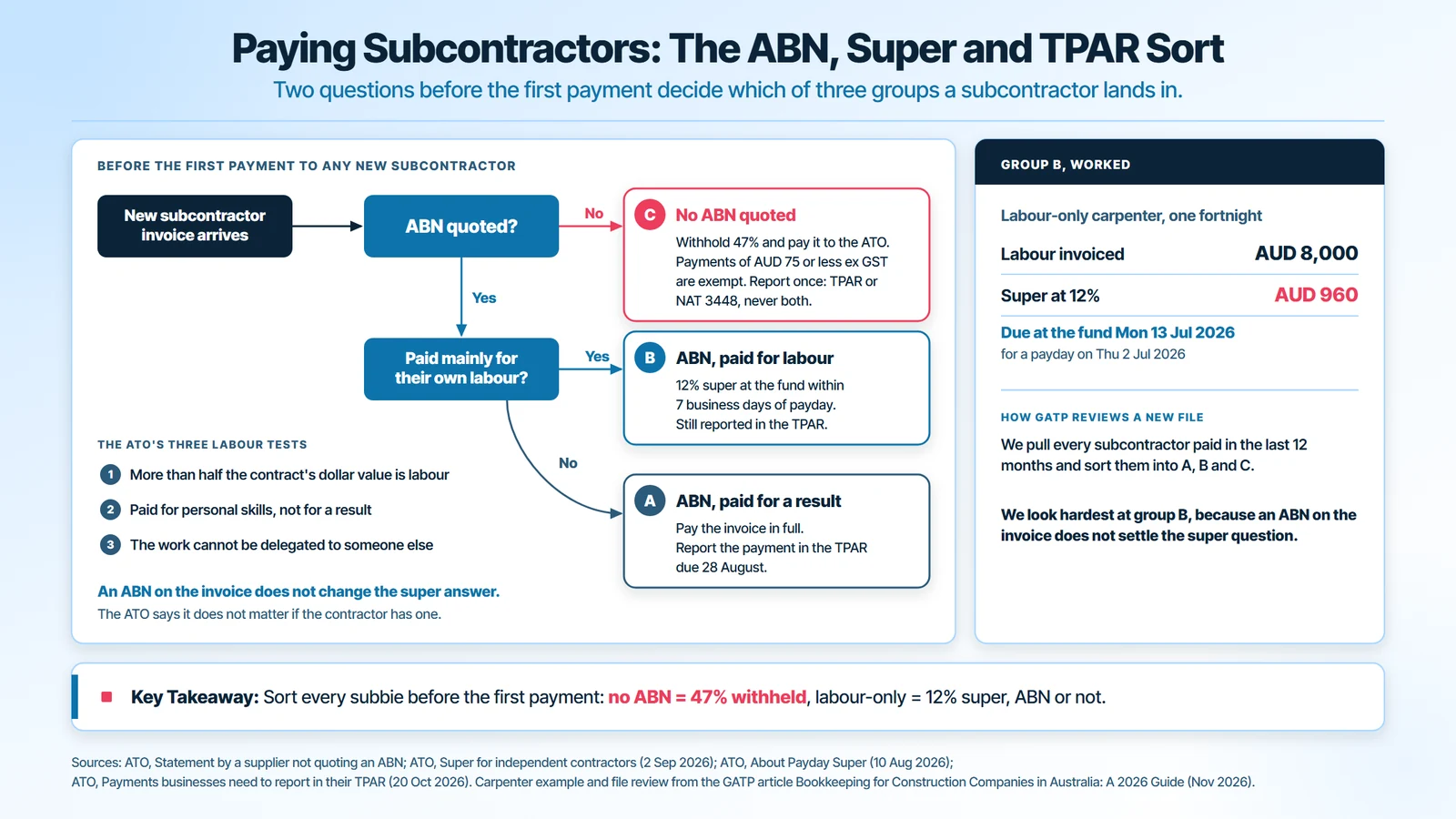
An ABN check and a contractor status check happen once, before the first payment to any new subcontractor. Each check drives a different obligation:
- No ABN quoted: you must withhold 47 percent of the payment, under the ATO’s no-ABN withholding rules. Payments of AUD 75 or less, excluding GST, are exempt.
- Paid mainly for labour: the ATO treats an independent contractor paid mainly for their labour as an employee for super. The tests are that more than half the contract’s dollar value is labour, payment is for personal skills rather than a result, and the work cannot be delegated.
- ABN held: holding an ABN does not change the super answer. The ATO says it does not matter if the contractor has one.
GATP Accountant’s Note: On a new construction file, we pull every subcontractor paid in the last 12 months. We sort them into three groups: ABN and paid for a result, ABN but paid by the hour for their own labour, and no ABN.
The first group goes in the TPAR. The second group needs super, and we look hardest there, because an ABN on the invoice does not settle the super question. The third group needs withholding or an explanation.
The first group goes in the TPAR. The second group needs super, and we look hardest there, because an ABN on the invoice does not settle the super question. The third group needs withholding or an explanation.
Step 4: Record Progress Claims, Variations and Retentions
Raise each progress claim as an invoice for the gross amount of work claimed. Post the retention deducted from it to a retention receivable account by job, rather than netting it off the sale.
Give each variation its own invoice line, and get a signed instruction before you invoice it. Track three balances per job:
- Claimed to date, against the contract value.
- Retention held, usually 5 percent of each claim, with the release dates from the contract.
- Approved but unbilled variations.
The failure this prevents: retention that quietly drops off the books when the defects period ends and nobody claims it.
Step 5: Run Payroll for Construction Workers and Labour-Only Contractors
Payroll for construction allocates every hour to a job through timesheets, so labour cost lands on the right project. Your pay runs report through Single Touch Payroll, and your super follows the Payday Super clock.
A labour-only carpenter who invoices AUD 8,000 of labour in a fortnight needs AUD 960 of super, which is 12 percent, at the fund within 7 business days. Many builders hand this part to payroll outsourcing because the deadline now runs every pay cycle. The failure this prevents: a late-super charge, which the ATO now assesses itself when contributions arrive late.
Step 6: Reconcile, Review WIP and Close the Month by Job
Month-end close for a construction company means you reconcile every account, then compare each job’s cost to date with its budget and claims. Close the month in this order:
- Reconcile bank, credit card and loan accounts.
- Accrue costs for work done but not yet billed by subcontractors.
- Update cost to complete for each job with the site supervisor.
- Run the work in progress schedule and post any over-claimed or under-claimed adjustment.
- Lock the period so nobody edits a closed month.
Keep claims, variations, timesheets and subcontractor records for 5 years, which is the minimum in the ATO’s record-keeping rules.
What Is the Best Accounting Method for a Construction Company?
The best accounting method for a construction company is accrual accounting with a monthly work in progress review. A cash ledger books an AUD 420,000 claim as profit the day it lands, even when the work behind it is months away.
Cash or accrual for GST is a separate choice you make on the BAS with your registered agent. It does not change how your management accounts should read.
What Is Work in Progress (WIP) in Construction Accounting?
Work in progress in construction accounting compares what a job has earned with what it has claimed. Earned revenue is the contract value multiplied by the percentage complete, and percentage complete is cost to date divided by estimated total cost. The comparison gives one of two results:
- Over-claimed: claims exceed earned revenue. The excess is a liability, because the client has paid for work still to come.
- Under-claimed: earned revenue exceeds claims. The gap is an asset, but only if a claim goes out to collect it.
Worked Example: A Progress Claim With 5 Percent Retention and a WIP Check
A builder holds a head contract worth AUD 2,400,000 before GST, with an estimated total cost of AUD 2,000,000. Claim 4 certifies 55 percent of the work. Every figure below is shown so you can rebuild it:
| Line | Working | AUD |
| Claimed to date | 2,400,000 x 55 percent | 1,320,000 |
| Previously claimed | Claims 1 to 3 | 900,000 |
| This claim | 1,320,000 less 900,000 | 420,000 |
| Retention on this claim | 420,000 x 5 percent | 21,000 |
| Cash due on this claim | 420,000 less 21,000 | 399,000 |
| Retention held to date | 1,320,000 x 5 percent | 66,000 |
| Cost to date | From the job ledger | 1,000,000 |
| Percentage complete | 1,000,000 / 2,000,000 | 50 percent |
| Earned revenue | 2,400,000 x 50 percent | 1,200,000 |
| Over-claimed (liability) | 1,320,000 less 1,200,000 | 120,000 |
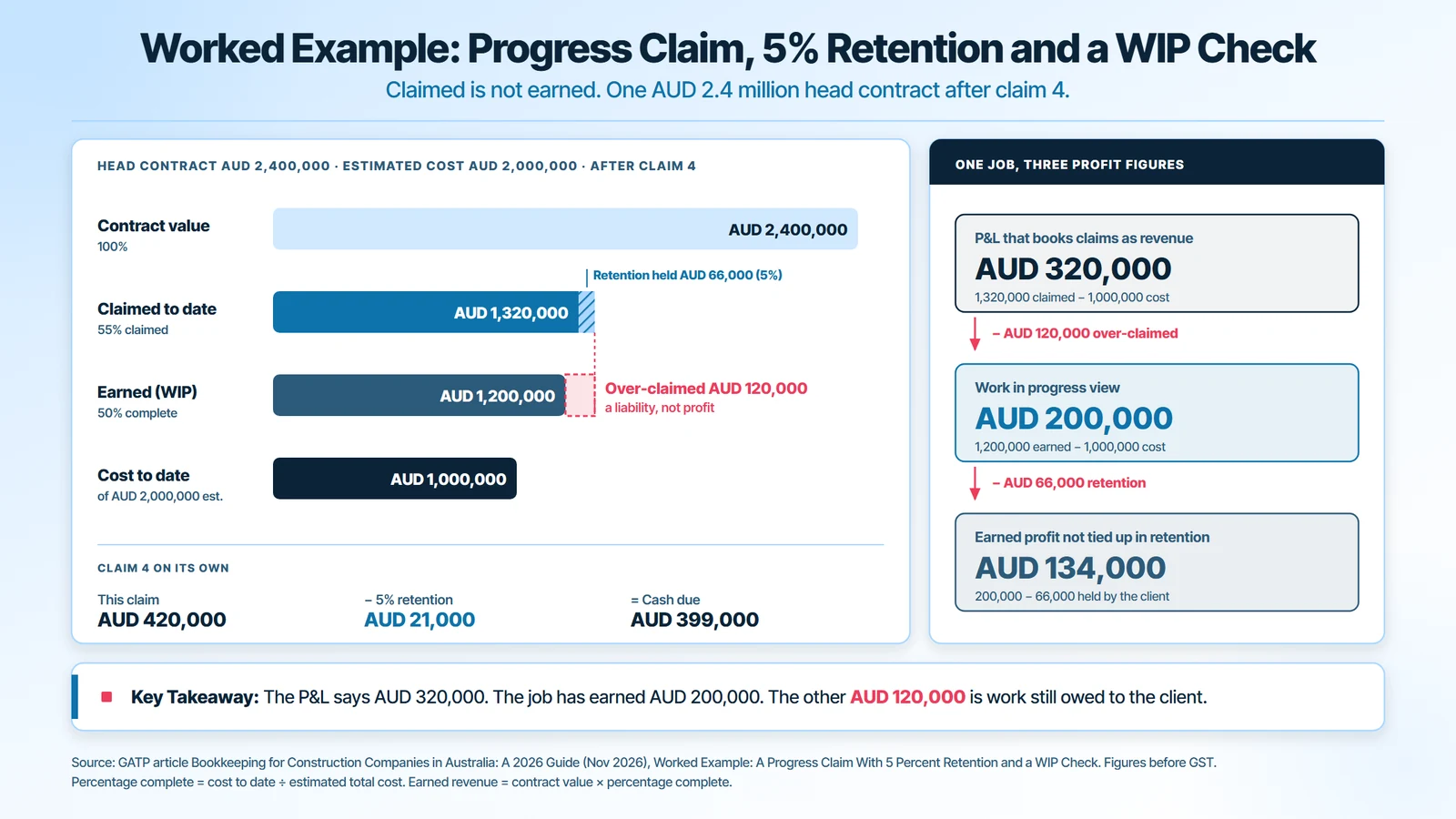
A profit and loss that books all claims as revenue shows AUD 320,000 of profit to date. The work in progress view shows AUD 200,000. The AUD 120,000 difference is work the client has paid for that the builder still has to do. AUD 66,000 of the claimed amount is not in the bank either.
The same logic runs through smaller cases:
- Electrical subcontractor: an AUD 80,000 claim with 5 percent retention brings in AUD 76,000 of cash and AUD 4,000 of retention receivable.
- Labour-only carpenter: an AUD 8,000 labour invoice carries AUD 960 of super.
- TPAR timing: a subcontractor paid on 30 June goes in that year’s TPAR. One paid on 2 July goes in the next year’s report.
Construction Job Costing: How Do You Track Profit on Every Job?
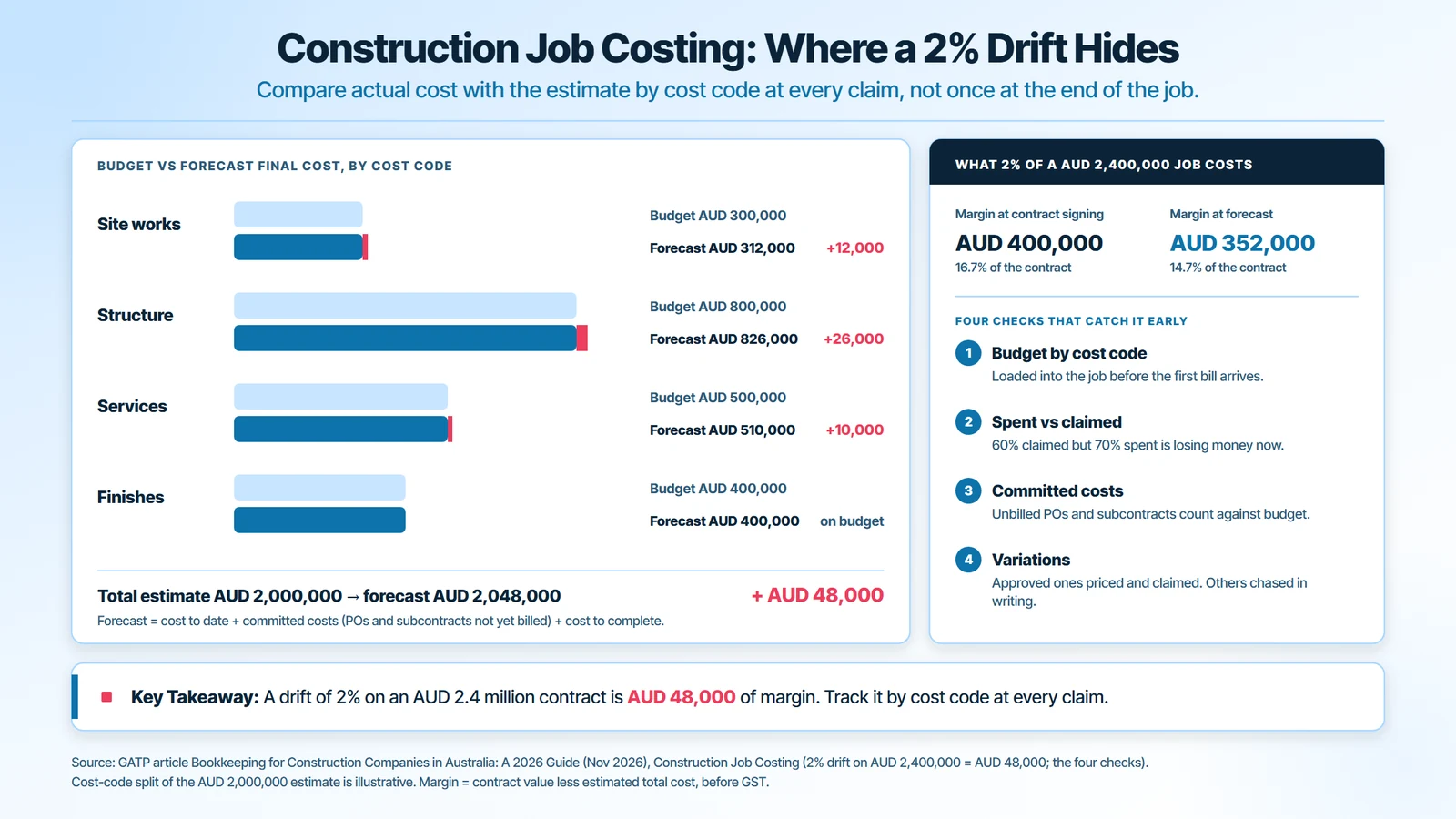
Construction job costing assigns every direct cost to a job and cost code, then compares actual cost with the estimate at each claim. The comparison only works when you load the budget at contract signing. A drift of 2 percent on an AUD 2,400,000 contract is AUD 48,000 of margin. Four checks catch it early:
- Budget by cost code: load the estimate into the job before the first bill arrives.
- Cost to date against claimed percentage: a job 60 percent claimed but 70 percent spent is losing money now.
- Committed costs: purchase orders and subcontracts not yet billed still count against the budget.
- Variations: approved variations get priced and claimed, and unapproved ones get chased in writing.
Does Your Construction Company Need to Lodge a TPAR?
A construction company that pays contractors for building and construction services must lodge a Taxable payments annual report by 28 August each year. The test that applies to you is different from the one most guides quote.
For cleaning, courier, IT and security businesses, the ATO uses a 10 percent income test. The ATO’s building and construction TPAR guidance uses a primarily test instead. You are primarily in building and construction if any of these applies:
- 50 percent or more of your income this financial year comes from building and construction services.
- 50 percent or more of your business activity this year relates to building and construction services.
- 50 percent or more of your income last financial year came from building and construction services.
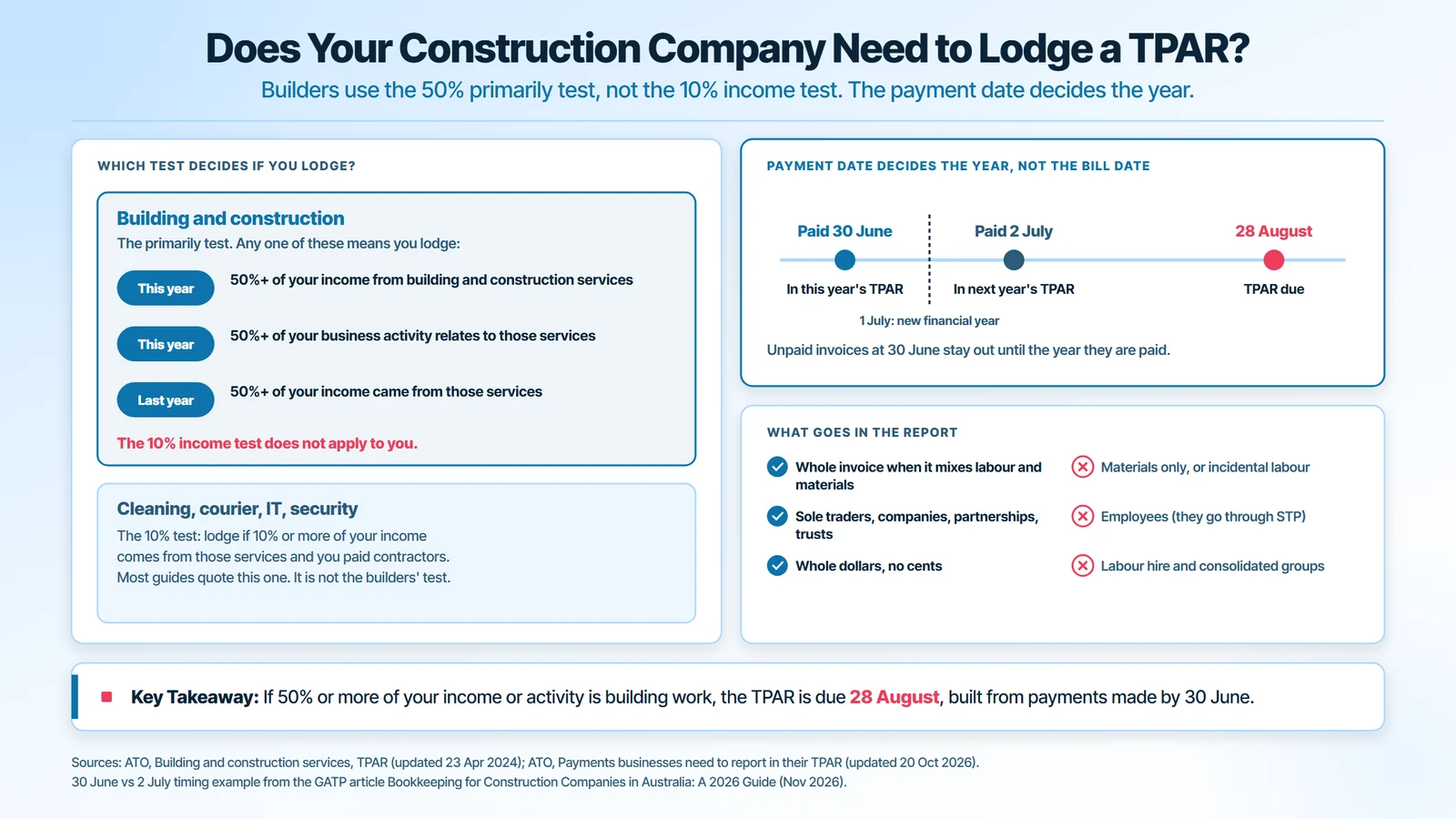
What goes in the report, from the ATO’s list of reportable payments:
| Report | Do not report |
| The total payment when an invoice mixes labour and materials | Payments for materials only, or incidental labour |
| Payments to sole traders, companies, partnerships and trusts | Employees (reported through Single Touch Payroll) |
| Amounts in whole dollars, no cents | Invoices still unpaid at 30 June |
| No-ABN amounts, if not reported on the NAT 3448 form | Labour-hire workers and payments inside a consolidated group |
GATP Accountant’s Note: The TPAR is built from the payment date and the contact record, not the bill date. Before 30 June we check that every subcontractor contact in Xero or MYOB carries an ABN and is flagged as reportable. We then pull payments made on or before 30 June only, and check that no subcontractor appears in both the TPAR and the no-ABN annual report.
How Do You Manage Construction Cash Flow?
Construction cash flow management means forecasting by claim date and payment terms, not by calendar month. A 13-week forecast by job shows you when a slow claim will collide with a pay run. Five habits keep the forecast honest:
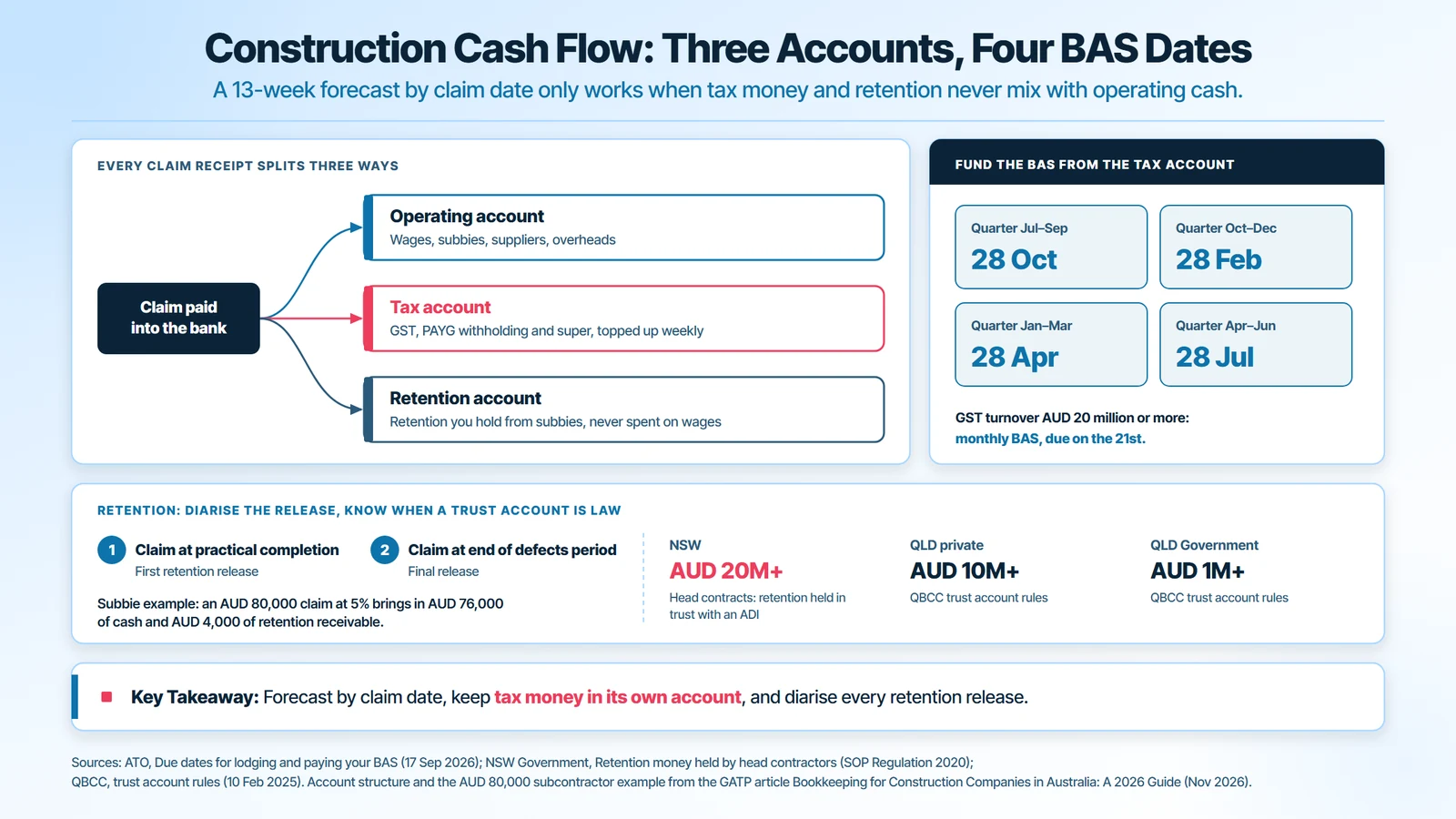
- Use multiple bank accounts: one for operating, one for tax (GST, PAYG withholding and super) and one for retention.
- Fund the BAS from the tax account: quarterly BAS is due 28 October, 28 February, 28 April and 28 July under the ATO’s BAS due dates. At AUD 20 million or more of GST turnover, monthly BAS is due on the 21st.
- Claim on the contract date: a claim sent three days late is paid at least three days late.
- Diarise retention release: claim retention at practical completion and again at the end of the defects period.
- Know whose retention is protected: in New South Wales, head contractors on projects worth AUD 20 million or more hold retention in a trust account with an authorised deposit-taking institution. The rule sits in the Building and Construction Industry Security of Payment Regulation 2020. In Queensland, QBCC trust account rules cover private contracts of AUD 10 million or more and Queensland Government contracts of AUD 1 million or more.
What Is the Best Accounting System for a Construction Company?
The best accounting system for most construction companies turning over AUD 1 million to 10 million is a cloud ledger, usually Xero or MYOB, with job tracking and clean bank feeds. A dedicated construction platform earns its cost when you run many concurrent jobs with formal claims and subcontract packages. Whichever system you pick, check it does six things:
- Tracks every transaction by job and cost code.
- Handles progress claims and retention as separate balances.
- Runs Single Touch Payroll and pays super inside the 7 business day window.
- Flags subcontractor contacts as TPAR-reportable and produces the report.
- Locks closed periods.
- Keeps records retrievable for 5 years.
Common Construction Bookkeeping Mistakes
Common construction bookkeeping mistakes cost margin quietly, and most show up only at year-end. These are the six we check first on any file we take over:
- Booking retention as cash received. Fix: post it to retention receivable by job and diarise the release dates.
- Treating every ABN holder as a contractor. Fix: run the ATO’s three labour tests, then pay 12 percent super where they apply.
- Paying a subcontractor with no ABN in full. Fix: withhold 47 percent, or collect the ABN before payment.
- Leaving variations unbilled. Fix: get the instruction signed and invoice it with the next claim.
- Mixing tax money with operating cash. Fix: a separate tax account funded every week.
- Reporting profit from claims instead of work in progress. Fix: run the WIP schedule monthly and post the over-claimed adjustment.
How Can GATP Help With Bookkeeping for Construction Companies?
GATP runs construction bookkeeping services for Australian builders and trade contractors inside your own Xero, MYOB or QuickBooks file. The work covers job and cost code setup, weekly coding and reconciliation, progress claims and retention ledgers, subcontractor ABN and super checks, payroll and the TPAR file.
Month-end job profit and work in progress reporting sits inside our outsourced accounting services. Our offshore bookkeeping for construction clients works under a registered agent: we prepare the BAS, and your registered agent reviews and lodges it, because GATP is not a registered BAS agent.
The Short Version
- Code every cost, claim and retention to a job, or you cannot see which of your jobs makes money.
- Run work in progress monthly: a job claimed to AUD 1,320,000 but 50 percent complete on cost has AUD 120,000 claimed ahead of the work.
- Lodge the TPAR by 28 August if 50 percent or more of your income or activity is building and construction.
- Pay 12 percent super for labour-only contractors within 7 business days of payday, ABN or not.
- Withhold 47 percent from any subcontractor who has not quoted an ABN.
Conclusion: Bookkeeping for Construction Companies in 2026
Bookkeeping for construction companies works when every cost, claim and retention sits against its job and you run the WIP schedule every month. Build the TPAR due 28 August and 12 percent super paid within 7 business days into your weekly routine. Your decision is whether that routine runs in-house or with a team that already runs construction files.
Find out which of your jobs are making money
Send us your last 12 months of subcontractor payments and your current job list. We will review the ABN and super position, the retention you are owed and how each job reads on a work in progress basis. You get a written summary within 5 business days.
Frequently Asked Questions About Construction Bookkeeping
Does a construction company need to register for GST?
A construction company must register for GST once its GST turnover reaches AUD 75,000, according to the ATO’s GST registration rules. A new business that expects to reach that threshold in its first year registers from the start. Every builder and trade business in the AUD 1 million to 10 million range is well past it.
Do I need a separate bank account for retention money?
A separate retention account is good practice for every builder, and a legal requirement for some. In New South Wales, a head contractor on a project worth AUD 20 million or more must hold subcontractor retention in a trust account. Queensland applies trust accounts to private contracts from AUD 10 million. Below that threshold, a separate account still stops retention you owe being spent on wages.
Is bookkeeping for a small construction business different?
Bookkeeping for small construction business owners uses the same job, retention and subcontractor rules, with fewer jobs. The TPAR, no-ABN withholding and Payday Super apply at any size. What changes is the tooling: a business running 4 or 5 jobs rarely needs more than Xero or MYOB with job tracking.
Do contractors with no ABN go in the TPAR?
Amounts withheld from contractors with no ABN are reported once, either in the TPAR or in the PAYG payment summary form for withholding where no ABN is quoted, NAT 3448. The ATO says to report them in one of the two, not both. Withhold 47 percent from the payment first.
How long should a construction company keep its records?
A construction company should keep business records for at least 5 years. The ATO starts the clock from when the record was made or the transaction was completed, whichever is later. Keep claims, variations, timesheets and subcontractor statements together by job so an ATO review can be answered from one folder.

