
Bookkeeping for construction companies is the recording of every transaction by job: each bill, payroll hour and change order is coded to one contract and one cost code. That job-level ledger feeds progress billing, retainage, certified payroll and the monthly work in progress schedule that shows which jobs make money.
What Is Bookkeeping for Construction Companies?
Bookkeeping for construction companies is the daily and weekly record of a contractor’s money, organized by job instead of by account alone. A retailer asks what the company spent on supplies. A contractor asks what the company spent on supplies for the Main Street job.
That one change runs through every task in construction bookkeeping. The ledger has to answer these questions for every open contract:
- What has this job cost so far, by cost code?
- What have we billed, and how much retainage is the customer holding?
- Which approved change orders are not yet billed?
- Which subcontractors are paid, and which still owe a lien waiver or W-9?
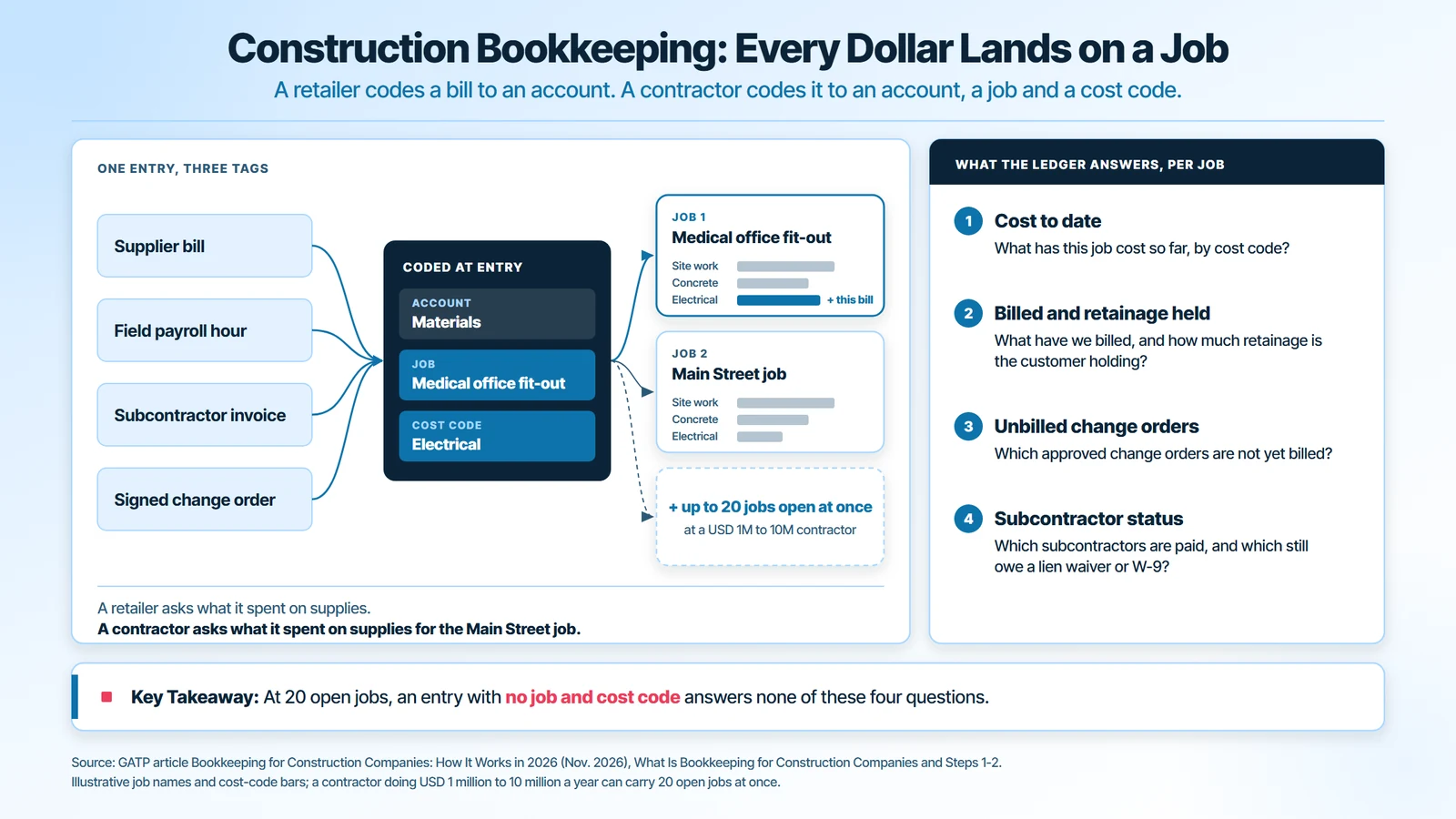
For a contractor doing USD 1 million to 10 million a year, that can mean 20 jobs open at once. The pressure points differ by the kind of contractor you run, and the monthly bookkeeping close has to match them.
Bookkeeping for General Contractors
Bookkeeping for general contractors centers on subcontractor costs and pay applications. Most of the contract value flows through subs, so each sub invoice, retainage hold and lien waiver is tracked by job. The general contractor bills the owner on a schedule of values and pays subs from that cash.
Bookkeeping for Specialty Subcontractors
Contractor bookkeeping for an electrical, mechanical or concrete sub centers on labor. Field payroll is usually the largest cost the sub controls, so hours must land on the right job each week. Subs also carry retainage receivable from the general contractor on almost every job.
Bookkeeping for Remodelers and Home Builders
Remodelers run many short jobs at once, often with customer deposits taken before work starts. Those deposits are a liability until earned. Home builders add construction loan draws, which are borrowed money and never revenue.
How Is Construction Accounting Different?
Construction accounting is different because profit is earned job by job over months, while cash arrives on a billing schedule that rarely matches the work. A normal business records a sale when it delivers. A contractor earns revenue as the job progresses.
The gap shows up in six places. Here is how the books of a typical business compare with a construction company:
| Area | Typical business | Construction company |
| Revenue | Recorded at the sale | Earned as the job progresses, checked on a WIP schedule |
| Costs | By account | By account, job and cost code |
| Billing | One invoice per sale | Progress billing on a schedule of values |
| Receivables | Due in full | Part held back as retainage until completion |
| Payroll | Company-wide expense | Allocated to jobs, certified weekly on public work |
| Contract changes | Rare | Change orders revise price and budget mid-job |
Each row needs its own account or report. The next two sections cover the method question and the rules that moved this year.
What Kind of Accounting Do Construction Companies Use?
Construction companies use accrual accounting with job costing, and they recognize contract revenue either over the life of the job or at completion. The method depends on the contract and the size of the company.
- Job costing: every cost is assigned to a contract and cost code, so each job has its own profit and loss.
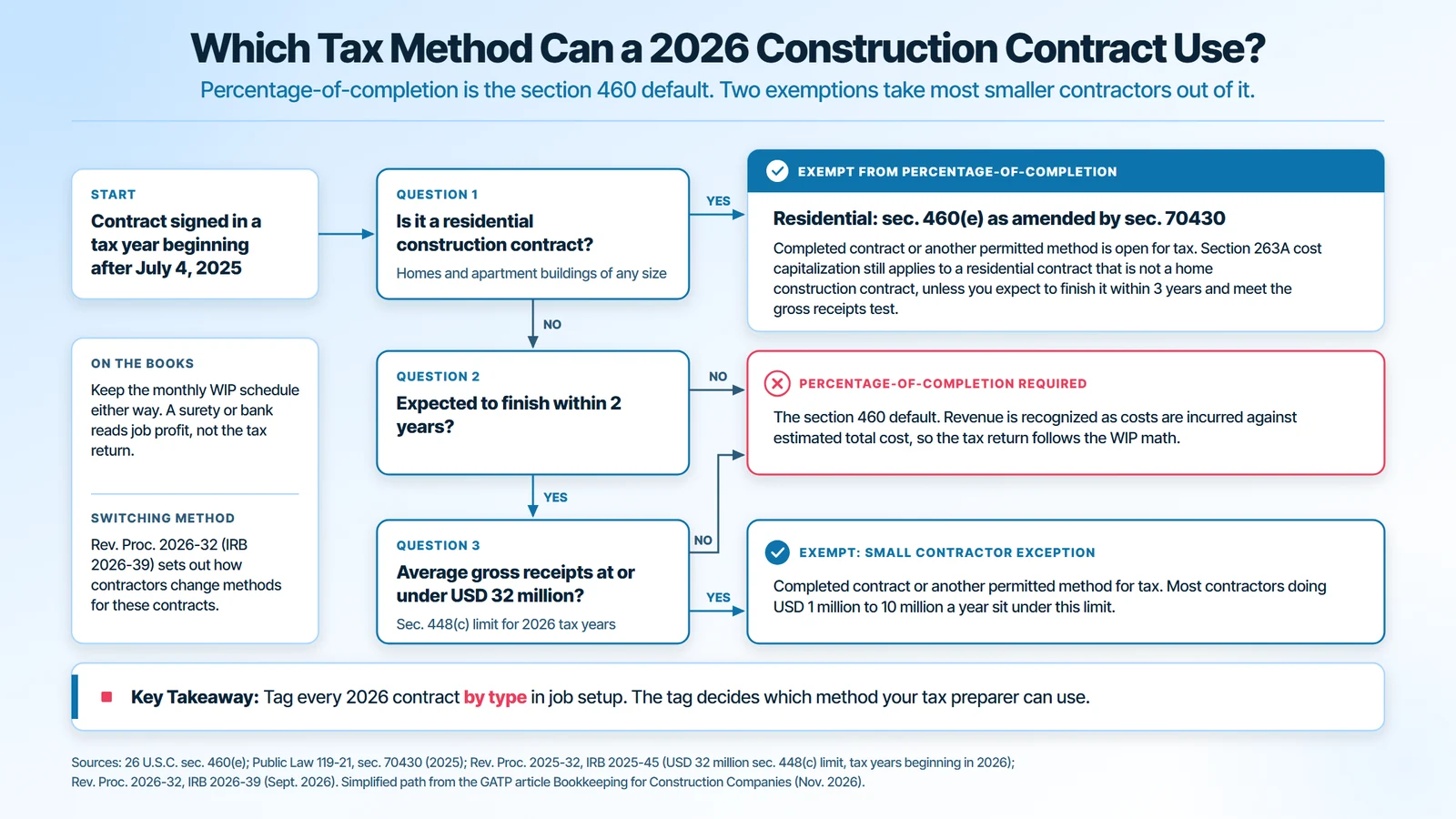
- Percentage-of-completion: revenue is recognized as costs are incurred against the estimated total cost. Section 460 makes this the default tax method for long-term contracts.
- Completed contract: revenue and cost are recognized when the job finishes. For tax, it is open to exempt contracts.
- Small contractor exemption: a contract you expect to finish within 2 years is exempt from percentage-of-completion for tax when average gross receipts are at or under the section 448(c) limit. That limit is USD 32 million for tax years beginning in 2026, under Proc. 2025-32.
Most contractors doing USD 1 million to 10 million a year sit under that limit. They still keep a WIP schedule, because a surety or bank reads job profit, not the tax return.
What Changed for Construction Bookkeeping in 2026
Two federal changes reach construction books in 2026. Both came from Public Law 119-21, enacted July 4, 2025.
- The 1099 threshold rose. Under the IRS Form 1099-NEC guidance, payments of USD 2,000 or more made after December 31, 2025 need a form, up from USD 600. Section 70433 indexes that figure for inflation after 2026.
- All residential contracts are now exempt. Section 70430 of Public Law 119-21 extends the percentage-of-completion exception from home construction contracts to every residential construction contract, including apartment buildings of any size. It applies to contracts entered into in tax years beginning after July 4, 2025. Section 263A cost capitalization still applies to a residential contract that is not a home construction contract, unless you expect to finish it within 3 years and meet the gross receipts test.
- The IRS issued the change procedure. Proc. 2026-32, in Internal Revenue Bulletin 2026-39, sets out how contractors switch methods for those contracts.
Tag every 2026 contract by type in the job setup. The tag decides which revenue method your tax preparer can use.
What Does a Construction Bookkeeper Do?
A construction bookkeeper records every transaction against the right job, keeps subcontractor and payroll records compliant, and hands the accountant clean job cost data each month. When you hire a bookkeeper for a construction company, this is the weekly and monthly scope to expect:
- Weekly: code bills and receipts to job and cost code, enter subcontractor invoices with retainage, collect W-9 forms before first payment, post payroll by job, and prepare certified payroll on public work.
- Each billing cycle: prepare the pay application, track approved change orders, and record retainage receivable.
- Monthly: reconcile bank and credit card accounts, review accounts payable and receivable aging by job, and update the job cost report.
- For the accountant: cost-to-date figures for the WIP schedule, plus a list of open items only the owner can answer.
In 2026, that includes tracking each subcontractor against the USD 2,000 Form 1099-NEC threshold. A construction bookkeeper does not set the revenue method or estimate cost to complete. Those belong to the accountant and the project manager. The bookkeeper’s job is a ledger they can trust without re-checking it.
How Do You Do Bookkeeping for a Construction Company?
You do bookkeeping for a construction company by setting up jobs and cost codes first, then coding every cost, bill and payroll hour to them. Six steps, in this order, keep the ledger usable all year.
Step 1: Build a Construction Accounting Chart of Accounts
A construction accounting chart of accounts adds the balance sheet and cost accounts that construction work needs. Without them, retainage and overbillings hide inside ordinary receivables and payables.
- Assets: retainage receivable, costs and estimated earnings in excess of billings (underbillings).
- Liabilities: retainage payable, billings in excess of costs (overbillings), customer deposits.
- Cost of revenue: direct labor, materials, subcontractors, equipment and other direct job costs.
- Overhead: office payroll, rent, insurance and software, kept apart from job cost. Allocate it to jobs in a separate report with one rate, such as overhead divided by direct labor cost, so bids carry their share.
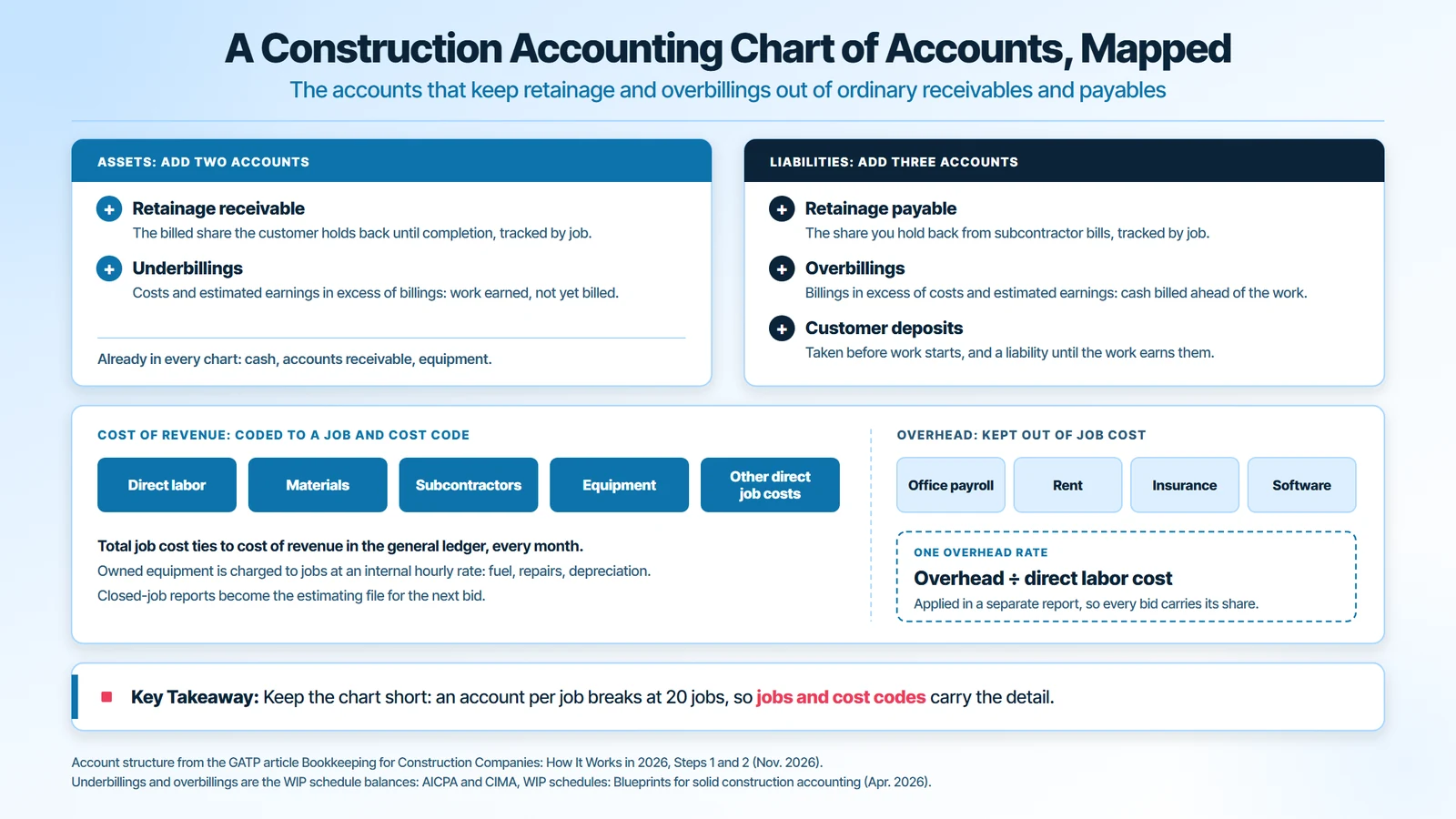
Keep the chart short and let jobs and cost codes carry the detail. A chart with an account per job breaks the first time you run 20 jobs.
Step 2: Open a Job and Assign Construction Accounting Cost Codes
Construction cost accounting starts with one job per contract and one standard cost code list for every job. Use the same codes as your estimates, such as site work, concrete, framing and electrical. Job costing construction work only helps when the estimate and the actual cost use the same codes.
Load the original contract amount and budget by cost code when the job opens. That is the baseline every change order and job cost report measures against.
Charge owned equipment to jobs at an internal hourly rate, so an excavator’s fuel, repairs and depreciation reach the jobs that used it. Closed-job reports then become your estimating file for the next bid.
Step 3: Code Subcontractor Bills and Change Orders to the Job
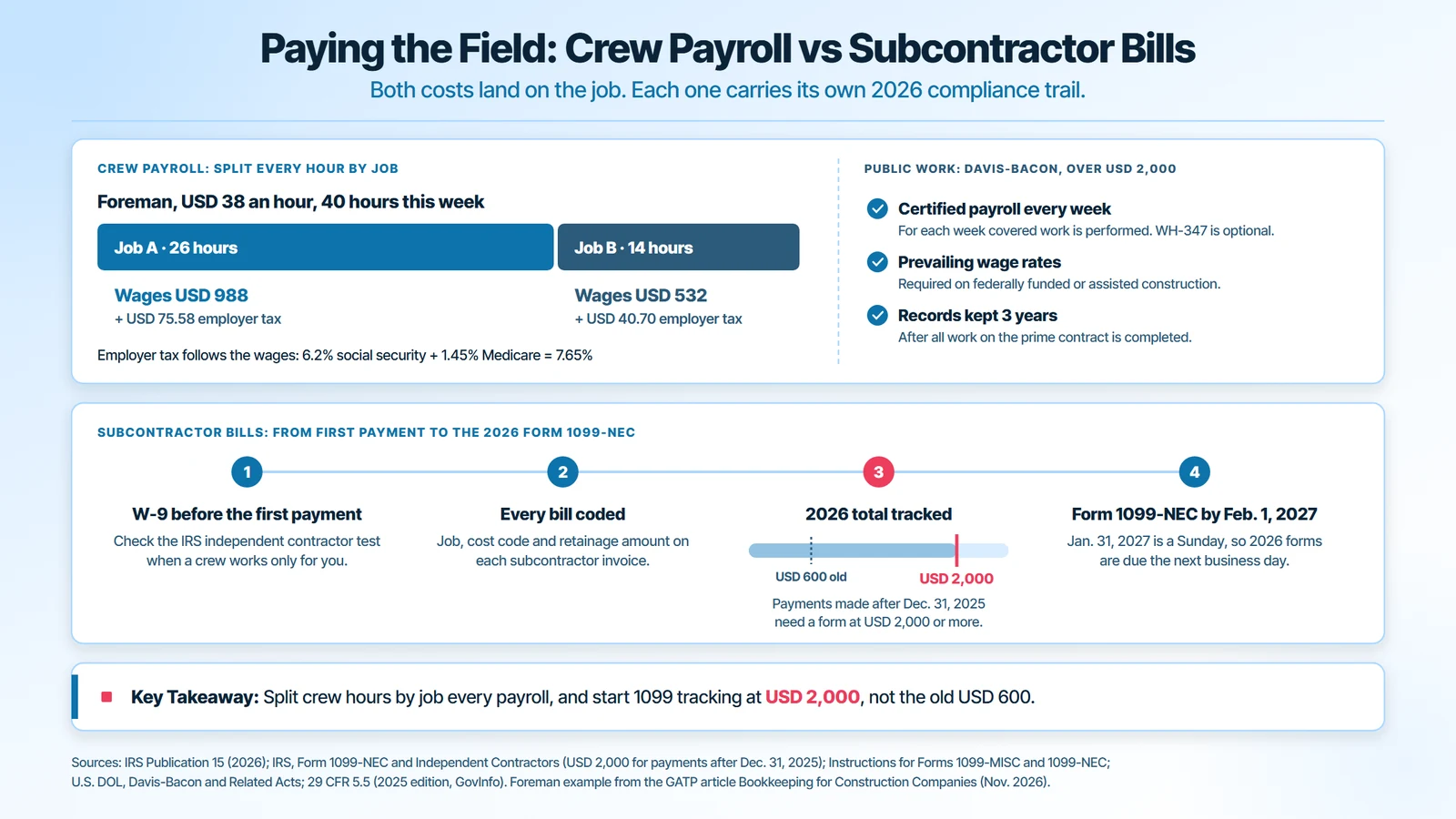
Every subcontractor bill is coded to a job, a cost code and a retainage amount. Collect a W-9 before the first payment, and check classification against the IRS independent contractor test when a crew works only for you.
Form 1099-NEC is due January 31, under the Instructions for Forms 1099-MISC and 1099-NEC. Track 2026 totals against the USD 2,000 threshold during the year.
Change orders get the same discipline. Record each approved change order as a revision to contract price and budget on the day it is signed. An unbilled change order is earned money nobody is collecting.
Step 4: Bill on Progress With AIA Billing and Retainage
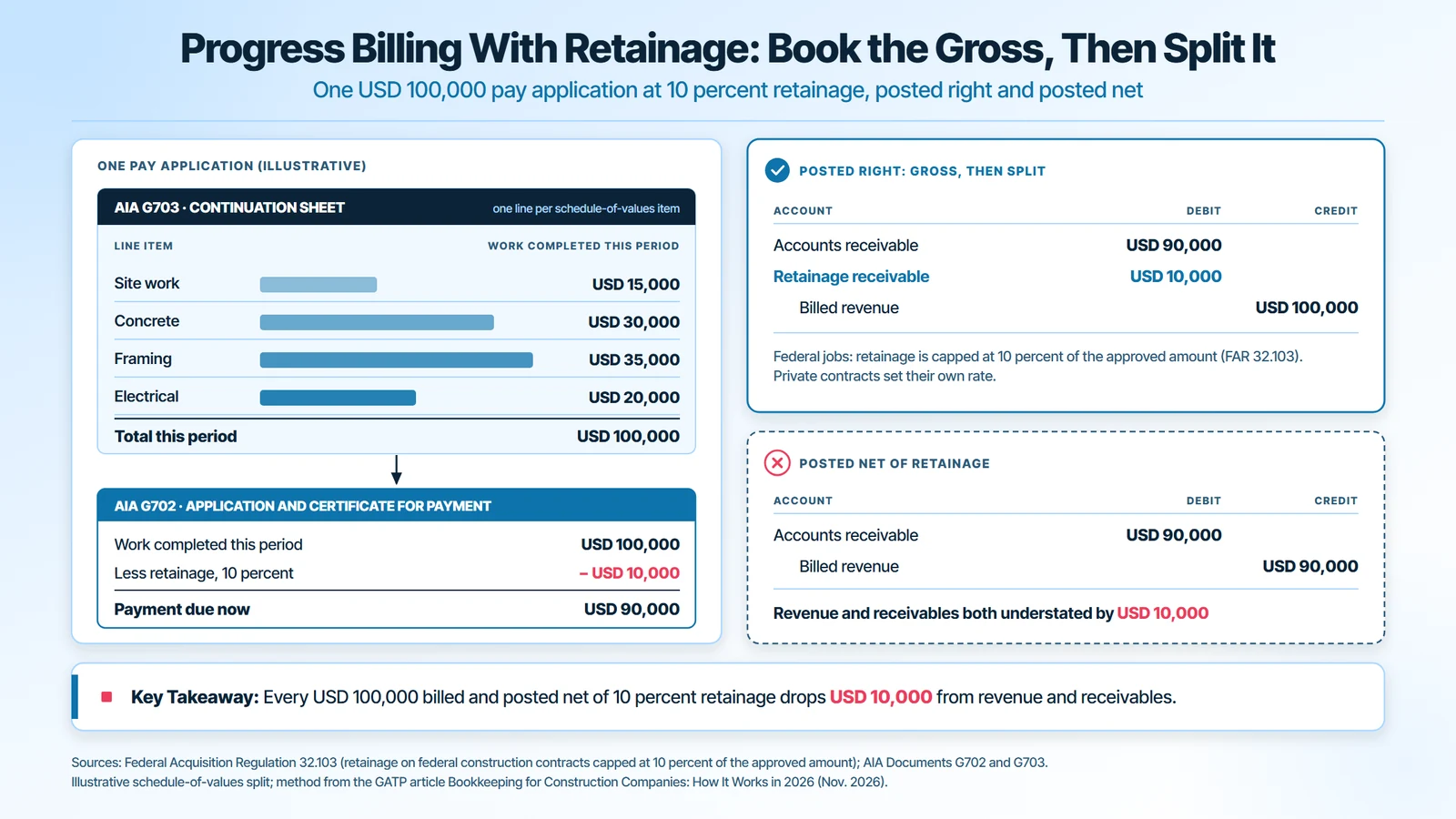
Progress billing is invoicing a share of the contract each period, based on work completed against a schedule of values. Many owners require AIA billing: Form G702, the application and certificate for payment, with G703, the continuation sheet listing each line.
Retainage is the share the customer holds back until completion. Under FAR 32.103, retainage on federal construction contracts cannot exceed 10 percent of the approved amount. Private contracts set their own rate. Record the gross billing in receivables, then move the held share to retainage receivable.
Step 5: Handle Construction Payroll Accounting by Job
Construction payroll accounting allocates every field hour to a job and cost code. A foreman paid USD 38 an hour who works 26 hours on Job A and 14 on Job B puts USD 988 and USD 532 of wages on those jobs. Employer payroll tax follows the wages: 6.2 percent social security and 1.45 percent Medicare under IRS Publication 15.
Public work adds certified payroll. The Davis-Bacon and Related Acts cover federally funded or assisted construction contracts over USD 2,000 and require prevailing wage rates.
- Submit certified payroll weekly for every week covered work is performed.
- Optional Form WH-347 or any other format meets the requirement.
- Keep payroll records for at least 3 years after all work on the prime contract is completed, under 29 CFR 5.5.
Step 6: Reconcile and Close the Month by Job
Reconcile every bank, credit card and loan account monthly. Then tie the job cost report to the general ledger, so total job cost equals cost of revenue.
Review accounts payable and receivable aging by job, with retainage split out. Clear the uncategorized accounts before the close, not after it. The close ends with cost-to-date by job, which is the input to the WIP schedule.
How to Do Accounting of a Construction Company?
You do accounting for a construction company by turning the job cost ledger into earned revenue each month through a WIP schedule. WIP construction accounting compares what each job has earned with what it has billed. The AICPA and CIMA note WIP schedules are commonly updated monthly.
- Pull the contract price, including approved change orders, for each open job.
- Update the estimated total cost with the project manager.
- Divide cost to date by estimated total cost to get percent complete.
- Multiply percent complete by contract price to get earned revenue.
- Compare earned revenue with billings to date.
- Book the difference as an overbilling liability or an underbilling asset.
Here is one job from a contractor doing USD 4.8 million a year, a medical office fit-out:
| WIP line | Amount | How it is worked out |
| Contract price | USD 1,200,000 | Signed contract plus approved change orders |
| Estimated total cost | USD 960,000 | Project manager’s current estimate |
| Cost to date | USD 576,000 | Job cost report at month end |
| Percent complete | 60 percent | 576,000 divided by 960,000 |
| Earned revenue | USD 720,000 | 60 percent of 1,200,000 |
| Billed to date | USD 780,000 | Pay applications issued |
| Overbilling | USD 60,000 | 780,000 minus 720,000, booked as a liability |
| Gross profit earned | USD 144,000 | 60 percent of the USD 240,000 expected profit |
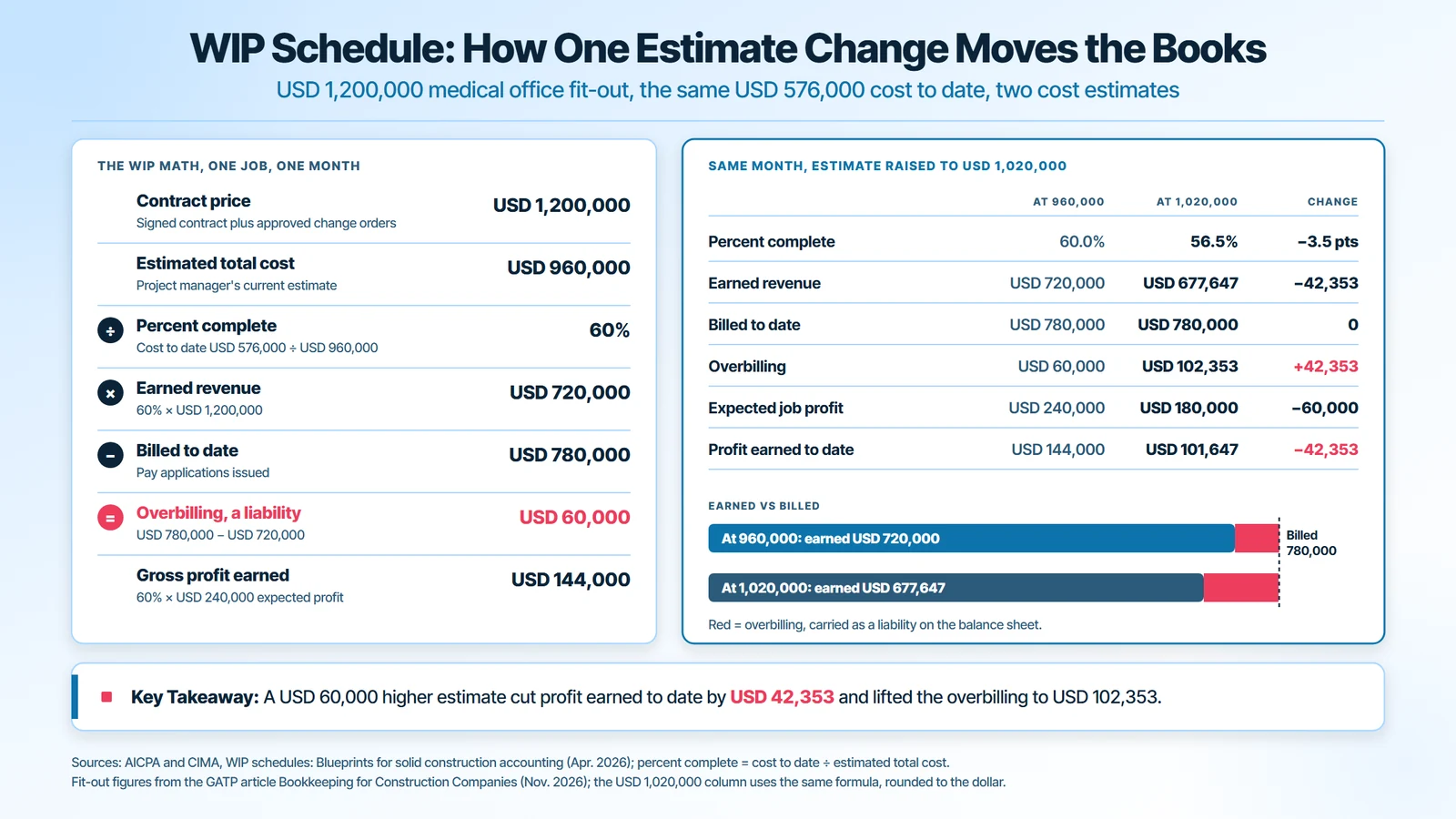
If the estimate rises to USD 1,020,000, expected profit drops to USD 180,000. The WIP schedule shows that loss in the month the estimate moves, not at closeout.
GATP Accountant’s Note: On contractor files, the first thing we check is retainage receivable by job against the customer’s latest pay application. When the two disagree, the cause is usually a payment posted net of retainage, so revenue and receivables are both understated. Fixing that one entry often moves the overbilling figure on the WIP schedule too.
How Do You Manage Construction Cash Flow Accounting?
You manage construction cash flow accounting by tracking three numbers apart from profit: retainage held, overbillings and unbilled change orders. A job can show profit on the WIP schedule and still drain cash.
Take the fit-out job above. If the owner holds 10 percent retainage on USD 780,000 billed, USD 78,000 sits with the customer. The most the contractor can have collected is USD 702,000, while USD 60,000 of that cash is an overbilling not yet earned.
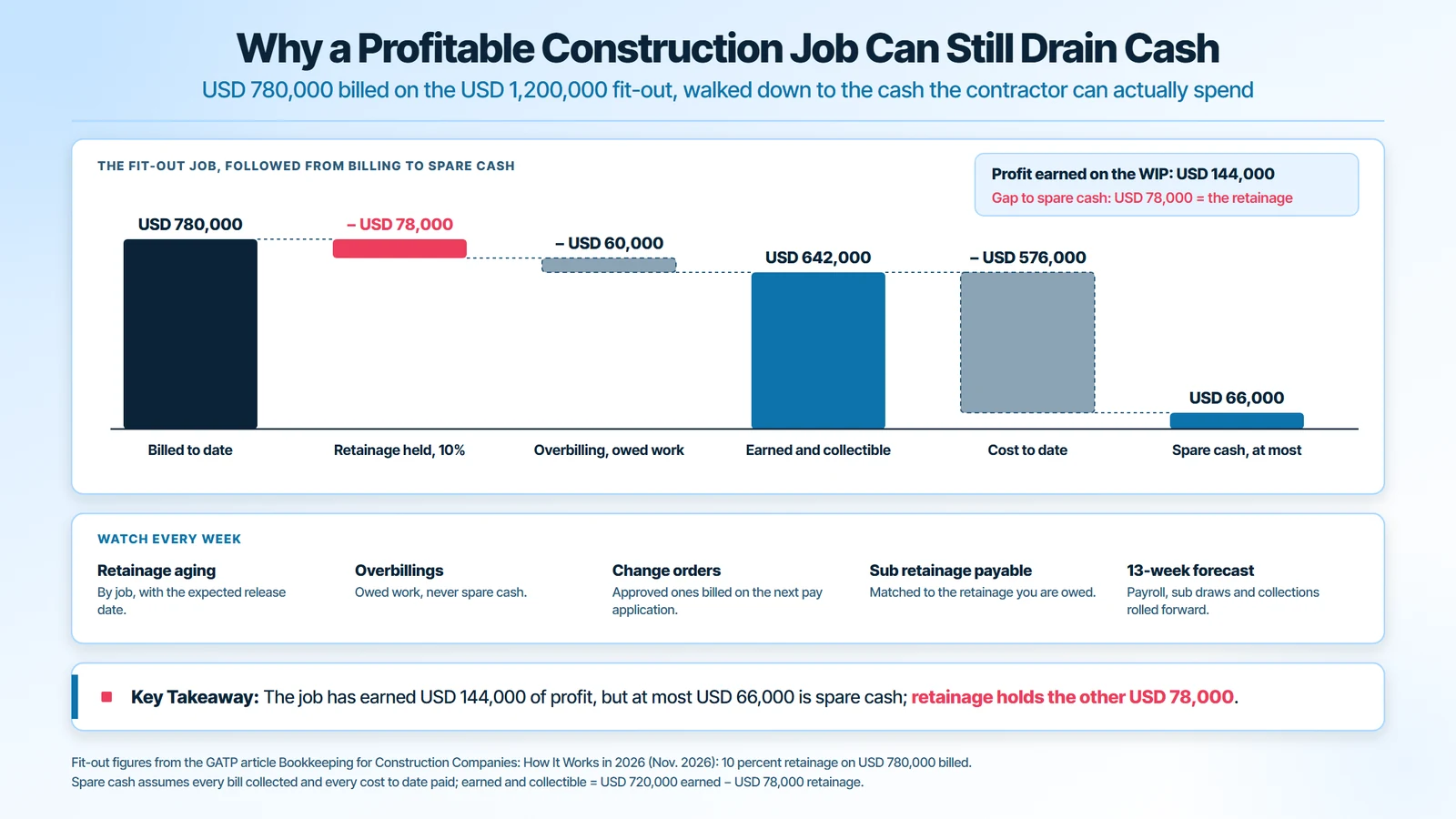
- Retainage aging: list retainage receivable by job with the expected release date.
- Overbillings: treat overbilled cash as owed work, not spare cash.
- Change orders: bill approved changes on the next pay application.
- Payables timing: match subcontractor retainage payable to the retainage you are owed.
- Construction cash flow forecast: roll payroll, sub draws and expected collections forward 13 weeks.
Payroll is weekly and owner payments are monthly or slower. That timing gap is why profitable contractors run short of cash.
How Do You Reduce Bookkeeping Errors in Construction?
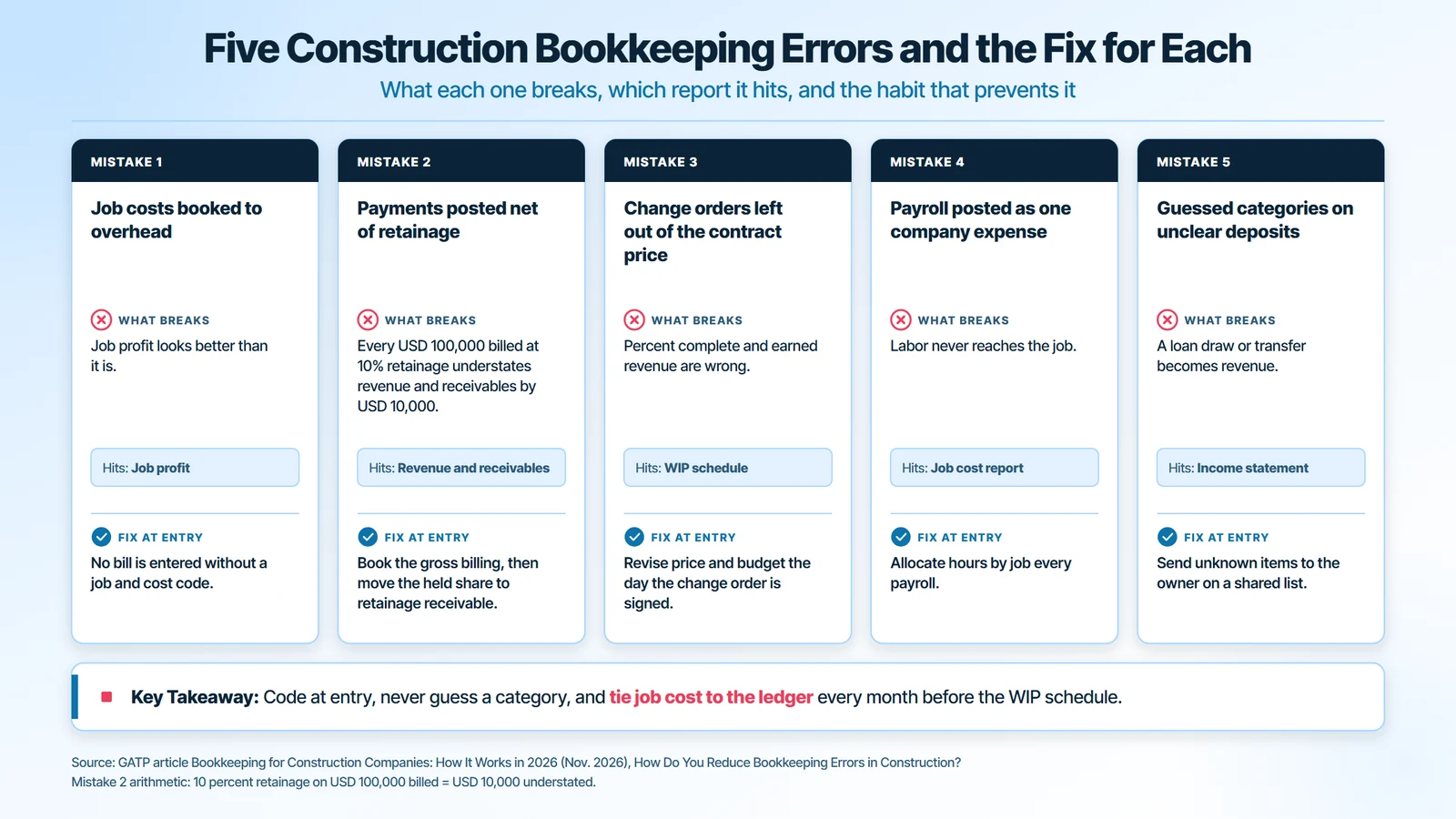
You reduce bookkeeping errors in construction by coding at entry, never guessing a category, and reconciling job cost to the ledger every month. These five mistakes cause most of the rework we see:
- Mistake 1: Job costs booked to overhead. Job profit looks better than it is. Fix: no bill is entered without a job and cost code.
- Mistake 2: Payments posted net of retainage. At 10 percent retainage, every USD 100,000 billed understates revenue and receivables by USD 10,000. Fix: book the gross billing, then move the held share to retainage receivable.
- Mistake 3: Change orders left out of the contract price. Percent complete and earned revenue are wrong. Fix: revise price and budget when the change order is signed.
- Mistake 4: Payroll posted as one company expense. Labor never reaches the job. Fix: allocate hours by job each payroll.
- Mistake 5: Guessed categories on unclear deposits. A loan draw or transfer becomes revenue. Fix: send unknown items to the owner on a shared list.
That last fix is the weekly routine GATP runs for a multi-entity home builder, where unplaced items wait on a shared uncategorized sheet instead of a guessed account. If several of these have built up, a QuickBooks cleanup resets the ledger before year end.
Should I Outsource My Construction Bookkeeping?
You should outsource your construction bookkeeping when the work needs construction skills nobody in-house has, or when one person’s absence would stop billing. Keep it in-house when you already run a trained construction bookkeeper and the volume fills the role.
For cost, the BLS reports a median bookkeeper wage of USD 50,670 in May 2025, in its Occupational Outlook Handbook. Add the 7.65 percent employer payroll tax and the cost is about USD 54,546 before benefits and software. Our guide to what a bookkeeper costs compares the models.
| Factor | In-house bookkeeper | Outsourced construction bookkeeping |
| Cost base | Salary, payroll tax, benefits, software | Monthly fee scoped to volume |
| Construction skills | Depends on the hire | WIP, retainage and certified payroll from a team |
| Coverage | One person, one point of failure | A team covers absences |
| Review | Owner reviews | Second-level review by an accountant |
You probably need outsourced help if:
- billing waits on one person every month;
- nobody prepares a WIP schedule, or the bank asks for one you cannot produce;
- you have public work and certified payroll is done at the last minute.
We recommend outsourcing when two of the three are true. One trained hire rarely covers bookkeeping, WIP and certified payroll alone.
How Can GATP Help With Bookkeeping for Construction Companies?
GATP provides bookkeeping for construction companies through its outsourced bookkeeping services, with a named professional bookkeeper on every account. The work covers transaction coding by job and cost code, monthly bank reconciliations, accounts payable and receivable, and the monthly financial statements.
For contractors, the team sets up retainage and overbilling accounts, tracks subcontractor W-9 forms and 1099 totals, and delivers cost-to-date by job for the WIP schedule. Unclear items go to the owner on a shared list. The service page lists support for QuickBooks, Xero and Sage.
The Short Version
- Code every bill, payroll hour and change order to a job and cost code at entry.
- Billing is not revenue: earned revenue comes from percent complete on the WIP schedule.
- Track retainage receivable and payable by job, with the 10 percent federal cap in mind.
- Use the 2026 USD 2,000 threshold for Form 1099-NEC and file certified payroll weekly on Davis-Bacon work.
- Reconcile monthly and tie job cost to the general ledger before the WIP schedule.
Conclusion
Bookkeeping for construction companies works when every cost reaches a job, so the WIP schedule shows real profit, like the USD 144,000 earned on the fit-out example. Your decision is whether that routine runs inside the company or with a team that runs it every week.
See what each job actually earned
We review your job cost report, retainage balances and last pay applications against the ledger. You get back a list of miscoded costs, missing retainage and unbilled change orders, with corrected profit by job, within a week of file access.
Frequently Asked Questions About Construction Bookkeeping
What Is the Best Bookkeeping Software for Construction Companies?
The best bookkeeping software for construction companies is the one that tracks jobs, cost codes and retainage, and connects to your payroll. Smaller contractors often run QuickBooks Online with jobs and classes. Larger firms move to construction systems such as Sage or Foundation. Setup matters more than the brand: one job per contract and one cost code list.
How Much Should You Pay Someone to Do Your Bookkeeping?
A full-time bookkeeper earned a median of USD 24.36 an hour, or USD 50,670 a year, in May 2025, according to the BLS. Add employer payroll tax and benefits on top. A construction company also needs WIP, retainage and certified payroll skills, which usually cost more than general bookkeeping.
What Is the Best Multi-Entity Accounting for Construction?
The best multi-entity accounting for construction keeps a separate ledger for each legal entity and books intercompany charges to due-to and due-from accounts. A transfer between related companies is never revenue. Reconcile the intercompany balances monthly so they net to zero, then combine the entities for the owner and the bank.
Is AI Replacing Bookkeepers?
AI is not replacing construction bookkeepers, because software cannot know which job a lumber receipt or deposit belongs to without context from the field. AI tools speed up bank feeds and receipt matching. The judgment calls still need a person: job coding, retainage, change orders and the open questions only the owner can answer.
How Long Should a Construction Company Keep Payroll Records?
A construction company on Davis-Bacon work keeps payroll records for at least 3 years after all work on the prime contract is completed. For tax records in general, the IRS period is 3 years in most cases. Keep timecards, certified payrolls, W-9 forms and job cost reports together by job.

