
Bookkeeping services for homebuilders are monthly accounting work organized around each house: costs coded to a lot, loan draws and buyer deposits kept off revenue, and each home moved to cost of sales at closing. For a builder doing USD 1 million to 10 million a year, that structure shows you the true margin on every house.
What Do Bookkeeping Services for Homebuilders Cover?
Bookkeeping services for homebuilders cover the recording, coding and reconciling of every dollar a residential builder spends or receives, tracked by house. The house ledger is where you make or lose money.
Most guides on bookkeeping for small construction business owners stop at job costing. A homebuilder needs more than that, because lenders, buyers and subcontractors all touch the same house.
Here is the work a homebuilder bookkeeping service should include every month:
- Job costing by lot: every bill coded to one house and one cost code, such as site work, framing or finishes.
- Construction in progress: house costs held on the balance sheet until the home closes.
- Construction loan tracking: each draw recorded against the loan, with interest and fees split out.
- Buyer deposits: earnest money and option deposits held as a liability until settlement.
- Subcontractor compliance: W-9 forms on file and Form 1099-NEC totals tracked through the year.
- Closings: each settlement statement booked line by line, then the house relieved to cost of sales.
- Reconciliations: bank, card and loan statements matched to the ledger every week or month.
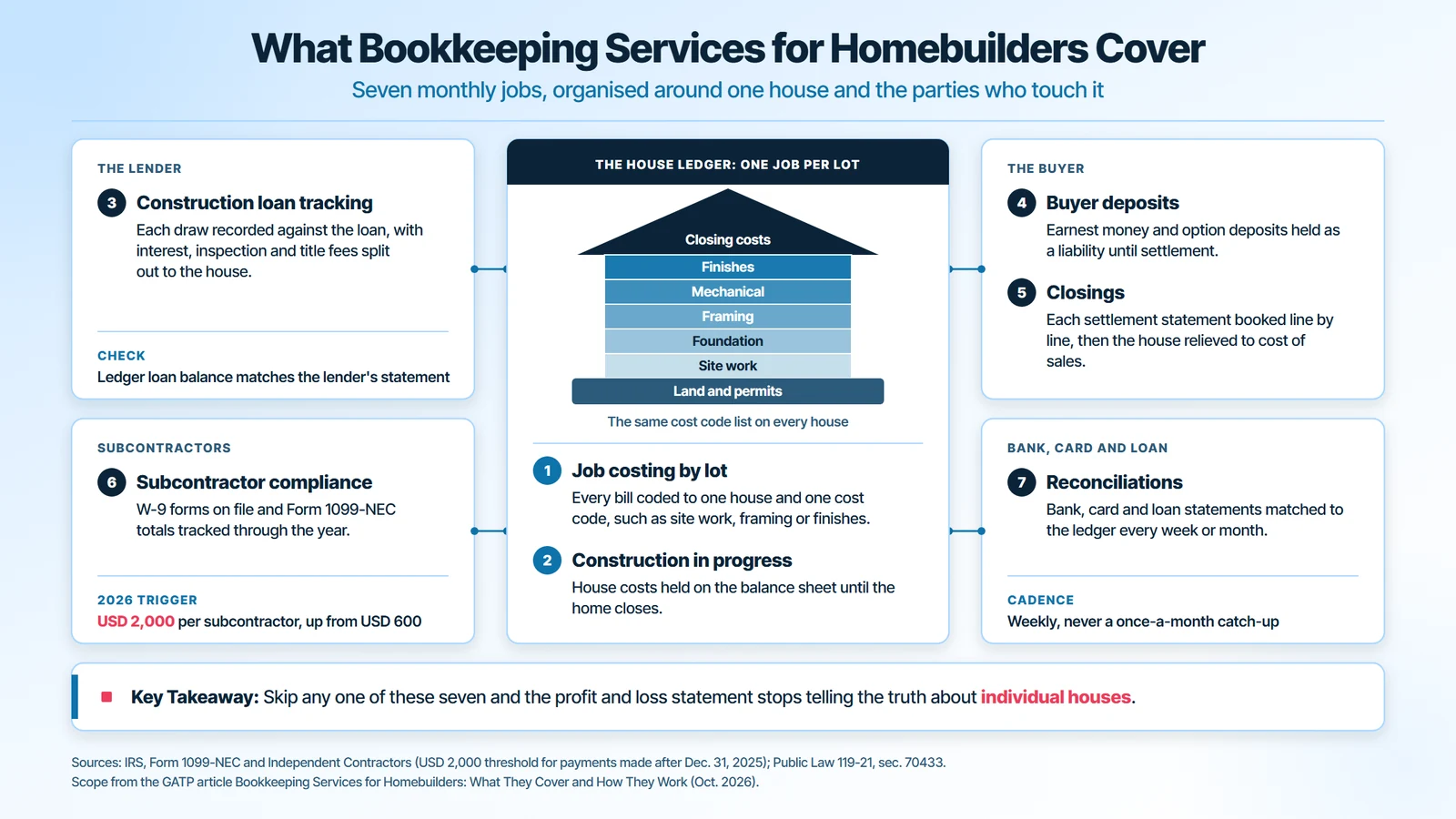
Skip any one of these and your profit and loss statement stops telling the truth about individual houses.
Why Is Bookkeeping for Home Builders Different From Regular Bookkeeping?
Bookkeeping for home builders differs because cash arrives before revenue and costs arrive before the sale. A retailer sells and gets paid the same week. You borrow, spend for months, then close in one day.
Generic bookkeeping for construction business owners treats every deposit as income. That single habit breaks a builder’s books. Three gaps separate your books from a standard small business ledger:
- Borrowed cash looks like sales. IRS Publication 334 states that money borrowed through a bona fide loan is not income. A USD 180,000 draw posted as sales overstates revenue by USD 180,000 until someone finds it.
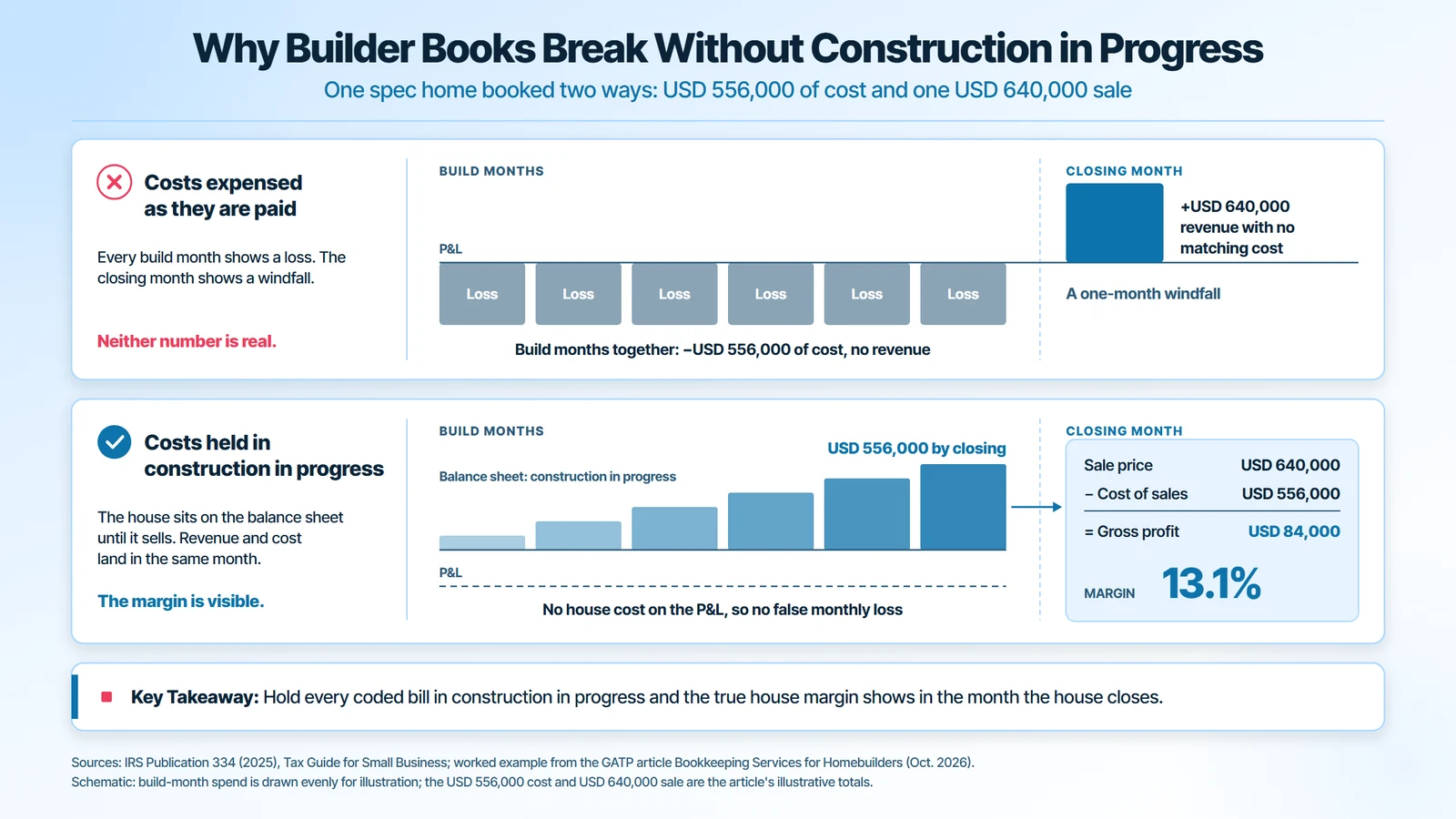
- Costs run months ahead of the sale. Expense a spec home’s costs as you pay them, and every month before closing shows a loss while the closing month shows a windfall. Neither number is real.
- One company holds many small businesses. With 20 houses running, each needs its own budget, cost codes and close-out.
Do Homebuilders Need a Specialized Construction Bookkeeper?
A homebuilder needs a bookkeeper who has closed houses before, because the hard entries are construction entries, not general ones. Hiring a bookkeeper for construction company work means testing for three skills.
- Loan draw handling: can they book a draw to the loan, split the interest reserve and reconcile to the lender’s draw statement?
- Closing entries: can they read a settlement statement and book sales price, seller credits, payoff and commissions on separate lines?
- Job cost discipline: do they refuse to post a bill until it has a house and a cost code?
A general bookkeeper can learn these. The cost of learning on your books is a year of margins you cannot trust. Ask any candidate to walk you through one closing statement.
Below roughly 10 closings a year, a part-time specialist is usually enough. Above that, the weekly volume of draws, bills and closings justifies a dedicated person or an outside team that already runs the routine.
What Changed for Homebuilder Bookkeeping in 2026?
Two federal changes from Public Law 119-21, enacted July 4, 2025, reach your books in 2026.
- Completed-contract method widened: section 70430 replaced “home construction contract” with “residential construction contract” in the section 460(e) exception. Condo and apartment contracts in buildings with more than 4 dwelling units now qualify. It applies to contracts entered in tax years beginning after enactment, so January 2026 contracts for a calendar-year builder.
- Capitalization test: for residential contracts that are not home construction contracts, the test for when section 263A cost capitalization applies now uses a 3-year completion estimate instead of 2-year.
- IRS method-change procedure: Proc. 2026-32 grants automatic consent to move existing residential contract methods into line, on a cut-off basis for contracts entered from the year of change.
- Higher 1099 threshold: section 70433 raised the Form 1099-NEC threshold to USD 2,000 for payments made after December 31, 2025.
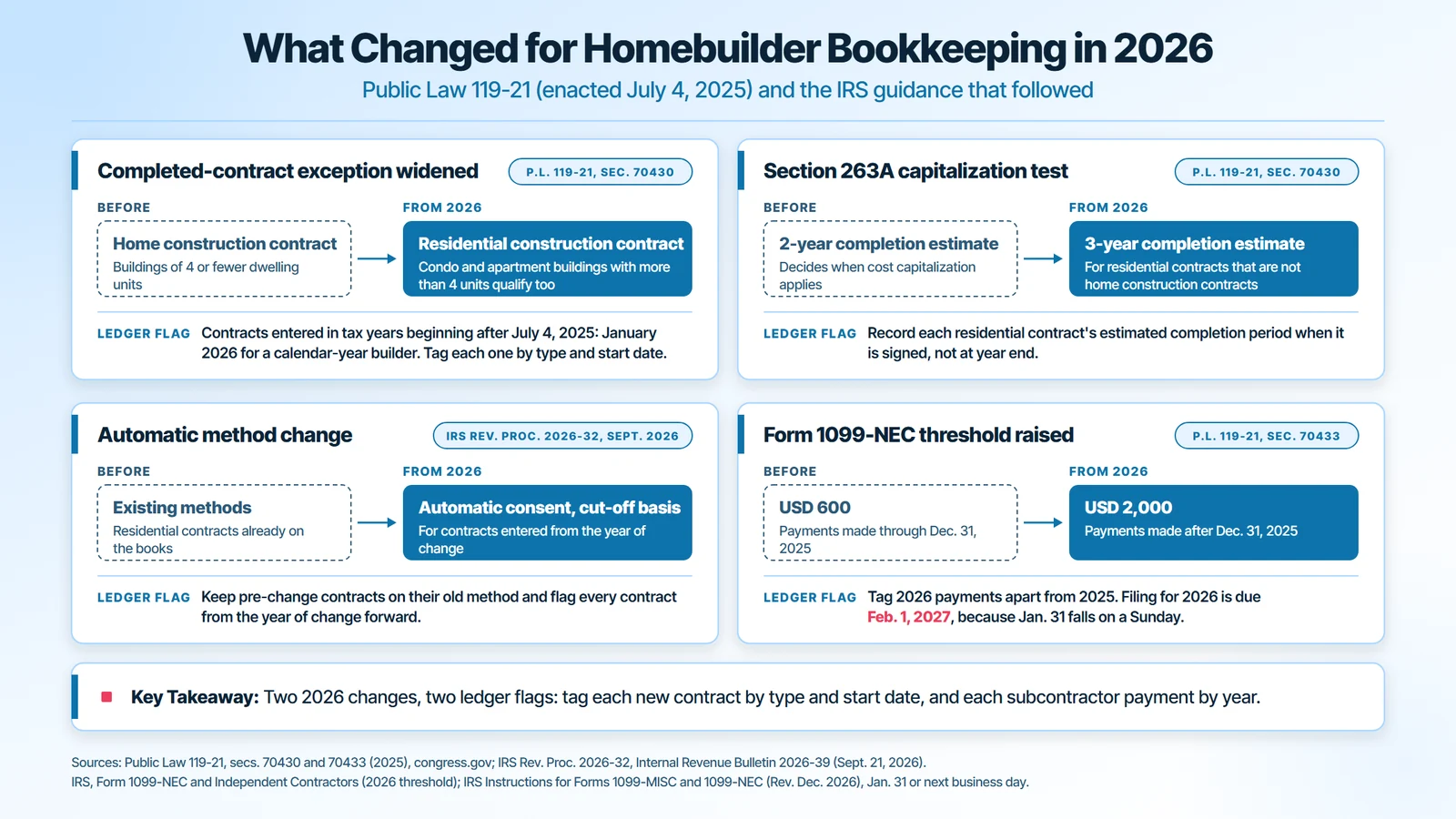
Both changes need a ledger flag. Tag each new contract by type and start date, so your tax method follows the contract. Then tag each subcontractor’s 2026 payments separately from 2025, because the two years carry different 1099 thresholds.
How Does Bookkeeping for a Homebuilder Work?
Bookkeeping for a homebuilder works as a fixed sequence that runs from lot purchase to closing. Each step exists to stop one specific error. Run them in order and the house margin is right on closing day.
The six steps below are the routine GATP runs for residential builders.
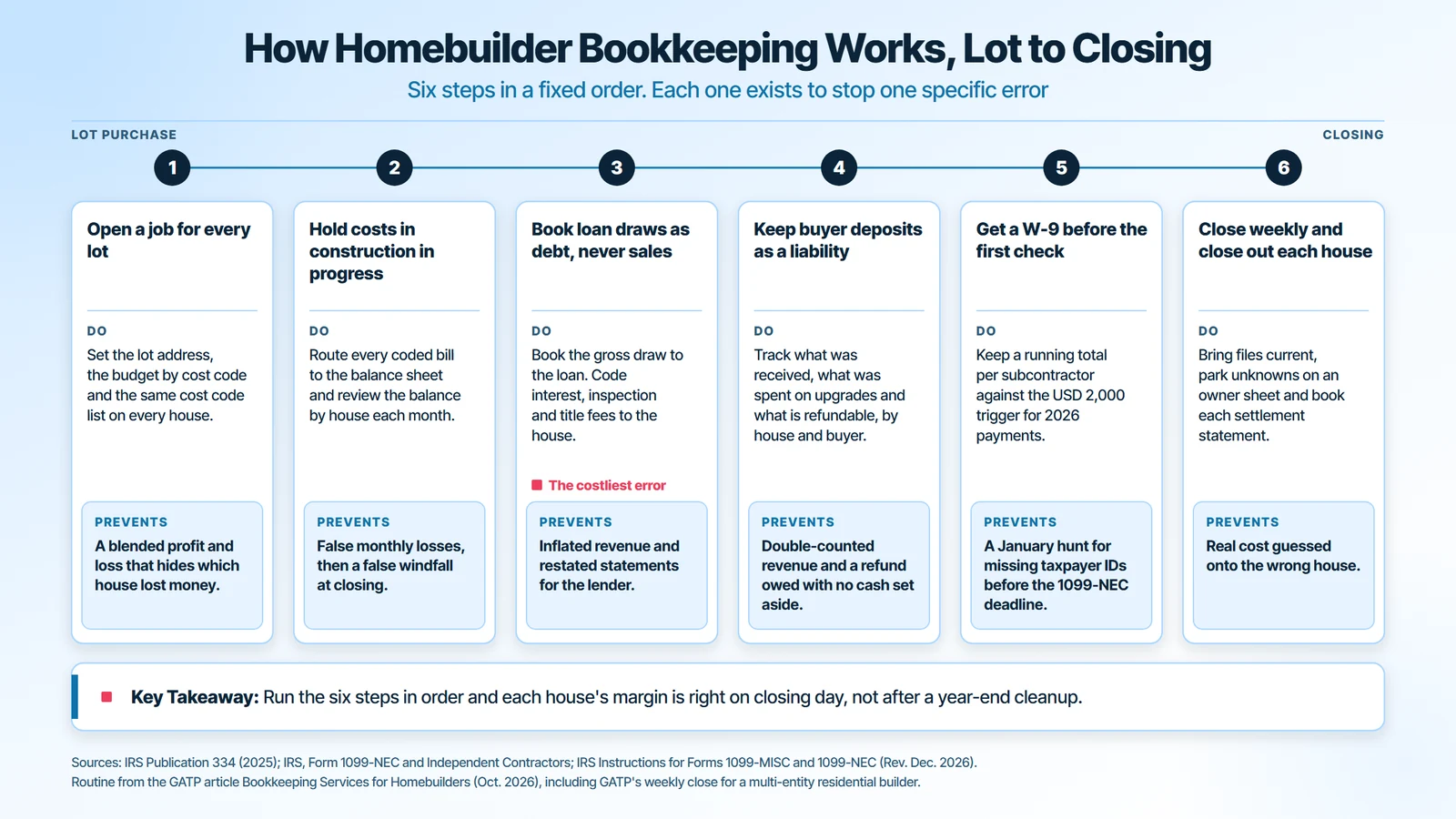
1. Open a Job for Every Lot Before the First Invoice Arrives
Job costing is the practice of assigning every cost to the house it built. The job has to exist before the first bill does, or that bill lands in a general expense account and stays there.
Set up each job with three things before work starts:
- the lot address and the budget by cost code;
- a standard cost code list grouped by phase: land, permits, site work, foundation, framing, mechanical, finishes and closing costs;
- the same list on every house, so you can compare one home’s framing cost to the next.
The failure this prevents is the blended profit and loss statement.
Without jobs, you see one gross margin for the year and cannot tell which floor plan or which subcontractor lost money. With jobs, the bad house shows up in the first month its costs run over budget, not after closing. You can still change the next bid while it matters,.
2. Hold Each House’s Costs in Construction in Progress Until Closing
Construction in progress is a balance sheet account that holds the costs of a house still being built. Every coded bill for a house goes there, not to the profit and loss statement.
On closing day the full balance for that house moves to cost of sales in one entry, matched against the sale. Revenue and cost then land in the same month, and the margin is visible.
Review your construction in progress balance by house every month, and look for two warning signs:
- A growing balance with no closing date: a cash problem is forming on that house.
- A balance left after the closing date: the close-out entry was missed, and that month’s cost of sales is understated.
This step prevents the false monthly losses that come from expensing house costs as they are paid. Lenders reading your statements expect house costs to sit in inventory until the sale, and they read monthly losses on an active builder as a warning sign.
3. Record Construction Loan Draws as Debt, Never as Sales
A construction loan draw is cash the lender advances against a house under construction, and it belongs on the loan liability account. The draw increases cash and increases the loan balance. Revenue does not move.
Match every draw to the lender’s draw statement. Lenders often net fees out of the draw, so your bank deposit is smaller than the draw approved. Book the gross draw to the loan, then book each netted item to the house it belongs to:
- Interest: the interest charged on the draws for that house.
- Inspection fees: the lender’s site visit before releasing each draw.
- Title fees: the title update the lender orders with each draw.
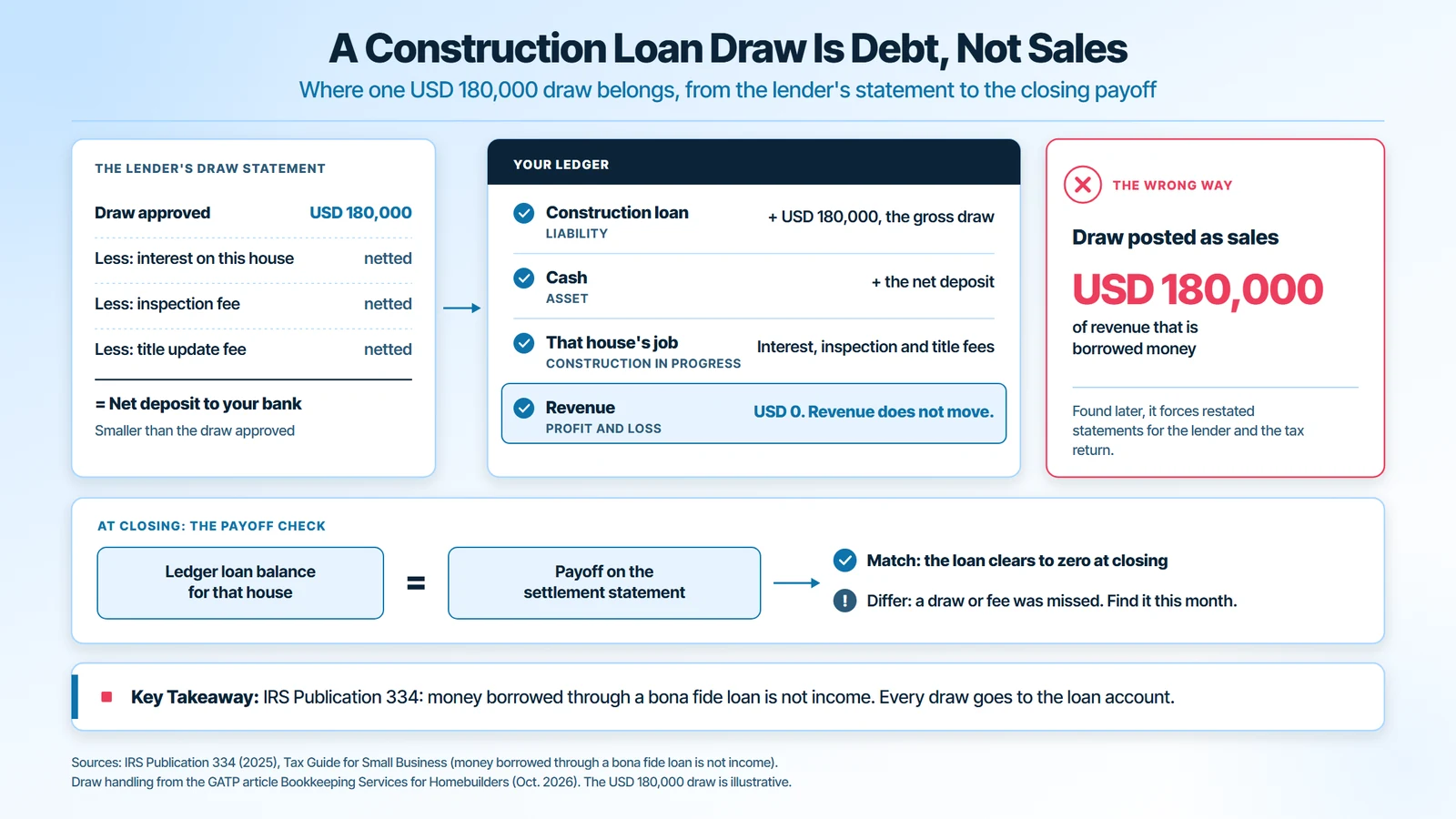
When the house closes, the payoff on the settlement statement clears that loan. If your ledger loan balance and the payoff figure differ, a draw or fee was missed. Find it before the books close for the month, while the lender’s statement is still in front of you.
This step prevents the most expensive error in builder books: inflated revenue that later forces restated statements for the lender and the tax return.
4. Keep Buyer Deposits on the Balance Sheet Until the Settlement Statement
Buyer deposits are earnest money, option payments and upgrade payments a buyer pays before closing, and they are a liability until the sale closes. You hold the money but have not earned it.
Track deposits by house and by buyer, in three columns:
- the amount received to date;
- the amount already spent on that buyer’s upgrades;
- the amount refundable if the sale falls through.
On a custom or semi-custom home, upgrade payments can be large, and some builders spend them on the upgrades before closing. That is fine, as long as your ledger still shows what is owed back.
At closing, the settlement statement credits the deposit against the sale price. Book it out of the liability on that line, not as fresh revenue. A deposit booked twice, once on receipt and once at closing, overstates the house margin by the full deposit.
This step prevents both double-counted revenue and the surprise of a refund owed with no cash set aside for it.
5. Collect a W-9 From Every Subcontractor Before the First Check
Form W-9 is the IRS form a subcontractor completes to give you a taxpayer identification number. Collect it before the first payment, because chasing it in January rarely works.
Under IRS Form 1099-NEC guidance, you report payments of USD 2,000 or more made after December 31, 2025 to a non-employee for services. The old trigger was USD 600. Track each subcontractor’s running total by calendar year, separate from the house it was coded to. Ask for a fresh W-9 when a subcontractor changes entity type.
The Instructions for Forms 1099-MISC and 1099-NEC set the filing date at January 31, moved to the next business day when it falls on a weekend.
Before you treat a crew as subcontractors at all, run the worker classification test. A misclassified framing crew is a payroll tax problem, not a 1099 problem, and it is far harder to fix after the year closes, once the quarterly payroll returns are filed.
6. Close Each House and Reconcile the Books Every Week
A weekly close is a routine that brings bank, card and loan activity current every seven days. Builders move too much money for a monthly catch-up to stay accurate.
GATP runs a four-move weekly cycle for a multi-entity residential home builder in QuickBooks Desktop and QuickBooks Online:
- Bring both files current to the week.
- Place every transaction that can be placed.
- Put anything only the owner can explain on a shared sheet of uncategorized expenses and uncategorized income.
- Back up the desktop company file.
The rule behind the cycle: no transaction gets a category it has not earned. A supplier payment might be materials for one house, a deposit on another or an owner draw. Guessing puts real cost on the wrong house.
Each open item waits on one answer from the owner. When a house closes, book the settlement statement, relieve construction in progress and confirm the loan payoff matched the ledger to the dollar.
What Type of Accounting Is Used in Construction?
Construction uses accrual accounting with job costing, and the revenue method depends on the contract type.
- Accrual accounting: revenue and costs are recorded when earned and incurred, not when cash moves.
- Job costing: every cost is assigned to one project, so each job shows its own profit.
- Percentage-of-completion: large long-term contracts recognize revenue as work progresses, usually by costs incurred divided by estimated total costs.
- Completed-contract method: revenue and costs are recognized when the contract finishes. For tax, section 460(e) exempts a home construction contract from the percentage-of-completion requirement.
- WIP schedule: a report comparing earned revenue to billings on open contracts, which AICPA and CIMA guidance on WIP schedules says is commonly updated monthly.
Under section 460(e)(4)(A), as the IRS restates it in Rev. Proc. 2026-32 (September 2026), a contract is a home construction contract when 80 percent or more of its estimated costs go to dwelling units in buildings of four or fewer units. Since 2026, residential construction contracts for larger buildings qualify too.
A spec home has no construction contract, so it is inventory and revenue lands at closing. Most home builder accounting runs both systems at once: inventory for spec homes and contract accounting for custom builds.
How Does Bookkeeping Differ for Custom, Spec and Production Home Builders?
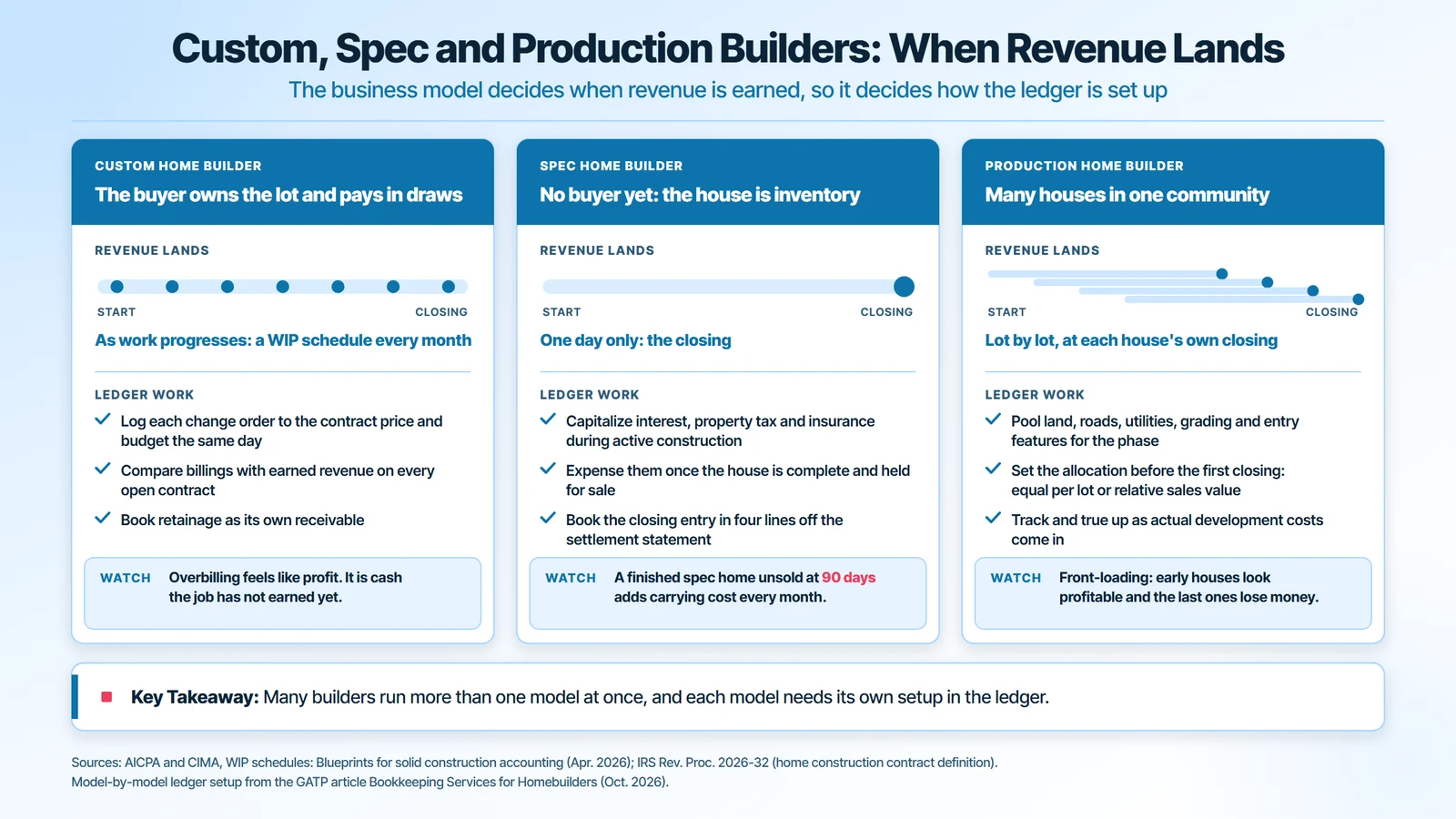
Accounting for home builders changes with the business model, because the model decides when revenue is earned. You may run more than one model, and each needs its own setup in the ledger.
Bookkeeping for Custom Home Builders: Contracts, Change Orders and WIP
Bookkeeping for custom home builders runs on the contract. The buyer owns the lot, signs a fixed-price or cost-plus contract and pays in draws as work hits milestones.
Three ledger habits matter most:
- Change orders: log each signed change order as a revision to the contract price and the budget on the same day. An unlogged change order makes the house look over budget when it is not.
- Billings versus earned revenue: run a WIP schedule each month. When billings run ahead of earned revenue, the excess is billings in excess of costs and estimated earnings, a liability.
- Retainage: if the contract holds back part of each draw, book it as a separate receivable so it is not lost at the final payment.
Overbilling feels like profit in the bank account. It is cash the job has not earned yet. Spend it on the next house and the last 40 percent of the current job runs short of cash.
Spec Home Builders: Inventory, Carrying Costs and the Closing Entry
Spec home builders build without a buyer, so the house is inventory until it sells. Revenue lands on one day: the closing.
The ledger work is in carrying costs. Construction loan interest, property tax, insurance and utilities keep running while the house sits unsold. Under US GAAP, interest, property tax and insurance during active construction are capitalized into the house, then expensed once it is complete and held for sale. Apply that cutoff the same way on every house.
Watch days on market by house. A completed spec home that has not sold in 90 days adds carrying cost every month and ties up your loan capacity for the next start.
The closing entry matters most. Book it in four lines, read straight off the settlement statement:
- Record the sale price as revenue.
- Relieve construction in progress to cost of sales.
- Clear the construction loan with the payoff amount.
- Record commissions and seller credits on their own lines.
Production Home Builders: Allocating Land and Community Costs Across Lots
Production home builders build many houses in one community, so some costs belong to the whole phase, not one lot. Land purchase, roads, utilities, grading and entry features all fall in that group.
Those shared costs need an allocation method, set before the first house closes:
- Equal per lot: total shared cost divided by lots in the phase. Simple, and fine when lots are similar.
- Relative sales value: each lot carries a share based on its expected sale price. Better when premium lots sell for much more.
- Track and true up: update the allocation when actual development costs come in above or below budget.
The error this prevents is front-loading. If early closings carry too little land cost, the first houses look profitable and the last ones lose money. If you also develop land, our guide to accounting for real estate developers covers that side.
Job Costing Example: One Spec Home and One Custom Contract in the Books
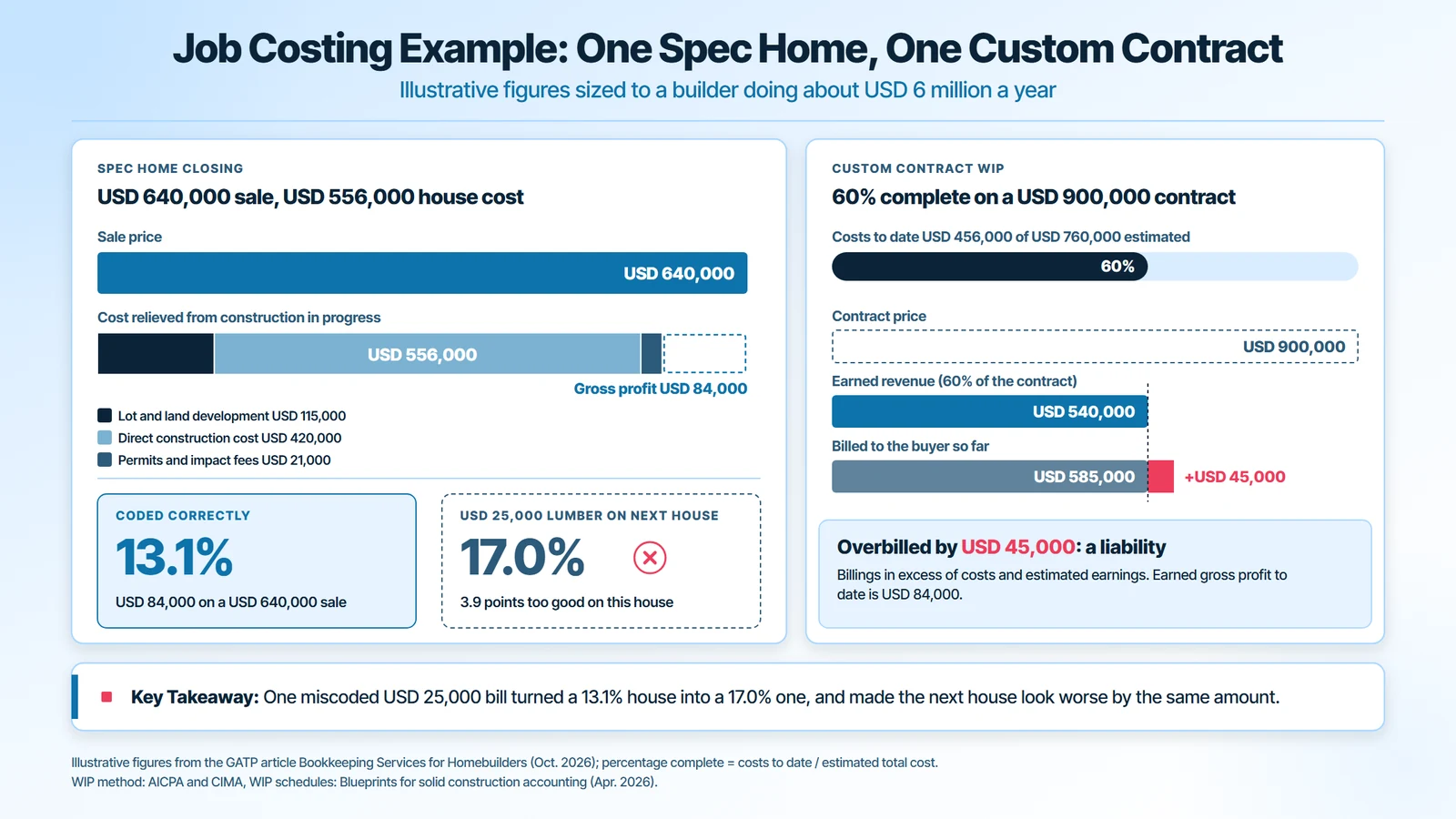
A job costing example shows how coding decisions change the margin you see. Both cases below use illustrative figures sized to a builder doing about USD 6 million a year.
Spec home closing. The house sells for USD 640,000. Its job ledger holds USD 115,000 of lot and land development, USD 420,000 of direct construction cost and USD 21,000 of permits and impact fees.
Spec home line | Coded correctly | USD 25,000 lumber coded to the next house |
Sale price | USD 640,000 | USD 640,000 |
Cost relieved from construction in progress | USD 556,000 | USD 531,000 |
Gross profit | USD 84,000 | USD 109,000 |
Gross margin | 13.1 percent | 17.0 percent |
One miscoded lumber bill makes this house look 3.9 points better than it was, and the next house worse by the same USD 25,000. You then price the next plan off the wrong number.
Custom contract WIP. A USD 900,000 contract has an estimated total cost of USD 760,000. Costs to date are USD 456,000, so the job is 60 percent complete. Earned revenue is USD 540,000 and earned gross profit is USD 84,000. You have billed USD 585,000, so USD 45,000 is overbilled and sits as a liability, not income.
How Much Do Bookkeeping Services for Homebuilders Cost?
Bookkeeping services for homebuilders usually cost less than an in-house hire, because the in-house floor starts at about USD 54,546 a year before benefits and unemployment taxes. Outside services price by volume: houses in progress, entities, bank and loan accounts, and monthly transactions. The more houses you run at once, the more draws and closings each month carries.
That floor comes from public data. The BLS Occupational Outlook Handbook puts the median annual wage for bookkeeping, accounting and auditing clerks at USD 50,670 in May 2025. IRS Publication 15 sets the 2026 employer share of social security at 6.2 percent and Medicare at 1.45 percent. Together that adds USD 3,876.
Four costs sit on top of that floor:
- health insurance and paid leave;
- software seats;
- a second person to review the work;
- the gap when the bookkeeper leaves in the middle of a closing season.
For a wider breakdown across business types, see what a bookkeeper costs in 2026.
What Do Bookkeepers Charge per Hour?
Employed bookkeepers earned a median of USD 24.36 per hour in May 2025, according to the BLS. That is the wage, not the price a firm charges, because a firm’s rate also covers software, review and overhead.
Hourly billing suits a one-off cleanup or a catch-up year. Ongoing builder books usually run better on a fixed monthly fee, because the volume is steady and the weekly routine is predictable.
When you compare quotes, compare the scope, not the hour. Three questions separate a construction-ready quote from a generic one:
- Does the fee include loan draw reconciliation for every open house?
- Does it include booking each settlement statement and relieving construction in progress?
- Does it include year-end Form 1099-NEC preparation for every subcontractor?
A cheap hourly rate that excludes these three leaves the hardest work with you, usually in January.
In-House Bookkeeper vs Outsourced Construction Bookkeeping at a Glance
Outsourced construction bookkeeping and an in-house hire post the same entries, but they differ on cost, coverage and review. The table compares the three common setups for a builder in the USD 1 million to 10 million range.
Factor | Owner or office manager | In-house bookkeeper | Outsourced bookkeeping team |
Direct cost | Owner time | USD 54,546 floor before benefits | Monthly fee by volume |
Construction entries | Usually missed | Depends on the hire | Part of the routine |
Second review | None | None unless you add one | Built in |
Vacation and turnover risk | High | High | Low |
We recommend an outside team for most builders under about 40 closings a year. At that size, your volume rarely fills a full-time seat, and the review layer comes with the fee. Above 40 closings, an in-house bookkeeper plus outside review of the monthly close usually fits better, because daily questions from the field and the sales office need someone on site who knows every open house.
How to Reduce Bookkeeping Errors in Construction: 5 Mistakes Homebuilders Make
The way to reduce bookkeeping errors in construction is to fix the five entries that go wrong most often on builder books.
- Mistake 1: Posting loan draws as sales. Revenue inflates by the draw amount. Fix: every draw goes to the loan account, matched to the lender’s draw statement.
- Mistake 2: Expensing house costs as they are paid. Months show false losses, then closings show false profits. Fix: route every coded bill to construction in progress.
- Mistake 3: Coding bills to the wrong house. One house looks better and the next looks worse. Fix: no bill posts without a lot and a cost code.
- Mistake 4: Booking buyer deposits as income. Revenue is counted twice. Fix: hold deposits as a liability until the settlement statement.
- Mistake 5: Chasing W-9 forms in January. Form 1099-NEC deadlines arrive with missing data. Fix: no first payment until a W-9 is on file.
If several of these have already built up, a QuickBooks cleanup before the next closing season resets the ledger.
GATP Accountant’s Note: On builder files, the first check we run is the construction loan balance in the ledger against the lender’s latest statement. When the two disagree, the gap is almost always a draw booked as income or a fee netted out of a deposit. Fixing that one reconciliation usually corrects revenue, interest and the house cost together.
How Can GATP Help With Bookkeeping for Homebuilders?
GATP provides bookkeeping for home builders as part of its outsourced bookkeeping services, run on a weekly routine. The work covers transaction categorization by house, bank, card and loan reconciliations, and a monthly profit and loss statement, balance sheet and cash flow statement.
For builders, the team sets up job costing by lot, holds house costs in construction in progress and books each settlement statement at closing. Unknown transactions go on a shared sheet for the owner, never into a guessed category. The service page lists support for QuickBooks Online and Xero, and the construction case study runs in QuickBooks Desktop as well.
The Short Version
- Code every cost to one house and one cost code, and hold it in construction in progress until closing.
- Book construction loan draws to the loan and buyer deposits to a liability. Neither is revenue.
- Track 2026 subcontractor payments against the USD 2,000 Form 1099-NEC threshold.
- Tag 2026 contracts by type: residential construction contracts can now use the completed-contract method for tax.
- Reconcile weekly and run a WIP schedule monthly on custom contracts.
Conclusion: Homebuilder Bookkeeping in 2026
Bookkeeping services for homebuilders exist to show the true margin on every house, which in the worked example was 13.1 percent, not the 17.0 percent one miscoded bill reported. Your decision is whether that routine runs inside the company or with an outside team that already runs it every week.
Find out what each house actually made
We review your loan balances against the lender statements, your construction in progress by house and your last three closings. You get back a short list of misposted draws, deposits and costs, with the corrected margin per house, within a week of receiving file access.
Frequently Asked Questions About Homebuilder Bookkeeping
Which Software Do Homebuilder Bookkeepers Work In?
GATP runs homebuilder files in QuickBooks Online and QuickBooks Desktop, and the service page also lists Xero. QuickBooks for home builders works when jobs, cost codes and classes are set up before the first bill. The software matters less than the setup: one job per lot, a standard cost code list and a separate liability account for each construction loan.
Can ChatGPT Do a Homebuilder’s Bookkeeping?
ChatGPT cannot do a homebuilder’s bookkeeping on its own, because it cannot see your bank feeds, lender statements or settlement statements. It can draft a cost code list or explain an entry. The work that protects your margin needs ledger access and a person accountable for it: reconciling the loan, matching draws and relieving construction in progress at closing.
Should a Homebuilder Use the Cash or Accrual Method?
A homebuilder should keep accrual books for management and lending, even when the tax return uses another method. Under the section 448(c) test in Rev. Proc. 2025-32, entities averaging USD 32 million or less in gross receipts generally qualify for simpler tax methods in 2026. Accrual books still show earned revenue, deposits and costs by house in the right month.
When Are 1099-NEC Forms Due for a Builder’s Subcontractors?
Form 1099-NEC for your subcontractors is due to the IRS and to each subcontractor by January 31, or the next business day when that date falls on a weekend. For payments made in 2026, a form is required when a subcontractor received USD 2,000 or more for services. Collect W-9 forms during the year so January is a filing task, not a search.
How Long Should a Homebuilder Keep Job Cost Records?
A homebuilder should keep job cost records for at least 3 years after filing the return they support, the general IRS period of limitations. Keep settlement statements, draw statements, change orders and subcontractor invoices for each house together. Longer periods apply in some cases, so check your situation against the IRS record retention rules.