
A CPA for an online business is a licensed certified public accountant who handles the taxes, sales tax and financial reporting of a company that sells online. Form 1099-K reports gross sales, while your deposits arrive after fees and refunds.
Online sellers may also owe sales tax in states they never visit. Whether you run a Shopify store, an Amazon catalog or a subscription app, an ecommerce CPA reads those reports against your books.
What Does a CPA for an Online Business Do?
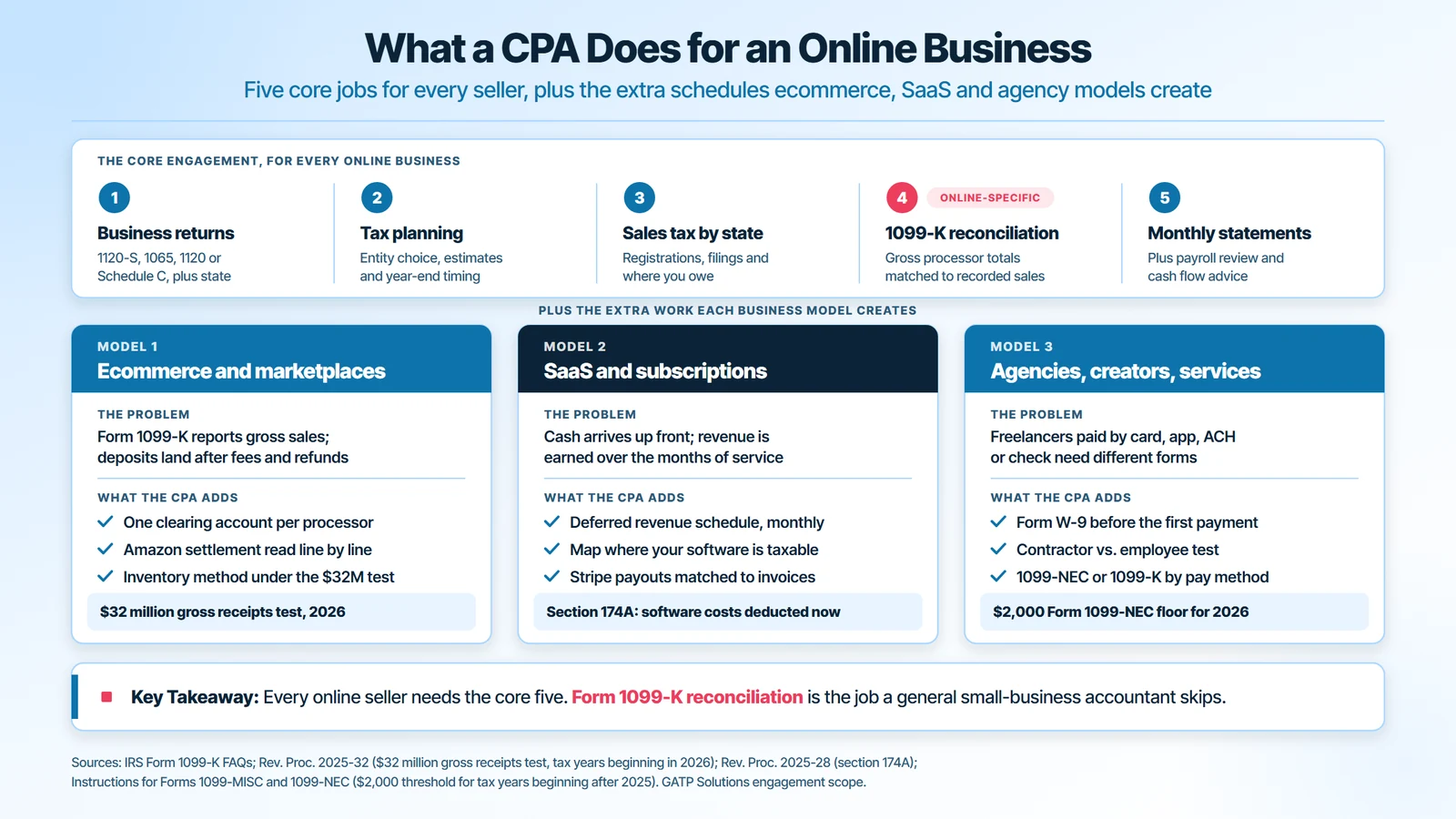
A CPA for an online business does the tax and reporting work that a sales platform creates. Most accountants for online businesses cover the same core list, and the difference is how well they know processor data and multi-state rules. The engagement usually includes:
- Business tax returns: Form 1120-S, Form 1065, Form 1120 or Schedule C, plus state returns.
- Tax planning: entity choice, estimated payments and year-end timing.
- Sales tax for online business: registrations, filings and a state-by-state review of where you owe.
- Form 1099-K reconciliation: gross processor totals matched to recorded sales.
- Monthly financial statements, payroll review and cash flow advice.
The work follows a monthly and yearly rhythm. For a calendar-year business, the 2026 tax year closes on this schedule:
- Every month: reconcile each processor, marketplace and bank account, then close the books.
- February 1, 2027: Forms 1099-NEC go to contractors and the IRS, because January 31 falls on a Sunday.
- March 15, 2027: Form 1065 and Form 1120-S returns are due, unless an extension is filed.
Ask what does a CPA do for a small business and you get a similar list. In accounting for online business, the extra job is tying every deposit back to the orders behind it.
Ecommerce and Marketplace Sellers: Gross Sales Versus Payouts
Ecommerce sellers get paid through processors such as Shopify Payments, Stripe, PayPal and Amazon. Each one deducts fees, refunds and sometimes reserves before the deposit lands. The processor reports the gross figure on Form 1099-K, before fees, refunds or shipping adjustments. Books built from bank deposits start below what the IRS sees.
For an online store paid through two processors, GATP set up one clearing account per processor, reviewed weekly, so every payout ties to its orders. The case study explains how an online store with two payment processors tied its sales back to cash.
Amazon adds its own fee and inventory reports, so a CPA for Amazon sellers reads the settlement report line by line. Common errors are in our list of Amazon seller accounting mistakes.
Inventory is the other ecommerce job. Two IRS rules set how much work it takes:
- Method: a small business taxpayer can account for inventory as non-incidental materials and supplies, or follow its own financial statements, under the Form 1065 instructions.
- Threshold: for tax years beginning in 2026, the gross receipts test for that status is $32 million on a 3-year average, per Proc. 2025-32.
A CPA picks the method that keeps cost of goods sold accurate without a full inventory system.
SaaS and Subscription Businesses: Deferred Revenue and Software Sales Tax
Subscription businesses collect cash up front for service delivered over months, so a CPA books part of each payment as deferred revenue. Take an illustrative annual plan sold for $1,200 on October 1. By December 31, three months are earned on the books, so $300 is revenue and $900 stays deferred.
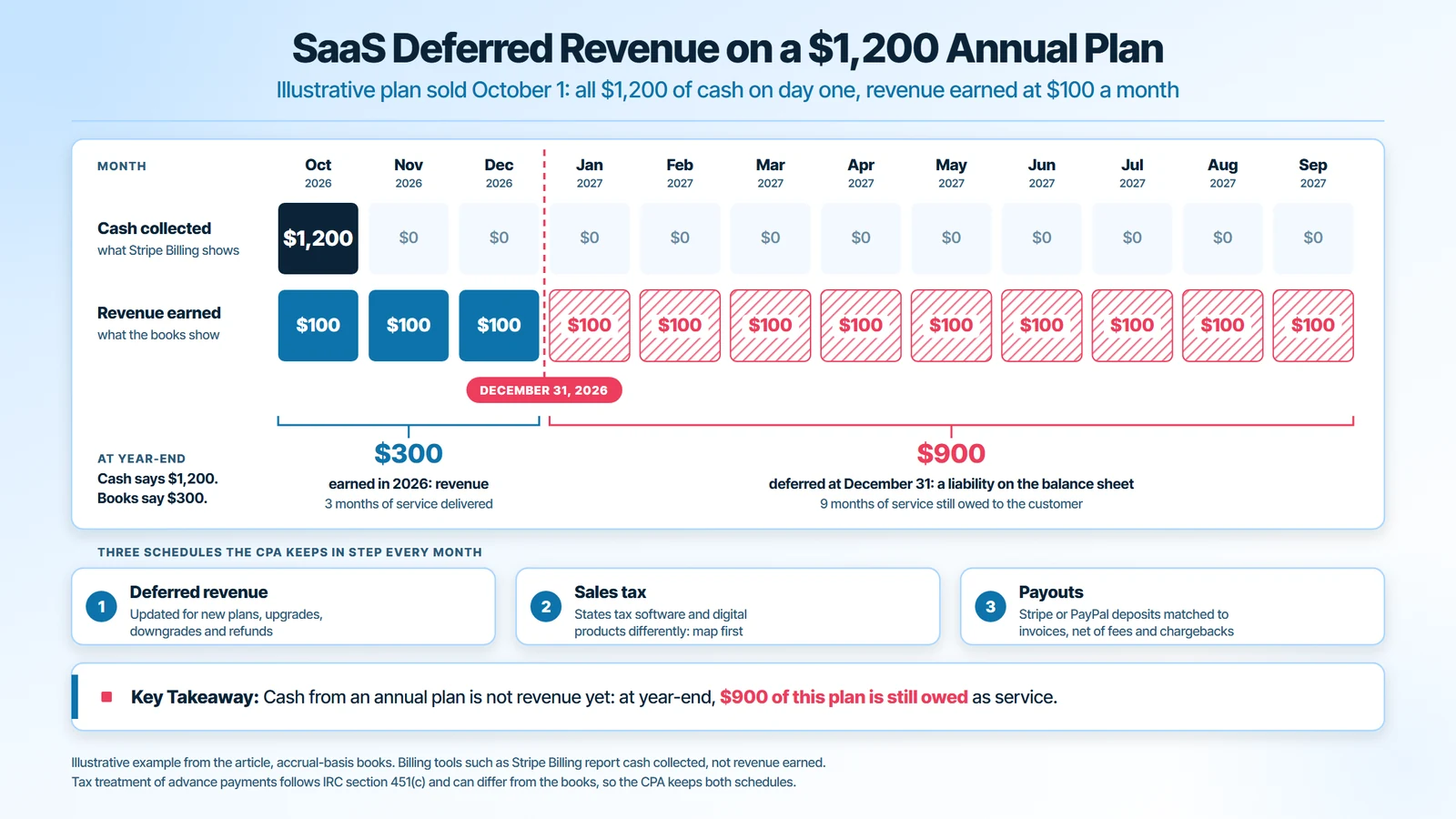
Annual prepaid plans can make December look like a record month in cash terms. The deferred revenue schedule shows how much of that cash is still owed as service. Billing tools such as Stripe Billing report cash collected, not revenue earned, so the CPA keeps three schedules in step each month:
- Deferred revenue: updated for new plans, upgrades, downgrades and refunds.
- Sales tax: states tax software and digital products differently, so the CPA maps where your product is taxable before you register.
- Payouts: Stripe or PayPal deposits matched to invoices, net of fees and chargebacks.
Development spending has its own tax rule. Section 174A now lets software costs be deducted sooner, as the What Changed section below explains.
Agencies, Creators and Service Sellers: Paying Contractors
Online service businesses often pay freelancers, and a CPA tracks which ones need a Form 1099-NEC. Contractors paid by card or a payment app are reported by the processor on Form 1099-K instead.
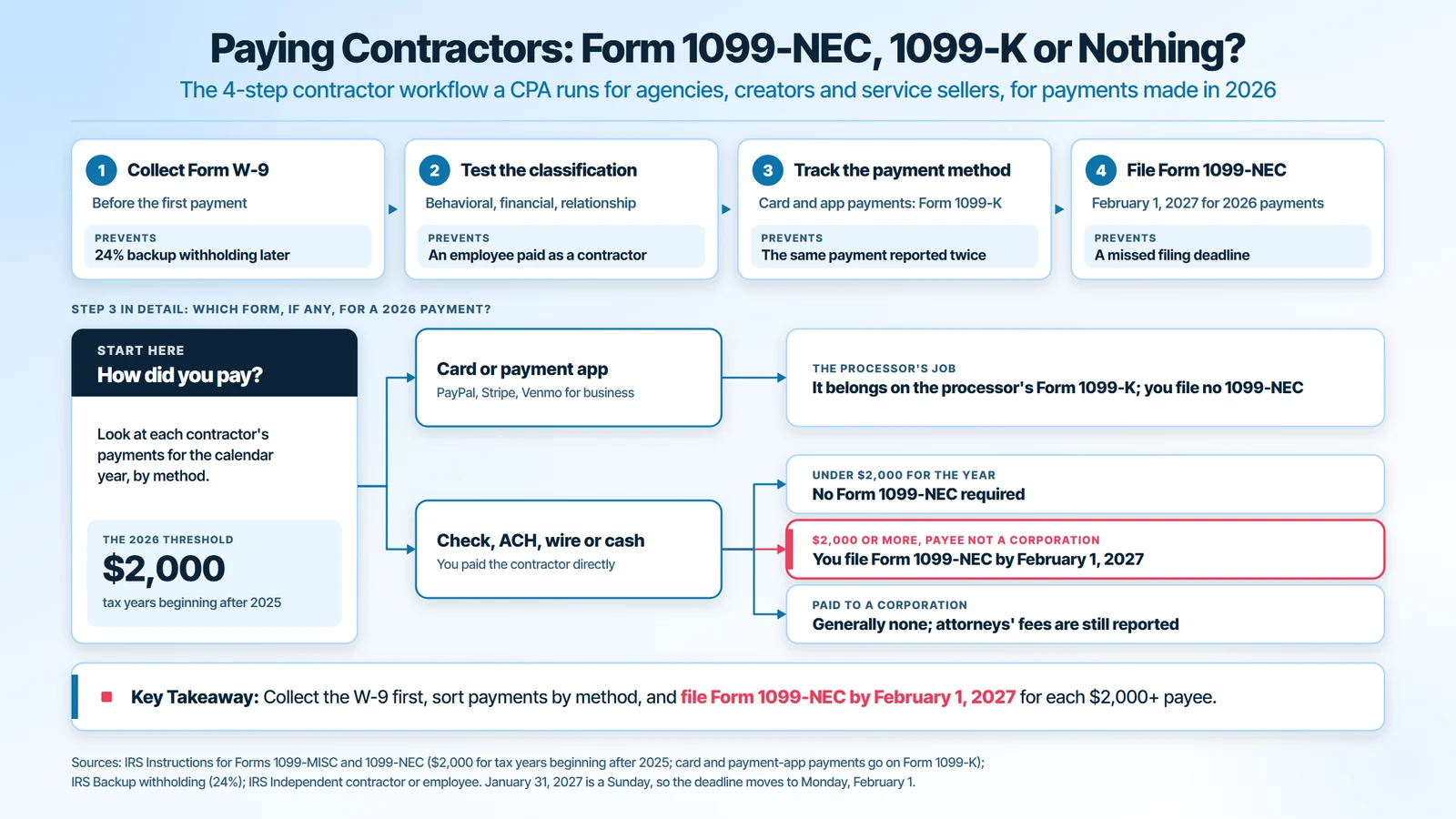
The contractor workflow runs in four steps, and each one prevents a specific problem:
- Collect Form W-9 before the first payment, so you hold each contractor’s taxpayer identification number.
- Test the classification. The IRS weighs behavioral control, financial control and the type of relationship to decide between contractor and employee.
- Track payments by method, since card and payment-app payments belong on the processor’s Form 1099-K.
- File Form 1099-NEC by January 31 for each contractor paid at least $2,000. When that date falls on a weekend, the deadline moves to the next business day.
A missing taxpayer identification number can force backup withholding at 24 percent on later payments. Payments to corporations are generally not reported on Form 1099-NEC, with exceptions such as attorneys’ fees.
What Is a CPA vs. Accountant?
A CPA is an accountant who holds a state license, while an accountant is anyone who works in accounting without needing one. State boards of accountancy license CPAs after the Uniform CPA Examination, college accounting study and work experience.
The CPA vs bookkeeper line is simpler. A bookkeeper records transactions, and a CPA interprets them for tax and reporting. An enrolled agent is a fourth option. Enrolled agents are licensed by the IRS itself, with the same unlimited representation rights as a CPA but no state CPA license.
Role | License | Prepares your return | Represents you before the IRS |
Bookkeeper | None required | Only with a PTIN | No |
Accountant | None required | With a PTIN | Limited or none |
Enrolled agent | IRS license | Yes, with a PTIN | Unlimited |
CPA | State board license | Yes, with a PTIN | Unlimited |
In practice, a bookkeeper fits daily transactions and an enrolled agent fits tax-only work and IRS problems. A CPA fits owners who also need financial statements, planning and multi-state filings.
Can You Hire a CPA Online?
Yes, you can hire a CPA online, and most online CPA services for small business run on video calls, secure portals and electronic signatures. Mobility rules in most states let a CPA with one state license serve clients in other states, virtually or in person. Three pieces make a remote engagement work:
- Credentials you can check: a state CPA license and a PTIN, as the IRS guide to preparer credentials
- Online authorization: you can submit Forms 2848 and 8821 online with an electronic signature, so the CPA can speak to the IRS for you. Faxed or mailed forms still need an ink signature.
- Data security: a client portal and a written information security plan, which the IRS says firms must keep by law (IR-2026-92).
A remote engagement usually starts in this order:
- Sign the engagement letter, which sets the scope, the fee and the response time.
- Give the CPA accountant access to QuickBooks Online or Xero, plus read-only access to Shopify, Amazon or Stripe reports.
- Sign Form 8821 so the CPA can see your IRS records, or Form 2848 if you want representation.
- Upload prior returns and state registrations to the portal.
Online CPA vs. Local CPA: What Actually Changes
An online CPA and a local CPA hold the same state license, so only the delivery changes:
- Choice: you can hire a firm that already serves Shopify, Amazon or SaaS clients.
- Access: documents, signatures and IRS authorizations move through a portal instead of an office visit.
- Meetings: calls run on video, while a local CPA can also meet in person.
- Pricing: many online firms quote a fixed monthly fee for a defined scope.
- States: a firm that already files in many states can cover every state where you sell.
- Records: ask for portal access that lets you download a full copy if you switch firms.
A local CPA still fits some businesses. Pick one when you want regular face-to-face meetings, handle a lot of cash or expect a state audit at a nearby office. For most online sellers, experience with their platforms matters more than distance. Either way, ask for the license number and the list of states the firm files in today.
Is a CPA Worth It for a Small Business?
Yes, a CPA is usually worth it for a small business once the tax work stops being routine, and online sellers reach that point early. Do I need a CPA for my small business is a fair question at launch. A single-member store with one processor can often manage with software and a bookkeeper.
The answer changes when any of these show up:
- More than one payment processor or marketplace.
- Sales tax registrations in several states.
- An LLC with two or more members, or an S corporation election.
- Inventory, contractors or payroll.
- A notice from the IRS or a state.
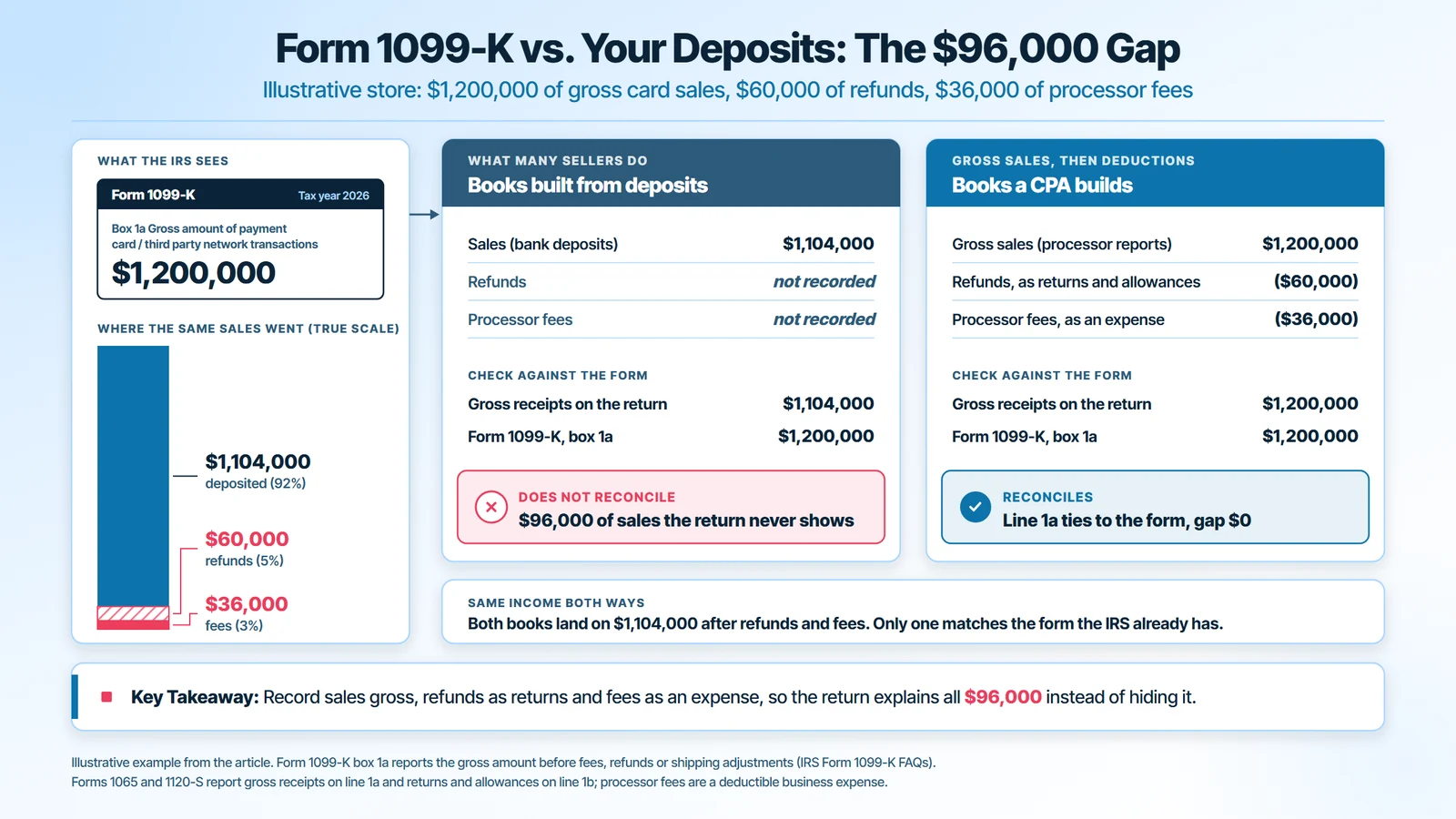
The Form 1099-K gap shows the value in dollars. Take an illustrative store with $1,200,000 of gross card sales on its Form 1099-K. Refunds were $60,000 and processor fees were $36,000, so deposits totaled $1,104,000.
Books built from deposits show $96,000 less revenue than the IRS form. A CPA records gross sales, then books refunds as returns and fees as an expense. Gross receipts on the return then reconcile to the form, and taxable income still reflects both.
Do I Need a CPA for LLC?
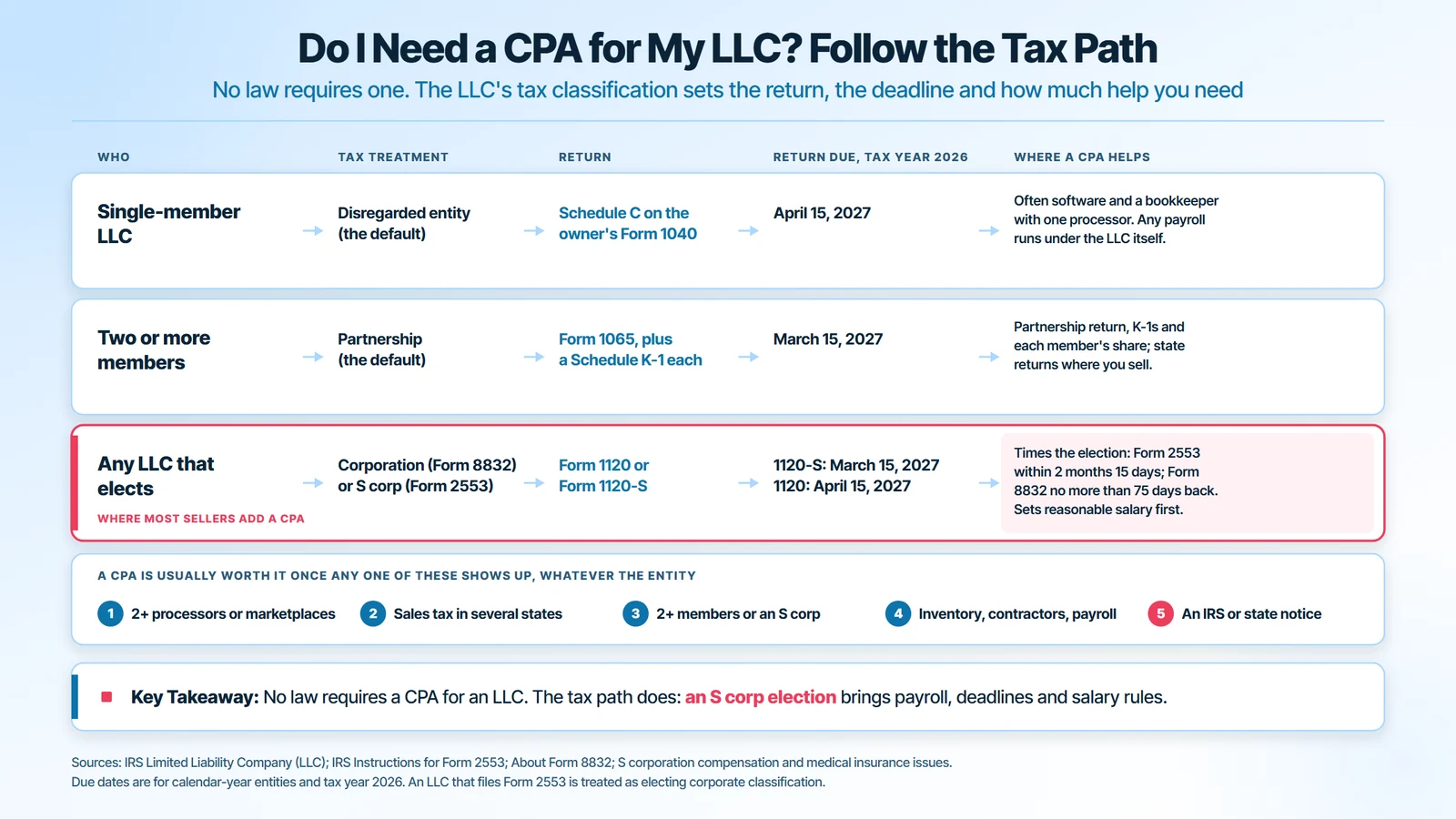
No, an LLC does not legally require a CPA, but its tax classification decides how much help you need. The IRS rules for LLCs set three paths:
- Single-member LLC: treated as a disregarded entity and reported on the owner’s return by default.
- Two or more members: classified as a partnership filing Form 1065, unless it elects corporate treatment on Form 8832.
- Elections: a Form 8832 election generally cannot take effect more than 75 days before it is filed, so timing matters.
The S corporation election is where many online sellers bring in a CPA. Three rules drive the timing and the payroll setup:
- Form 2553 is due no more than 2 months and 15 days after the start of the tax year the election takes effect. You can also file it at any time in the year before, per the Form 2553 instructions.
- Shareholder-employees must receive reasonable compensation as wages before taking non-wage distributions.
- Even a single-member LLC counts as a separate entity for employment taxes, so payroll filings run under the LLC itself.
Do I Need a CPA if I Use QuickBooks?
No, QuickBooks does not replace a CPA, because the software records transactions but does not decide how they are taxed. QuickBooks Online and Xero keep the ledger, and a CPA reviews it for tax treatment and processor mismatches. Two IRS audit rules matter:
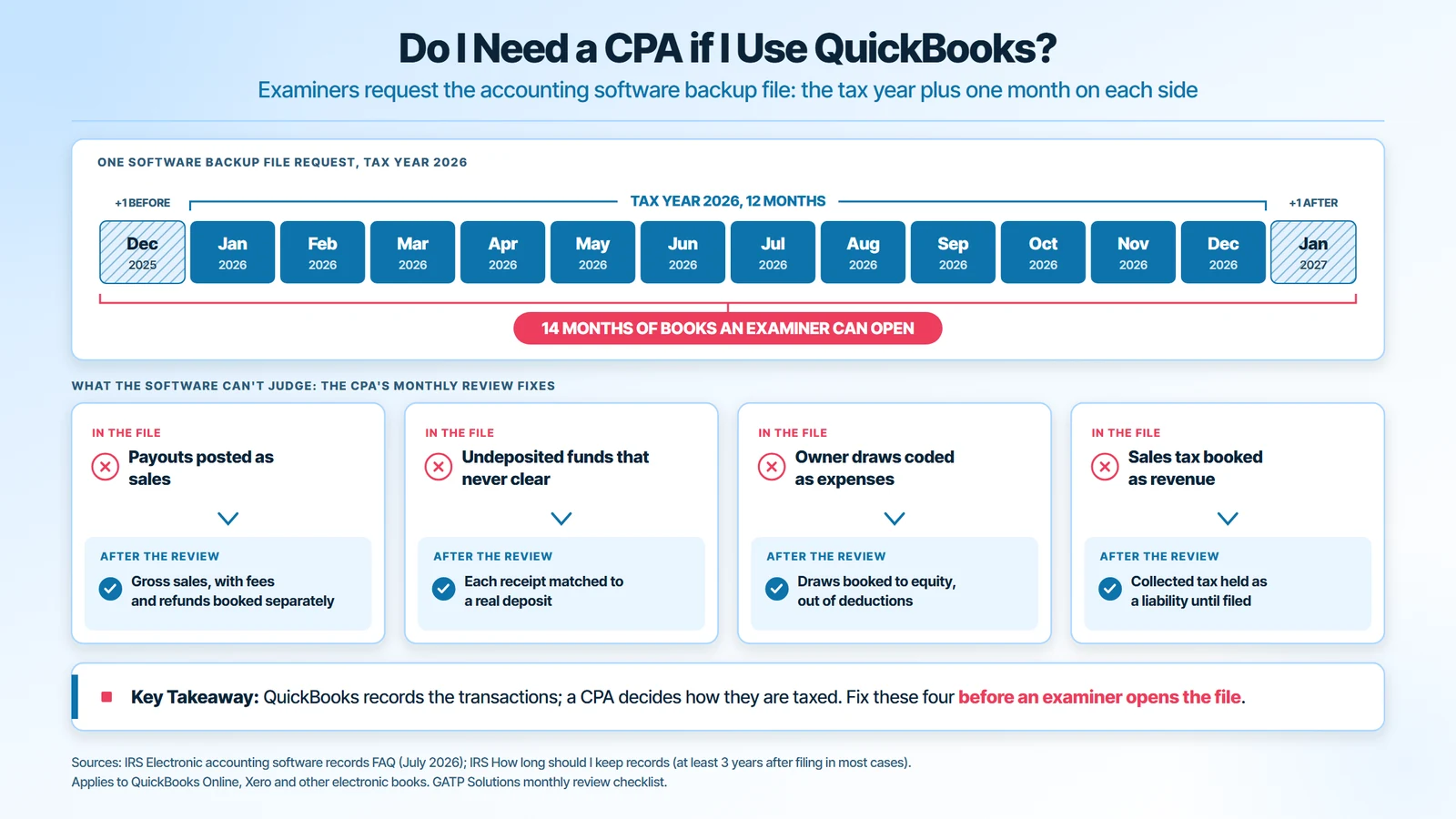
- Examiners request the accounting software backup file in most exams where a business keeps electronic books, per the IRS electronic accounting software records FAQ.
- The request can span 14 months: the tax year plus one month on each side.
Inside the file, a CPA’s monthly review covers the items software cannot judge:
- Payouts posted as sales instead of gross sales, fees and refunds.
- Undeposited funds that never cleared to a deposit.
- Owner draws or transfers coded as expenses.
- Sales tax collected but booked as revenue.
Keep the books and the records behind them for at least 3 years after filing in most cases. The IRS lists the exceptions in its guide on how long to keep records.
What Is the Best Way to Find a CPA?
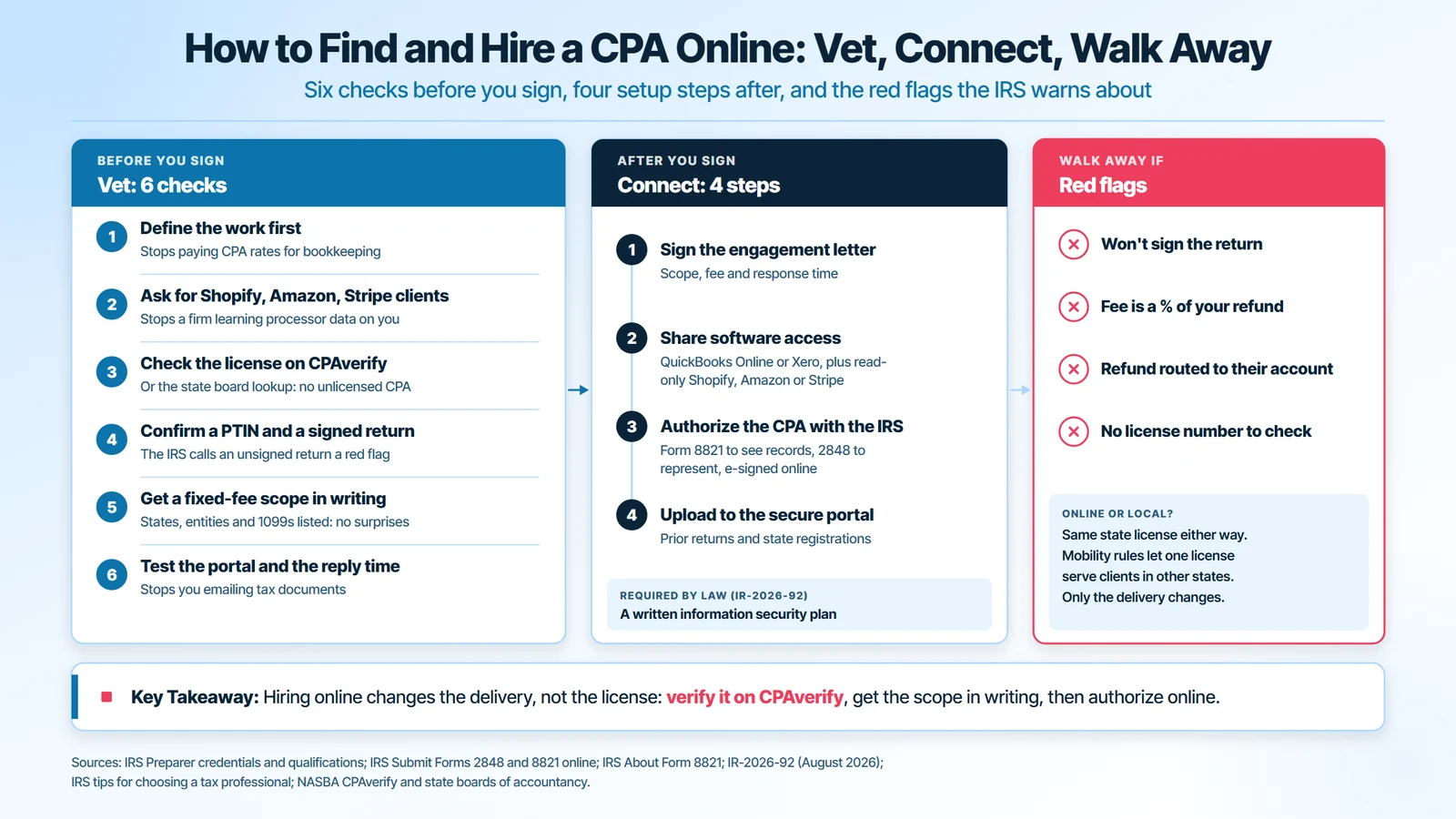
The best way to find a CPA for an online business is to shortlist three firms that already serve online sellers. Verify each license, then compare fixed-fee scopes. The same steps answer how to find a CPA for small business owners in any industry, and each one names the mistake it prevents:
- Define the work first: returns, sales tax, Form 1099-K reconciliation or monthly books. This stops you paying CPA rates for bookkeeping.
- Ask for online-business clients on Shopify, Amazon, Stripe or subscription billing, and ask who will do your work. This stops a firm learning processor data on your file.
- Verify the license on the state board of accountancy lookup or NASBA’s CPAverify. This stops you hiring an unlicensed virtual CPA.
- Confirm a PTIN and a signed return. The IRS calls an unsigned return a red flag.
- Get a fixed-fee scope in writing that lists states, entities and 1099 forms. This stops surprise invoices.
- Test the portal and the reply time before you sign. This stops you emailing tax documents.
How Much Does an Online Accountant Cost?
An online accountant charges a monthly bookkeeping fee plus a return fee, and IRS 2025 averages for business returns run $610 to $4,200. Those averages cover every preparation method, from software to paid preparers, so they are benchmarks, not CPA quotes. The entity figures apply to businesses with $10 million or less in assets.
The 2025 IRS averages by return type:
- Form 1040 with Schedule C or another business schedule: $610, per the Form 1040 instructions.
- Form 1065 partnership: $3,300.
- Form 1120 C corporation: $3,900.
- Form 1120-S S corporation: $4,200.
- Monthly bookkeeping: GATP Solutions’ fixed-fee plans start at less than $250 a month.
Many online firms answer how much does a CPA cost for a small business with a fixed monthly fee, not an hourly rate. Ask for the scope in writing. Processor count, state registrations and cleanup work push the price up. Return fees by entity type are broken down in our analysis of the average cost of tax preparation by CPA.
What Changed in 2026 for Online Business Taxes
Three federal rule changes now shape taxes for online business:
- Form 1099-NEC and 1099-MISC: the reporting minimum is $2,000 for tax years beginning after 2025, per the Instructions for Forms 1099-MISC and 1099-NEC. The same floor covers Form 1099-MISC rents and other income, and it may adjust for inflation from 2027. Update the threshold in your accounting software before year-end.
- Form 1099-K: the One Big Beautiful Bill Act retroactively restored the $20,000 and 200-transaction threshold for payment apps and marketplaces, per IR-2025-107. Card processors still report every payment, and your state may set a lower threshold, per the IRS Form 1099-K FAQs.
- Software development: section 174A makes domestic software development costs deductible in the year paid or incurred for tax years beginning after 2024, per Proc. 2025-28. Eligible small businesses can elect to apply it back to tax years beginning after 2021. That generally means amended returns, so ask your CPA before the next return is filed.
Conclusion: Choosing a CPA for Online Business
A CPA for an online business earns the fee by matching processor reports to your books, keeping sales tax current and filing returns that agree with every Form 1099-K. Verify the license, confirm online-seller experience and get a fixed-fee scope before you hire.
Get your processor reports and your books to agree
We compare your Form 1099-K totals with recorded sales and review your states for sales tax compliance. You get back the size of any gap and what it takes to make your next business return match. Thirty minutes, one clear answer.
Book a free consultation with a GATP Solutions CPA.
Frequently Asked Questions About a CPA for Online Business
Why Do CPAs Not Like QuickBooks Online?
Many CPAs dislike messy QuickBooks Online files, not the software. Owners can edit entries freely, so uncategorized deposits, duplicate bank feeds and net payouts posted as sales pile up between reviews. A CPA who works in QuickBooks Online locks closed periods and reviews the books monthly.
Can an Online CPA Represent Me in an IRS Audit?
Yes. CPAs have unlimited representation rights before the IRS, covering audits, collection issues and appeals. An online CPA files Form 2848 to act for you, and the IRS accepts it online with an electronic signature. Location does not limit the right.
Is an Online CPA Better Than TurboTax for an Online Business?
For a business with several processors or states, yes. TurboTax’s do-it-yourself versions prepare the return from the numbers you enter. They do not reconcile Form 1099-K to your books or decide where you owe sales tax. A CPA also signs the return and can represent you before the IRS.
Do Online CPAs Work With Businesses in Every State?
Yes, in most cases. Mobility rules let a CPA licensed in one state serve clients in other states without a second license. Your state returns still follow each state’s own rules and deadlines, so ask the firm which states it files in today.
What Accounting Software Do Online CPAs Typically Use?
Most online CPAs work in QuickBooks Online or Xero, with connectors that pull Shopify, Amazon and Stripe data. GATP Solutions works in both, and the client owns the file. Dext for receipts and Bill.com for payables are common add-ons.
How Often Will I Communicate With My Online CPA?
Expect a scheduled call each month or quarter, plus email or chat in between, written into the engagement letter. At GATP Solutions, plans range from a weekly call to recorded video updates, with response times of 24 to 96 hours depending on the plan.
What Are Red Flags When Hiring a CPA?
The biggest red flags are a preparer who will not sign the return and fees based on a percentage of your refund. A third is a request to route your refund into their account. The IRS warns about all three. For a business, add a firm with no license number.

