
Property development accounting is the bookkeeping, cost tracking and reporting for a project that buys land, builds and sells. Every land, construction and finance cost sits against the project until each lot settles. GATP runs this work for Australian developers, inside the same team that delivers our bookkeeping services in Australia.
What Is Property Development Accounting?
Property development accounting is a project-based accounting method for businesses that buy land, improve it and sell the result. Costs often build up for a year or more before any revenue arrives. The books must show what each project has cost, what it is worth and what it will make.
It covers land subdivisions, townhouse and apartment projects, and commercial builds. Most developers run each project through its own company or unit trust. The accounting follows that structure, so every project has its own ledger, bank account and reports.
Accounting for property development in Australia brings four rule sets together. These are listed below.
- The accounting standards: AASB 102 for inventory, AASB 123 for interest and AASB 15 for revenue.
- GST: credits on construction costs, the margin scheme and withholding at settlement.
- Income tax: whether the profit is on revenue account or capital account.
- Lender reporting: cost to complete, pre-sales and loan covenants.
What Distinguishes Property Development Accounting From Standard Business Accounting?
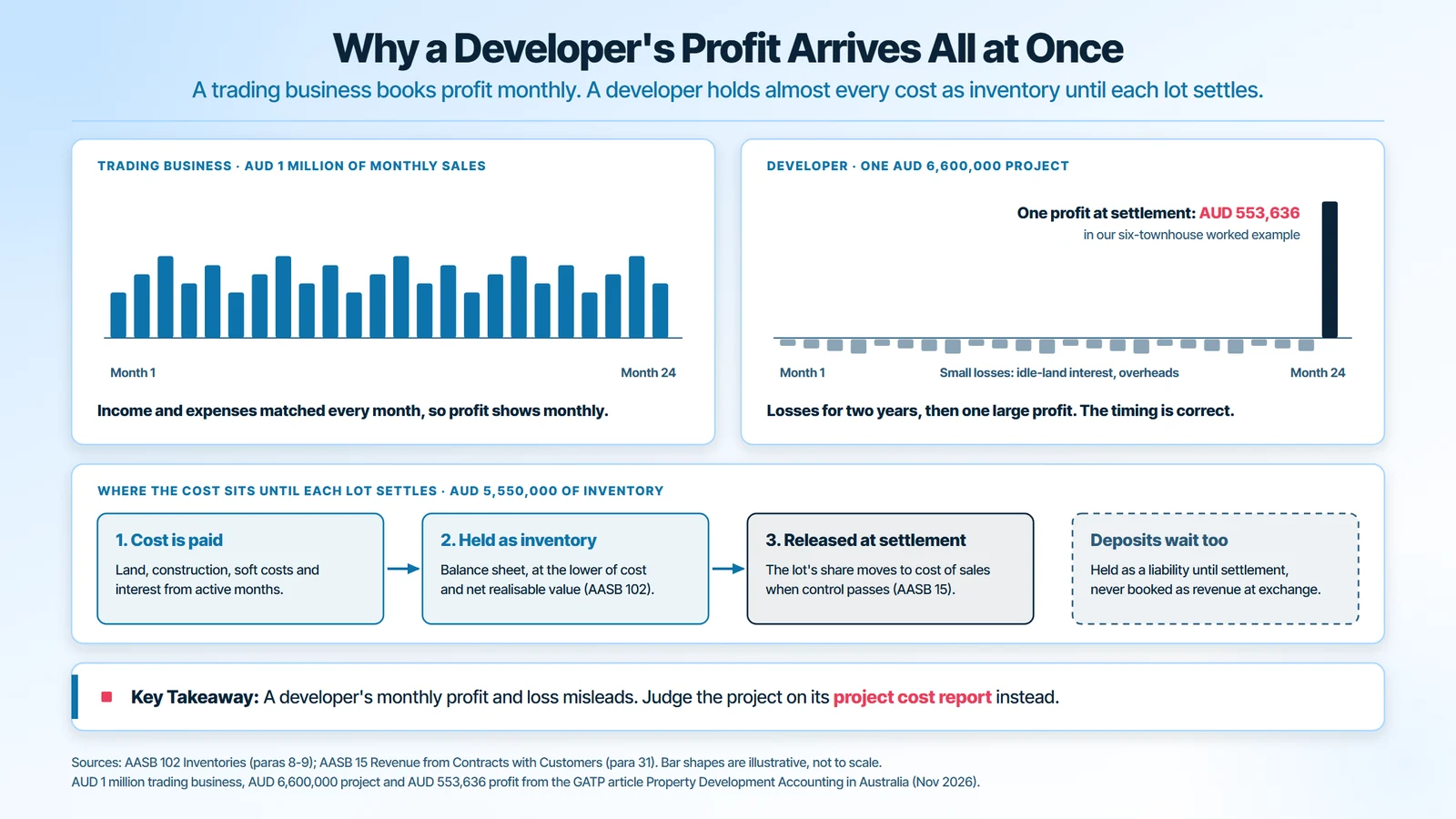
Standard business accounting matches income and expenses every month. Property development accounting does the opposite. It holds almost every cost on the balance sheet until a sale settles.
A trading business with AUD 1 million of monthly sales can report a profit every month. A developer with a AUD 6,600,000 project can show a loss for two years, then one large profit at settlement. That timing is correct, and it is why a standard monthly profit and loss report misleads a developer.
Property Developer or Property Investor: Why the Books Differ
A property developer builds to sell, so the land and buildings are trading stock. A property investor builds or buys to hold and rent, so the asset sits on capital account. The ATO says how you go about building or renovating, as a one-off or as a regular activity, changes your tax obligations on property development.
That is why property developer accounting treats the land as stock from day one. The choice drives everything below it. It decides where costs are coded, how GST works on the sale and which company tax rate applies. Record the intention in the board minutes when the land is bought, not when it is sold.
Why Does Property Development Accounting Matter for Developers?
Property development accounting matters because the largest numbers in the project are decided by bookkeeping choices. On a six-townhouse project in our worked example, the margin scheme alone changes GST by AUD 163,636. The company tax rate can move by 5 percentage points on the same profit.
Three things break when the books are wrong:
- GST: A missing margin scheme clause means GST on the full price, and the ATO cannot fix it after the parties disagree.
- Finance: Lenders release progress draws against cost to complete. A cost report that does not reconcile delays the next draw.
- Profit: Interest charged to the project at the wrong time overstates the inventory and the final margin.
The developer carries the risk on each of these. The bookkeeper and the registered agent can only work with what the ledger shows.
What Changed for Property Developers in 2026
Two changes in 2026 matter for development groups. Both affect how a group is structured and reported.
- Company size thresholds: ASIC notes the Government is consulting on the 2026-27 Budget proposal to lift the large proprietary company thresholds. Consolidated revenue would rise from AUD 50 million to AUD 100 million, and gross assets from AUD 25 million to AUD 50 million. The change is not yet in effect.
- Base rate entity checks: The ATO’s base rate guidance, updated in April 2026, added examples of companies that lose the 25 percent rate because net capital gains push passive income too high.
A development group holding AUD 25 million of land across several projects can meet the assets test today. Until the thresholds change, any two of the three tests make the group large. A large proprietary company must lodge an audited financial report each year, while a small one usually does not.
How Does Property Development Accounting Work?
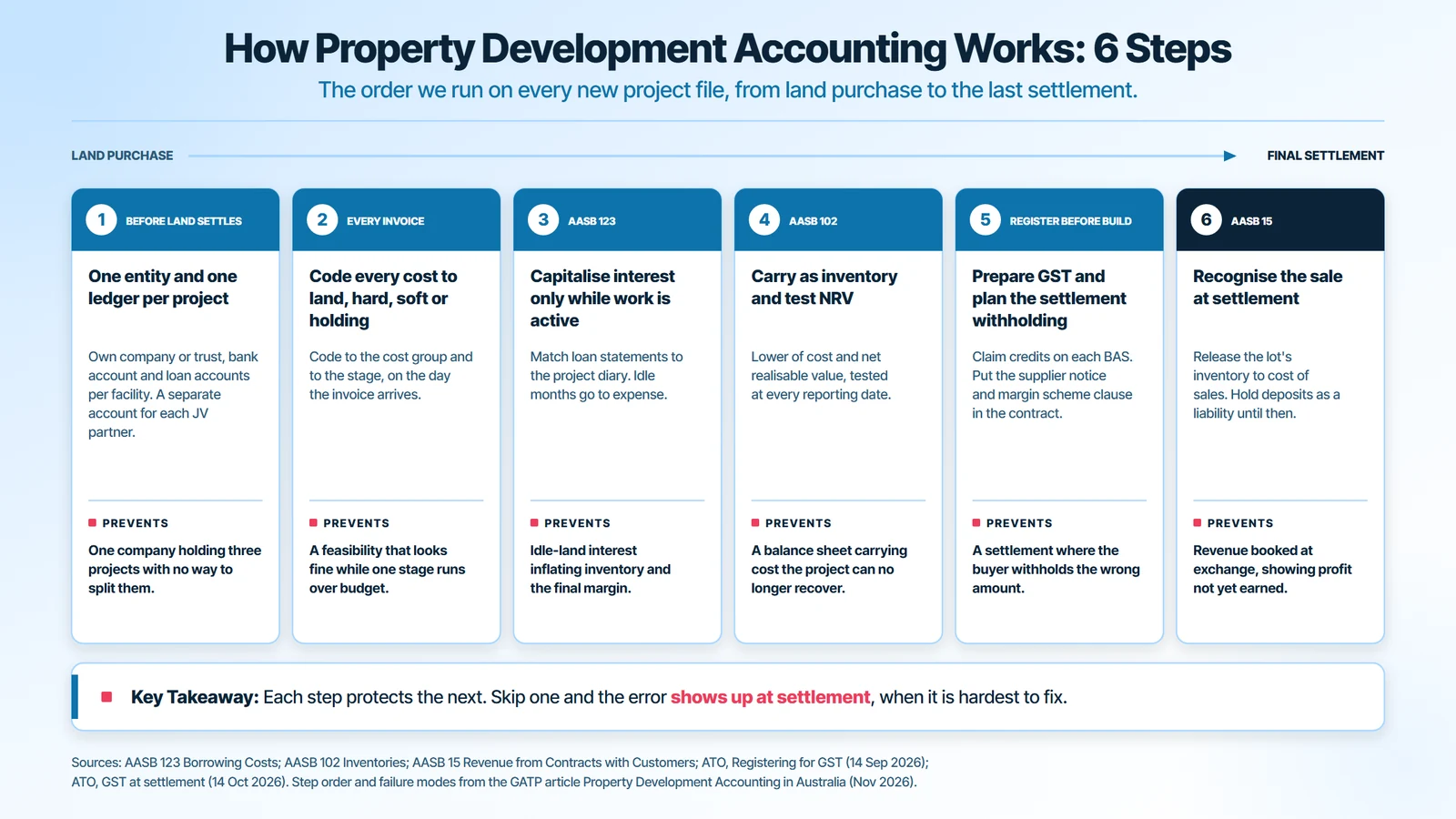
Property development accounting works as a sequence that runs from land purchase to final settlement. Each step protects the one after it. Skip a step and the error shows up at settlement, when it is hardest to fix.
The six steps below are the order we run on every new project file.
Step 1: Set Up One Entity and One Set of Books for Each Project
Accounting for property development company structures starts with one entity, one bank account and one ledger per project. Group several projects in one company and their costs, loans and GST mix together. Lenders and joint venture partners then cannot see a clean position for their project.
Set up the chart of accounts before the land settles:
- Inventory accounts for land, hard costs, soft costs and capitalised interest.
- A loan account for each facility, split into land and construction tranches.
- A separate account for each joint venture partner’s contribution.
- GST accounts that separate credits on costs from GST on sales.
Keep every contract, invoice and loan statement in the project file. The ATO expects most business records to be kept for 5 years. This step prevents the most common failure we see: one company holding three projects with no way to split them.
Step 2: Code Every Cost to Land, Hard, Soft or Holding Costs
Code every invoice to one of four cost groups on the day it arrives. Land covers the purchase price, stamp duty and legal fees. Hard costs cover the builder’s progress claims. Soft costs cover design, approvals and finance fees, and holding costs cover rates, land tax and interest.
Code to the stage as well as the group. A cost report by stage shows where the budget is slipping while there is still time to act. This step prevents a feasibility that looks fine on paper while one stage runs over budget.
Step 3: Capitalise Loan Interest Only While Development Is Active
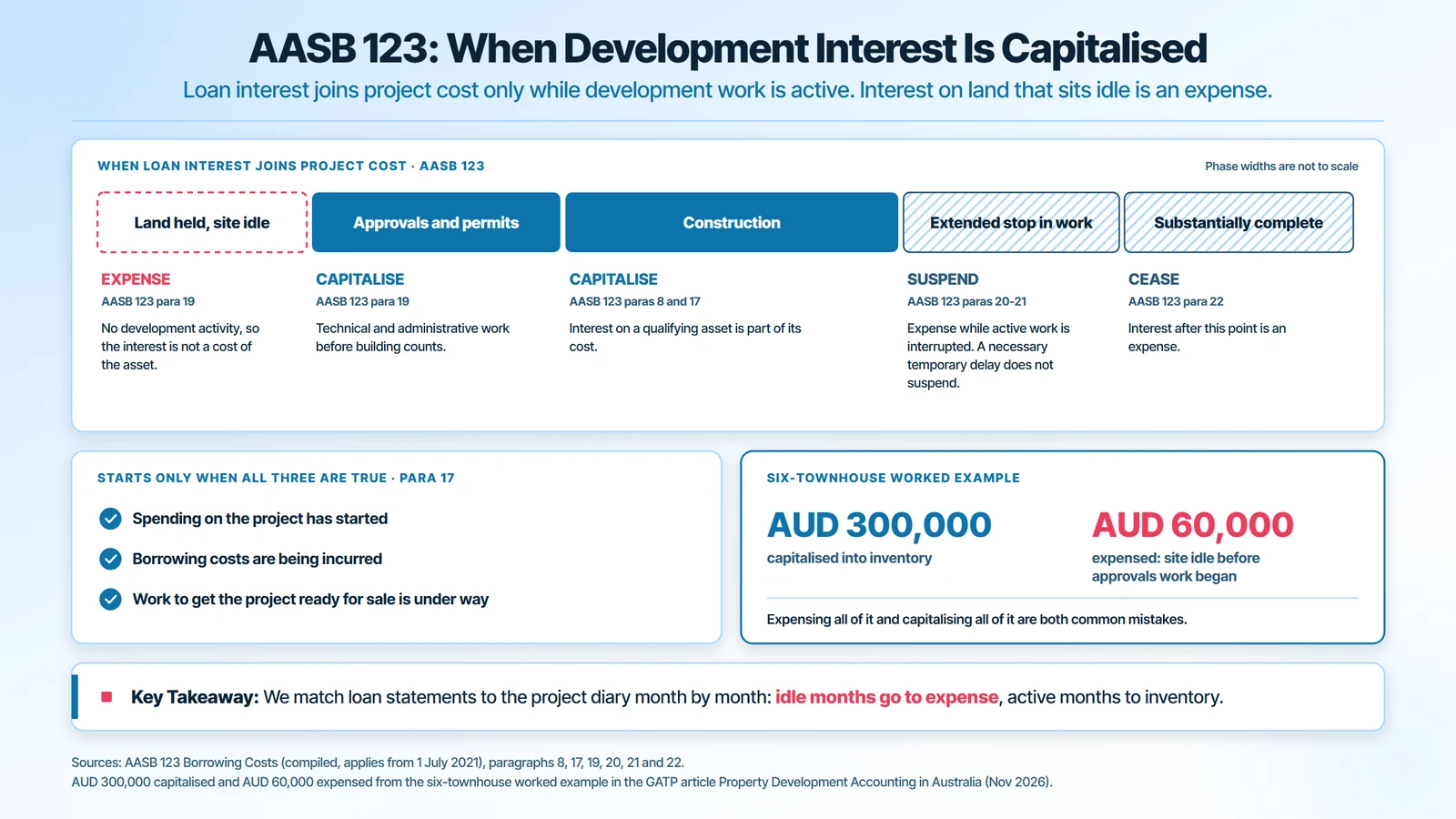
Loan interest joins the project cost only while the land is being developed. AASB 123 paragraph 8 requires interest on a qualifying asset to be capitalised as part of its cost. Paragraph 19 says interest on land held with no development activity does not qualify.
Work on permits before construction counts as development activity. Capitalisation pauses during an extended stop in work. It ends when substantially all the work is complete.
GATP Accountant’s Note: On a new development file, we match the loan statements against the project diary month by month. Interest from months when the site sat untouched goes to expense. Interest from months with approvals or building work goes to inventory. This one check is the most common correction we make when we take over a development file.
Step 4: Carry the Project as Inventory and Test Net Realisable Value
A development held for sale is inventory. AASB 102 paragraph 8 lists land and other property held for resale as inventory. Paragraph 9 measures it at the lower of cost and net realisable value.
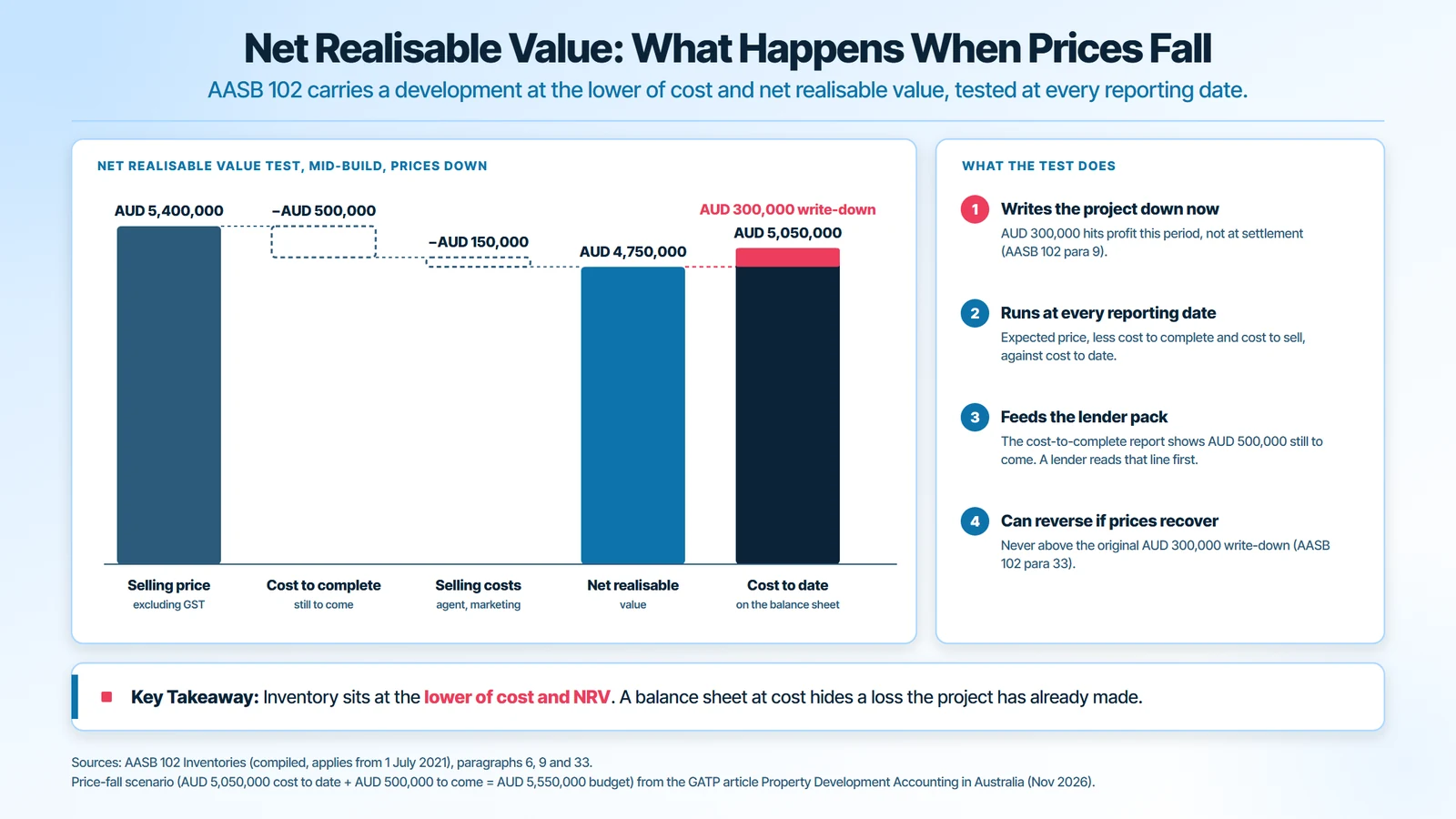
Net realisable value is the expected selling price less the costs to complete and the costs to sell. Run the test at every reporting date. When the value falls below cost, write the project down in that period. This step stops a balance sheet from showing a project at a cost it can no longer recover.
Step 5: Prepare GST on Each BAS and Plan the Settlement Withholding
A development company registers for GST once its turnover reaches the AUD 75,000 GST registration threshold. Most projects pass it on the first sale. Register before construction starts so the credits on building costs can be claimed on each BAS.
Plan the sale side at the same time. The contract must carry the supplier notice for GST at settlement and, where it applies, the margin scheme clause. This step prevents a settlement where the buyer withholds the wrong amount.
Step 6: Recognise the Sale at Settlement and Release Cost of Sales
Revenue is recognised when the buyer obtains control of the lot. AASB 15 paragraph 31 sets that rule, and the transfer of legal title is one sign that control has passed. For a typical off-the-plan sale, that point is settlement, not exchange.
At settlement, release that lot’s share of inventory to cost of sales. Hold deposits as a liability until then. This step prevents a profit and loss that books revenue on exchange and shows profit the project has not earned.
How Should Cost Be Classified in Property Development Accounting?
Accounting for property development costs follows 4 groups, and each group has its own accounting and GST treatment. Getting the group right on day one decides what sits in inventory, what is expensed and what GST can be claimed. The table shows each group at a glance.
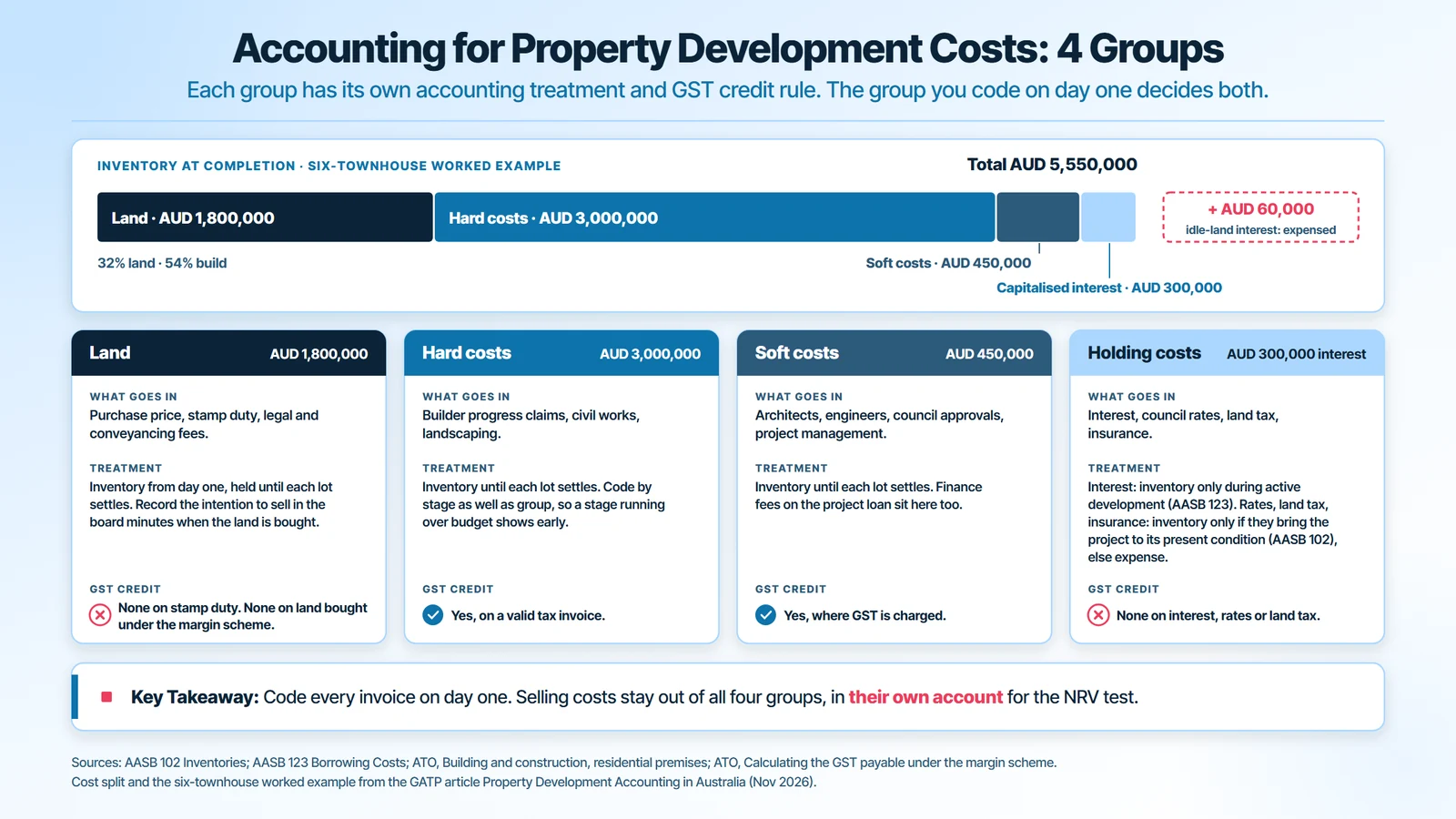
| Cost group | What goes in it | Accounting treatment | GST credit |
| Land | Purchase price, stamp duty, legal and conveyancing fees | Inventory | None on stamp duty; none on land bought under the margin scheme |
| Hard costs | Builder progress claims, civil works, landscaping | Inventory | Yes, on a valid tax invoice |
| Soft costs | Architects, engineers, council approvals, project management | Inventory | Yes, where GST is charged |
| Holding costs | Interest, rates, land tax, insurance | Interest is capitalised only during active development (AASB 123). Rates, land tax and insurance go into inventory only to the extent they bring the project to its present condition (AASB 102), otherwise they are expensed | None on interest, rates or land tax |
On our six-townhouse worked example, the first three groups plus capitalised interest add up to AUD 5,550,000 of inventory. Selling costs, such as agent commission and marketing, follow the sale. Keep them in their own account so the net realisable value test can use them.
How Does GST Apply to a Property Development?
GST on property development applies to the sale of new residential premises and potential residential land. The developer pays GST on the sale and claims GST credits on construction costs. Three rules set how much GST is paid and when.
Each rule fails in a different way, so each one gets its own check below.
GST at Settlement: One Eleventh or 7 Percent Withheld by the Buyer
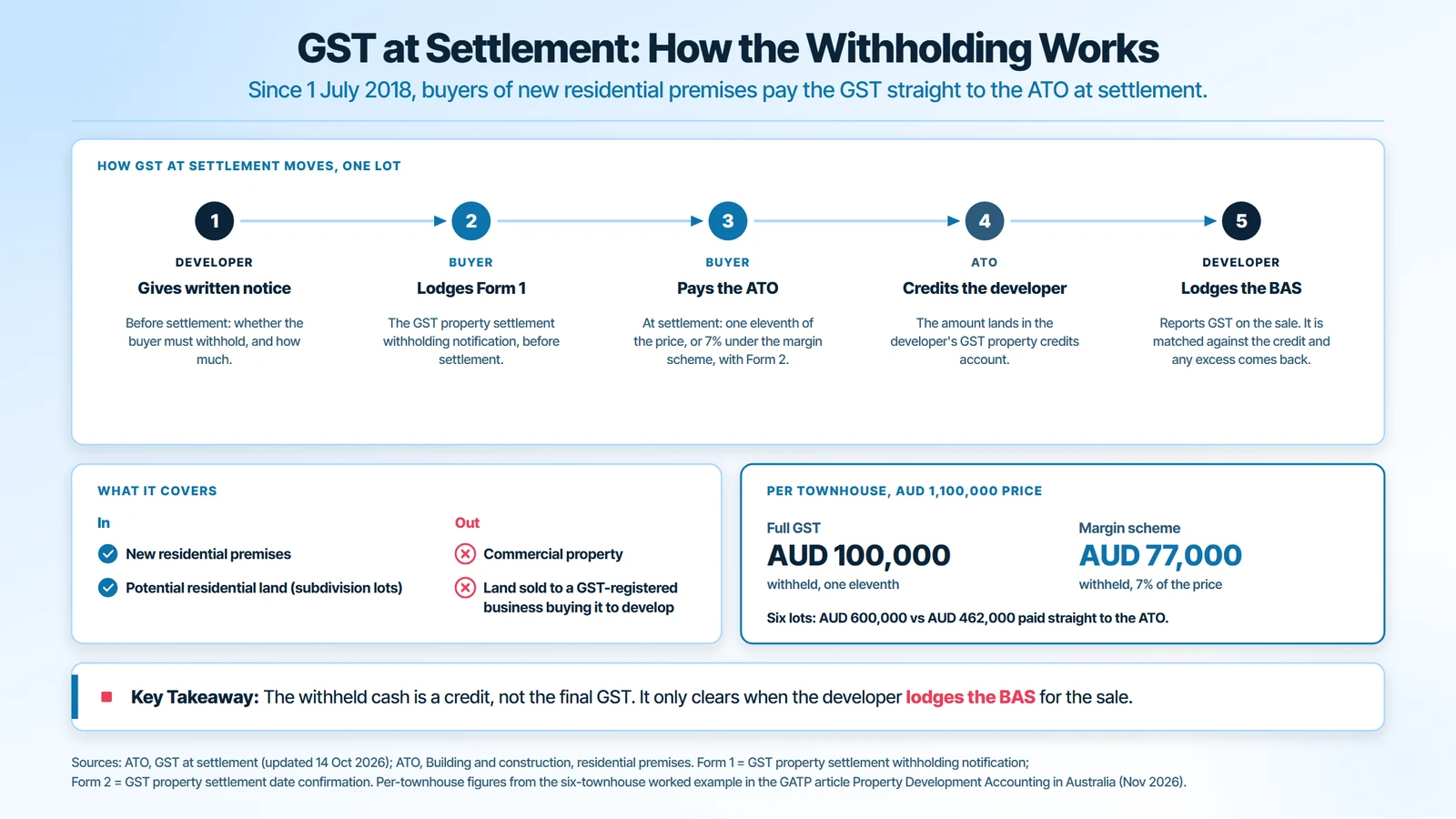
Since 1 July 2018, buyers of new residential premises withhold GST at settlement and pay it straight to the ATO. The amount is one eleventh of the contract price, or 7 percent under the margin scheme. The ATO’s GST at settlement rules require the developer to give the buyer a written notice before settlement.
The withheld amount lands in the developer’s GST property credits account. The ATO matches it against GST on the sale when the developer lodges the BAS. Commercial property is excluded.
The Margin Scheme Needs a Written Agreement Before Settlement
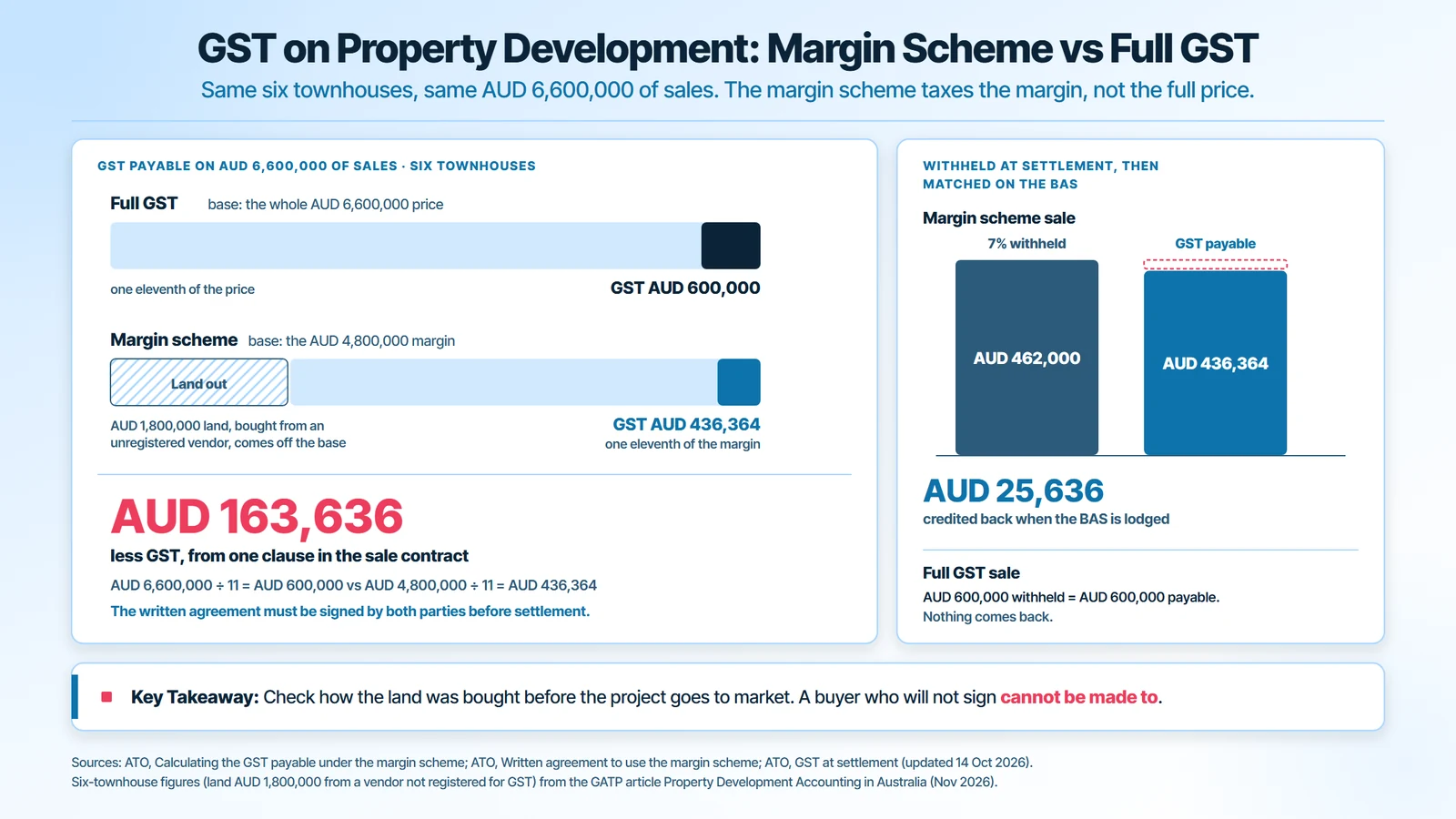
The margin scheme charges GST on the margin, not the full sale price. GST is one eleventh of the sale price less what the developer paid for the land, when the land was eligible. The ATO requires a written margin scheme agreement signed by both parties before settlement.
Renting Unsold Stock Changes Your GST Credits
A developer who rents out unsold new homes must adjust part of the GST credits claimed on them. The ATO’s rules on new residential premises say active marketing shows the intention to sell. After more than 5 years of continuous renting, the premises are no longer new.
Track rented stock in its own account. Record each month the lot is leased, so the credit adjustment can be worked out.
Property Development Tax: Capital or Revenue, and the 25 or 30 Percent Rate
Property development tax starts with one question: is the profit on revenue account or capital account? A developer selling trading stock earns ordinary income. Capital gains tax on property development applies when the land is held on capital account, for example a long-held site sold as the mere realisation of an asset. Whether a subdivision stays on capital account turns on the facts, so your registered tax agent confirms it.
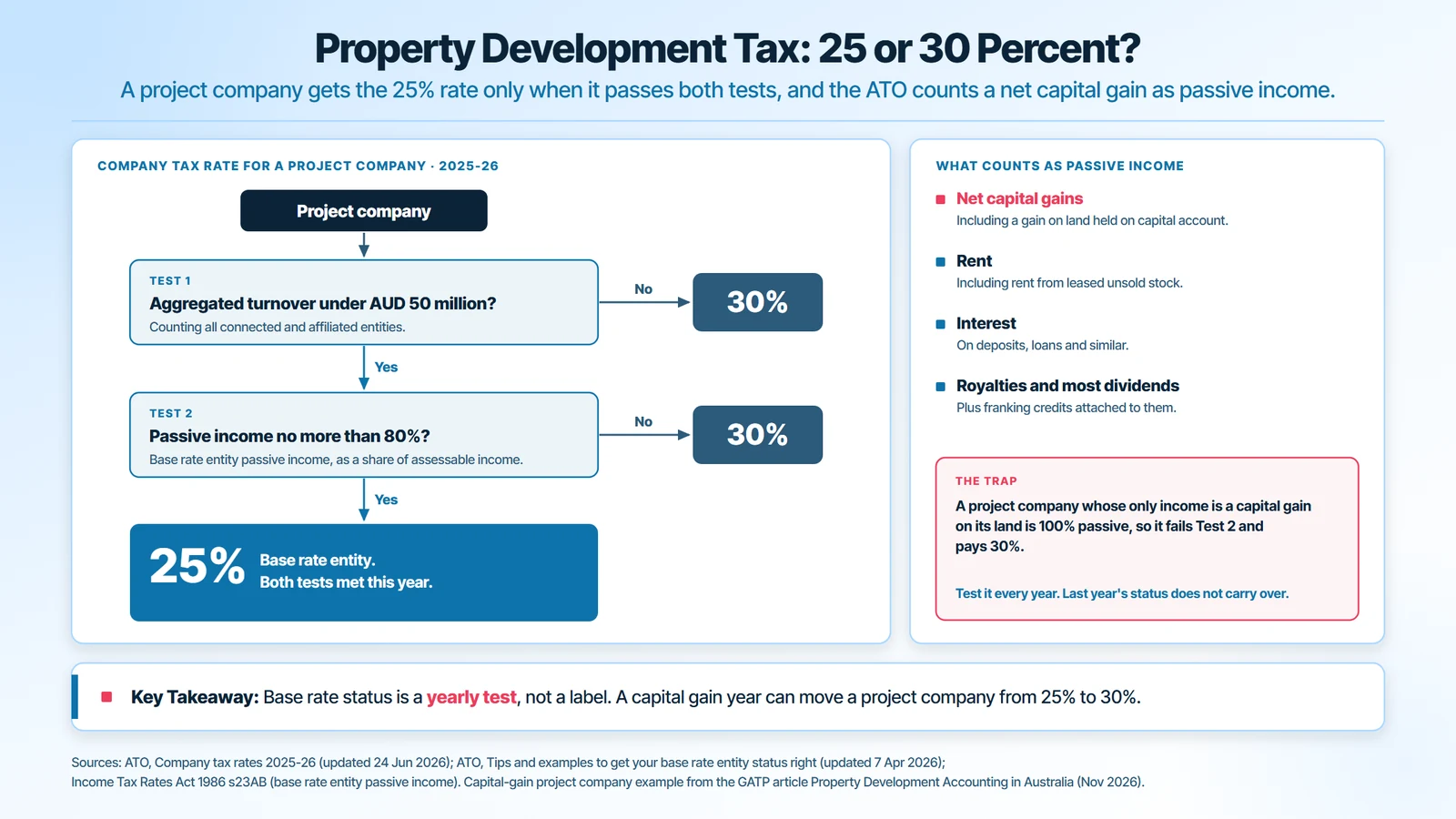
For a project company, that classification also sets the company tax rate. The ATO’s 2025-26 company tax rates are 25 percent for a base rate entity and 30 percent otherwise. A company qualifies only when both tests below are met.
- Aggregated turnover is under AUD 50 million, counting all connected and affiliated entities.
- No more than 80 percent of assessable income is passive income.
The ATO’s base rate entity guidance counts a net capital gain as passive income. A project company whose only income is a capital gain on its land can fail the test. GATP prepares the classification in the books. Your registered tax agent confirms the position and lodges the return.
Worked Example: Six Townhouses From Land Purchase to Settlement
A worked example on one six-townhouse project shows how the accounting runs from land to settlement. The figures are illustrative. They are sized for a developer turning over AUD 1 million to AUD 10 million a year.
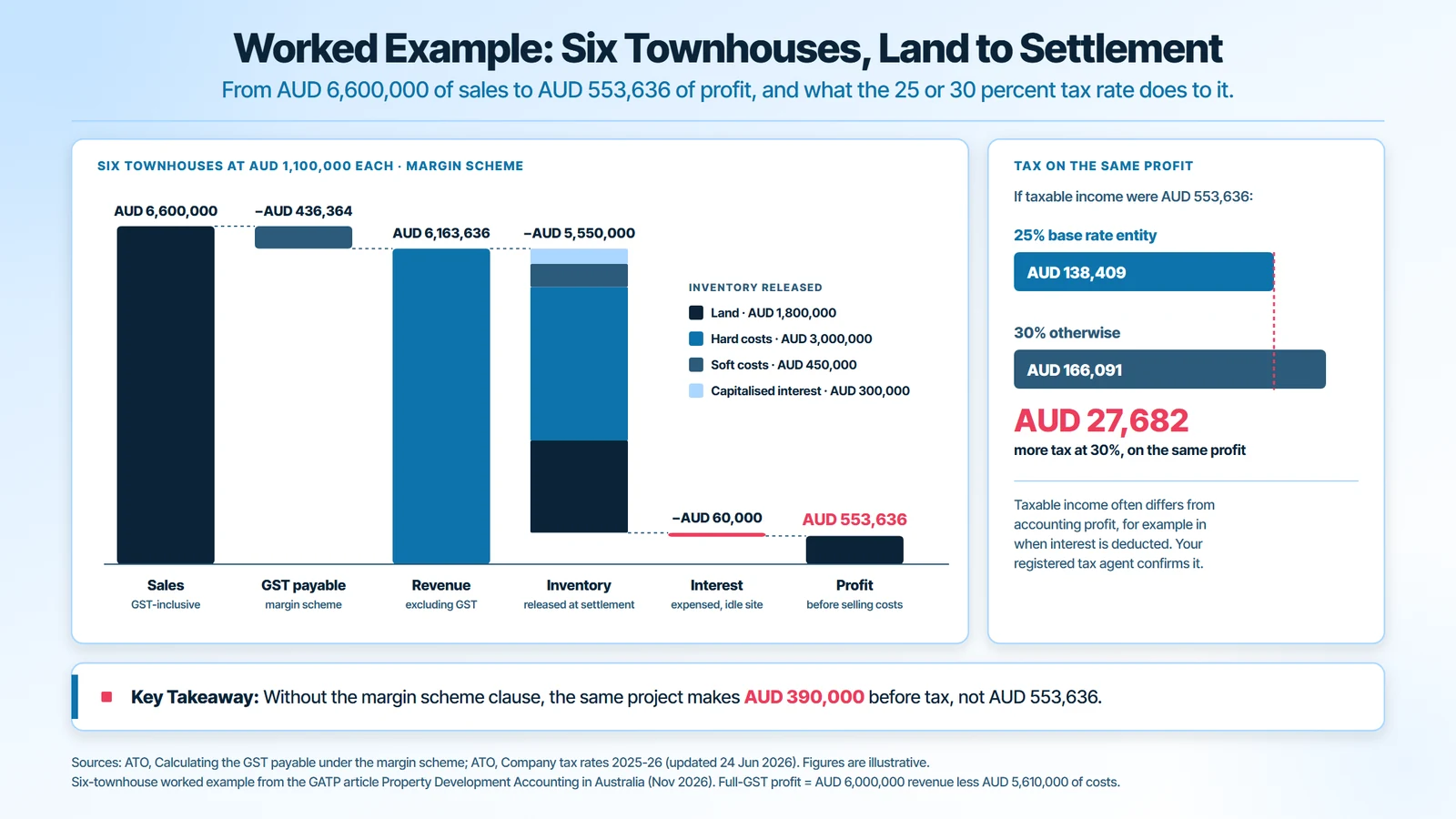
- Land: AUD 1,800,000, bought from a vendor not registered for GST.
- Construction: AUD 3,000,000, excluding GST.
- Soft costs: AUD 450,000, excluding GST.
- Interest during development: AUD 300,000, capitalised. Another AUD 60,000 accrued while the site sat idle before approvals work began, so it is an expense.
- Inventory at completion: AUD 5,550,000.
- Sales: six townhouses at AUD 1,100,000 each, GST-inclusive, so AUD 6,600,000.
Using the ATO’s method for calculating GST under the margin scheme, the two outcomes compare as follows:
| Line | Full GST | Margin scheme |
| GST base | AUD 6,600,000 | AUD 4,800,000 margin |
| GST payable (one eleventh) | AUD 600,000 | AUD 436,364 |
| Withheld by buyers at settlement | AUD 600,000 | AUD 462,000 (7 percent) |
| Credit back on the BAS | Nil | AUD 25,636 |
Under the margin scheme, revenue excluding GST is AUD 6,163,636. Less AUD 5,550,000 of inventory and AUD 60,000 of expensed interest, the accounting profit before selling costs is AUD 553,636. If taxable income were the same amount, the gap between a 25 and a 30 percent tax rate would be AUD 27,682. Taxable income often differs from accounting profit, for example in when interest is deducted.
What the Net Realisable Value Test Does When Prices Fall
Say prices fall mid-build, and the six townhouses would now sell for AUD 5,400,000 excluding GST. AUD 500,000 of cost is still to come and selling costs are AUD 150,000. Net realisable value is AUD 4,750,000.
Cost to date is AUD 5,050,000, so the project is written down by AUD 300,000 in that period. The write-down shows the loss when it happens, not at settlement.
How the Same Rules Play Out on Three Other Developer Projects
The same steps apply across project types, with a different pressure point on each.
- Land subdivider: Potential residential land is inside GST at settlement too, so each lot sale needs the supplier notice. The exception is a sale to a GST-registered business buying the land to develop it. Civil works are hard costs held in inventory until each lot settles.
- Builder-developer: A builder that develops its own sites runs two sets of rules. The project company follows this article, and the building company follows our guide to bookkeeping for construction companies.
- Developer with a rent roll: A group that keeps some finished homes and manages them needs trust accounting on the rental side. Our real estate bookkeeping page covers that work.
What Reports Do Lenders and Investors Want From a Property Developer?
Lenders want proof that the project can still be finished on budget. Investors and joint venture partners want to see their share of the cost and the expected profit. Both need the same numbers, reported monthly.
A standard monthly reporting pack for a development project holds five reports:
- Cost to complete: budget, cost to date and cost still to come, by cost group and stage.
- Feasibility against actual: the original feasibility beside the current forecast, with the margin on both.
- Loan reconciliation: facility limit, amount drawn, interest capitalised and headroom.
- Pre-sales register: exchanged contracts, deposits held and expected settlement dates.
- GST position: credits claimed, GST expected at settlement and the margin scheme status of each lot.
On our worked example, the cost-to-complete report would show AUD 500,000 still to come in the month of the price fall. A lender reads that line first.
Common Property Development Accounting Mistakes
The same six mistakes appear on most development files we take over. Each one is cheap to prevent and expensive to unwind after settlement.
- Mistake 1: Several projects in one company. Fix: open a new entity and ledger before the next land contract.
- Mistake 2: Expensing all interest. Fix: capitalise interest for the months with active development, as AASB 123 requires.
- Mistake 3: Capitalising all interest. Fix: expense interest for months when the site sat with no work.
- Mistake 4: No margin scheme clause. Fix: confirm eligibility before the contract goes to the agent. On our example, the cost is AUD 163,636.
- Mistake 5: Revenue booked at exchange. Fix: hold deposits as a liability and recognise the sale at settlement.
- Mistake 6: Base rate status assumed every year. Fix: test the 80 percent passive income limit each year, because a capital gain counts.
Why Is Outsourcing Accounting Services Beneficial for Property Developers?
Outsourcing gives a developer a team that runs project ledgers every day, without hiring for work that peaks around each settlement. A single project can sit quiet for months, then need a full GST, inventory and lender pack in one week. A property development accountant on staff is hard to justify for that pattern.
Here is how the work splits when you outsource it:
- Moves to the outsourced team: project ledgers, cost coding, interest allocation, BAS preparation, net realisable value workings and the monthly lender pack.
- Stays with you: approving payments, signing contracts and deciding the capital or revenue intention.
- Stays with your registered agent: lodging the BAS and income tax return. The Tax Agent Services Act 2009 limits paid tax and BAS services to registered agents.
Switching starts with read access to the existing file and loan statements. We rebuild each project’s cost report first, then take over the monthly cycle. Where the development company employs site staff, we can run their pay through our payroll outsourcing service as well.
How Can GATP Help With Property Development Accounting?
GATP runs property development accounting for Australian developers inside your own Xero, MYOB or QuickBooks file. The work covers project entity setup, cost coding into the four groups and interest allocation under AASB 123. It also covers the net realisable value test, GST credits and settlement withholding, and the monthly lender and investor pack.
Year-end financial reports for the group sit inside our outsourced accounting services. We prepare the BAS and the year-end file. Your registered agent reviews and lodges them.
The Short Version
- Run each project through its own entity and ledger, and hold its costs as inventory until each lot settles.
- Capitalise interest only for months with active development work, under AASB 123.
- Get the margin scheme clause into the contract before settlement: on a AUD 6,600,000 project it saved AUD 163,636 of GST.
- Expect buyers to withhold one eleventh, or 7 percent under the margin scheme, at settlement.
- Check base rate status every year: a net capital gain counts toward the 80 percent passive income limit.
Conclusion: Property Development Accounting in 2026
Property development accounting works when each project has its own books, every cost sits in the right group and the GST position is settled before the contract goes out. On a AUD 6,600,000 project, that order of work protected AUD 163,636 of GST. Your next decision is whether those project ledgers run in-house or with a team that runs development files every month.
Find out what your current project will really make
Send us your feasibility, your loan statements and your cost report for one live project. We will check the interest allocation, the margin scheme position and the net realisable value of the stock. You get a written summary within 5 business days.
Frequently Asked Questions About Property Development Accounting
Does a property development company need to register for GST?
A property development company must register for GST once its GST turnover reaches AUD 75,000, and almost every project passes that on its first sale. Register before construction starts. Early registration lets the company claim GST credits on building costs from the first BAS, instead of waiting until the first settlement.
How long must a property developer keep records?
A property developer should keep most business records for 5 years, the period the ATO sets for most business records. For a development, keep the full trail from the land contract to the last settlement. That includes the margin scheme agreement, loan statements and every builder’s progress claim, because the project file is reviewed as one unit.
How do you account for joint venture contributions in a development?
Joint venture contributions are recorded in a separate account for each partner, exactly as the joint venture agreement defines them. Cash, land and in-kind work each go in at the value the agreement sets. Each partner’s share of costs and sale proceeds then follows the ratio the agreement sets. Keep each partner’s statement reconciled monthly, so distributions match what each partner put in.
Can a property developer claim GST credits on construction costs?
A GST-registered developer building new homes for sale can generally claim GST credits on construction costs and related purchases. The developer claims the credits on the BAS for the period of each tax invoice. If the finished homes are rented instead of sold, part of those credits must be adjusted back, so rented stock needs its own records.
Who lodges the BAS for a development company?
A registered tax or BAS agent lodges the BAS for a development company, or the company lodges it itself. Only registered agents can provide BAS services for a fee in Australia. An outsourced team can prepare the BAS figures and reconciliations, which the registered agent then reviews before lodging it with the ATO.