You just sold a rental property for $800,000. You bought it for $350,000 and claimed $100,000 of depreciation along the way. A cost segregation study is usually what made that depreciation figure so large so fast. Your realized gain is $550,000, and at the top long term rate the federal bill on that gain reaches $135,900 before your state takes a cut. There is a legal way to defer all of it. Careful tax planning around Section 1031 keeps that money working in your portfolio instead of leaving it. This guide walks through every 1031 exchange rule, deadline, and disqualifier that applies in 2026.

What Is a 1031 Exchange in Real Estate?
A 1031 exchange is a transaction under Section 1031 of the Internal Revenue Code that lets an investor sell one investment property, buy another, and defer the capital gains tax on the sale. The tax is not erased. It moves forward into the replacement property through a carried over basis. The depreciation recapture on a rental property moves with it, and it carries its own 25 percent ceiling rather than the capital gains rate.
The rules narrowed in 2018. According to the IRS Instructions for Form 8824, “For 2018 and later years, section 1031 like-kind exchange treatment applies only to exchanges of real property held for use in a trade or business or for investment, other than real property held primarily for sale.” Equipment, vehicles, and partnership interests no longer qualify.
Two words in that sentence decide most audits: “held for.” Section 1031 sets a purpose test, not a time test. There is no statutory minimum holding period. What matters is documented investment intent, which is why the paperwork behind an exchange matters as much as the timing.
How a 1031 Exchange Works Step by Step
A 1031 exchange runs as a fixed sequence of six steps, and skipping any one of them ends the deferral. The order is not flexible. In particular, the intermediary has to be engaged before the first closing, not after.
Here is the sequence every compliant exchange follows.
- Step 1. Engage a Qualified Intermediary and sign the exchange agreement before the sale closes.
- Step 2. Sell the current investment property, called the relinquished property.
- Step 3. The Qualified Intermediary receives the sale proceeds directly. You never take possession of the funds.
- Step 4. Identify the replacement property in writing within 45 days.
- Step 5. Close on the replacement property within the exchange period.
- Step 6. Report the exchange on Form 8824 with the tax return for the year of the transfer.
Investors who hold property through funds and multi member entities carry an extra layer here, because title, capital accounts, and intercompany balances all have to line up before the first closing. Clean real estate fund accounting is what makes that possible on a 45 day clock.
1031 Exchange Timeline: The 45 Day and 180 Day Deadlines
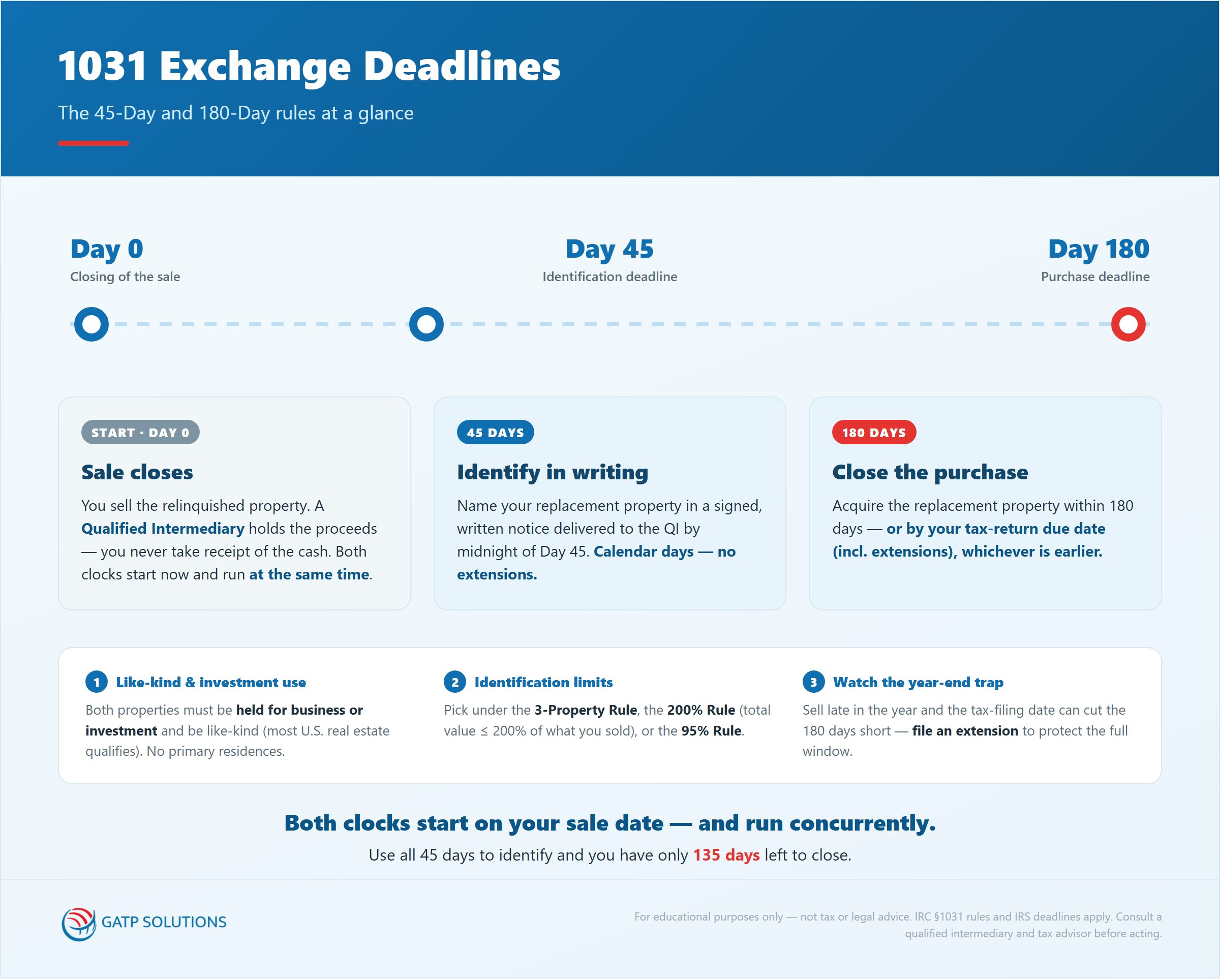
The 1031 exchange timeline is governed by two clocks that start on the same day and run at the same time. Both begin on the date you transfer the relinquished property. Missing either one converts the whole transaction into a taxable sale, and the IRS grants no discretionary extensions.
The exact wording of both periods matters more than most investors realise.
The 45 Day Identification Period
The identification period ends at midnight on the 45th day after the transfer. Treasury Regulation 1.1031(k)-1(b)(2)(i) states that “The identification period begins on the date the taxpayer transfers the relinquished property and ends at midnight on the 45th day thereafter.” Weekends and federal holidays do not extend it. The identification must reach the Qualified Intermediary in writing, and a verbal instruction is worth nothing.
The 180 Day Exchange Period Can End Well Before Day 180
The exchange period ends on the earlier of two dates, and this is the single most expensive misunderstanding in the 1031 exchange rules. The regulation reads that the exchange period “ends at midnight on the earlier of the 180th day thereafter or the due date (including extensions) for the taxpayer’s return.”
Read that against a real calendar. An individual who closes a sale on 1 December 2026 does not get until late May 2027. The return due date of 15 April 2027 arrives first, which leaves 135 days rather than 180. Filing a valid extension restores the full 180 days. Investors who sell in the fourth quarter and plan to file on time routinely lose six weeks of searching without knowing it.
How to Identify Property So the IRS Accepts It
An identification only counts if the property is described unambiguously in the written notice. Treasury Regulation 1.1031(k)-1(c)(3) states that “Real property generally is unambiguously described if it is described by a legal description, street address, or distinguishable name.” A phrase such as “a retail building in Phoenix” fails. A street address, a parcel number, or a named building such as the Mayfair Apartment Building passes.
The Three Identification Rules
The regulations give you three ways to identify replacement property, and you pick one. All three appear in Treasury Regulation 1.1031(k)-1(c)(4).
- The 3 property rule. Identify up to three properties without regard to their fair market values. Most investors use this.
- The 200 percent rule. Identify any number of properties as long as their combined fair market value does not exceed 200 percent of the value of everything you sold.
- The 95 percent rule. Identify any number of properties of any value, but you must actually acquire at least 95 percent of the total value identified.
When the IRS Postpones Your Deadlines
A federally declared disaster can postpone both deadlines by 120 days, and almost no investor knows the relief exists. Section 17 of Revenue Procedure 2018-58 states that the last day of the 45 day identification period and the last day of the 180 day exchange period “are postponed by 120 days or to the last day of the general disaster extension period authorized by an IRS News Release or other guidance announcing tax relief for victims of the specific federally declared disaster, whichever is later.”
Three conditions control it. The relinquished property must have transferred on or before the disaster date. The IRS must have issued a news release or other guidance for that specific disaster, because a Federal Emergency Management Agency declaration alone does nothing. And the postponement can never run past the return due date including extensions, or past one year.
Relief is not limited to investors inside the disaster area. It also applies when the principal place of business of any party to the transaction sits in the covered area, when exchange documents or land records are destroyed, or when a lender declines to fund the closing because of the disaster.
What Qualifies as Like Kind Property?
Like kind property for a 1031 exchange means any real property held for investment or for productive use in a trade or business, exchanged for other real property held the same way. The definition is far broader than most sellers expect. Grade and quality do not matter, only the character of the interest.
The 1031 exchange rules let you exchange a single family rental for a strip mall. You can exchange raw land for an apartment building, or a warehouse for a medical office condominium. All of it is like kind.
What does not qualify:
- A primary residence, because it is not held for investment
- Property held primarily for sale, which covers flips and builder inventory
- Stocks, bonds, and notes
- Partnership interests, which are not real property
- Any personal property, following the 2018 change described above
The Qualified Intermediary Rules and Who You Cannot Use
A Qualified Intermediary is an independent party who takes the sale proceeds, holds them outside your control, and applies them to the replacement property purchase. Touching the money yourself, even for a day, ends the exchange. The choice of intermediary is where do it yourself exchanges fail most often.
Here the 1031 exchange rules are stricter than “pick someone independent,” because the disqualification test reaches backwards two years.
Treasury Regulation 1.1031(k)-1(k)(2) provides that “a person who has acted as the taxpayer’s employee, attorney, accountant, investment banker or broker, or real estate agent or broker within the 2-year period ending on the date of the transfer of the first of the relinquished properties is treated as an agent of the taxpayer at the time of the transaction.” An agent cannot serve as your intermediary.
So the accountant who prepared your return two years ago is disqualified. So is the broker who leased your building last spring. The regulation carves out two categories of work that do not taint a person: services performed on prior Section 1031 exchanges, and routine financial, title insurance, escrow, or trust services provided by a financial institution or title company.
Qualified Intermediaries are not federally licensed or federally regulated. Nobody audits their trust accounts for you. Ask where the funds sit, whose name is on the account, whether the account is segregated, and what bonding and fidelity coverage exists before you sign.
The Four Types of 1031 Exchange
Four exchange structures exist, and the one you choose changes the deadlines you have to manage. Most investors use the delayed exchange without ever considering the alternatives. The other three solve specific timing problems.
Here is how the four compare.
| Exchange Type | How It Works | Key Requirement | Timing | Best Fit For |
|---|---|---|---|---|
| Delayed exchange | You sell first, then buy the replacement. | Standard 45 day and 180 day deadlines. | Sell before you buy. | Most investors. The simplest path. |
| Reverse exchange | You buy the replacement first, then sell. | An Exchange Accommodation Titleholder parks the new property. | Buy before you sell. | Investors who find the right property before selling. |
| Improvement exchange | You use the proceeds to build on or improve the replacement. | All improvements finish inside the exchange period. | Build within 180 days. | Investors developing or upgrading a property. |
| Simultaneous exchange | Both properties close on the same day. | Precise coordination between every party. | Same day close. | Rare deals with tight, controlled timing. |
Reverse 1031 Exchange: The Safe Harbor Rules
A reverse 1031 exchange is a structure where you acquire the replacement property before selling the property you are giving up. Because you cannot own both properties at once and still exchange them, an Exchange Accommodation Titleholder takes title to one of them and holds it. Revenue Procedure 2000-37 created the safe harbor that makes the arrangement work.
The parking period runs 180 days. Under the safe harbor the accommodation titleholder holds the parked property for no more than 180 days, and within that window either the parked replacement property transfers to you or the parked relinquished property transfers to a buyer. Revenue Procedure 2018-58 confirms the structure is still current and extends the same disaster postponement to its deadlines.
Two practical points decide whether a reverse exchange is worth it. First, you need the cash or the financing to buy before you sell, because the sale proceeds are not available yet. Second, the structure costs more than a delayed exchange, because it adds a separate single member entity, an accommodation agreement, and carrying costs on the parked property.
Drop and Swap 1031 Exchange Rules
A drop and swap is a structure where a partnership or limited liability company distributes real property to its members as undivided tenancy in common interests, and each member then completes an individual 1031 exchange. The problem it solves is common. Partnership interests are not real property, so a partner cannot exchange an interest in the entity, and partners who disagree about reinvesting have no other route.
The drop happens first, then the swap. The entity deeds out fractional interests, the members hold real property directly, and each one decides independently whether to exchange or cash out.
The risk sits entirely in the holding requirement. Section 1031 applies only to real property “held for use in a trade or business or for investment,” in the words of the Instructions for Form 8824. When an entity drops title days before a closing, the IRS can argue the individual member never held the property for investment at all, and that the partnership was the real seller. There is no statutory minimum holding period to point at, which cuts both ways.
Investors reduce that exposure by widening the gap between the drop and the sale, by having the tenancy in common owners actually behave like owners on reporting and distributions, and by documenting a business reason for the restructuring that is not the exchange itself.
What Is Boot and How Do You Avoid It?
Boot is any value you receive in an exchange that is not like kind real property, and you pay tax on it in the year of the exchange. The Instructions for Form 8824 define the amount to report as “Any cash paid to you by the other party; the FMV of other (non-like-kind) property you received, if any; and net liabilities assumed by the other party.”
Boot arrives in three ways, and the third one surprises people.
- Cash boot. You pull proceeds out of the exchange instead of reinvesting them.
- Value boot. You buy a replacement property that costs less than the one you sold.
- Mortgage boot. You take on less debt on the new property than you paid off on the old one, so the debt relief counts as value received.
Work the numbers on the property from the introduction. You sell for $800,000 with a $300,000 mortgage retired at closing, so $500,000 of equity reaches the intermediary. You then buy a replacement for $700,000 using all $500,000 of that equity plus a new $200,000 loan. There is no cash boot, because every dollar of equity was reinvested. Your debt dropped from $300,000 to $200,000, so the $100,000 of debt relief is mortgage boot. Your total boot is $100,000, not $200,000, because the drop in purchase price and the drop in debt are the same shortfall counted once.
The tax on it is not the 20 percent long term rate. Because you had claimed $100,000 of depreciation, the first $100,000 of recognised gain is unrecaptured Section 1250 gain, taxed at a maximum 25 percent under IRS Topic 409. Add the 3.8 percent net investment income tax and the bill is $28,800 on a deal you thought was tax free. The remaining $450,000 of gain still defers.
The avoidance rule is one sentence. Buy equal or greater in price and carry equal or greater debt, or bring outside cash to close the gap. Investors who accept some boot deliberately should also check how the recognised gain interacts with the passive activity loss rules for rental property, because suspended losses can absorb part of it.
Depreciation Recapture and Basis Carryover
A 1031 exchange defers depreciation recapture, it does not cancel it. Your adjusted basis follows you into the replacement property. The Instructions for Form 8824 confirm the mechanic: the figure carried to line 25 “is your basis in the like-kind property you received in the exchange.”
That carried basis is why the replacement property depreciates more slowly than a fresh purchase of the same price.
Take the same deal. You bought at $350,000, claimed $100,000 of depreciation, and hold an adjusted basis of $250,000. Exchange into an $800,000 building with no boot and your starting basis in the new property is $250,000 plus any new cash and debt added, not $800,000. Sell one day without exchanging again and the whole accumulated figure comes due, with the depreciation layer taxed at a maximum 25 percent.
Two moves work against that drag. Ordering a cost segregation study on the replacement property reallocates the carried basis and any new investment into shorter lived components, which accelerates deductions in the early years. Modelling the eventual exit tells you what the deferred bill actually is, and the arithmetic behind depreciation recapture on a rental property is what decides whether you exchange again or pay.
1031 Exchange Rules by Investor Situation
The 1031 exchange rules apply differently depending on how you hold title and what you plan to do with the replacement property. Three situations account for most of the real questions. Each one has a different failure point.
Find yours below.
You Own One Rental Property in Your Own Name
Your exchange is the simplest version and your only real risk is the calendar. Engage the intermediary before closing, identify by midnight on day 45 with a street address or legal description, and file an extension if you sell after 1 October so the return due date does not shorten your exchange period. One property, one identification, one closing.
You Own Property Through an LLC or Partnership
Entity held property exchanges at the entity level, so the LLC that sold has to be the LLC that buys. A single member limited liability company is disregarded and the member exchanges directly, which is why so many investors hold each property in its own entity. Where members disagree about reinvesting, the drop and swap covered above is the route, and the structure has to be in place well before a buyer appears. Investors carrying several entities usually clean up the structure first, because you cannot run a 45 day clock through an LLC consolidation. Funds and syndicates sit one layer above that, where capital accounts and investor allocations have to be defensible before a deed moves, and real estate fund accounting is what keeps them that way.
You Want to Move Into the Replacement Property Later
Converting a property acquired through a 1031 exchange into a residence triggers a five year lock before any home sale exclusion applies. IRS Publication 523 states that you cannot claim the exclusion if “You acquired your home in a like-kind exchange (also known as a section 1031 exchange)” and “You sold the home within 5 years of the date your home was acquired in the like-kind exchange.” You still have to own it for 24 months and live in it for 24 months of the last five years, and the $250,000 or $500,000 exclusion is prorated for the years of investment use.
California 1031 Exchange Rules and Form FTB 3840
California requires an annual information return for as long as a 1031 exchange keeps California gain deferred out of state. The Franchise Tax Board calls it Form FTB 3840, and investors leaving California for Texas, Nevada, or Arizona miss it constantly. The obligation has applied to exchanges in taxable years beginning on or after 1 January 2014.
The trigger is narrow and the duration is long.
The Franchise Tax Board instructions state that “All taxpayers who conduct an IRC Section 1031 exchange, regardless of residence status or commercial domicile, who exchange real property located in California for like-kind property located outside of California, must file form FTB 3840.” Residency is irrelevant. Selling California real property and buying outside the state is the whole test.
Filing is not once. Form FTB 3840 “must be filed for the taxable year of the exchange and for each subsequent taxable year, generally until the California sourced deferred gain or loss is recognized.” That can run for decades, and it continues even if you exchange the out of state property again. It ends when the California gain is finally recognised on a California return, when the property passes by inheritance, or when it is donated to a nonprofit. Franchise Tax Board compliance guidance lists those three exits and no others.
Stop filing and the state does the arithmetic for you. The Franchise Tax Board can issue a Notice of Proposed Assessment picking up the previously deferred gain, plus penalties and interest.
Delaware Statutory Trust Rules for a 1031 Exchange
A Delaware Statutory Trust is a legal entity that holds real property for multiple investors and can receive 1031 exchange proceeds, because the IRS treats each beneficial owner as holding an undivided fractional interest in the underlying real estate. Revenue Ruling 2004-86 settled the question in 2004. The ruling makes it a genuine option for an investor facing day 44 with nothing identified.
Qualification depends on how little the trustee is allowed to do.
Revenue Ruling 2004-86 holds that “A taxpayer may exchange real property for an interest in the Delaware statutory trust described above without recognition of gain or loss under section 1031, if the other requirements of section 1031 are satisfied.” That conclusion only holds where the trustee’s powers are limited to collecting and distributing income. A trustee who can sell and reinvest, accept new contributions, renegotiate leases or debt, or make structural changes turns the trust into a partnership, and a partnership interest is not like kind property.
The practical trade is control. You get institutional management, diversification across several properties, and a passive position that still defers the gain. You give up every decision about the asset, and interests are illiquid.
What Changed for 1031 Exchanges in 2026
Section 1031 itself was not amended for 2026, and the proposals to cap annual deferral did not become law. The 1031 exchange rules on the 45 day and 180 day periods, on identification, and on Form 8824 reporting all read the same as they did last year. What changed is the depreciation math on the property you exchange into.
One piece of guidance drives the difference.
On 14 January 2026 the Treasury Department and the IRS issued Notice 2026-11 on the additional first year depreciation deduction. The notice implements a “permanent 100-percent additional first year depreciation deduction” for qualified property acquired after 19 January 2025. Taxpayers may instead elect to deduct “40-percent (60-percent for certain property having longer production periods or certain aircraft)” for qualified property placed in service during the first tax year ending after 19 January 2025.
Here is why an exchange investor should care. Bonus depreciation does not apply to the building shell, but it does apply to the shorter lived components a cost segregation study carves out of it, such as site improvements, appliances, and specialty electrical. Combining a 1031 exchange with a cost segregation study on the replacement property is now materially stronger than it was under the 40 percent rate that applied earlier in 2025.
The date is the trap. Property acquired on or before 19 January 2025, including property under a written binding contract signed before 20 January 2025, does not reach 100 percent.
How to Report a 1031 Exchange on Form 8824
Form 8824, Like-Kind Exchanges, is the form that reports an exchange to the IRS, and it is filed with the return for the year the relinquished property transferred. Skipping it does not hide the transaction. The buyer’s closing statement and the intermediary’s records already put the sale in the system, so a missing form reads as an unreported gain.
Four things go on the form, and the 1031 exchange rules behind each one are already settled by the time you file.
- A description of the property given up and the property received, with the dates of each transfer
- The identification date and the date you actually received the replacement property
- Any cash, non like kind property, or net liability relief you received, which is the boot calculation
- The realized gain, the recognized gain, and your carried basis in the new property
Form 8824 also carries the related party disclosure. If you exchanged with a related person, the Instructions for Form 8824 warn that “if you or the related party (either directly or indirectly) dispose of property received in an exchange before the date that is 2 years after the last transfer that was part of the exchange, the deferred gain or (loss) from line 24 must be reported on your tax return.” That means you file Form 8824 again in the year of the disposal.
Three 1031 Exchanges From Real Portfolios
Three short examples show where the 1031 exchange rules bite in practice. Each one comes from a different corner of the market. The pattern in all three is that the tax question was decided by bookkeeping done months earlier.
Read them as failure modes rather than case law.
A Multi Property Real Estate Firm
An owner holding nine buildings across four limited liability companies sold two of them and wanted a single replacement asset. Because each property sat in a different entity, the two sales could not be combined into one exchange without restructuring first, and the intercompany balances between the entities had never been reconciled. Getting the books onto an accrual basis and clearing those balances was the work that made the exchange possible, which is exactly what happened when a multi property firm moved to accrual accounting and reconciled intercompany balances.
An E-commerce Owner Selling a Warehouse
An online retailer sold the distribution warehouse the business had occupied for eight years and exchanged into a larger facility. The warehouse qualified because it was held for productive use in a trade or business. The racking, conveyors, and shelving inside it did not, because Section 1031 no longer covers personal property, so the allocation between real property and equipment on the closing statement decided how much gain deferred.
A Clinic Owner Selling a Medical Building
A practice owner sold the medical office building she had leased to her own clinic for eleven years. Related party leasing did not disqualify the exchange, because the property was still held for investment. What nearly did was the intermediary. Her first choice was the accountant who had prepared the practice returns, and the two year lookback rule made him a disqualified person.
Common Mistakes That Disqualify a 1031 Exchange
Most failed exchanges fail for one of eight reasons, and every one of them is preventable before the first closing. None of them are judgement calls. Each is a bright line rule with a documented answer.
Check your transaction against all eight before you rely on the 1031 exchange rules to defer anything.
- Taking the sale proceeds into your own account instead of the intermediary’s
- Engaging the intermediary after the sale has already closed
- Using a disqualified person, including your accountant, attorney, or broker from the last two years
- Missing midnight on day 45, or identifying property too vaguely to be unambiguous
- Assuming you have 180 days when your unextended return due date arrives first
- Buying down in price or debt without planning for the boot
- Exchanging a primary residence, a flip, or a partnership interest
- Filing the return without Form 8824
A San Diego investor sold a rental and closed without an intermediary in place, taking the funds into her personal account. The IRS disqualified the exchange and the gain became taxable in that same year. There is no retroactive fix once the money touches your account.
Our Compliance and On Time Delivery Guarantees
An exchange runs on deadlines that nobody can reset, so the reporting behind it has to arrive on time and be right the first time.
Regulatory Compliance Assurance. We ensure all tax filings, payroll, and financial reports meet compliance standards. If an error on our part results in a financial penalty, we will cover the cost.
On Time Delivery Guarantee. Monthly, quarterly, and annual reports are delivered without delays. If we miss a compliance deadline due to our fault, we pay a 50 percent fee.
Conclusion
The 1031 exchange rules are the most powerful deferral tool available to a real estate investor in the United States, and they are unforgiving about process. The deadlines are fixed. The intermediary rules reach back two years. Boot is taxed at the recapture rate before the capital gains rate, and California keeps asking about the gain for as long as it stays deferred.
Nothing in the 1031 exchange rules changed against you in 2026, and the restored 100 percent bonus depreciation makes the exchange plus cost segregation combination stronger than it was. What changes outcomes is preparation. Preparation here is tax planning that starts with the depreciation schedule, not with the listing agreement. Investors who lose an exchange almost never lose it at the closing table. They lose it in the weeks before, on entity structure, on title, or on a phone call to the wrong intermediary.
Find Out What Your Exchange Actually Defers
We will review your closing statement, your depreciation schedule, and the entity that holds title, then tell you what gain is at stake, whether your timeline works against your filing date, and where boot is hiding in the deal. You get the numbers and the deadline calendar, not a brochure. Thirty minutes, one clear answer, no obligation.
Frequently Asked Questions About 1031 Exchange Rules
What happens when you sell a 1031 exchange property?
Selling a property acquired through a 1031 exchange without starting another exchange makes all the deferred gain taxable in that year. The accumulated depreciation layer is taxed as unrecaptured Section 1250 gain at a maximum 25 percent, the rest at long term capital gains rates, plus the 3.8 percent net investment income tax where it applies. Rolling into another qualifying property is the only way to keep deferring.
What is the 1031 exchange timeline?
The timeline is 45 days to identify replacement property and 180 days to close, with both clocks starting the day you transfer the relinquished property. The exchange period actually ends on the earlier of the 180th day or your return due date including extensions, so a fourth quarter sale needs a filed extension to get the full 180 days.
What is the 2 year rule for a 1031 exchange?
The 2 year rule applies to exchanges between related parties and requires both sides to hold their properties for two years after the exchange. Disposing of the property earlier makes the deferred gain reportable on your return for the year of the disposal. A separate two year rule disqualifies anyone who has been your employee, attorney, accountant, banker, broker, or real estate agent within the previous two years from acting as your intermediary.
What are the 1031 exchange requirements?
The requirements are real property held for business or investment on both sides, a Qualified Intermediary holding the funds, written identification by midnight on day 45, closing by the earlier of day 180 or your return due date, and equal or greater value and debt on the replacement property to avoid boot. Form 8824 has to be filed with the return for the year of the transfer.
What is a drop and swap 1031 exchange?
A drop and swap is when a partnership or limited liability company distributes real property to its members as tenancy in common interests so each member can run an individual exchange. The structure exists because a partnership interest is not real property and cannot be exchanged. The exposure is whether each member held the property for investment, so the longer the gap between the distribution and the sale, the stronger the position.
Can you do a partial 1031 exchange?
Yes, you can reinvest part of the proceeds and take the rest as cash, which is a partial exchange. The amount you keep is boot and is taxed in the year of the exchange, while the reinvested portion still defers. Investors use it deliberately when they need liquidity and accept the tax on that slice.
Is a reverse 1031 exchange more expensive than a delayed exchange?
Yes, a reverse exchange costs more because it requires an Exchange Accommodation Titleholder, a separate single member entity to hold the parked property, and an accommodation agreement on top of the standard exchange documents. You also carry the parked property’s operating costs and debt service during the parking period, which can run up to 180 days. The trade is certainty about the replacement property.
Do California 1031 exchange rules differ from federal rules?
California follows the federal deferral rules but adds an annual reporting obligation when you exchange California real property for property outside the state. Form FTB 3840 is due for the year of the exchange and every year afterwards while the California sourced gain stays deferred. Failing to file lets the Franchise Tax Board assess the deferred gain with penalties and interest.
Can you 1031 exchange into a property you will live in?
Yes, but you cannot claim the home sale exclusion if you sell within five years of acquiring the property in the exchange. Publication 523 sets that five year lock, and you still need 24 months of ownership and 24 months of residence in the last five years. The $250,000 or $500,000 exclusion is also reduced for the period the property was used for investment.
Does a 1031 exchange defer depreciation recapture?
Yes, a 1031 exchange defers depreciation recapture along with the capital gain, because your adjusted basis carries over into the replacement property. The recapture is not forgiven, it simply waits. It becomes payable at a maximum 25 percent when you eventually sell without completing another exchange.