Ecommerce bookkeeping is the weekly work of splitting every payout from your sales channels into sales, fees, refunds and sales tax, so a USD 9,840 deposit is never booked as USD 9,840 of sales. It also covers your inventory, your payout reconciliation and the monthly close that ties your books to your bank.
A week of Shopify sales worth USD 10,000 can land as USD 9,840 once refunds, fees, a chargeback and the tax you collected pass through it. Book the deposit as revenue and your books are wrong from the first line. The fix starts with an ecommerce chart of accounts that gives each part of your payout its own account.
This guide is for small businesses and growing sellers on Shopify, Amazon, Walmart and TikTok Shop, from a first store to USD 1 million or more a year.

What Is E-commerce Bookkeeping?
E-commerce bookkeeping is the recording and organizing of an online store’s money activity, so you know your true profit and your true cash. It covers sales by channel, marketplace and processor fees, refunds, chargebacks, inventory, sales tax and payouts. Bookkeeping for ecommerce is finished only when every deposit matches the orders behind it.
The job has 5 recurring parts. Each one exists because a platform pays you net, late and in batches.
- Sales capture: your gross sales recorded by channel, with discounts and shipping income kept apart.
- Fee tracking: referral, processing, fulfillment and app charges recorded as expenses, never netted out of revenue.
- Refunds and disputes: returns and chargebacks booked against the sale they reverse.
- Sales tax: tax you collect held as a liability until you file and pay it.
- Payout reconciliation: each settlement matched to your bank deposit, line by line.
Two of those parts carry the most legal risk. Since 2018, ecommerce sales tax can reach you in states where you have no office. Disputed orders need their own chargeback accounting, because you often keep paying the fee even when you win.
Why Ecommerce Bookkeeping Matters for an Online Seller
Clean ecommerce books pay off in four places:
- Margins you can trust: profit by channel and by product, so you cut the channel that loses money.
- Tax returns that match: gross sales in your ledger agree with every Form 1099-K a processor files.
- Cash you can see: payouts, reserves and stock purchases on one screen before a peak season.
- Lender-ready statements: statements you can hand a lender the same week.
What Is Ecommerce Accounting?
Ecommerce accounting is the layer that turns your recorded transactions into decisions: financial statements, margin by channel, tax planning and the tax return. Bookkeeping is daily and weekly, and it records that a channel sold USD 50,000. Accounting is monthly and yearly, and it tells you how much of that was profit after product cost, fees, ads and returns.
Ecommerce accounting answers four questions every month:
- Profit by channel: which store or marketplace actually makes money after its own fees and ads.
- True cost of goods sold: product cost plus inbound freight and duty, matched to the units that sold.
- Cash position: money in the bank, money in transit from platforms and money held in reserves.
- Tax owed: sales tax by state and the income tax the year’s profit will create.
Take a single USD 100 order. The customer pays USD 100 plus USD 7 of sales tax. Fees take USD 3, the product cost USD 35, shipping USD 9 and the ad that won the order USD 18. The sale earned USD 35, and the USD 7 of tax belongs to the state.
Cash or Accrual: Which Method Fits an Online Store?
Accrual accounting fits most online sellers that carry inventory. It records revenue when an order ships and costs when you incur them, so a December sale paid out in January lands in December.
Federal tax rules leave room for the cash method. Under IRS Publication 538, a business that keeps an inventory generally must use accrual for purchases and sales. Small business taxpayers get an exception. For tax years beginning in 2026, it covers average annual gross receipts of USD 32 million or less over the 3 prior years, per Revenue Procedure 2025-32.
You can file on one method and manage on the other. A small business can often file on cash under that exception, but lenders and buyers will still ask for accrual statements.
How to Do Accounting for Ecommerce?
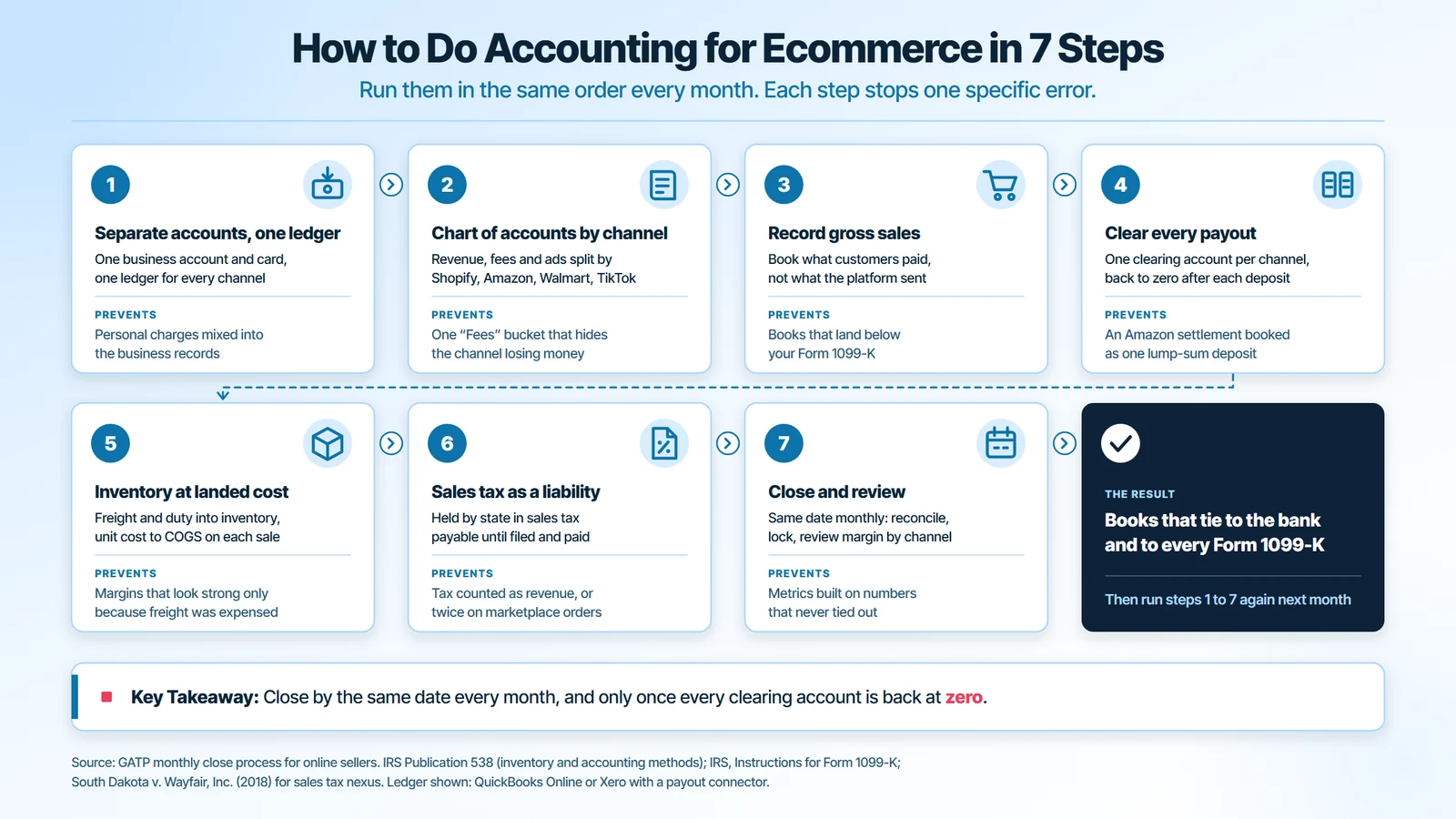
You do accounting for ecommerce in 7 steps, run in the same order every month. Each step names the failure it prevents.
Step 1: Set Up Bookkeeping With Separate Accounts and One Ledger
Start with the accounts, then the ledger, then the rules that keep it clean:
- Open dedicated accounts. Use one business checking account for payouts and one business card for platform, app and ad charges. Nothing personal runs through either, so every line in the feed is a business transaction.
- Pick one ledger. QuickBooks Online and Xero both connect to the main payout tools. Choose one and keep every channel and entity in it, so there is one source of truth.
- Connect the feeds. Link the bank, the card and any processor accounts. The feed brings in transactions daily, so you categorize instead of typing.
- Record opening balances. Enter starting cash, inventory and any balances owed. Without them, the first reconciliation never ties out.
- Set bank rules. Create rules for repeat charges such as app subscriptions and shipping labels, so they land in the same account every month.
Failure prevented: personal charges mixed into your records, which weakens the paper trail behind every deduction.
Step 2: Build the Chart of Accounts by Channel
Create revenue accounts by channel and contra-revenue accounts for refunds and chargebacks. Add cost of goods accounts for product, inbound freight and duty. Then add an expense account for each fee type and each ad platform.
- Revenue: Shopify sales, Amazon sales, Walmart sales, TikTok Shop sales, shipping income.
- Contra-revenue: refunds, discounts, chargebacks.
- Balance sheet: inventory, goods in transit, a clearing account per processor, sales tax payable by state.
Failure prevented: one “Advertising” or “Fees” bucket that hides which of your channels actually makes money.
Step 3: Record Gross Sales, Not Bank Deposits
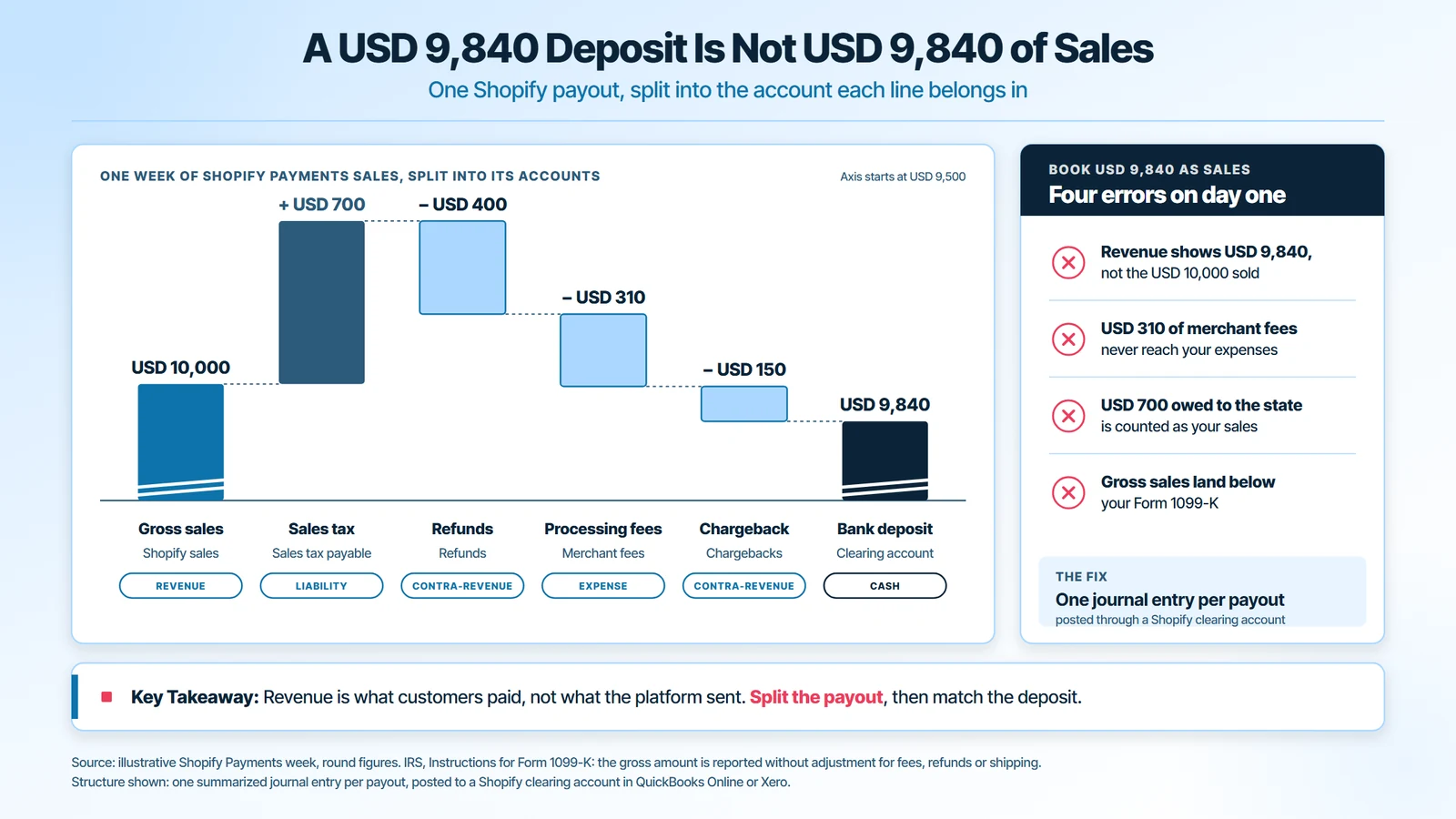
Your revenue is what customers paid, not what the platform sent you. Good Shopify accounting starts here. One summarized journal entry per payout splits the deposit into its parts, as this example week shows.
| Payout line | Amount | Where it is booked |
|---|---|---|
| Gross sales | USD 10,000 | Shopify sales (revenue) |
| Sales tax collected | USD 700 | Sales tax payable (liability) |
| Refunds | minus USD 400 | Refunds (contra-revenue) |
| Processing fees | minus USD 310 | Merchant fees (expense) |
| Chargeback | minus USD 150 | Chargebacks (contra-revenue) |
| Bank deposit | USD 9,840 | Clears the Shopify clearing account |
If you book USD 9,840 as sales, you understate revenue, hide USD 310 of fees and miss a USD 700 tax liability. You also land below your Form 1099-K. The Form 1099-K instructions define the reported figure as gross, without adjustment for fees, refunds or shipping.
Step 4: Reconcile Every Payout Through a Clearing Account
Give each processor and marketplace its own clearing account. Post the payout breakdown into it, then post the bank deposit out of it. When the account returns to zero, that payout is reconciled.
A negative balance means you recorded a deposit late. A positive one means money is still in transit or held in a reserve. Amazon settlements carry the most lines, and booking them as one deposit tops the list of Amazon seller accounting mistakes.
GATP used this structure for an online brand paid through a card processor and a buy-now-pay-later processor. Each processor got its own clearing account, and rolling reserves were tracked as money owed to the business. The two-processor payout reconciliation walks through the 5 controls.
Step 5: Track Inventory and Cost of Goods Sold
Inventory moves through four bookings, and each one has a fixed treatment:
- Purchase. Record the supplier bill to the inventory account, not to expenses. Goods you own but have not received sit in goods in transit.
- Landing. When freight, duty and broker bills arrive, add them to the same purchase. Spread them across units by quantity or by value, and use the same basis every time.
- Sale. Use a perpetual system, which moves the unit cost to cost of goods sold with every sale. A periodic system only counts at period end, which leaves multi-channel sellers blind between counts.
- Return. Put resalable returns back into inventory at their original cost. Write off damaged returns to an inventory loss account, so the loss is visible.
Failure prevented: margins that look strong only because freight and duty were expensed.
Step 6: Hold Sales Tax as a Liability Until It Is Filed
Sales tax compliance starts in your ledger. Tax you collect is never revenue. It sits in sales tax payable, by state, until you file and pay. Where a marketplace facilitator law makes Amazon or Walmart collect and remit, record those orders net of tax so you do not count it twice.
Nexus is your trigger to register. In South Dakota v. Wayfair (2018), the Supreme Court ended the physical-presence rule. The law in that case reached sellers with more than USD 100,000 of sales, or 200 or more separate transactions, into the state. Your inventory stored in a fulfillment center can also create a physical presence there.
Step 7: Close the Month and Review the Numbers
Close your books by the same date every month. Reconcile bank, cards, clearing accounts and inventory, then lock the period. Review gross margin, contribution margin by channel and cash on hand.
Your ecommerce financial metrics are only as reliable as this close.
How Do Shopify, Amazon, TikTok Shop and Walmart Payouts Differ?
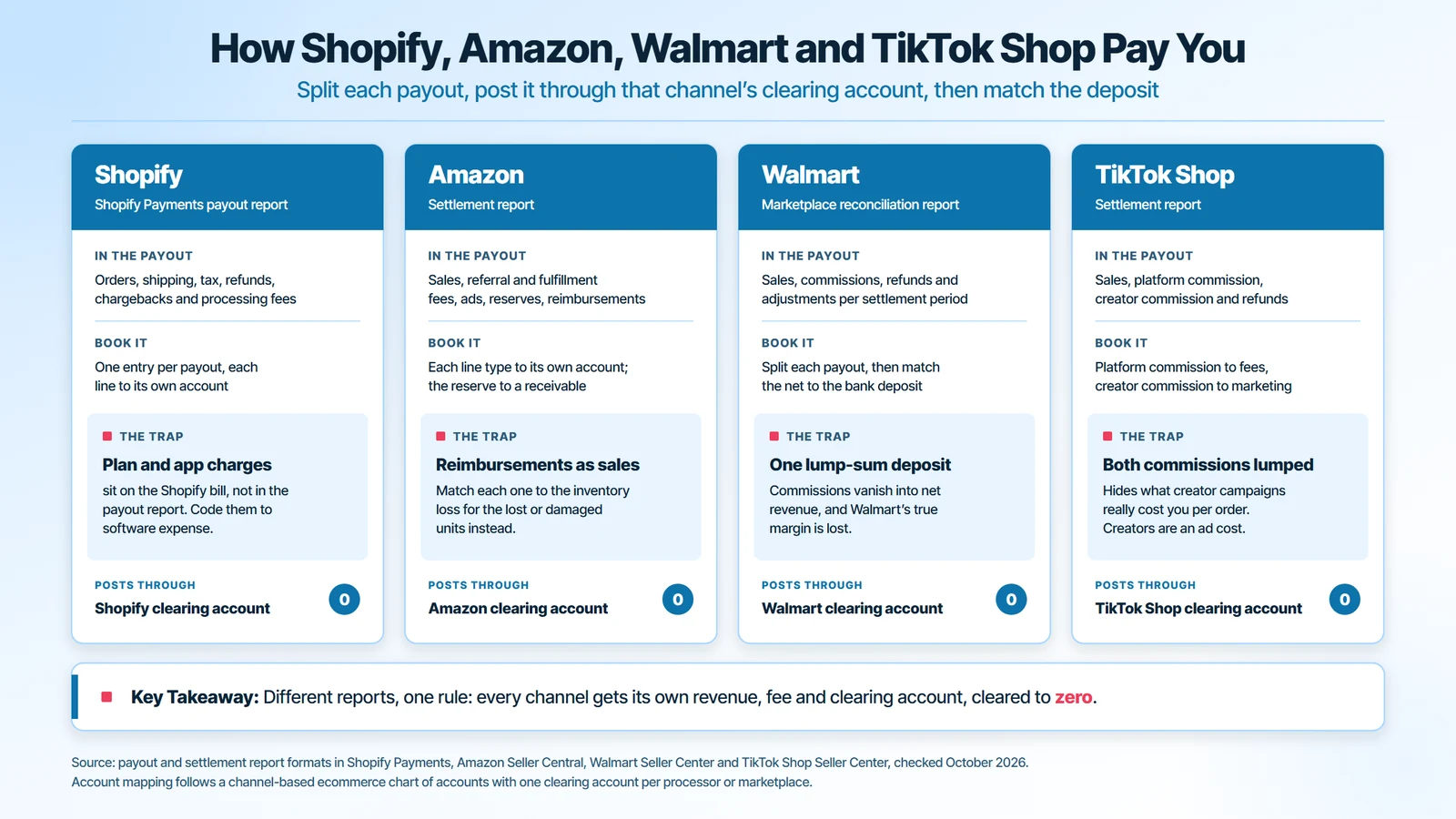
Every channel pays you on its own schedule and in its own report format, but the rule is the same: split the payout, then match the deposit. If you sell on 3 or more channels, multi-channel ecommerce accounting keeps each one in its own revenue, fee and clearing accounts.
Shopify Payments Payout Report
Each Shopify payout bundles a day or more of orders. Open the payout and export its transactions. Then book one entry: gross sales and shipping income to revenue, tax to sales tax payable, refunds and chargebacks to their contra accounts and processing fees to merchant fees.
The trap is the Shopify bill. Subscription and app charges appear on the Shopify bill, not as lines in the payout report. Code them to software expense, or they never reach your profit and loss.
Amazon Settlement Report
The settlement report carries the most lines of any channel: product sales, referral fees, fulfillment fees, advertising, reserves and reimbursements. Book each line type to its own account, and post the reserve to a receivable, because Amazon still owes you that money.
The trap is reimbursements. When Amazon pays you for lost or damaged stock, record it against the inventory loss for those units. Booking it as sales overstates revenue and leaves the missing units in inventory.
Amazon also bills you a selling plan: USD 39.99 a month for Professional, or USD 0.99 per item sold on Individual, per Amazon’s seller pricing page.
Walmart Marketplace Reconciliation Report
Walmart pays by settlement period. Use the reconciliation report to split each payout into sales, commissions, refunds and adjustments, then match the net to the deposit.
The trap is booking the deposit as one lump sum. Commissions then disappear into net revenue, and you lose Walmart’s true margin.
TikTok Shop Settlement Report
The TikTok Shop settlement report lists sales, platform commission, creator affiliate commission and refunds. Book platform commission to marketplace fees and creator commission to marketing, because creators are an ad cost.
The trap is lumping both commissions together. That hides what creator campaigns really cost per order. Pay creators directly outside the platform? Those payments count toward the Form 1099-NEC threshold covered below.
How Should an Online Store Account for Inventory and Landed Cost?
Inventory is often one of the largest assets on your balance sheet, and its value drives cost of goods sold and taxable income. Two choices matter most: what goes into each unit’s cost, and which units you assume sold first.
Landed Cost: What the IRS Counts as Inventory Cost
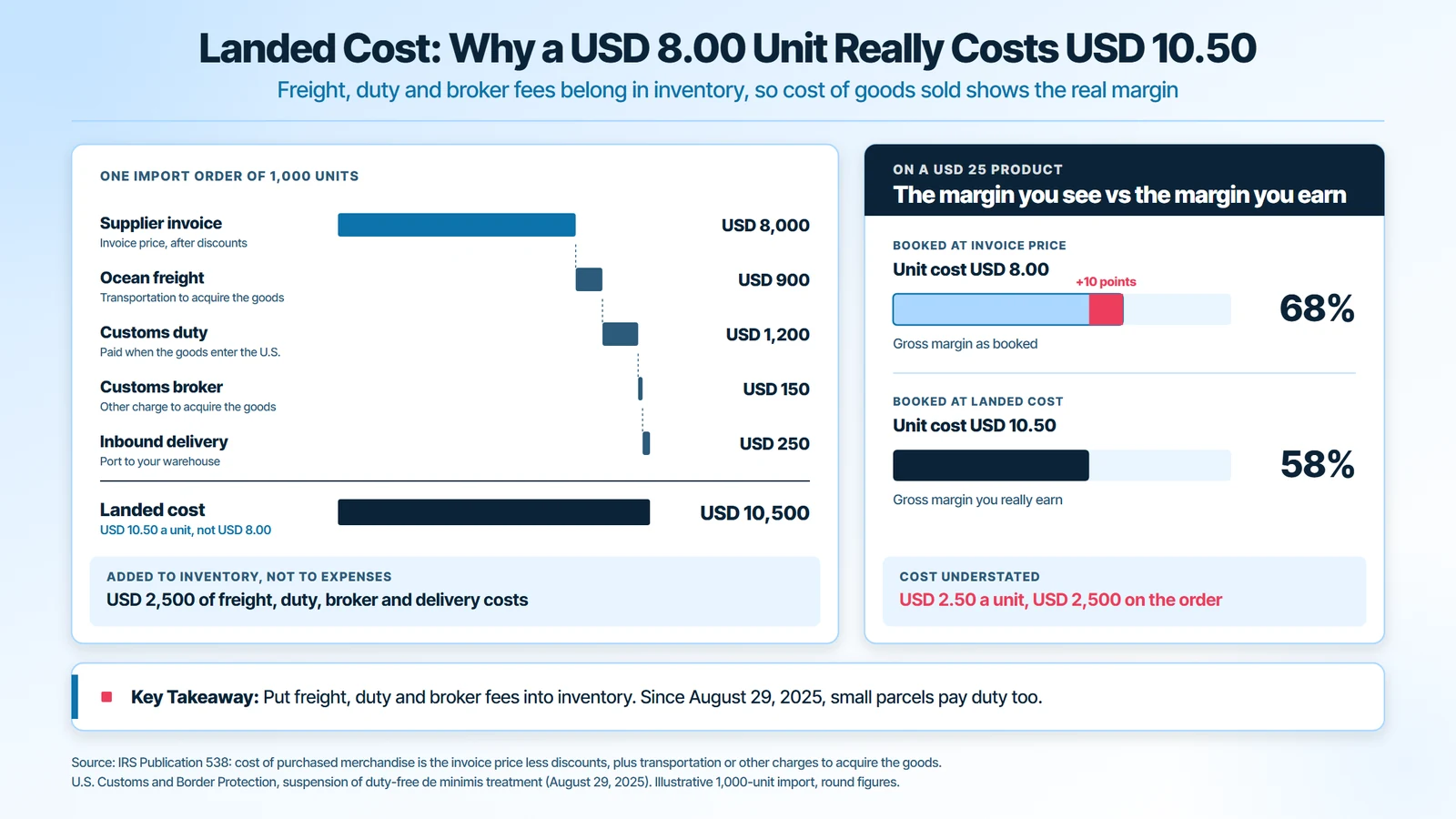
Landed cost is the full cost of getting a unit into your warehouse. Publication 538 defines the cost of purchased merchandise as invoice price, minus discounts, plus transportation or other charges to acquire the goods.
| Example cost line (1,000 units) | Amount |
|---|---|
| Supplier invoice | USD 8,000 |
| Ocean freight | USD 900 |
| Customs duty | USD 1,200 |
| Customs broker | USD 150 |
| Inbound delivery to the warehouse | USD 250 |
| Landed cost | USD 10,500, or USD 10.50 a unit |
Book the units at the USD 8.00 invoice price and you understate cost by USD 2.50 a unit, or USD 2,500 on the order. On a USD 25 product, your gross margin looks like 68 percent when it is really 58 percent.
Duty now hits smaller shipments too. Imports valued at USD 800 or less lost duty-free treatment for all countries on August 29, 2025, per the CBP de minimis fact sheet. If you import small parcels, that duty now belongs in inventory.
FIFO, LIFO or Weighted Average: A Worked Comparison
Publication 538 allows specific identification, FIFO and LIFO, and LIFO needs Form 970 with your first LIFO return. Say you bought 100 units at USD 10, then 100 at USD 12, and sold 150.
| Method | Cost of 150 units sold | Ending inventory (50 units) |
|---|---|---|
| FIFO (first in, first out) | USD 1,600 (100 x 10 plus 50 x 12) | USD 600 |
| LIFO (last in, first out) | USD 1,700 (100 x 12 plus 50 x 10) | USD 500 |
| Weighted average (USD 11 a unit) | USD 1,650 | USD 550 |
When prices rise, LIFO gives the highest cost of goods sold and the lowest taxable income. Whichever you pick, keep it, because a change needs IRS consent on Form 3115.
The Small Business Inventory Exception at USD 32 Million
If you are under the USD 32 million gross receipts test for 2026, you may skip a formal tax inventory. Publication 538 lets you treat inventory as non-incidental materials and supplies, or follow your books. Keep a perpetual count anyway, because your margins and reorders depend on it.
One scope point most guides miss. Moving merchant fees between cost of goods sold and operating expenses changes your gross margin, not your taxable income, because both are deductible. Freight-in and duty are different: they sit in inventory until the units sell.
Which Financial Reports Should an Online Seller Review Every Month?
You should review 4 reports every month. The first 3 are the standard financial statements. The fourth shows which channel actually earns.
- Profit and loss statement: sales, refunds, cost of goods sold, fees, ads and overhead.
- Balance sheet: cash, inventory, clearing balances, sales tax payable, cards and loans.
- Cash flow statement: where your cash went. Stock bought before a peak season is why profitable stores run short.
- Contribution margin by channel: revenue minus product cost, fees, fulfillment and that channel’s ad spend.
Here is why the fourth report matters. A channel with USD 100,000 of sales, USD 38,000 of product cost, USD 15,000 of fees and fulfillment and USD 30,000 of ads contributes USD 17,000, or 17 percent. Strong sales can still hide a weak channel.
What Does an Ecommerce Accountant Do?
An ecommerce accountant keeps the books of a business that sells online, so the owner knows what each channel really earns, what is owed and where the cash went. The work covers 8 tasks:
- Reconcile online sales: match Shopify, Amazon and Walmart sales and refunds to processor payouts and bank deposits, line by line.
- Track inventory and cost of goods sold: record purchases at landed cost, including freight and import duty, so reported profit is real.
- Handle sales tax: track tax collected by state, watch nexus thresholds and file returns where you are registered.
- Code expenses: platform fees, ads, packaging, fulfillment, shipping and software, each to its own account.
- Prepare tax returns: the business return and the estimated payments, built from the same books.
- Produce financial reports: profit and loss, balance sheet and cash flow every month.
- Analyze profit by channel: show whether Amazon is still profitable after fees, fulfillment and ads.
- Advise on decisions: pricing, stock purchases, cash flow and which channel to grow.
GATP’s ecommerce bookkeeping services run these tasks on the 3 checklists below.
Ecommerce Accountant vs General Accountant
A general accountant handles a service business paid by bank transfer. An online store adds inventory, several sales channels, processors, marketplace fees, reserves, refunds and multi-state sales tax. An ecommerce accountant knows how each platform pays.
Weekly Ecommerce Bookkeeping Checklist
- Categorize the feeds. Review every new bank and card line, accept rule matches and code the rest.
- Post each payout. Book the payout breakdown to its clearing account and match the bank deposit, so the clearing balance returns to zero.
- Check reserves and disputes. Note any new reserve hold or chargeback on each channel, and answer disputes before their deadline.
- Record stock and bills. Enter inventory receipts and supplier bills as they arrive, so inventory and payables stay current.
- Look ahead on cash. Compare cash on hand with bills due in the next 2 weeks, including stock orders and ad spend.
Monthly Close Checklist
- Reconcile every account. Tie bank and card balances to statements. Each clearing account should be zero or equal to a payout you can name as in transit.
- Tie inventory out. Compare the inventory balance in the ledger with the value in your inventory system, and book the difference with a written reason.
- File sales tax. Pull tax collected by state from the payout splits, file the returns that are due and pay from the liability account.
- Review and lock. Read the 4 monthly reports, explain any large swing from last month, then lock the period so no one posts into it.
Quarterly and Year-End Checklist
- Pay estimated tax. Base each payment on the year-to-date profit from the closed books. For 2026, Publication 505 lists April 15, June 15 and September 15, 2026, and January 15, 2027.
- Count physical stock. Count units in each warehouse, compare with the system and write off shrinkage and obsolete units with the count sheet as support.
- Recheck nexus. Total sales and order counts by state for the last 12 months, and compare them with each state’s threshold before you cross it.
- Match every Form 1099-K. Compare each form’s gross figure with the gross sales you booked for that processor, and keep the reconciliation on file.
- Keep the records. Save payout reports, settlement files and invoices for at least 3 years, and employment tax records for 4, per the IRS record retention guidance.
Case Study: Reconciling 4 Marketplaces in 2 Currencies
A multi-entity seller of European auto parts sold through Amazon in the United States and Canada, Walmart Marketplace, eBay and its own Shopify store. Lump-sum payouts overstated revenue, and stock drifted from cost of goods because the inventory offset account was never cleared.
GATP built a monthly cycle with 4 tracks:
- Every payout split into sales, fees, refunds and reimbursements, then tied to its deposit.
- Every entry posted to the right entity, with intercompany balances reconciled.
- Item receipts recorded and the inventory offset account cleared.
- Old uncleared items worked down while current months closed.
The ecommerce bookkeeping case study ended with 1 consolidated ledger, because every channel was handled the same way.
What Changed for Ecommerce Bookkeeping in 2026?
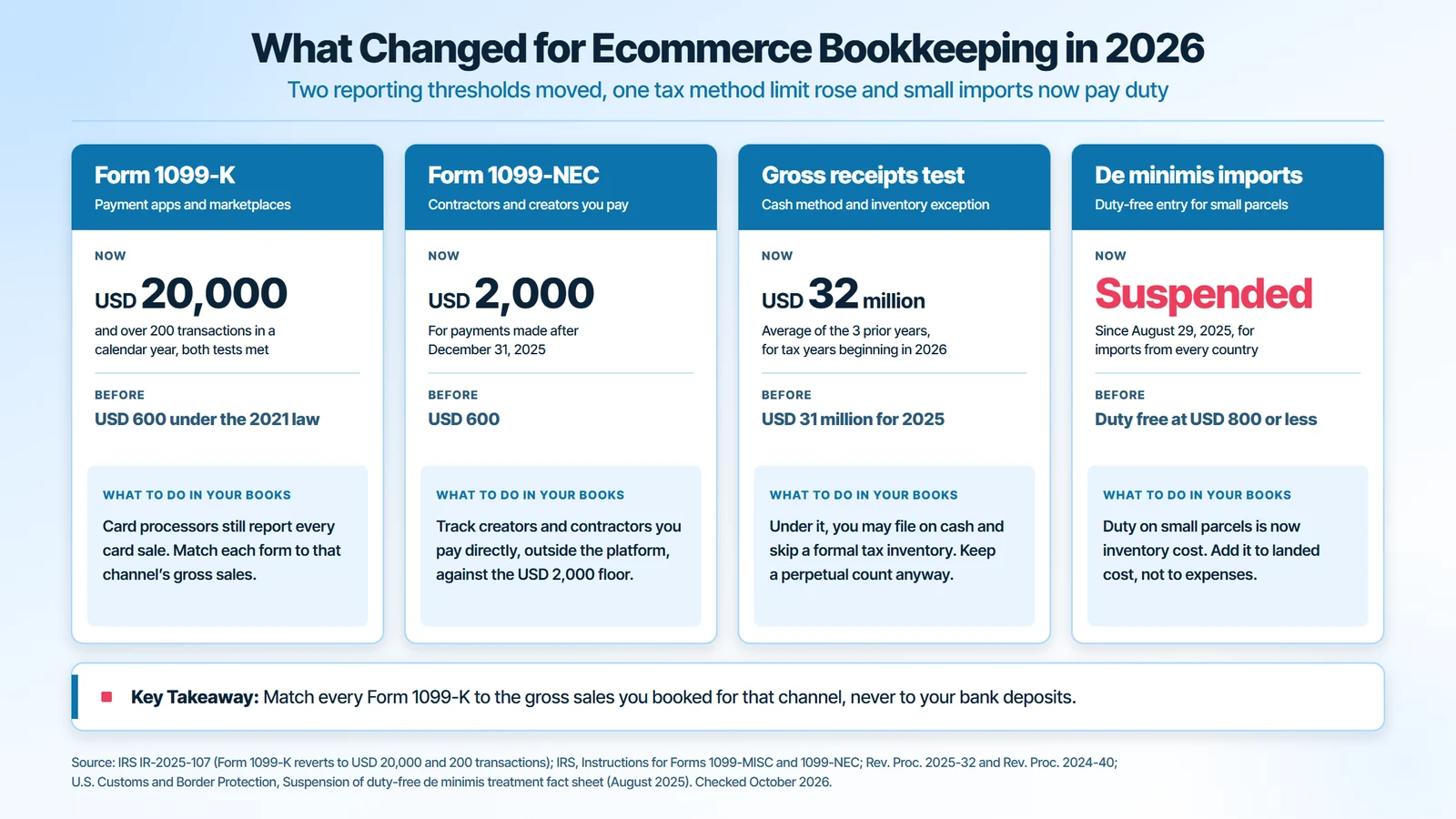
Four rule changes affect your books in 2026. Two moved reporting thresholds, one raised a tax method limit and one added cost to imported stock.
- Form 1099-K threshold back at USD 20,000. Payment apps and marketplaces report when your payments exceed USD 20,000 in more than 200 transactions, per IRS release IR-2025-107. Card processors still report card sales with no minimum, so match each form to that channel’s gross sales.
- Form 1099-NEC threshold at USD 2,000. For payments made after December 31, 2025, the floor rose from USD 600 to USD 2,000, per the Form 1099-NEC instructions. It covers contractors and creators you pay directly.
- Gross receipts test at USD 32 million for tax years beginning in 2026.
- No duty-free imports at USD 800 or less since August 29, 2025.
Which Ecommerce Bookkeeping Software Automates the Work?
Ecommerce bookkeeping automation takes 4 tools: a ledger, a payout connector, sales tax software and an inventory system. The payout connector reads each settlement and posts one summarized entry split into sales, fees, refunds and tax, ready to match against each Form 1099-K.
| Layer | Common tools | What it automates |
|---|---|---|
| Ledger | QuickBooks Online, Xero | Bank and card feeds, rules, financial statements |
| Payout connector | A2X, Link My Books, Synder | Splitting settlements into accounts and matching deposits |
| Sales tax | TaxJar, Avalara, Zamp | Nexus tracking, rates, filing and remittance |
| Inventory | Cin7, Finale Inventory, Linnworks | One stock record across channels and warehouses |
| Payroll | Gusto, ADP | Wages, payroll tax and contractor forms |
What Are the Most Common Ecommerce Bookkeeping Mistakes?
The common ecommerce bookkeeping mistakes are also the main accounting issues for ecommerce sellers, and they share one root: treating a payout as a sale. Each one below says what goes wrong and how to fix it.
- Recording deposits as revenue. Revenue comes in low, fees vanish and the books fall below each Form 1099-K. Spot it when your sales account equals your bank deposits. Fix it by splitting every payout through a clearing account.
- Expensing freight and duty. The month you import looks like a loss, then later months look too profitable. Spot it when freight sits in operating expenses. Fix it by adding freight and duty to the inventory purchase.
- One fee account for every channel. You cannot see which channel is losing money. Fix it with one fee account per channel, then run contribution margin by channel each month.
- Booking marketplace-collected tax as sales. Revenue is overstated and tax looks owed twice. Fix it by recording marketplace orders net of the tax the marketplace remits.
- Ignoring reserves and reimbursements. Cash forecasts miss money you are owed. Fix it by posting reserves to a receivable and matching each reimbursement to the lost units.
- Reconciling once a quarter. Errors stack across 12 or more payouts before anyone looks. Fix it by matching payouts weekly and closing monthly.
How Much Does Ecommerce Bookkeeping Cost in 2026?
Ecommerce bookkeeping pricing depends on who does it. An in-house bookkeeper costs you about USD 4,223 a month in salary alone. That is the USD 50,670 median wage for bookkeeping clerks in the BLS May 2025 wage data, before payroll taxes and benefits. The median hourly wage is USD 24.36.
A monthly bookkeeping service for ecommerce usually costs you less than a full-time hire. GATP’s fixed-fee plans start at less than USD 250 a month, and the price rises with your channels, transactions and entities.
The right setup depends on your stage:
- Small business on one channel: keep the books yourself in QuickBooks Online or Xero with a payout connector, and have an accountant review the month and file the return.
- Growing seller on 2 or 3 channels: move to a monthly bookkeeping service once payouts and sales tax take more than a few hours a month.
- Seller with stock in several warehouses or tax in several states: outsource ecommerce bookkeeping fully, because the errors now cost more than the service.
At that last stage, outsourced bookkeeping services with ecommerce experience usually cost you less than the errors they prevent.
Conclusion: Ecommerce Bookkeeping That Ties Every Payout to Cash
Ecommerce bookkeeping works when every payout is split into sales, fees, refunds and tax, then matched to the deposit. The ecommerce bookkeeping best practices are short: split every payout, capitalize landed cost, track tax by state and reconcile weekly. Get those right and the 2026 changes, from the USD 20,000 Form 1099-K floor to duty on small imports, fit into books that already reconcile.
Want your payouts tied to cash every month? GATP’s CPAs review your chart of accounts, clearing accounts and inventory treatment, then show you where your books and your bank disagree. You get a clear list of fixes.
Frequently Asked Questions About Ecommerce Bookkeeping
What software automates ecommerce bookkeeping?
The software that automates ecommerce bookkeeping is a payout connector such as A2X, Link My Books or Synder, linked to QuickBooks Online or Xero. The connector reads each settlement and posts sales, fees, refunds and tax to the right accounts. To automate ecommerce bookkeeping fully, add sales tax software and an inventory system.
Do I need an accountant for my ecommerce business?
You need an accountant once your books include several channels, stored inventory or sales tax in more than one state. A small business on one channel can keep its own books with a ledger and a payout connector, and have an accountant review the month and file the return. As complexity grows, a general bookkeeper often books the net deposit as sales, which breaks the match to Form 1099-K.
How often should an online store reconcile its books?
An online store should reconcile payouts weekly and close the full books monthly. Weekly matching catches reserves, missing deposits and disputes while they are small. The monthly close then reconciles bank, cards, clearing accounts and inventory, so your monthly reports are final and comparable.
Is sales tax that Amazon collects part of my revenue?
No, sales tax that Amazon collects and remits under a marketplace facilitator law is not your revenue. Record those orders net of that tax. You may still owe returns in states where you have nexus from other activity, such as stored inventory or sales through your own store.
What do lenders ask for before ecommerce financing?
Lenders usually ask for recent monthly profit and loss statements, a current balance sheet, inventory value and your payout history by channel. Revenue-based lenders often connect to your store and bank. Books that reconcile payouts to deposits shorten the review, because your numbers match what the lender sees.
How do you outsource ecommerce bookkeeping?
To outsource ecommerce bookkeeping, choose a firm that already works with your channels and connectors. Ask how it handles clearing accounts, reserves and marketplace tax. Expect an onboarding review of your chart of accounts, open balances and any months behind, before your first monthly close.
What is a monthly bookkeeping service for ecommerce?
A monthly bookkeeping service for ecommerce is a fixed-scope engagement covering payout reconciliation, inventory updates, sales tax tracking and the month-end close. You get a profit and loss statement, balance sheet and cash flow statement each month. Pricing scales with your channels, transactions and entities.