A landlord who bought a rental for $300,000 and held it for ten years can walk into closing expecting a capital gains bill and leave owing more than $22,000 on depreciation alone. That figure catches people out because the depreciation recapture rental property rules run backwards from every other tax they have paid. Every deduction that lowered their rental income for a decade returns as taxable gain in a single year.
The arithmetic is fixed and knowable before you list. Once you can see how depreciation recapture on rental property is calculated, what the real rate is, and which deferrals the IRS actually allows, you can price the tax into your asking figure instead of meeting it in April. The deferral that postpones the most, a like kind swap run under the 1031 exchange rules, has to be arranged before the property is listed rather than after. If you are within twelve months of a sale, our real estate tax planning services can model the bill while there is still time to change the answer.
Key Takeaways
- Depreciation recapture is the tax on the depreciation you claimed, triggered when you sell the rental property.
- For a residential rental depreciated straight line over 27.5 years, the correct name for it is unrecaptured Section 1250 gain, and it is capped at 25 percent.
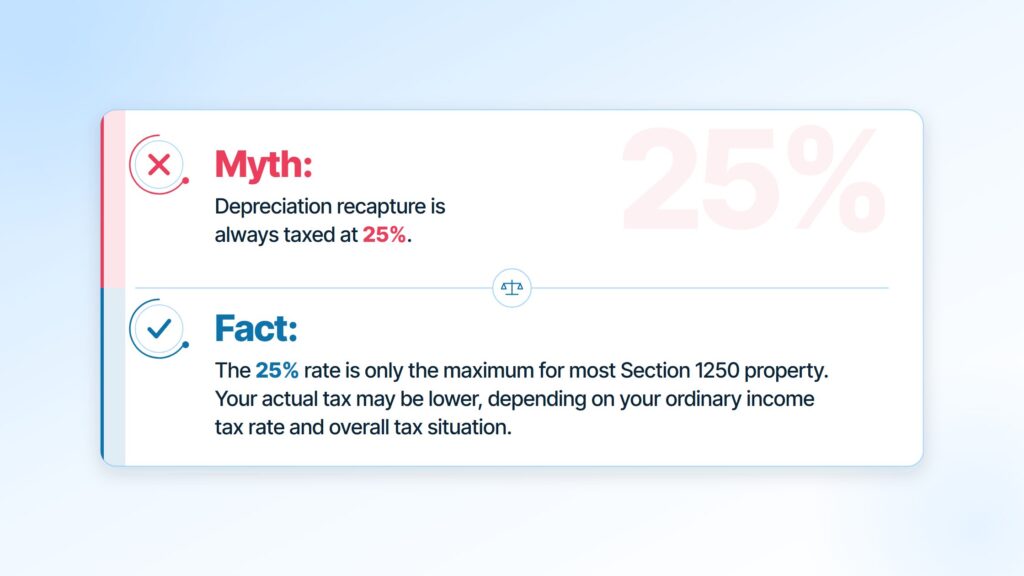
- The 25 percent figure is a ceiling, not a flat rate. If your ordinary marginal rate is lower, you pay the lower rate.
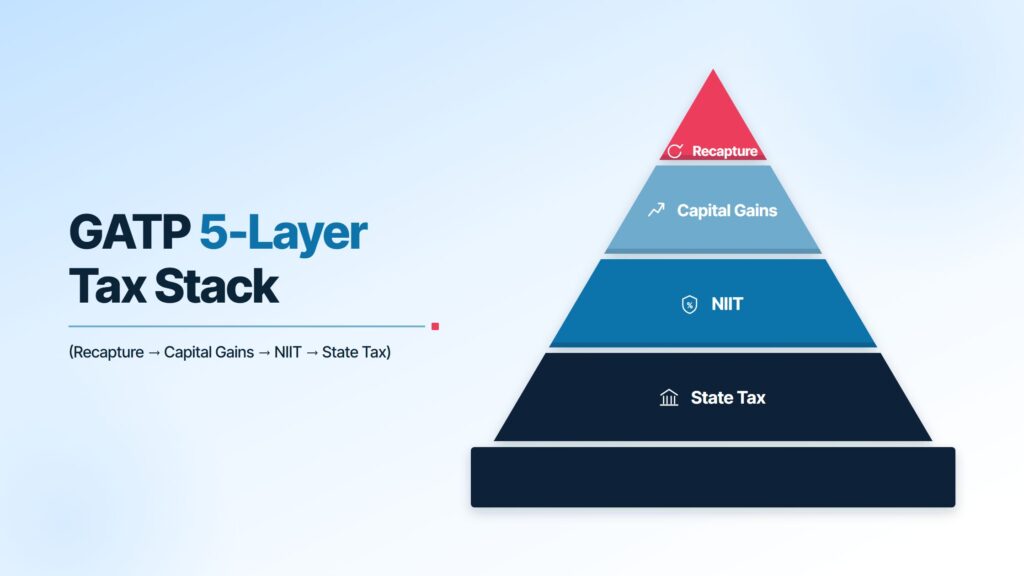
- Recapture is only one layer. Long term capital gains at 0, 15 or 20 percent, the 3.8 percent Net Investment Income Tax and state tax can all land on the same sale.
- Skipping depreciation does not avoid the tax. The IRS reduces your basis by what was allowed or allowable either way.
- A 1031 exchange, an installment sale, a step up in basis at death and the Section 121 exclusion each change the timing or the size of the bill, and only two of them can remove it.
What Is Depreciation Recapture on a Rental Property?
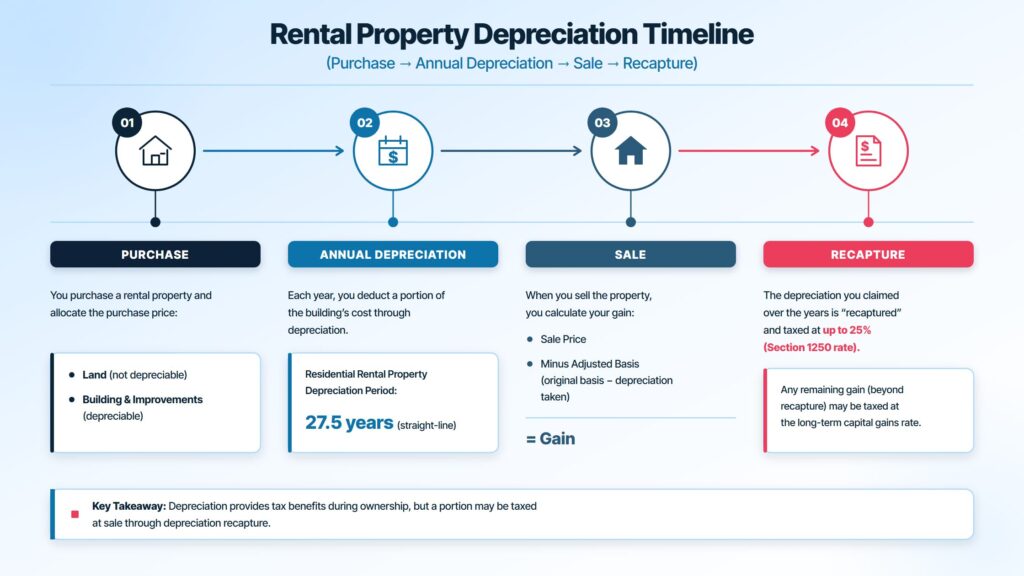
Depreciation recapture on rental property is the tax the IRS charges on the depreciation deductions you claimed while you owned the building, collected when you sell. Depreciation lowered your taxable rental income every year you held the property. It also lowered your cost basis by the same amount, so the gain you report at sale is larger than your economic profit. On a $250,000 building written off over 27.5 years, that is $9,091 of basis coming off every year and $90,909 after a decade.
Two things follow. On the sale of rental property, depreciation recapture is calculated first and taxed at its own rate, and only the profit above it is treated as an ordinary long term capital gain. The recapture is also limited, because it can never exceed your total gain, which is why selling at a loss produces no recapture at all. It is not a penalty for having claimed the deductions. It is the IRS collecting the deferred tax on deductions you have already spent.
How Rental Property Depreciation Works Before You Sell
Residential rental property is depreciated over 27.5 years under the General Depreciation System using the straight line method, per IRS Publication 527. Only the building depreciates. Land never does, so the purchase price has to be split before anything else happens. If you elect or are required to use the Alternative Depreciation System, the recovery period is 30 years for property placed in service after 2017. Your first year is also partial, because the IRS applies a mid month convention that treats the property as placed in service at the midpoint of the month.
Capital improvements made after purchase are added to that basis and depreciated in the same way, and in a condominium a special assessment for genuine capital work belongs there too, so HOA accounting records are part of your basis evidence whether the association treats them that way or not. Careful property management accounting is what keeps the whole split defensible years later, when the only proof of your basis is your own ledger.
| Cost category | Example amount | How it is treated |
|---|---|---|
| Land value, 20 percent | $80,000 | Not depreciable. It stays in basis and reduces your gain at sale. |
| Building value, 80 percent | $320,000 | The starting figure for annual depreciation. |
| Capitalized closing costs | $8,000 | Title insurance, legal fees, recording fees and transfer taxes are added to the building and depreciated over 27.5 years. |
| Final depreciable basis | $328,000 | Building plus capitalized closing costs. This is the number that drives your recapture. |
| Annual depreciation | $11,927 | $328,000 divided by 27.5 years. Year one is lower under the mid month convention. |
How Does Depreciation Recapture Work on a Rental Property Sale?
Depreciation recapture works by tracking the gap between what you paid for the building and what your basis has shrunk to after years of deductions. The IRS is not taxing a windfall. It is collecting on deductions you already used, at a rate it sets separately from capital gains.
The rental property depreciation recapture rules turn on one phrase in the code, and it is the phrase that costs owners money: allowed or allowable. Publication 527 requires you to reduce your basis by the depreciation you deducted or could have deducted. So if you never filed for it, the IRS still assumes you did. Selling rental property depreciation recapture exposure therefore exists whether or not a single deduction ever reached a return.
There are only three real exceptions to depreciation recapture residential rental property owners can use, and all three appear further down this page. You defer it, you die holding the asset, or you never generate a gain in the first place.
How to Calculate Depreciation Recapture on Rental Property
To calculate depreciation recapture on rental property, total your depreciation, subtract it from your basis, then split the resulting gain into its recapture layer and its capital gain layer. Five steps get you there, and you can run all five before you sign a listing agreement.
- Total the depreciation. Annual depreciation multiplied by the years held, or the figure from your depreciation schedule. Use what was allowable if you claimed nothing.
- Find the adjusted basis. Purchase price plus capitalized closing costs plus capital improvements, minus total depreciation.
- Find the net sale price. Selling price minus broker commissions, transfer taxes and other selling costs.
- Find the total gain. Net sale price minus adjusted basis.
- Split the gain. The lesser of your total depreciation or your total gain is the recapture layer. Everything above it is long term capital gain.
This depreciation recapture example uses round numbers so the split is easy to follow.
| Purchase price, of which land was $50,000 | $300,000 |
| Annual depreciation, $250,000 divided by 27.5 | $9,091 |
| Total depreciation over ten years | $90,909 |
| Selling price $420,000, less $20,000 of selling costs | $400,000 net |
| Adjusted basis, $300,000 less $90,909 | $209,091 |
| Total gain | $190,909 |
| Recapture layer, taxed at up to 25 percent | $90,909 |
| Remaining long term capital gain | $100,000 |
At the full 25 percent ceiling the recapture on that sale is $22,727. The remaining $100,000 is taxed at whichever long term capital gains rate your income puts you in.
What Is the Depreciation Recapture Tax Rate for 2026?
The depreciation recapture tax rate for a residential rental in 2026 is your ordinary income tax rate, capped at a maximum of 25 percent. IRS Topic no. 409 states that the portion of gain that is unrecaptured Section 1250 gain is taxed at a maximum 25 percent rate. The word maximum is doing the work there. The rental property depreciation recapture tax rate is a ceiling, so an owner whose marginal rate is 22 percent pays 22 percent, not 25.
Above the recapture layer, the 2026 long term capital gains bands from Revenue Procedure 2025-32 apply. Zero percent runs to $98,900 of taxable income for a couple married filing jointly and $49,450 for a single filer. Fifteen percent runs to $613,700 and $545,500 respectively, and 20 percent applies above those. Separately, the Net Investment Income Tax adds 3.8 percent once modified adjusted gross income passes $250,000 for a couple married filing jointly or $200,000 for a single filer. Neither threshold is indexed for inflation, so one large sale pushes many ordinary landlords over them.
| Tax | 2026 rate | What it is charged on |
|---|---|---|
| Unrecaptured Section 1250 gain | Your ordinary rate, capped at 25 percent | The lesser of the depreciation claimed on the building or your total gain. |
| Long term capital gains tax | 0, 15 or 20 percent | The gain remaining above the recapture layer, by taxable income band. |
| Net Investment Income Tax | 3.8 percent | Investment income once modified adjusted gross income passes $250,000 jointly or $200,000 single. |
| State income tax | Zero to roughly 13 percent | Usually the whole gain, with no separate 25 percent bucket for the depreciation layer. |
| Section 1245 recapture | Your full ordinary rate, no cap | Depreciation claimed on appliances, fixtures and other personal property. |
Is Depreciation Recapture on Rental Property Always Taxed at 25 Percent?
No. Depreciation recapture is not a flat 25 percent tax, and the reason rests on a distinction almost nobody spells out. For a residential rental placed in service after 1986 and depreciated straight line over 27.5 years, there is no Section 1250 recapture at all. The Instructions for Form 4797 define additional depreciation as the excess of actual depreciation over depreciation figured using the straight line method, then exclude 27.5 year residential rental property from Section 1250 recapture outright.
Straight line depreciation creates no excess, so there is nothing to recapture as ordinary income. What you actually owe is unrecaptured Section 1250 gain, a capital gain that carries its own 25 percent ceiling. The practical difference is real money. True recapture would be depreciation recapture taxed as ordinary income with no ceiling at all. Unrecaptured Section 1250 gain is taxed at the lower of your ordinary rate or 25 percent, and it reaches your return through Schedule D rather than as ordinary income.
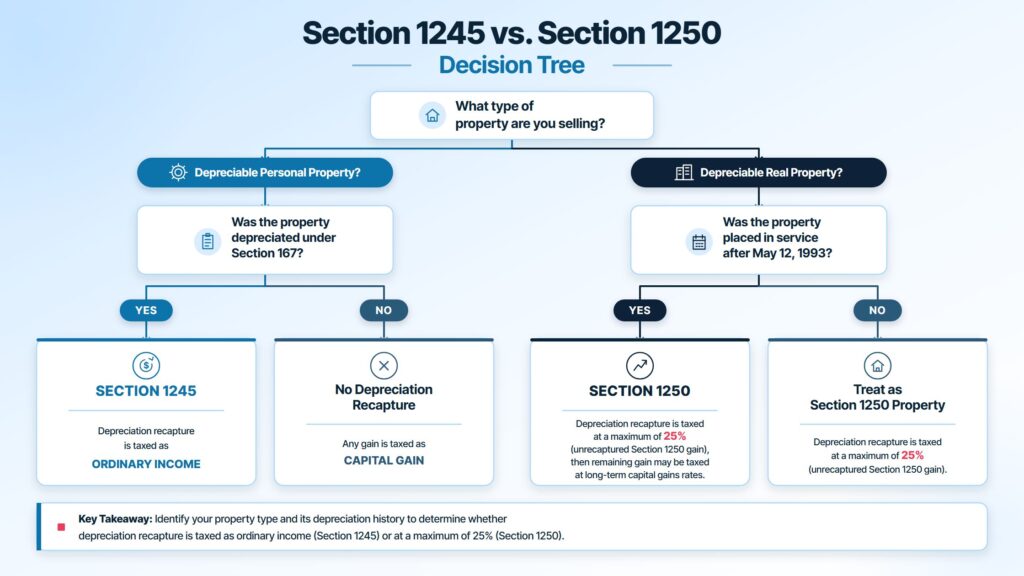
Section 1250 Depreciation Recapture, Residential Rental Property and Section 1245 Assets
Section 1250 covers the building and its structural components. Section 1245 covers the personal property inside it, and the two are taxed on completely different terms. Most owners who have never commissioned a cost segregation study hold only Section 1250 property and never meet Section 1245 at all, which is why a 2026 study changes the answer so sharply. A short term let is the exception, because it carries far more capitalized furnishing than a long term rental does, so Airbnb bookkeeping tends to produce more Section 1245 property and more ordinary rate recapture.
| Feature | Section 1250 property | Section 1245 property |
|---|---|---|
| What it covers | The building and its structural components | Appliances, carpeting, cabinets, furniture, equipment and some land improvements |
| Depreciation method | Straight line over 27.5 years | Accelerated, over recovery periods far shorter than 27.5 years, and eligible for bonus depreciation |
| What is taxed at sale | Unrecaptured Section 1250 gain, capped at 25 percent | All depreciation claimed, as ordinary income |
| Rate ceiling | 25 percent | None, so up to 37 percent in 2026 |
| Installment sale treatment | Spread across the payments as they are received | Taxable in full in the year of sale |
What Changed for 2026: Restored Bonus Depreciation Raises Your Section 1245 Exposure
The 100 percent special depreciation allowance was restored for qualified property acquired and placed in service after 19 January 2025, and Publication 527 now confirms it can apply to property used in residential real estate activities. That change gets written up everywhere as a win. At sale it is also a liability, and the two halves are rarely discussed in the same place.
Bonus depreciation never touches the 27.5 year building. It applies to the Section 1245 components a cost segregation for real estate study carves out of the purchase price, such as appliances, cabinetry, flooring and site improvements. Every dollar moved off the 27.5 year schedule and written off immediately is a dollar that comes back at your full ordinary rate instead of the 25 percent ceiling. An owner in the 35 percent bracket who shifted $60,000 of basis into Section 1245 assets in 2025 accelerated $60,000 of deductions and converted $60,000 of capped future gain into uncapped ordinary income. The study still usually wins on present value. It stops winning if you sell within a few years, and that is the calculation to run before you commission one.
How to Report Depreciation Recapture on Form 4797 and Schedule D
Every depreciation recapture IRS form you need for a rental sale sits in one short sequence, and getting that sequence wrong is the most common filing error on these returns. Dispositions of Section 1250 property held more than one year are reported in Part III of Form 4797, at lines 25 and 26.
The Instructions for Form 4797 then require you to identify the amount of gain that is unrecaptured Section 1250 gain and report it on Schedule D, where the Unrecaptured Section 1250 Gain Worksheet applies the 25 percent ceiling. The IRS depreciation recapture rental property trap is that Form 4797 on its own will not produce the right tax, because Part III computes ordinary recapture and a straight line residential rental generates none. If your software reports a large ordinary income figure out of Part III on a 27.5 year building, something has been entered as Section 1245 property. An installment sale adds Form 6252, and any recapture figure belongs in Part I of that form.
The Bookkeeping Error That Inflates Your Depreciation Recapture
The largest single driver of an overstated recapture bill is not the tax rate. It is a chart of accounts that never separated repairs from capital improvements, because that one distinction decides which costs were deducted in the year they were paid and which were added to basis and depreciated over 27.5 years.
A rental property bookkeeping cleanup we ran for a multi property long term rental owner covered 73 months of transactions from January 2020 through January 2026. The books carried four or more credit cards with personal and rental charges mixed together, closed card accounts still live in the chart of accounts, no separation of property tax from insurance, and no clean distinction between repairs and capital improvements. Follow that last one through to a sale. A new roof booked as a repair was deducted once and never entered basis, so the basis is too low, the gain is too high, and the depreciation schedule feeding the recapture layer has been wrong every year since. Correcting it after the closing statement is signed means amending returns rather than adjusting a figure. Our real estate bookkeeping work on portfolios with several income streams meets the same pattern. Recapture is a bookkeeping output before it is a tax rate, and the year to fix it is any year before the one you sell in.
4 Legal Ways to Avoid, Reduce or Defer Depreciation Recapture on Rental Property
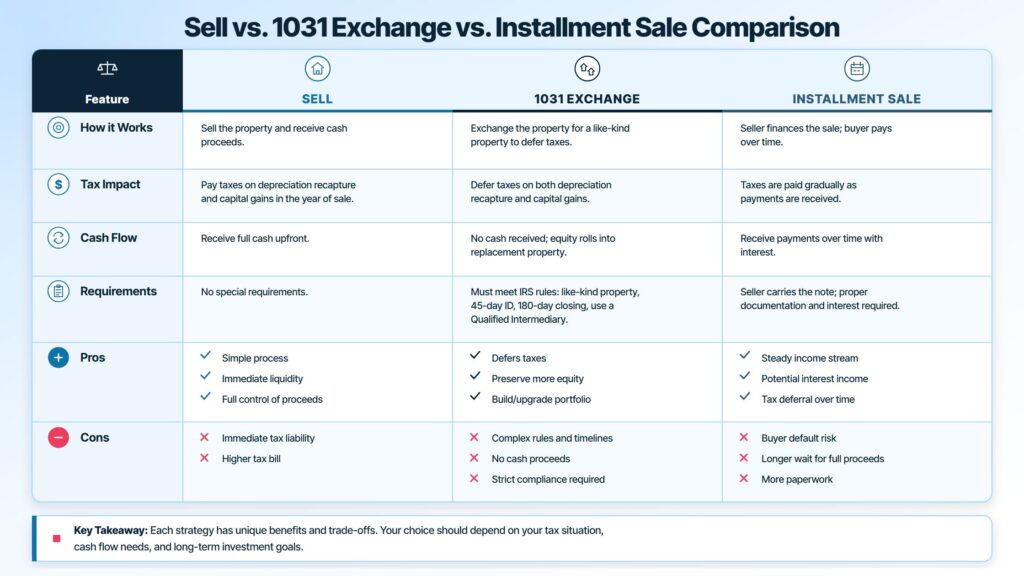
Use a 1031 Exchange to Defer the Entire Bill
A 1031 exchange defers both the recapture layer and the capital gain by rolling the proceeds into another qualifying investment property instead of taking cash. It is the only route here that postpones 100 percent of the tax while keeping you invested in real estate. The cost is control. The deadlines are strict, the replacement property has to be like kind, and any cash you take out becomes immediately taxable boot. The deferral also compounds, because your carried over basis keeps the old depreciation history attached to the new property. An owner who exchanges three times across twenty years is carrying twenty years of depreciation into one eventual cash sale, and the recapture layer on that final sale can exceed what the first property originally cost. Before you start one, check your transaction against the 1031 exchange rules for the identification and closing deadlines, because missing either one turns the whole exchange into a fully taxable sale.
Use an Installment Sale to Spread the Capital Gain
An installment sale spreads the gain across the years you receive payments, and the rules for depreciation recapture on installment sale of rental property are more favourable than most articles suggest. IRS Publication 537 requires depreciation recapture income to be reported in the year of sale whether or not you received a payment that year. For a straight line 27.5 year building there is no recapture income, so nothing accelerates. Instead the Instructions for Schedule D state that the entire gain in each installment payment is treated as unrecaptured Section 1250 gain until that total has been used in full. Your recapture is spread, but it is front loaded. On the worked example above, the first $90,909 of gain collected across the payment schedule is taxed at up to 25 percent before a single dollar reaches the 15 percent band. Section 1245 assets do accelerate into year one, so a property that has been through a cost segregation study loses part of the benefit before the first payment arrives.
Hold the Property Until Death So Your Heirs Inherit a Stepped Up Basis
Holding the rental until death resets the basis to fair market value on the date of death, which erases the depreciation history completely. Inherited rental property depreciation recapture is the one case where the tax genuinely disappears rather than moving. The accumulated depreciation goes with the step up, and so does the appreciation that built up during the owner’s lifetime, so an heir who sells shortly after inheriting often reports little or no gain. On the worked example above, a step up removes the $90,909 recapture layer and the $100,000 capital gain together. The trade off is liquidity and estate exposure, and the rules are involved enough to need an estate professional rather than a rule of thumb. It is also why a 79 year old landlord and a 45 year old landlord should not follow the same advice about a 2026 sale. Depreciation the heir claims afterwards starts a fresh schedule from the stepped up figure.
Move Into the Rental and Use the Section 121 Exclusion
Converting the rental into your main home lets you exclude up to $250,000 of gain, or $500,000 on a joint return, once you have owned and lived in it for 24 months out of the 5 years before the sale. The limit is the part owners miss. IRS Publication 523 states that you cannot exclude the portion of gain equal to any Section 1250(b)(3) depreciation adjustments allowed or allowable after 6 May 1997, and that the depreciation portion is reported on Form 4797. The exclusion shelters the appreciation and leaves the depreciation fully taxable. On the worked example above, moving in for two years would remove the $100,000 capital gain and leave the $90,909 recapture layer untouched. The 24 months of residence has to fall inside the 5 year period ending on the date of the sale. A fifth option suits the charitably minded, because donating appreciated rental property to a qualified charity can avoid the recapture entirely, subject to income limits.
What If You Never Claimed Depreciation on Your Rental Property?
Skipping depreciation does not remove the tax, and this is the most expensive misunderstanding in the whole subject. Do I have to recapture depreciation on rental property I never deducted is a question with an unwelcome answer, because Publication 527 requires basis to be reduced by depreciation deducted or that could have been deducted. The IRS therefore calculates your gain as though every year had been claimed.
An owner in that position has paid more income tax for years and will pay the same tax at sale. The fix is a change in accounting method on Form 3115, which can catch up the missed depreciation in a single year without amending a stack of prior returns. Do it before the sale rather than after, because the catch up deduction lands against ordinary income at up to 37 percent while the recapture it creates is capped at 25 percent. Run the numbers with a preparer first, since the form is unforgiving and a late correction costs more than a timely one.
How State Taxes Change Your Depreciation Recapture Bill
Most states have no equivalent of the 25 percent federal ceiling, which means the depreciation layer of your gain can be taxed harder by your state than the capital gain layer is by the IRS. There is no separate bucket at state level. The whole gain is income at your ordinary state rate.
| Regime | Verified example | What it means at sale |
|---|---|---|
| No state income tax | Florida, Texas, Tennessee, Washington | Federal tax only. Washington’s 7 percent capital gains tax exempts real estate outright. |
| Flat rate on all income | Illinois, 4.95 percent | Predictable. The same rate applies whatever the size of the gain. |
| Flat rate plus a high income surtax | Massachusetts, 5 percent plus 4 percent above $1,107,750 in 2026 | One large sale can push a single year’s income over a cliff that normal years never reach. |
| Graduated, taxed as ordinary income | California, New York, New Jersey | The gain stacks on your other income and can reach the state’s top marginal bracket. |
Two checks are worth making before you list. Confirm your own state’s current rate with its revenue department, because state rates change more often than federal ones do. Then check whether the state requires withholding at closing, since several do, and a withheld deposit changes your cash at settlement even when the final tax works out lower.
Should You Sell This Year or Wait?
Timing changes the bill through your income, not through the property. The 25 percent recapture ceiling is fixed, so waiting will not shrink that layer. What moves is everything stacked around it: which long term capital gains band the rest of the gain falls into, whether the sale pushes you past the $250,000 Net Investment Income Tax threshold, and whether a state surtax cliff is in play.
A year on year income analysis is how that question gets answered with numbers instead of instinct, by modelling the sale against the tax year with the most room in it. One factor is regularly missed. A fully taxable disposition releases the suspended losses that have been accumulating against the property, and those losses offset the gain in the year of sale, so an owner sitting on years of disallowed deductions may owe far less than the raw arithmetic suggests. Check your carryforward against the passive activity loss rules before you assume a high income year is the wrong year to sell.
Mistakes to Avoid and Your Pre Sale Checklist
Five errors account for most of the avoidable tax on these sales. Assuming 25 percent is a flat rate and overpaying the estimate. Treating Form 4797 Part III as the whole calculation on a straight line building. Commissioning a cost segregation study within a few years of an intended sale, which converts capped gain into uncapped ordinary income. Believing that never claiming depreciation avoids the recapture. And taking cash out of a 1031 exchange, which makes that portion immediately taxable.
Work through this list before you sign a listing agreement:
- Pull the depreciation schedule for every year of ownership and total the accumulated depreciation.
- Confirm the original land and building split, and that closing costs were capitalized correctly.
- Re-examine every repair over about $2,500 to see whether it should have been a capital improvement.
- Separate out any Section 1245 assets, because they are taxed at your full ordinary rate.
- Total your suspended passive losses, which are released on a fully taxable sale.
- Model the sale in this tax year and the next one, including the 3.8 percent Net Investment Income Tax and state tax.
- Decide on a deferral route before the property is listed, because a 1031 exchange cannot be arranged after closing.
Our Compliance and On Time Delivery Guarantees
A depreciation schedule that turns out to be wrong at closing is an expensive way to learn that basis was never tracked properly. On a return where a $20,000 roof coded as a repair instead of a capital improvement moves the taxable gain by close to the same amount, and where the recapture layer is fixed years before anyone lists the property, the accuracy of the ledger is the whole exposure. The property management accounting services behind that ledger are what keep the land split, the improvement history and the depreciation schedule defensible for every year of ownership rather than only the year you file. Our guarantees exist so that the risk of an error in the numbers we prepare sits with us rather than with your sale, and they apply to the depreciation schedule and the basis reconciliation as much as to the filing itself.
Regulatory Compliance Assurance. We ensure all tax filings, payroll, and financial reports meet compliance standards. If an error on our part results in a financial penalty, we will cover the cost.
On Time Delivery Guarantee. Monthly, quarterly, and annual reports are delivered without delays. If we miss a compliance deadline due to our fault, we pay a 50 percent fee.
The Short Answer on Depreciation Recapture When You Sell
Depreciation recapture when selling rental property is the tax on deductions you already took, charged at your ordinary rate with a 25 percent ceiling, on the lesser of your accumulated depreciation or your total gain. For a straight line residential rental it is technically unrecaptured Section 1250 gain rather than Section 1250 recapture, which is why it belongs on Schedule D and not in the ordinary income column. You recapture depreciation on sale of rental property whether or not you ever claimed it, so the deductions are always worth taking. The size of the bill is decided long before closing by two things you control, the accuracy of your basis records and which tax year you choose to sell in. Both stay open until you sign, which is why real estate tax planning belongs in the year before a sale rather than the April after it.
Find out what your sale will actually cost before you list it.
We review your depreciation schedule for every year of ownership, the original land and building split, how repairs and capital improvements were coded, and your suspended passive losses. You get back your accumulated depreciation figure, the unrecaptured Section 1250 gain you will report on Form 4797, whether any assets are sitting in Section 1245 by mistake, and which tax year produces the lower total bill. Thirty minutes, one clear answer.
Frequently Asked Questions About Depreciation Recapture
How to avoid depreciation recapture on rental property?
You cannot avoid depreciation recapture on rental property outright unless you defer it, hold the property until death, or never realise a gain. A 1031 exchange defers the whole amount for as long as you keep exchanging into qualifying investment property. Dying while holding the asset eliminates it, because your heirs take a stepped up basis at fair market value. Selling at or below your adjusted basis produces no gain and therefore no recapture, since the recapture layer can never exceed the total gain. An installment sale spreads the tax across several years without reducing it, and the Section 121 exclusion shelters appreciation while leaving the depreciation layer fully taxable. Donating the property to a qualified charity can remove it entirely, subject to income limits. What does not work is simply choosing not to claim the depreciation in the first place, because the IRS reduces your basis by what was allowable regardless.
What is depreciation recapture on sale of rental property?
Depreciation recapture on the sale of a rental property is the portion of your gain equal to the depreciation you claimed or could have claimed on the building, taxed at its own rate. Every year of depreciation reduced both your taxable rental income and your cost basis. A lower basis produces a larger gain when you sell, and the IRS taxes that specific slice of the gain separately from ordinary capital gains. For a residential rental depreciated straight line over 27.5 years the correct name is unrecaptured Section 1250 gain, and it carries a 25 percent ceiling. The layer is the lesser of two figures, either the total depreciation taken or the total gain on the sale. It is reported through Part III of Form 4797 and then carried to Schedule D for the rate calculation, which is where the ceiling is actually applied. Selling costs and capital improvements both change the figure, so pull the closing statement before you estimate anything.
How does depreciation recapture work when you sell?
Depreciation recapture works by dividing your gain into two layers and taxing the depreciation layer first. Start with your net sale price, subtract your adjusted basis, and you have the total gain. The lesser of your accumulated depreciation or that total gain becomes the recapture layer, taxed at your ordinary rate up to a 25 percent ceiling. Whatever remains above it is long term capital gain at 0, 15 or 20 percent depending on your taxable income. Two further layers can apply on top. The 3.8 percent Net Investment Income Tax applies if your modified adjusted gross income passes $250,000 jointly or $200,000 single, and state income tax applies as well, which in most states has no 25 percent cap of its own. Section 1245 assets such as appliances are taxed separately at your full ordinary rate. Suspended passive losses are released on a fully taxable sale and offset the gain, which lowers every one of these layers at once.
Do I have to recapture depreciation on rental property I never claimed?
Yes. The IRS applies an allowed or allowable standard, so recapture is calculated on the depreciation you were entitled to claim whether or not you ever claimed it. Publication 527 requires your basis to be reduced by depreciation deducted or that could have been deducted, which means your adjusted basis at sale is the same either way and so is your gain. Owners in this position have effectively paid tax twice, once on rental income they could have sheltered and again at sale on depreciation they never used. The remedy is Form 3115, an application for a change in accounting method, which catches up all the missed depreciation in one year without amending prior returns. File it before the sale, because the catch up deduction offsets ordinary income at up to 37 percent while the recapture it produces is capped at 25 percent. The catch up figure has to reconcile to a corrected depreciation schedule rather than an estimate.
Do heirs pay depreciation recapture on inherited rental property?
No. Depreciation recapture on inherited rental property is eliminated by the step up in basis at death, which resets the property’s tax basis to its fair market value on the date of death. The accumulated depreciation from the previous owner’s years of ownership disappears with the old basis, and so does the appreciation that built up during their lifetime. An heir who sells soon after inheriting typically reports little or no taxable gain, because any gain is measured from the stepped up figure rather than the original purchase price. Depreciation the heir claims after inheriting starts a fresh schedule and will be recaptured on their own eventual sale. This is why holding a heavily depreciated rental until death is the only strategy that removes the tax rather than deferring it into a later year. The date of death value is what an appraisal has to establish, so an heir who never obtains one is left proving basis from the previous owner’s records.
Is depreciation recapture always taxed at 25 percent?
No. The 25 percent figure is a maximum rate rather than a flat rate. Unrecaptured Section 1250 gain is taxed at your ordinary income tax rate up to a ceiling of 25 percent, so an owner whose marginal rate is 22 percent pays 22 percent on that layer. IRS Topic no. 409 states the rate as a maximum, and the ceiling only binds taxpayers already in the 24 percent bracket or above. Two things can push the effective cost above 25 percent even so. The 3.8 percent Net Investment Income Tax applies on top once modified adjusted gross income passes $200,000 single or $250,000 jointly. State tax applies on top of that, generally with no separate 25 percent bucket for depreciation. Section 1245 depreciation on appliances and fixtures carries no ceiling at all. Because all three are calculated on the same dollars, an owner in a high tax state can pay an effective rate on the depreciation layer well above 30 percent.
How is depreciation recapture taxed on residential rental property?
Depreciation recapture on residential rental property is taxed as unrecaptured Section 1250 gain, which is a capital gain carrying a 25 percent rate ceiling rather than ordinary income. The distinction matters because true Section 1250 recapture applies only to depreciation taken in excess of the straight line method, and the Instructions for Form 4797 exclude 27.5 year residential rental property from that treatment. A straight line building therefore generates no ordinary recapture income at all. The gain is identified in Part III of Form 4797, carried to Schedule D, and run through the Unrecaptured Section 1250 Gain Worksheet, which applies the ceiling. If your return shows a large ordinary income figure coming out of Part III on a residential rental, assets have almost certainly been coded as Section 1245 property by mistake. Check which figure your preparer carried to Schedule D, because that is the line the 25 percent ceiling is applied to.
Do you have to recapture depreciation on rental property sold at a loss?
No. The recapture layer can never exceed your total gain, so a sale at or below your adjusted basis produces no depreciation recapture at all. This catches out owners who expect the tax to follow the depreciation figure regardless of the outcome. The calculation takes the lesser of two numbers, either your accumulated depreciation or your total gain, and if the second is zero or negative the recapture is zero. Remember that adjusted basis, not purchase price, is the comparison point, and that is where most of the confusion sits. A property bought for $300,000 with $90,000 of depreciation claimed has an adjusted basis of $210,000, so a sale at $250,000 still produces a $40,000 gain and $40,000 of recapture even though the owner sold for less than they paid. Work from the depreciation schedule rather than the purchase price, because the two diverge by the full accumulated depreciation figure and that gap is what creates the surprise.