Form 8825 is the 2-page IRS form a partnership or S corporation uses to report rental real estate income and expenses. It attaches to Form 1065 or Form 1120-S and sends one net figure to Schedule K, line 2.
What is Form 8825 in practice? It is where a rent roll becomes a tax number. This guide covers the Form 8825 instructions line by line, with a worked example from our business tax preparation work.
What Is the Purpose of Form 8825?
Form 8825, Rental Real Estate Income and Expenses of a Partnership or an S Corporation, keeps rental real estate out of ordinary business income. The entity reports each property separately.
Who Needs to File Form 8825?
Any partnership or S corporation that owns rental real estate files Form 8825. That includes a multi-member LLC taxed as a partnership and an LLC with an S election.
The instructions keep 5 items off the form:
- Trade or business income, and non-real-estate rentals.
- Portfolio income or deductions.
- The section 179 expense deduction.
- Other items reported separately to owners.
- Commercial revitalization deductions.
Is Form 8825 the Same as Schedule E?
No. Form 8825 is an entity form, and Schedule E is an individual form. The Instructions for Schedule E show where they meet: a partner or shareholder reports their K-1 share in Schedule E, Part II.
The Form 8825 vs Schedule E differences in 3 rows:
| Point | Form 8825 | Schedule E |
| Who files | Partnerships and S corporations | Individuals and single-member LLC owners |
| Attached to | Form 1065 or Form 1120-S | Form 1040 |
| Passive loss limit | Never applied at the entity | Applied on the owner’s return |
Do Individuals or Single-Member LLCs File Form 8825?
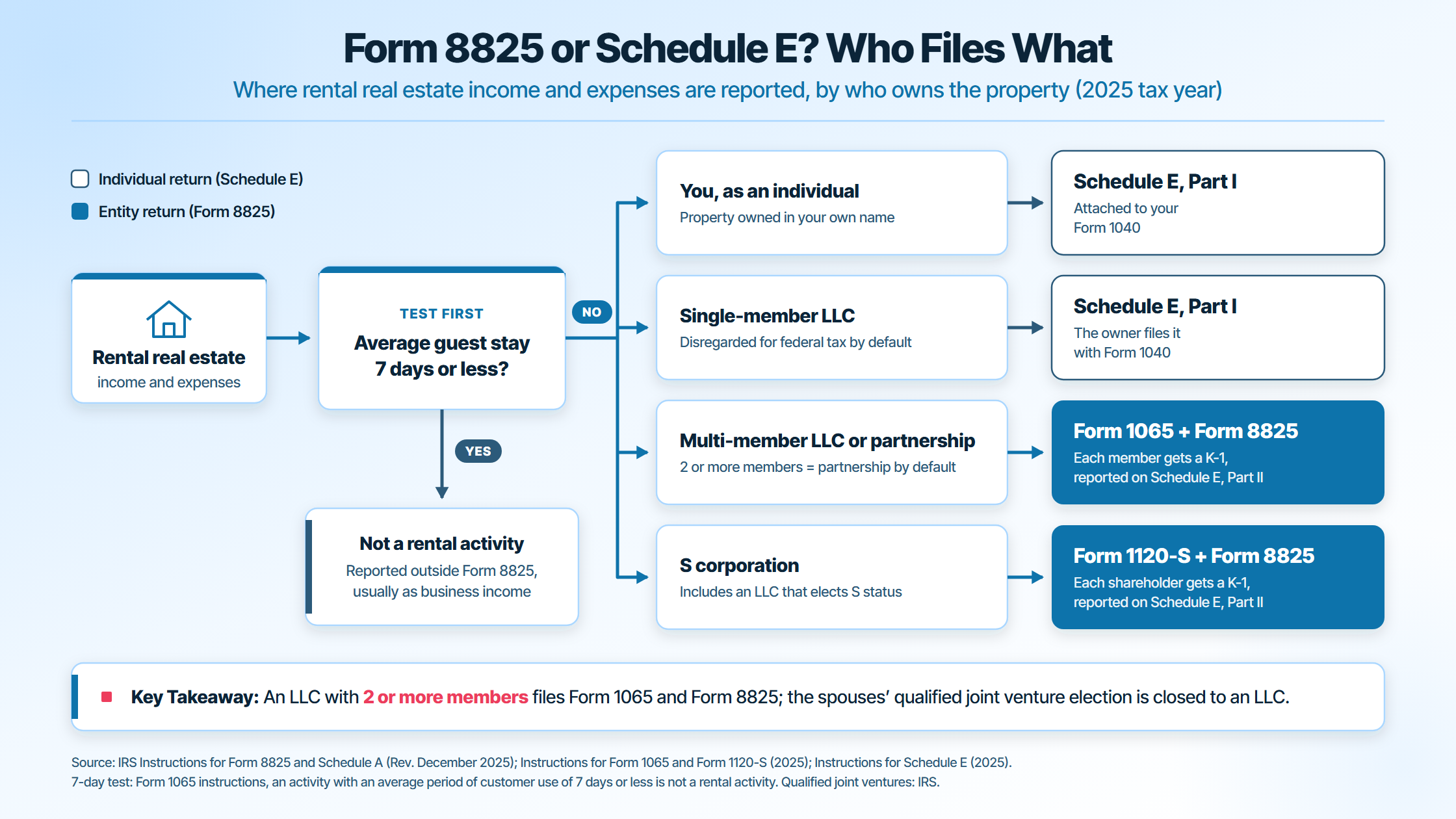
No. An individual landlord uses Schedule E, Part I. A single-member domestic LLC is usually disregarded for federal tax, so its owner files Schedule E too. One exception is an LLC that elects S corporation status: it files Form 1120-S with Form 8825.
Do I File Form 8825 or Schedule E for My Multi-Member LLC Rental Property?
A multi-member LLC rental property goes on Form 8825. By default, an LLC with 2 or more members is a partnership. It files Form 1065, attaches Form 8825 and issues each member a K-1.
The qualified joint venture election, which skips Form 1065, is closed to an LLC. The IRS limits it to spouses who co-own a business directly, not through a state law entity. Community property states follow Revenue Procedure 2002-69.
An LLC with 2 or more members is a partnership by default, so its rentals go on Form 8825, not Schedule E.
What Are the Instructions for IRS Form 8825?
The Instructions for Form 8825 and Schedule A ask for lines 1 through 19 once per property. Lines 20a through 23 are completed once, on page 1, using totals from every page.
Page 1 holds 4 properties in columns A to D. Page 2 adds 4 more, and you attach extra pages as needed. The line map:
| Line | What goes there |
| 1, columns (a) to (e) | Address, type code, other information code, fair rental days, personal use days |
| 2a, 2b, 2c | Gross rents, other rental income, total |
| 3 to 14 | Named expenses, advertising to depreciation |
| 15 and 16 | Reserved |
| 17 | Other deductions, from Schedule A for M-3 filers |
| 18 and 19 | Total expenses, and income or loss per property |
| 20a and 20b | Combined income and expenses |
| 21 | Gain or loss from Form 4797, Part II, line 17 |
| 22a and 22b | Rental income from other entities, with names and EINs |
| 23 | Net result, carried to Schedule K, line 2 |
What Type of Property Is Covered by Form 8825?
Form 8825 covers rental real estate, sorted in column (b) by 8 property type codes: 1 single-family, 2 multi-family, 3 vacation or short-term rental, 4 commercial, 5 land, 6 royalties, 7 self-rental and 8 other, with a description.
Form 8825 Codes A Through I for Column (c)
Form 8825 codes A through I flag a transaction that changed a property’s basis during the year. Column (c) is required only for entities with a Schedule M-3 filing requirement.
- A: nontaxable contribution, sections 721 and 351.
- B: other exchange, such as section 1031 or 1033.
- C: taxable acquisition, section 1012.
- D: construction, renovation or other basis change.
- E:
- F: nontaxable distribution, section 731.
- G: taxable disposition, section 1001.
- H:
- I: other, with a description.
Fair Rental Days and Personal Use Days in Columns (d) and (e)
Fair rental days are days rented at fair market value. Personal use days are days used by an owner, a relative or anyone paying below fair rent. The instructions point both columns to section 280A.
IRS Publication 527 sets the test. A dwelling is a home when personal use exceeds the greater of 14 days or 10 percent of fair rental days. A condo with 150 fair rental days and 18 personal days exceeds that 15-day limit, so its losses can be limited.
The Fannie Mae Selling Guide accepts a business return with a Form 8825 showing 365 fair rental days as proof of 12 months of property management experience. Without that history, positive Form 8825 rental income cannot count as qualifying income.
Rental Property Expenses on Lines 3 Through 14
Rental property expenses are entered per property, never as a portfolio total:
- Lines 3 to 7: advertising, auto and travel, cleaning and maintenance, commissions, insurance.
- Line 8: interest, which section 163(j) may limit. See the Instructions for Form 8990.
- Lines 9 to 13: legal and professional fees, real estate taxes, repairs, utilities, wages. Replacing an entire roof is a capitalized improvement under Treasury Regulation 1.263(a)-3, but new shingles alone can be a line 11 repair.
- Line 14: rental property depreciation, never on land. Residential buildings use 27.5 years and nonresidential use 39 years, per the Instructions for Form 4562. Attach Form 4562 when property was placed in service during the year.
Who Is Required to File Form 8825 Schedule A?
Form 8825 Schedule A is required only from partnerships and S corporations that must file Schedule M-3. Everyone else enters other deductions directly on line 17.
The Instructions for Form 1065 require Schedule M-3 when any one of these applies:
- Total assets or adjusted total assets of $10 million or more.
- Total receipts of $35 million or more.
- A reportable entity partner owning 50 percent or more.
The Instructions for Form 1120-S use one test: total assets of $10 million or more on the last day of the tax year.
What Is Schedule A (Form 8825)?
Schedule A (Form 8825), Rental Real Estate Other Deductions, splits line 17 into 20 named categories, with “Other” on line 30. An M-3 filer completes one per property and carries line 31 to Form 8825, line 17.
What Changed on Form 8825 for 2025?
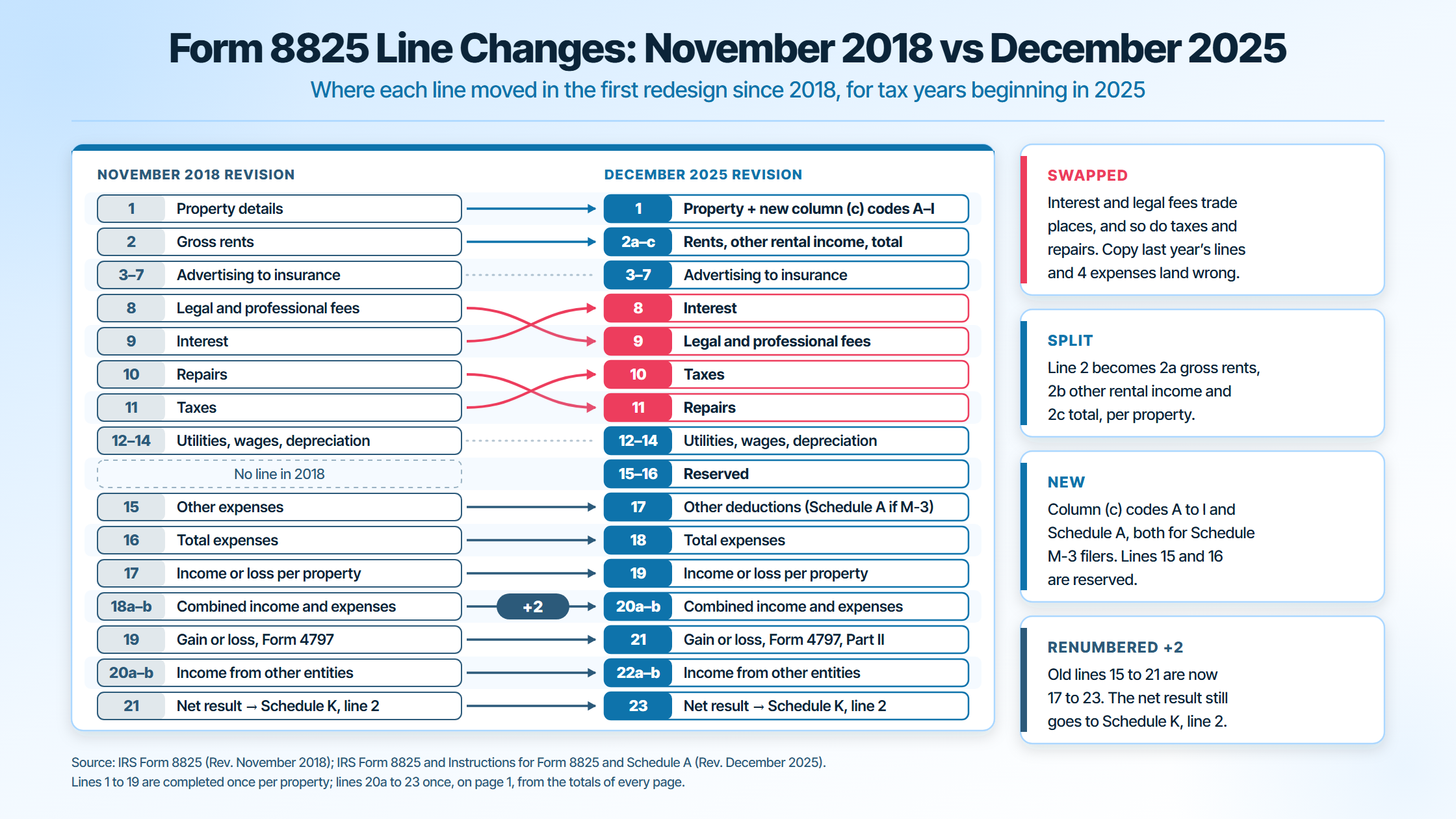
The December 2025 revision is the first redesign since November 2018. It applies to tax years beginning in 2025. Most changes move lines:
| Item | November 2018 | December 2025 |
| Rental income | Line 2 only | Lines 2a, 2b, 2c |
| Legal fees and interest | Lines 8 and 9 | Swapped: lines 9 and 8 |
| Repairs and taxes | Lines 10 and 11 | Swapped: lines 11 and 10 |
| Other expenses | Line 15 | Line 17, plus Schedule A |
| Totals and net result | Lines 16 to 21 | Lines 18 to 23 |
| Column (c) codes | None | A to I, M-3 filers |
Interest and legal fees, and taxes and repairs, swapped lines in the December 2025 revision, and the totals moved down 2 lines.
How Do I Fill Out Form 8825 for an S Corporation With Multiple Rental Properties?
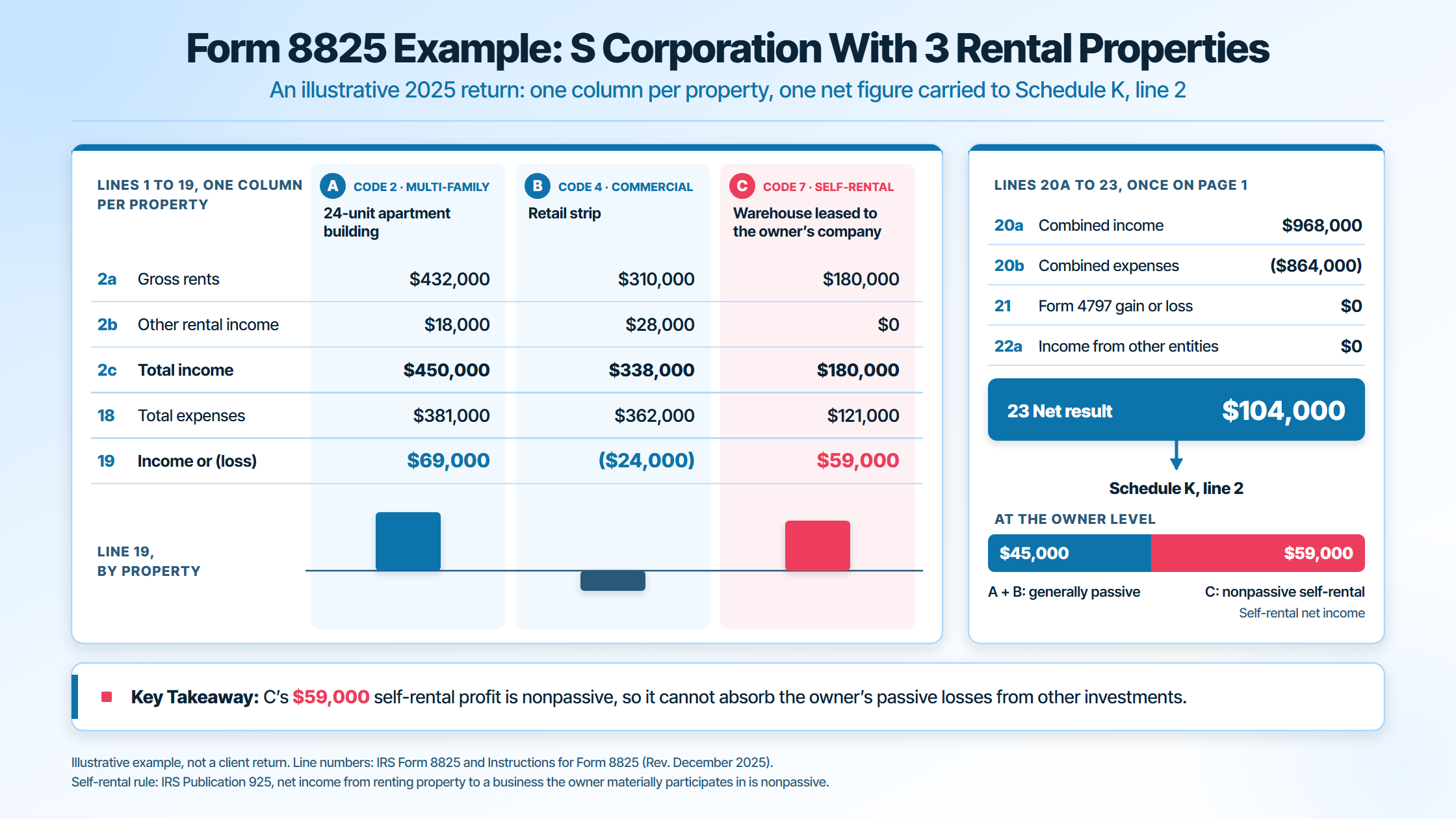
An S corporation with multiple rental properties gives each its own column. Take an illustrative one with 3 properties: A, a 24-unit apartment building (code 2); B, a retail strip (code 4); C, a warehouse leased to the owner’s operating company (code 7).
| Line | A | B | C |
| 2a Gross rents | $432,000 | $310,000 | $180,000 |
| 2b Other income | $18,000 | $28,000 | None |
| 2c Total | $450,000 | $338,000 | $180,000 |
| 18 Expenses | $381,000 | $362,000 | $121,000 |
| 19 Income or (loss) | $69,000 | ($24,000) | $59,000 |
Line 20a is $968,000 and line 20b is $864,000. With no sale or outside K-1 income, line 23 is $104,000, carried to Schedule K, line 2. If the properties are separate passive activities, a statement showing net income by activity goes with Schedule K and each K-1.
Each property keeps its own column; only the line 23 net result travels to Schedule K, line 2.
In one GATP real estate accounting engagement, an 8-property, 1,278-unit portfolio kept consolidated books only. Eight properties fill both pages of Form 8825, so a per-property close had to come first.
Self-Rental Rules for Code 7 Properties
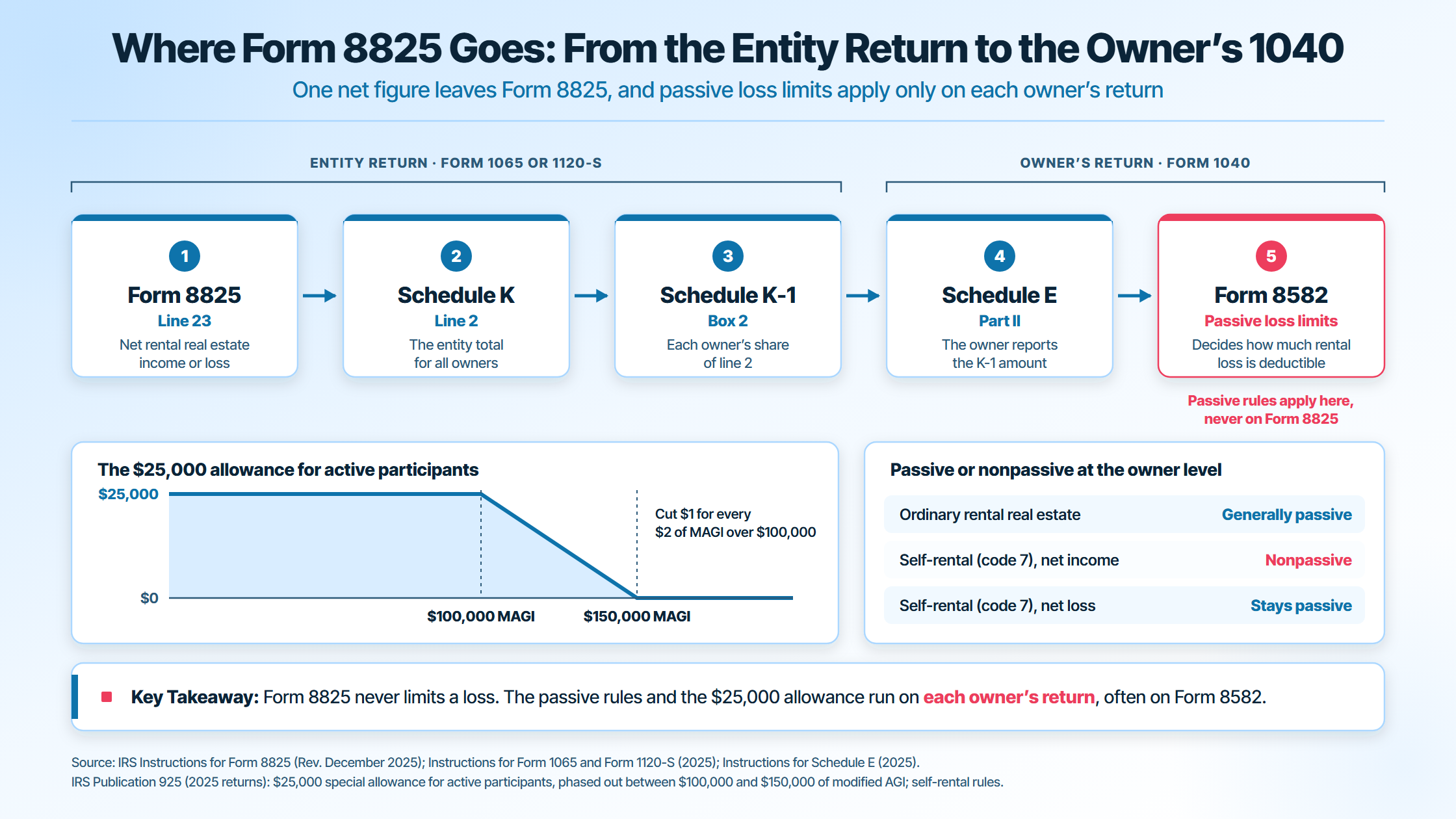
Self-rental rules apply when an owner rents property to a business in which they materially participate. Under IRS Publication 925, net income from that rental is nonpassive. A net loss stays passive.
So property C’s $59,000 cannot absorb the owner’s passive losses from other investments, while A and B net $45,000 that generally stays passive. Common setups:
- E-commerce: a Shopify brand leases its warehouse from the founder’s LLC.
- Clinics: a dental practice pays rent to a building LLC the dentists own.
Passive Activity Loss Rules and Form 8582 at the Owner Level
Passive activity loss rules apply on each owner’s return, never on Form 8825. Each partner or shareholder decides what is deductible, often on Form 8582. Publication 925 allows up to $25,000 of rental losses for active participants, phased out between $100,000 and $150,000 of modified adjusted gross income. Above that, the full passive activity loss rules apply.
Form 8825 never limits a loss; the passive activity rules run on each owner’s return.
Who Can Prepare Form 8825 for My Real Estate Partnership?
Any paid preparer with an IRS preparer tax identification number can prepare Form 8825. Only certified public accountants, enrolled agents and attorneys can represent you before the IRS on any matter, per the IRS page on tax return preparer credentials.
Bring 3 facts to any preparer: property count, the states involved, and whether total assets exceed $10 million. GATP is a CPA firm, and federal and state tax filing is in our Premium plan.
Conclusion: Form 8825 Instructions in Short
The Form 8825 instructions come down to one column per property, the December 2025 line order and one net figure on Schedule K, line 2. Three facts change the work: how many properties you own, whether you file Schedule M-3, and whether any building is a self-rental.
Get every property column on your next Form 8825 right. Send us your rent roll, last year’s Form 8825 and your fixed asset list. We map each property to the December 2025 lines, test Schedule M-3 and flag any self-rental. You get back a per-property schedule for your next business return. Our property management accounting team keeps those books current all year.
Form 8825 Frequently Asked Questions
Can You Deduct Section 179 on Form 8825?
No. The instructions keep section 179 off Form 8825, so it passes through on Schedule K. For section 179 rental property and every other asset, the 2025 limit is $2.5 million, phased out above $4 million of purchases. It requires use in the active conduct of a business, which many passive rentals lack. Roofs, heating and air conditioning, fire protection and security systems on nonresidential property can qualify by election.
What Are Common Charges on Form 8825?
Common charges are a named deduction on line 4 of Schedule A (Form 8825). In real estate, the term usually means shared building costs a condominium or cooperative unit owner pays. Only Schedule M-3 filers itemize them there. Other filers include them in the line 17 total for that property.
What Is the Form 1065 Due Date and the 1120-S Due Date for Form 8825?
Form 8825 is due with its return. The Form 1065 due date and the 1120-S due date are both the 15th day of the third month after year end. For calendar 2025 returns, that was March 16, 2026, because March 15 fell on a Sunday. Form 7004 extends the filing date.
What Is the Penalty If Form 8825 Is Filed Late?
The penalty applies to the whole return. It is $255 per partner or shareholder for each month or part of a month, for up to 12 months. A 4-partner LLC filing 5 months late owes $5,100. At 12 months, the same LLC owes $12,240. An S corporation that owes tax also pays 5 percent of the unpaid tax per month, up to 25 percent.
Does Each Property Need Its Own Column on Form 8825?
Yes. Every rental real estate property gets its own column, with lines 1 through 19 completed for each. The rule holds even when properties are grouped as one activity for the passive rules. The IRS example uses two grouped apartment buildings that still take two columns.
Can a Partnership Deduct Mortgage Interest on Form 8825?
Yes, on line 8, property by property. Section 163(j) may limit it. An entity with average annual gross receipts of $31 million or less is exempt for 2025 unless it is a tax shelter, such as a syndicate allocating more than 35 percent of losses to limited partners. A real property business can also elect out, but must then use the alternative depreciation system for certain property.
Do Short-Term Rentals Go on Form 8825?
Only when they still count as a rental activity. Code 3 covers vacation and short-term rentals. When the average guest stay is 7 days or less, the Form 1065 instructions say the activity is not a rental activity. Its income is then reported outside Form 8825, usually as trade or business income.
How Is a 1031 Exchange Shown on Form 8825?
An M-3 filer enters code B in column (c) for the property involved. Code B covers like-kind exchanges under section 1031 and involuntary conversions under section 1033. The exchange itself is reported on Form 8824. Filers without an M-3 requirement do not have to complete column (c).