
A clinic bills a payer $1,200 for an infusion visit. The payer contract sets the allowed amount at $430. If the books record $1,200 as revenue, that one visit is overstated by $770. Run that across a year of claims and the profit and loss statement stops describing the business.
Healthcare accounting is the discipline that stops this. It records revenue a third party prices and pays late, allocates cost across sites, and holds the reporting lenders, auditors and grant agencies ask for. Most practices reach for healthcare accounting services when a spreadsheet stops answering questions. Below is what those books have to do.
What Healthcare Accounting Is, and the Contractual Allowance That Defines It
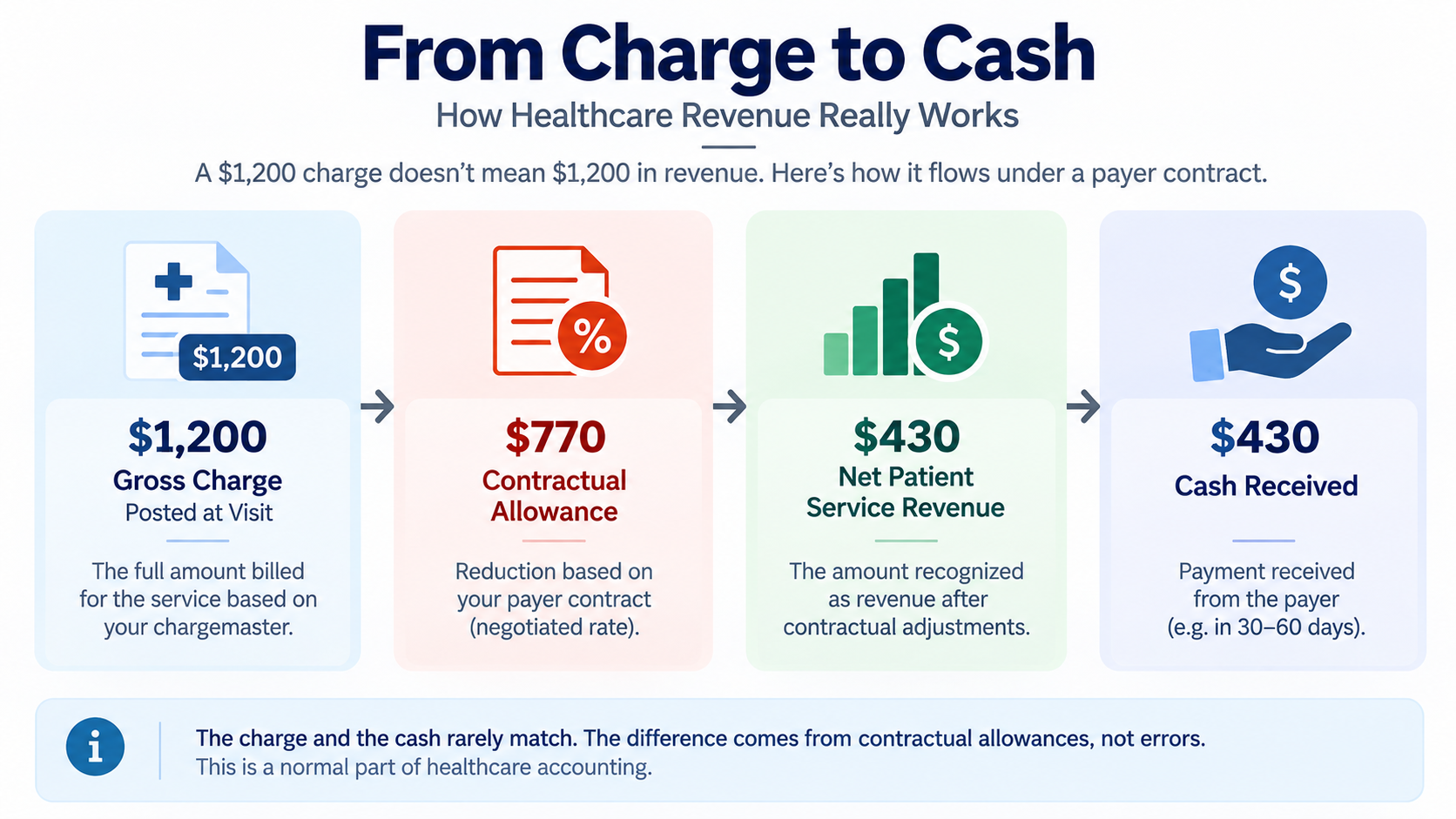
Healthcare accounting is the practice of recording, allocating and reporting a provider’s money when a third party sets the price and pays later. Ordinary accounting books a sale at the price charged.
Accounting in healthcare cannot. The charge and the cash almost never match, and the difference is not an error.
Four things separate healthcare industry accounting from any other ledger:
- The payer contract sets the price, not the fee schedule at the front desk.
- The gap between them is a contractual allowance. It reduces revenue, and it is neither a discount nor bad debt.
- Cash lands months after the visit, so accounts receivable carries the business.
- Provider pay is part expense and part owner draw, and the split moves the profit number.
Here it is, worked in full.
| Line | Amount |
|---|---|
| Gross charge posted at the visit | $1,200 |
| Contractual allowance per the contract | ($770) |
| Net patient service revenue recognised | $430 |
| Cash received on day 47 | $430 |
Revenue is $430 from the day of the visit. Not $1,200, and not on day 47. Get this entry wrong and every margin below it is wrong.
In a multi location rheumatology practice we rebuilt, six months of revenue sat at gross charges with no adjustment posted at all.
Cash Basis or Accrual Accounting in Healthcare, and the Gross Receipts Test
Accrual accounting in healthcare records revenue when the service happens and expense when it is incurred. Cash basis records both only when money moves.
Most small practices start on cash basis, because it matches how the tax return already works.
Tax law sets the outer limit. For tax years beginning in 2026, a corporation or partnership may use the cash method only if average annual gross receipts for the three prior years do not exceed $32,000,000.
One exception matters more to providers than the threshold does. A practice taxed as a C corporation keeps the cash method at any size if it is a qualified personal service corporation. Publication 538 sets that at 95 percent of activity in health services, with substantially all stock held by the people performing it.
Three things force the switch anyway:
- A lender or an investor asks for statements prepared on an accrual basis.
- The group crosses the gross receipts test and loses the cash method outright.
- Two sites need comparing, and cash timing makes the comparison meaningless.
Who These Books Belong To, by Provider Type
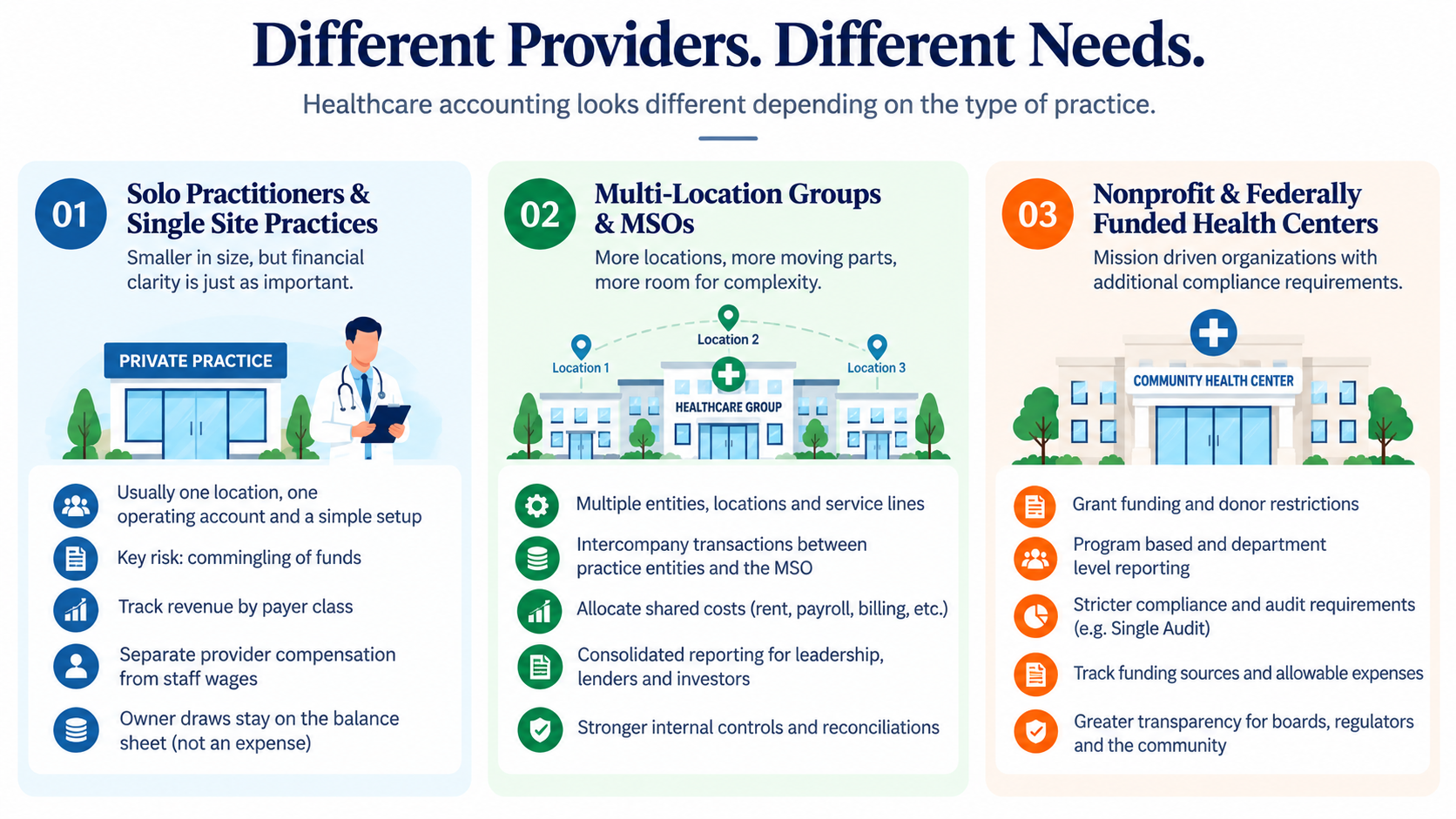
Accounting for healthcare organizations is not one job. A solo therapist, a multi site specialty group and a federally funded health center run different ledgers, different close calendars and different audits.
Accounting for healthcare professionals who own one practice looks almost nothing like the books of a management services organization. Three provider types cover most of the US market, and each one fails in its own way first.
Solo Practitioners and Single Site Practices
A single site practice usually runs one operating account, one card and one payroll provider. The risk here is not complexity. It is commingling, and it shows up as an owner draw sitting in an expense account.
Three splits in the chart of accounts do most of the work:
- Patient service revenue broken out by payer class, so a bad contract becomes visible.
- Provider compensation on its own line, separate from staff wages.
- Owner draws out of expense entirely, where they belong on the balance sheet.
The payer class split is the one that pays for itself. A practice that cannot see which payer sits below its own cost per visit renews that contract by default, every year.
Practice type changes the detail underneath. A dental chair and a therapy hour carry different cost structures, which is why dental bookkeeping and bookkeeping for therapists use different account sets on the same three splits.
Multi Location Groups and Management Services Organizations
A group with a management services organization runs two sets of books that must agree every month. One we work with runs six related entities against more than $1.3 million of annual revenue.
Three balances break first at this size:
- Intercompany loans, when no entity owns the reconciliation schedule.
- The management fee, when the services agreement has no written calculation behind the number.
- Accounts receivable, when the billing portal and the general ledger are never tied together.
Receivables fail in two directions at once. In that group, invoices raised in the billing portal were missing from the books entirely, while voided portal invoices were still carried as open receivables in QuickBooks.
Payroll is the fourth. Reclassifying two years of payroll for a healthcare services company covering 150 to 200 employees per period meant rebuilding wages, statutory taxes, reimbursements, benefits and accrued liabilities by department before investors would read the statements.
The practice level mechanics sit in our medical practice accounting guide.
Nonprofit Providers and Federally Funded Health Centers
A nonprofit provider reports on net assets rather than owner equity, and answers to funders as well as the IRS. Grant money is tracked award by award, because each carries its own allowable cost rules and reporting date.
Two federal triggers decide how heavy the year gets:
- Spend $1,000,000 or more in federal awards in a fiscal year and 2 CFR 200.501 requires a single audit on top of the financial statement audit.
- File Form 990 every year, where the functional expense allocation is public and funders read it.
The single audit is a separate engagement. It has its own fieldwork, its own schedule of expenditures of federal awards and its own findings, so budget it as a second audit rather than an add on.
Covered entities carry a third ledger for discounted drug inventory and program savings, covered in 340B program compliance. The rest of the reporting shape is in nonprofit and health center accounting.
Healthcare Cost Accounting, Allocated by Department, Site and Service Line
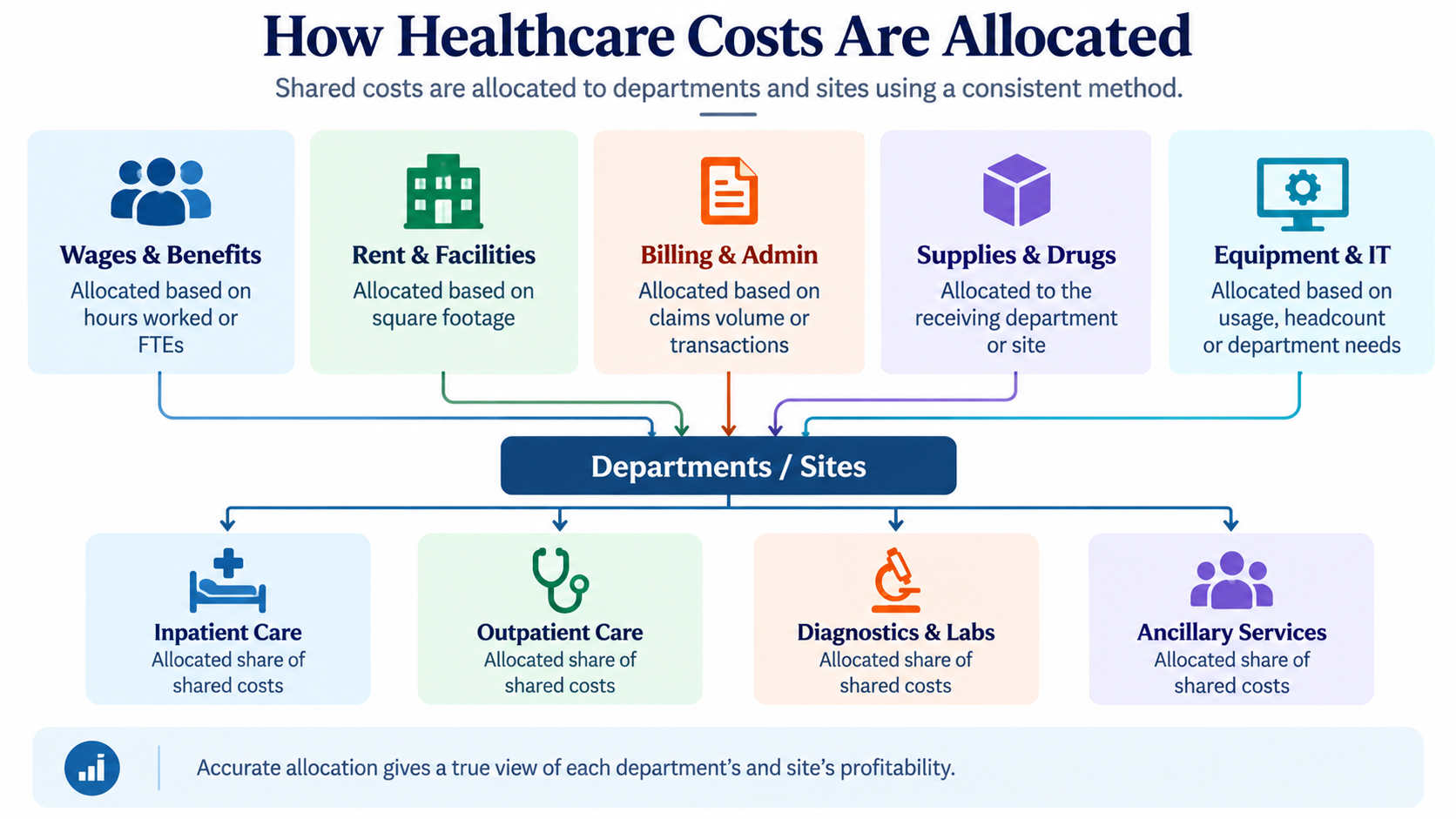
Healthcare cost accounting is the allocation of shared cost down to the department, site or service line that caused it. It answers one question. Which part of this practice actually makes money.
Cost accounting in healthcare fails for a dull reason. Nobody wrote the allocation basis down, so it drifts and no two reports agree.
Write it once for 2026, in a table, and hold it all year:
| Cost pool | Allocation basis |
|---|---|
| Clinical staff wages | Hours worked per site |
| Drug and medical supply cost | Purchase invoices coded to the receiving site |
| Rent, utilities and cleaning | Square feet per site |
| Billing and administration | Claims volume per site |
| Management fee | The written formula in the services agreement |
Drug cost is where this breaks. In the rheumatology rebuild, a full run of McKesson invoices for one location had never been entered, so that site looked like the profitable one.
Wage allocation depends on clean pay data, which is why healthcare payroll feeds this table directly.
The Monthly Close Calendar a Provider Organization Can Hold
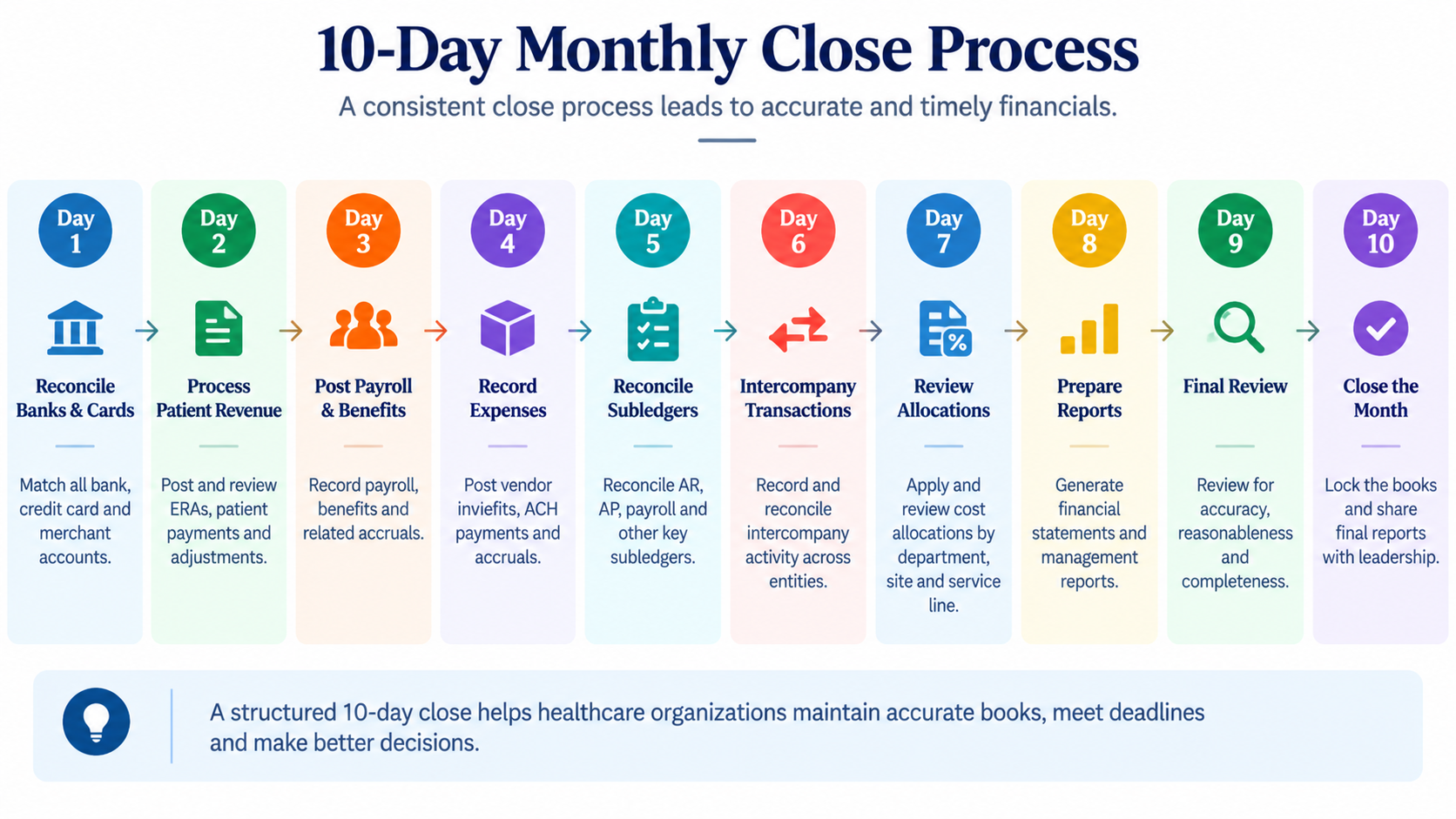
A healthcare close calendar gives every reconciliation a day number and a named owner. Without one the close drifts and statements arrive too late to act on.
This is the eight step sequence we run, finishing by the 10th of the following month:
- Day 1 to 2. Pull bank and card feeds, reconcile every account.
- Day 3. Match payer remittances to the billing system, invoice by invoice.
- Day 4. Post contractual allowances so revenue moves to the allowed amount.
- Day 5. Code drug and supply invoices to the site that received them.
- Day 6. Allocate payroll by department and by provider.
- Day 7. Agree intercompany balances across every entity.
- Day 8. Recalculate the management fee against the services agreement.
- Day 9 to 10. Review the statements and release them.
Step 2 decides whether the rest holds. Our healthcare accounts receivable reconciliation work moved a six entity group to a weekly invoice by invoice cycle across an $800,000 to $980,000 receivable, and the close has landed by the 10th since. The reports it produces are covered in healthcare financial reporting.
Healthcare Audit and Accounting, and What an Auditor Actually Tests
Healthcare audit and accounting is the work of keeping records in a state that survives outside testing. An auditor does not read your profit and loss statement and form an opinion. They pick samples and chase them back to source documents.
We supported a multi entity infusion and specialty group through its fiscal 2024 and fiscal 2025 financial statement audits by a national firm. Seven request categories came back:
- Revenue confirmations, split between owned and outreach revenue.
- Accounts receivable sample testing, general ledger against the practice management system.
- Accounts payable confirmations sent to third party vendors.
- Related party advances between entities.
- Goodwill schedules from prior acquisitions.
- Debt confirmations sent directly to the lender.
- An information technology controls and cybersecurity questionnaire.
Number two is where groups fail. If the ledger and the practice management system were never tied during the year, nobody can tie them during fieldwork. That multi entity healthcare group got through because the tie ran monthly.
What Changed in 2026 for Healthcare Accounting
Two federal thresholds moved for 2026, and each one decides how much accounting a provider has to do this year.
- The cash method limit rose. The gross receipts test was $31,000,000 for tax years beginning in 2025 and is $32,000,000 for 2026. A group that crossed the old line during a growth year may have another year on cash basis.
- The single audit threshold is now fully in force. It rose from $750,000 to $1,000,000 for fiscal years starting on or after 1 October 2024. Fiscal 2026 is the first full year most health centers test against the higher number, and some drop out of single audit entirely.
Neither change is automatic. The gross receipts test runs on the prior three years, and the audit test runs on federal award spend for the year in progress. Book both into the November close, while there is still time to act on the answer.
Five Healthcare Accounting Mistakes and the Month They Surface
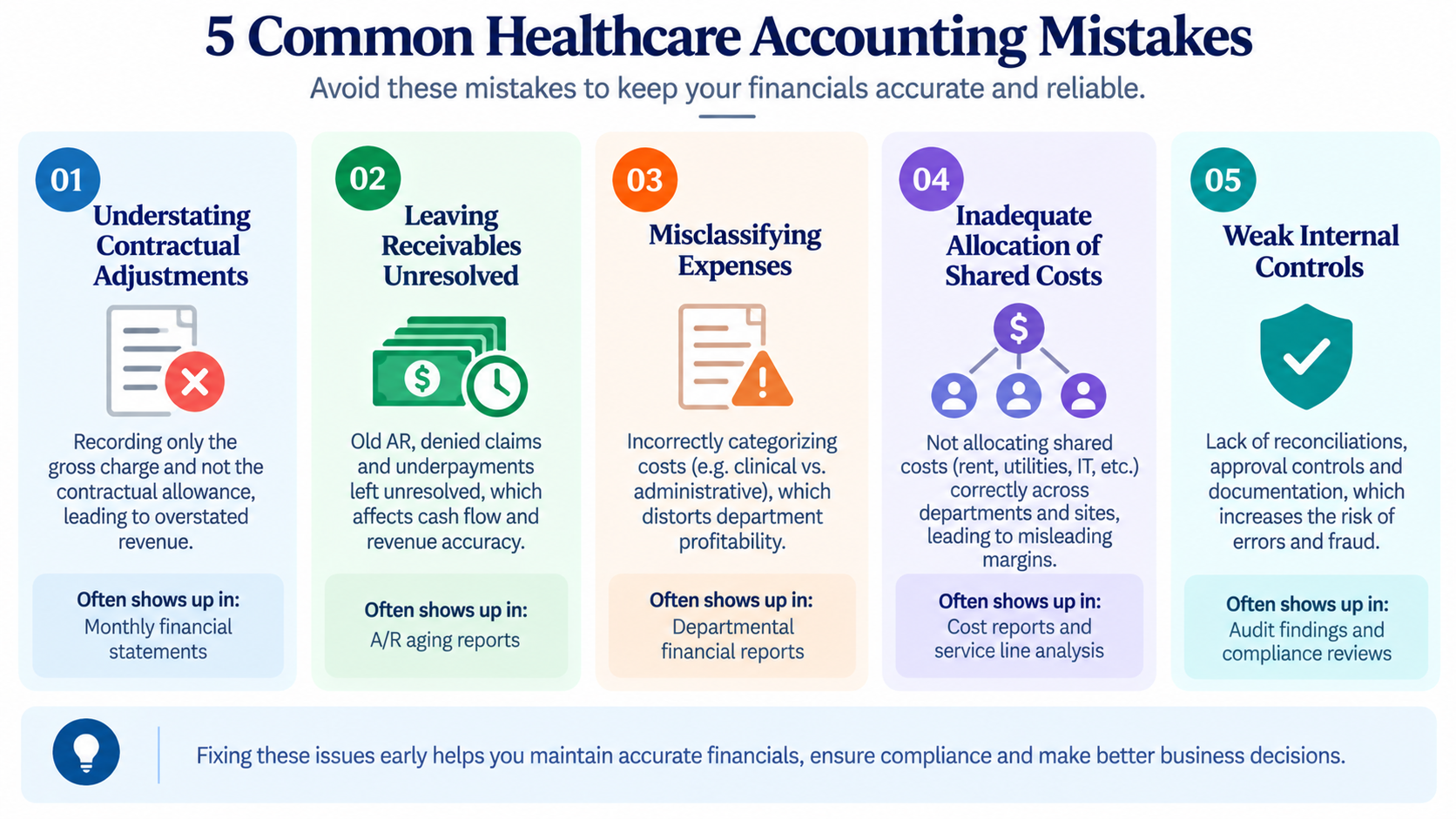
Five errors account for most of the rebuild work we are asked to do. Each hides for a while, then surfaces at a predictable moment.
- Posting gross charges as revenue. This is the $770 error from the top of this page, repeated across every claim in the year.
- Leaving voided invoices open in the ledger. Receivables age forever and nobody can say what is actually collectible.
- Letting a card feed stop syncing. A whole month of expense disappears and the site looks unusually profitable.
- Charging a management fee with no written calculation. Surfaces in fieldwork, when the auditor asks for support that was never produced.
- Running provider pay through the staff wages account. Productivity per provider cannot be measured, so compensation talks run on opinion.
Run the close calendar above as a monthly checklist and four of the five cannot survive past day 8. The fifth, provider pay, is fixed once in the chart of accounts.
Our Compliance and On Time Delivery Guarantees
A healthcare accounting error costs money twice, once in the correction and once in the filing that carried the wrong number.
Regulatory Compliance Assurance. We ensure all tax filings, payroll, and financial reports meet compliance standards. If an error on our part results in a financial penalty, we will cover the cost.
On Time Delivery Guarantee. Monthly, quarterly, and annual reports are delivered without delays. If we miss a compliance deadline due to our fault, we pay a 50 percent fee.
The Short Version
Healthcare accounting comes down to one habit. Record revenue at the allowed amount, $430 in the example above, rather than the $1,200 billed, then allocate every shared cost to the site that caused it.
Everything else follows. The close calendar makes those entries happen on a date, the cost table stops the allocation drifting, and the audit tests whether both held all year.
Accounting for healthcare services is not harder than other industries. It just fails earlier when the revenue entry is wrong.
Find out what your books are actually recording.
We review your last three months of revenue postings, your contractual allowance entries and your cost allocation basis. You get back where revenue was booked at gross instead of allowed, what that did to margin by site, and whether your method still fits the gross receipts test. Thirty minutes, one answer, from our outsourced accounting team.
Frequently Asked Questions About Healthcare Accounting
What is healthcare accounting?
Healthcare accounting is the recording, allocation and reporting of a provider’s finances when a third party sets the price and pays after the service. It covers net patient service revenue, contractual allowances, cost allocation by site, and the compliance reporting that payers, lenders and funders require.
What makes healthcare accounting unique?
The price is set by someone other than the provider. A $1,200 charge may be worth $430 under the payer contract, so revenue is booked net of a contractual allowance rather than at the amount billed. No other service industry records a sale that way as standard practice.
Is healthcare accounting hard?
The bookkeeping is ordinary. The hard part is the revenue side, because you estimate what each payer will allow before the remittance arrives. A bookkeeper who has never worked a remittance advice will post gross charges, and every margin downstream inherits that error.
Does healthcare accounting use cash basis or accrual?
Both are used. Small practices generally run cash basis, and accrual accounting in healthcare becomes necessary once lenders or investors need comparable statements. For tax years beginning in 2026 the cash method is capped at $32,000,000 in average gross receipts, with an exception for qualified personal service corporations.
What is cost accounting in healthcare?
Healthcare cost accounting allocates shared costs to the department, site or service line that caused them. Wages go out on hours worked, occupancy on square feet, supplies on the invoice coding. Done properly it tells you which service line is profitable, which ordinary financial reporting cannot answer.
How does healthcare accounting impact the patient?
It sets what the patient owes. The patient balance is whatever remains after the contractual allowance and the payer payment, so a practice that posts allowances wrongly bills patients the wrong amount. Accurate books also fund staffing and equipment, which is the slower route to care.
What does an auditor test in healthcare accounting?
Samples, traced back to source. Expect revenue confirmations, receivable samples tied from the ledger to the practice management system, payable confirmations, related party balances, goodwill schedules, debt confirmations and a technology controls questionnaire. The receivable tie is the test that most often fails.
Do you need a CPA for healthcare accounting, or is a bookkeeper enough?
A bookkeeper can maintain the ledger. A CPA is needed for the accounting method election, the tax position, the audit response and the accrual conversion. The two work best under one roof, because a method decision made in January changes every entry posted for the rest of the year.