
A fractional controller is a part-time controller who runs your month-end close, financial statements and internal controls for a set number of hours instead of as a full-time employee. A median employed controller costs about USD 246,668 a year with benefits. For a USD 1 million to USD 10 million business, we recommend buying controller hours instead, through a fractional controller or an outsourced finance department.
What Does a Fractional Controller Do?
A fractional controller does the same job as a full-time controller, on a part-time schedule. The BLS Occupational Outlook Handbook for financial managers describes controllers as the managers who direct the preparation of financial reports, such as income statements and balance sheets. Controllers often oversee the accounting, audit and budget work too.
For a business doing USD 1 million to USD 10 million, one person then owns three outputs:
- A closed month.
- Financial statements the owner trusts.
- Controls that stop money leaking.
The bookkeeper keeps doing the daily entries. The controller reviews, corrects and signs off. In a company without a CFO, the fractional controller can be the most senior finance person the owner meets each month.
BLS counted 841,710 financial managers employed in May 2025, and controllers are one named type within that group. The four parts of the job below show how the work splits across a month.
The Month-End Close a Fractional Controller Runs, Step by Step
The month-end close is the core deliverable of a fractional controller. The close runs in a fixed order, so each step catches the errors of the step before it.
- Cut off the month. Stop posting to the closed period, so late entries do not change numbers already reported.
- Reconcile cash and debt. Match every bank, credit card and loan account to its statement balance, so missing or duplicate transactions surface.
- Tie out receivables and payables. Compare the aging reports to the general ledger, so no invoice is counted twice or missed.
- Post accruals. Book accrued expenses, prepaid amortization and depreciation, so costs land in the month they belong to.
- Reconcile liabilities. Match payroll liabilities and sales tax payable to the filed returns, so the balance sheet shows what was actually owed.
- Review the trial balance. Look for unusual swings against last month and the budget, then correct misclassified entries.
- Issue and lock. Send the statements with a short variance note to the owner, then lock the period.
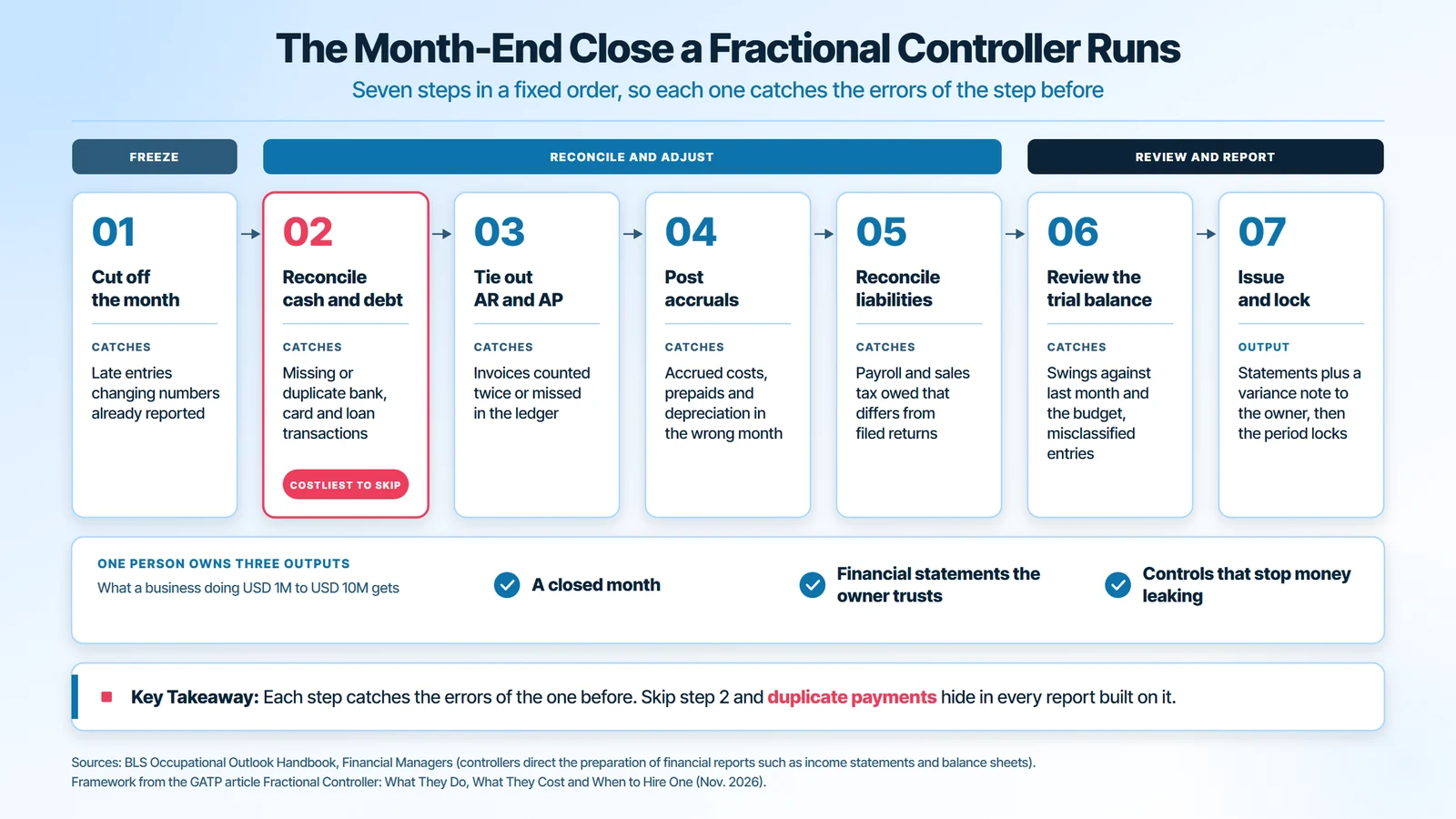
Skipping step 2 is the most expensive shortcut. An unreconciled account hides duplicate payments and bank errors in every report built on it.
Financial Reporting, Internal Controls and Audit-Ready Records
Financial reporting is the monthly output a controller sends to owners, lenders and investors. The package holds the income statement, balance sheet and cash flow statement on the same basis every month. When a lender or investor asks for accrual statements under US GAAP, the controller converts the books and adds board reporting once outside investors join.
Internal controls are the rules that stop one person from both creating and paying a bill. A fractional controller sets four basic controls for a small team:
- Separate the person who adds a vendor from the person who releases payment.
- Require a second approval on payments above a set amount.
- Review the vendor list every month for duplicates and changed bank details.
- Restrict who can reopen a closed period.
Records are part of the job too. Under the IRS record retention rules, most records are kept for 3 years and employment tax records for at least 4 years. The period runs to 6 years if income was underreported by more than 25 percent, so reconciliation support has to stay findable.
Budgets, Cash Flow Forecasting and KPIs
Budgeting turns the closed month into a plan. A fractional controller builds the annual budget with the owner, compares actual results to it every month and explains the variances that matter.
A business can run short of cash while its income statement still shows a profit, because receivables, inventory and loan payments tie up cash. A rolling 13-week model for cash flow forecasting lays payroll weeks, tax payments and large vendor bills against expected collections. A shortfall then shows up weeks early, while there is still time to act.
The controller also picks 5 to 8 KPIs the owner reads each month, for example:
- Gross margin by product line or service
- Days sales outstanding and days payable outstanding
- Cash runway in weeks
- Payroll as a share of revenue
Strategy on top of those numbers, such as raising capital or pricing a new market, belongs to a CFO. The controller makes sure the numbers under that strategy are right.
What a Fractional Controller Fixes in E-commerce, Real Estate and Medical Practices
Industry detail changes what a fractional controller checks first. Three examples from businesses in the USD 1 million to USD 10 million range show the difference:
- E-commerce: Shopify, Amazon and Stripe payouts arrive net of fees, refunds and reserves. The controller books gross sales and fees separately and ties each payout to the bank. Payment apps report on Form 1099-K once payments pass USD 20,000 in more than 200 transactions, under the IRS Form 1099-K rules, so the controller matches those totals to sales.
- Real estate: Rent rolls, security deposits and owner distributions sit in different accounts for each property. The controller reconciles deposits held to the deposit liability and keeps each entity’s books separate.
- Medical practices: Insurance payments arrive weeks after the visit and often below the billed amount. The controller reconciles payer deposits to the practice management system and books contractual adjustments, so revenue is not overstated.
When Does a Business Need a Fractional Controller?
A business needs a fractional controller when its financial questions outgrow what a bookkeeper is trained to answer. The work does not yet justify a full-time salary of USD 166,570, the May 2025 median. In our experience that point sits between USD 1 million and USD 10 million in revenue.
The revenue share shows why, for a business with USD 6 million in revenue:
- A full-time controller at the median loaded cost of USD 246,668 is about 4.1 percent of revenue.
- Ten controller hours a week, about USD 61,667 a year, is about 1.0 percent.
Experienced controllers are also hard to hire. BLS projects financial manager jobs to grow 10 percent from 2025 to 2035, with about 65,600 openings a year. Part-time access gives a smaller company a senior controller it could not recruit full-time.
The signs below show when the controller work is already being skipped.
Signs Your Business Has Outgrown Bookkeeping Alone
Bookkeeping alone stops being enough when the business needs judgment on the numbers, not just entries. Watch for these signs:
- The month closes after the 15th of the next month, or never formally closes.
- A lender, investor or buyer asks for accrual statements or covenant reports.
- You run two or more entities or locations that need intercompany entries.
- Gross margin moves and nobody can explain why within a day.
- A first audit, review or due diligence request is coming.
- One person can create a vendor, approve the bill and release the payment.
- Sales tax or payroll is now filed in several states, and nobody reconciles the filings to the ledger.
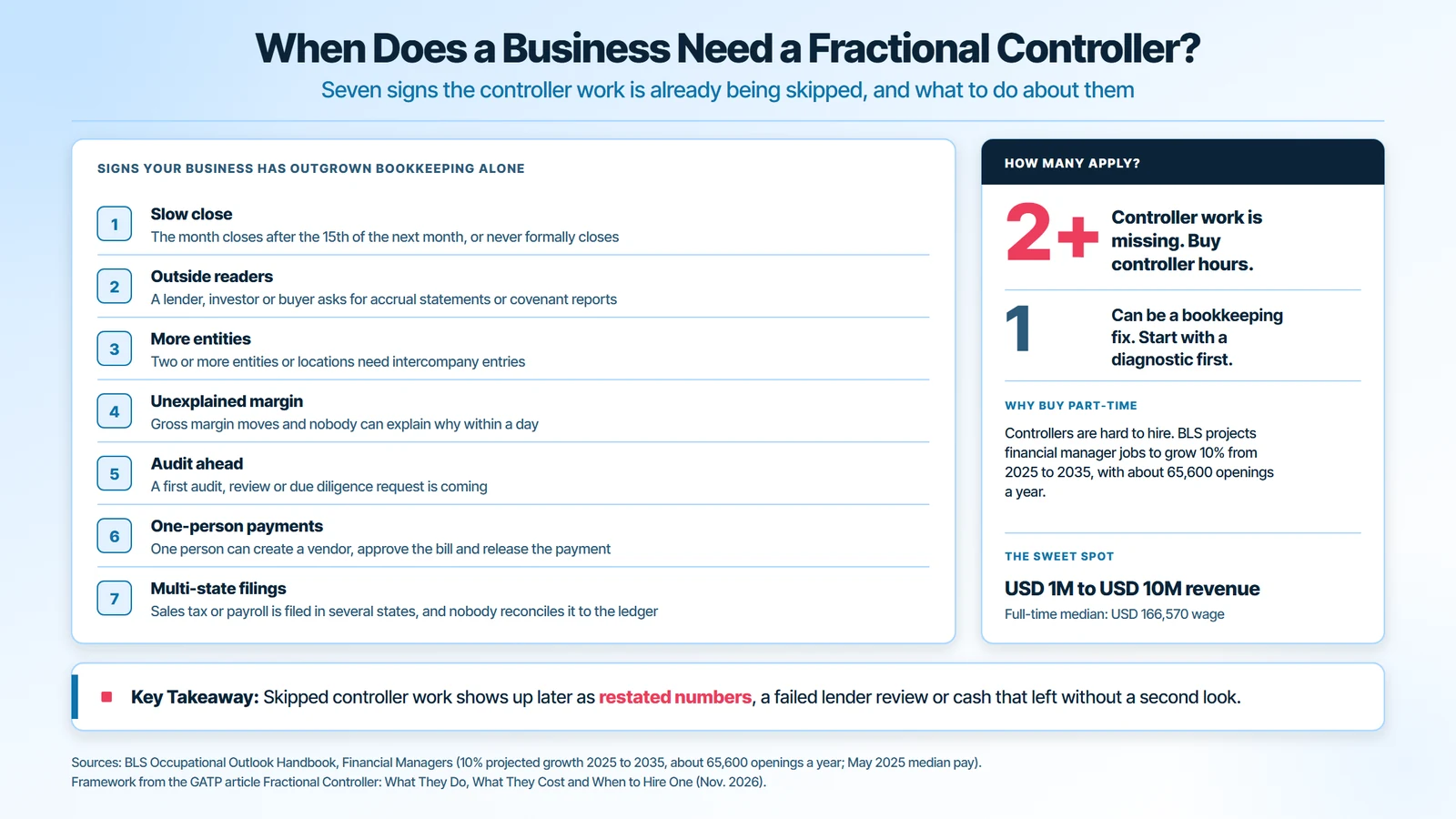
In our experience, two or more of these mean controller work is missing. The cost shows up later as restated numbers, a failed lender review or cash that left the business without a second look.
One sign alone can be a bookkeeping fix. A slow close with clean controls may only need more bookkeeper hours, so start with a diagnostic before buying controller time.
What Changed in 2026 for Controller Work
Form 1099 reporting is the 2026 change that lands on a controller’s desk. Under the IRS information return rules, the threshold for Forms 1099-NEC and 1099-MISC moved as follows:
- Payments made before 2026: USD 600.
- Payments made in 2026: USD 2,000.
- Payments made after 2026: adjusted for inflation.
The higher threshold cuts the number of forms, not the work. A controller still collects a Form W-9 when a contractor is set up. The controller then tracks each contractor’s running total for the year and checks it against the new threshold before filing season.
One rule did not move. The IRS still requires a Form 1099-NEC for any person from whom you withheld federal income tax under backup withholding, whatever the amount paid. A controller flags those vendors separately in the tracking report.
The Form 1099-K level for payment apps also stays at over USD 20,000 in more than 200 transactions. Online sellers should expect fewer forms and reconcile the ones that arrive.
Fractional vs Outsourced, Part-Time, Virtual and Interim Controller Services
Controller services is the umbrella term for every way of buying controller work, from fractional controller services to a full-time hire. The labels describe how the controller is engaged, not a different job. The duties stay the same: close, reporting, controls and cash. What changes is the hours, the length of the engagement and who employs the person.
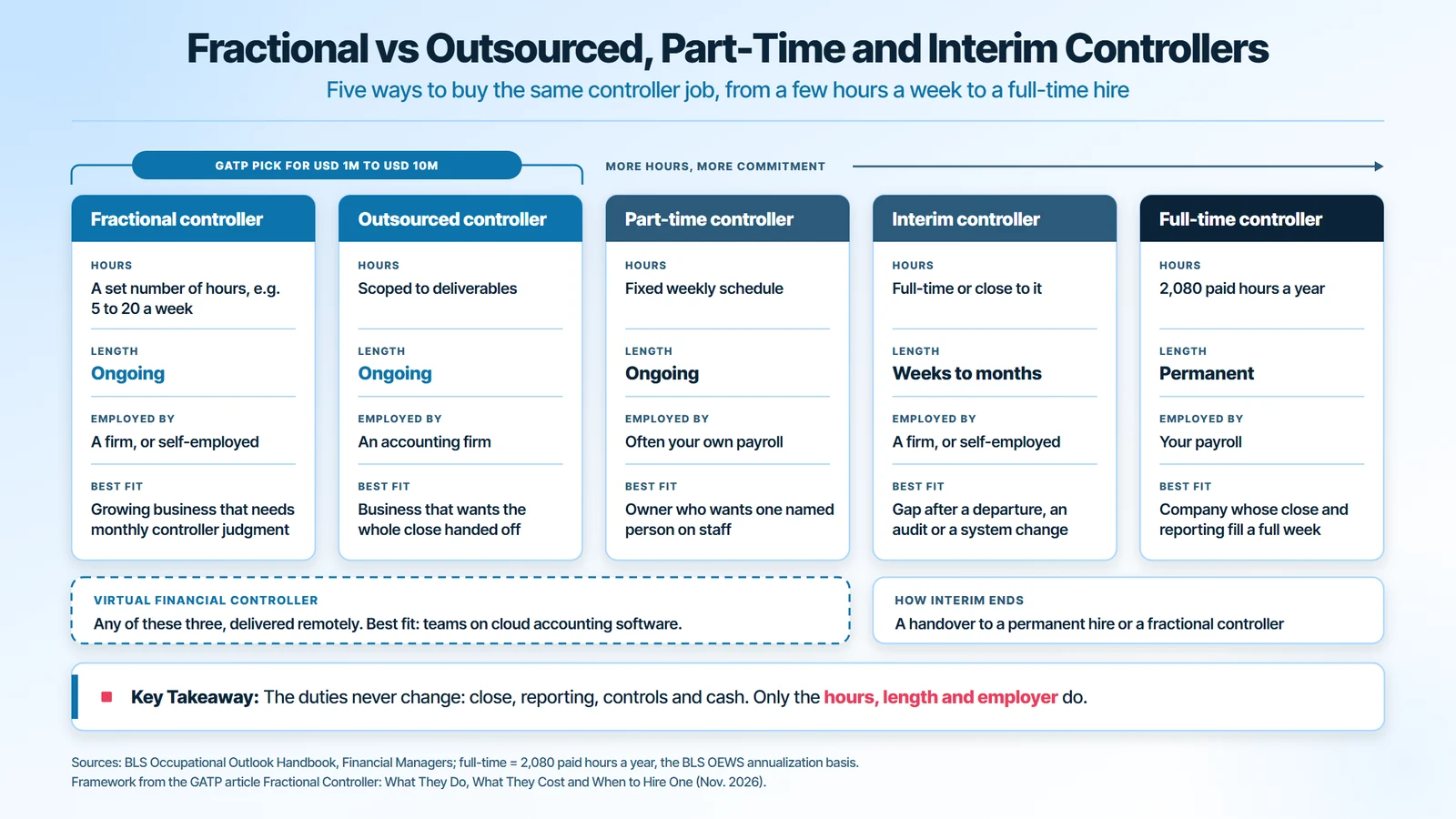
| Model | Hours | Length | Employed by | Best fit |
| Fractional controller | A set number of hours, for example 5 to 20 a week | Ongoing | A firm, or self-employed | Growing business that needs controller judgment every month |
| Part-time controller | Fixed weekly schedule | Ongoing | Often your own payroll | Owner who wants one named person on staff |
| Outsourced controller services | Scoped to deliverables | Ongoing | An accounting firm | Business that wants the whole close handed off |
| Virtual financial controller | Any of the above, delivered remotely | Ongoing | A firm, or self-employed | Teams on cloud accounting software |
| Interim controller | Full-time or close to it | Weeks to months | A firm, or self-employed | Gap after a departure, an audit or a system change |
| Full-time controller | 2,080 paid hours a year | Permanent | Your payroll | Company whose close and reporting fill a full week |
We recommend the fractional or outsourced model for most companies between USD 1 million and USD 10 million. Controller work rarely fills 40 hours a week below that range. A part-time controller on payroll makes sense when you want one person in the office and can carry payroll taxes and benefits.
What Is an Interim Controller?
An interim controller is a temporary controller who runs the accounting function full-time or close to it for a defined period. Interim controller services usually follow a controller’s departure, or support an audit, an acquisition or a system change. The engagement ends with a handover to a permanent hire or to a fractional controller.
Companies bring in an interim controller for four common reasons:
- A controller resigns and the close cannot pause.
- A first audit or lender review needs clean books by a deadline.
- An acquisition or a second entity needs consolidated statements.
- An accounting software migration needs someone to own cutover and reconciliation.
Judge an interim controller by what they leave behind. That means a written close calendar, signed reconciliations for every balance sheet account, a clean vendor list and a contractor file ready for Form 1099 season. When the gap is at the CFO level instead, interim CFO services cover strategy, lenders and the board.
Controller vs CFO: Who Ranks Higher and Who Does What?
The CFO ranks higher than the controller. The controller owns the accuracy of the numbers and reports to the CFO, or to the owner when there is no CFO. The CFO owns what the business does with those numbers: capital, lenders, pricing and strategy.
Federal filing rules treat the two as separate jobs. SEC Form 10-K must be signed by the principal financial officer and, separately, by the controller or principal accounting officer. The BLS Occupational Outlook Handbook for top executives lists CFOs as a type of chief executive, while controllers sit under financial managers.
| Point | Controller | CFO |
| Main question | Are the numbers right? | What should we do with them? |
| Core work | Close, reconciliations, statements, controls | Strategy, capital, lenders, forecasting models |
| Time horizon | Last month and this month | Next year and beyond |
| Reports to | CFO, or the owner | CEO and board |
| May 2025 median pay (BLS class) | USD 166,570 (financial managers) | USD 213,990 (chief executives) |
| Typical fractional need | Often more hours, scoped weekly | A few days a month |
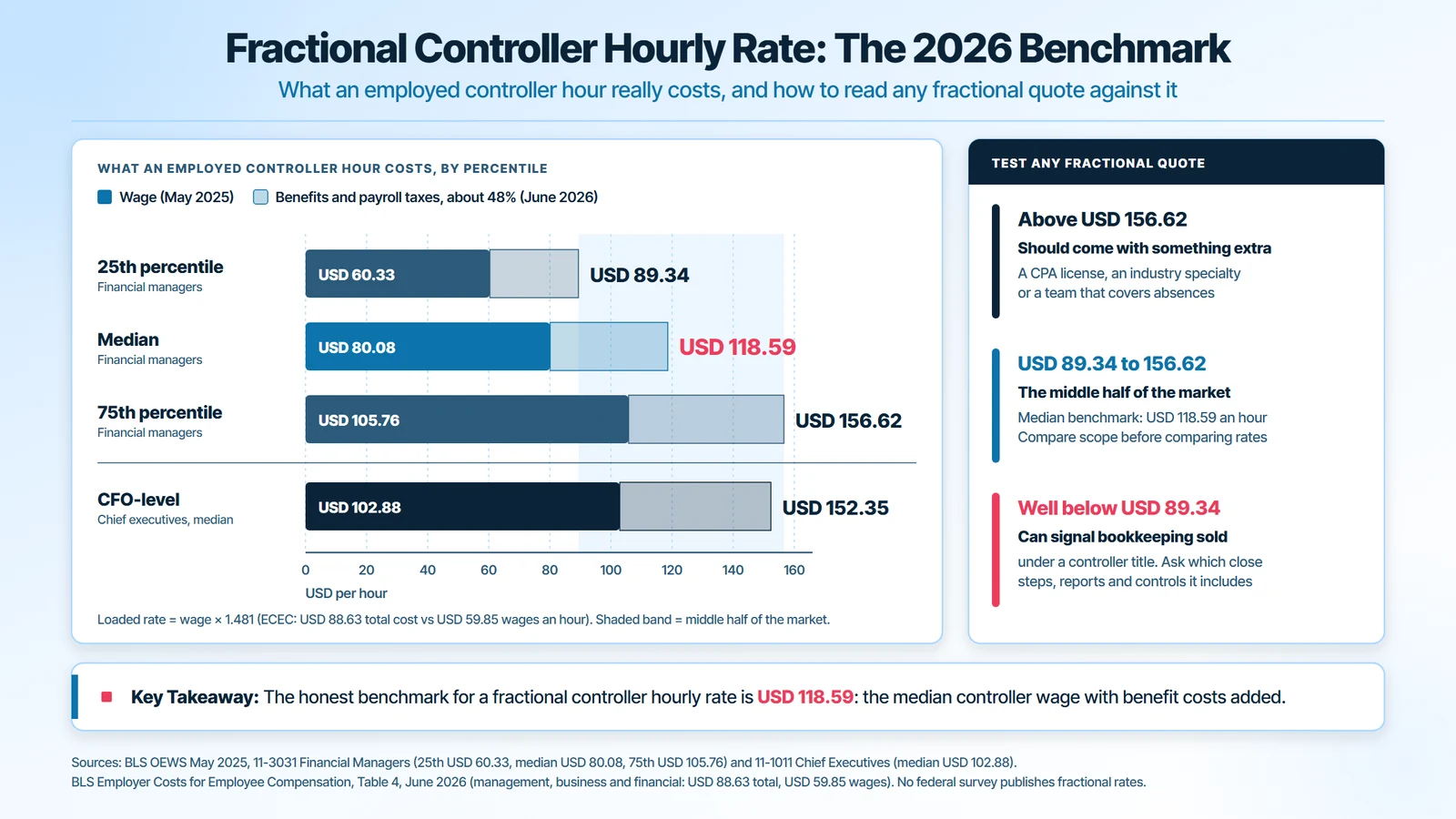
The pay gap follows the job. Chief executives, the BLS class that includes CFOs, earned a May 2025 median of USD 213,990 in the BLS OEWS chief executives wage data. That is USD 47,420, or 28 percent, more than the financial managers median.
A bookkeeper, a controller and a CFO form a ladder. The bookkeeper records, the controller verifies and reports, and the CFO decides. We recommend fixing the controller layer first, because a fractional CFO working from unreconciled books spends paid hours cleaning data instead of planning.
How Much Does a Fractional Controller Cost?
A fractional controller costs a share of a full-time controller’s loaded cost. That loaded cost was about USD 246,668 a year, or USD 20,556 a month, at the May 2025 median wage plus June 2026 benefit costs. No federal survey publishes fractional controller rates, so the honest benchmark is what an employed controller costs per hour.
The benchmark rests on two BLS data sets. The BLS OEWS financial managers data puts the median wage at USD 80.08 an hour in May 2025. The BLS Employer Costs for Employee Compensation release shows management, business and financial workers cost USD 88.63 an hour in June 2026, against USD 59.85 in wages.
Benefits and payroll taxes added about 48 percent on top of wages for that group. OEWS also converts annual wages to hourly on 2,080 paid hours, so the hourly and annual figures below line up.
Fractional Controller Hourly Rate vs a Full-Time Controller Salary
The fractional controller hourly rate to test any quote against is USD 118.59. That figure is the median controller wage with benefit costs added. Across the middle half of the market, the same load gives USD 89.34 to USD 156.62 an hour.
| Percentile (May 2025) | Wage per hour | Annual wage | Loaded cost per hour |
| 25th percentile | USD 60.33 | USD 125,490 | USD 89.34 |
| Median | USD 80.08 | USD 166,570 | USD 118.59 |
| 75th percentile | USD 105.76 | USD 219,980 | USD 156.62 |
A full-time controller salary is high: the median is USD 166,570 a year on 2,080 paid hours. A fractional rate above the 75th percentile figure should come with something extra. Examples are a CPA license, an industry specialty or a team that covers absences.
A quote far below the 25th percentile figure can signal bookkeeping sold under a controller title. Ask which close steps, reports and controls the price includes before comparing rates.
Worked Example: A USD 6 Million Distributor Buys 10 Hours a Week
Take a distributor with USD 6 million in revenue, one bookkeeper and a close that runs into the third week of the next month. The owner needs a monthly close, accrual statements for the bank and a 13-week cash forecast. That work fits in about 10 controller hours a week.
| Controller hours a week | Hours a month | Monthly cost at the median loaded rate |
| 5 | 21.7 | USD 2,569 |
| 10 | 43.3 | USD 5,139 |
| 20 | 86.7 | USD 10,278 |
| Full-time | 173.3 | USD 20,556 |
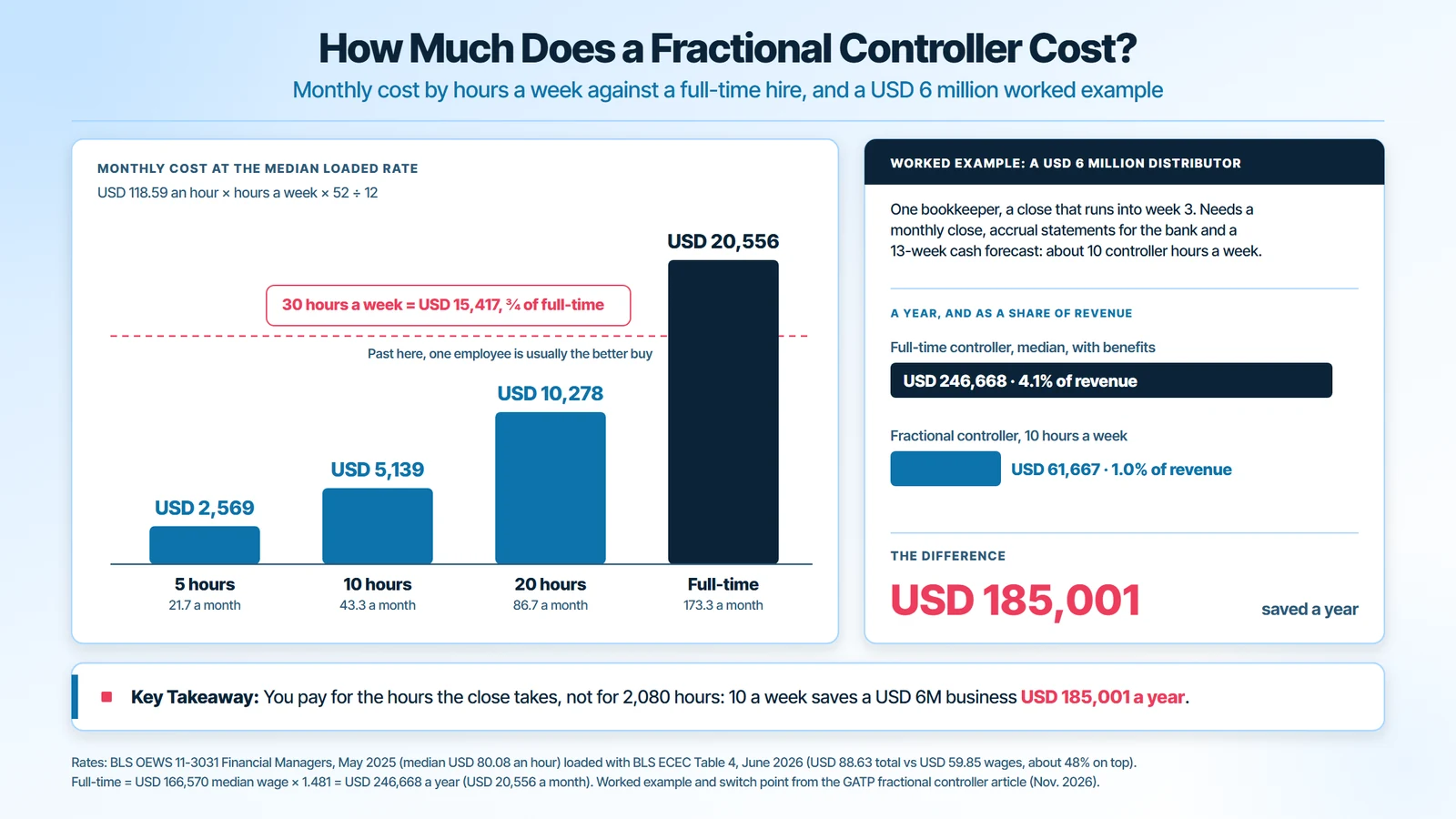
At 10 hours a week, the distributor spends about USD 61,667 a year. A full-time controller at the median costs USD 246,668. The difference is USD 185,001 a year, because the business pays for the hours the work takes, not for 2,080 hours.
The same arithmetic shows when to switch. Once the work needs 30 or more hours a week every month, the fractional cost reaches three quarters of a full-time hire. At that point one dedicated employee is usually the better buy.
Fractional Controller vs Fractional CFO Cost
A fractional CFO costs more per hour than a fractional controller, because the job sits a level higher. Loading the chief executive median of USD 102.88 an hour gives USD 152.35. The controller benchmark is USD 118.59.
At 10 hours a week, CFO-level time costs about USD 6,602 a month and controller time about USD 5,139. The gap is USD 1,463 a month.
For businesses in the USD 1 million to USD 10 million band, we recommend more controller hours than CFO hours. The mix matters more than the rate.
An example mix at the loaded medians looks like this:
- 10 controller hours a week for the close and reporting: about USD 5,139 a month.
- 8 CFO-level hours a month for planning and lender meetings: about USD 1,219.
- Combined finance function: about USD 6,358 a month.
How Does a Fractional Controller Engagement Work?
A fractional controller engagement starts with a review of the books and settles into a monthly rhythm. We recommend a five-step plan for the first 90 days, where each step prevents a specific failure:
- Diagnostic review, weeks 1 to 2. Read the chart of accounts, the last three bank reconciliations, open payables and receivables, and who can approve and pay. The output is a written list of fixes. Without it, the controller treats symptoms.
- Cleanup, weeks 2 to 6. Reconcile every balance sheet account to support, clear old uncleared items and fix misclassified expenses. Without it, every new report sits on wrong balances.
- Close calendar, month 2. Set a day-by-day close checklist with owners and due dates, then run the first close against it. Without it, the close drifts.
- Controls, months 2 to 3. Split vendor setup, approval and payment, set approval limits and restrict who can reopen a period. Without them, double payments go unnoticed.
- Reporting cadence, month 3. Deliver monthly statements, a budget-to-actual report and the 13-week cash forecast on a fixed date. Without a date, reports arrive when they are no longer useful.
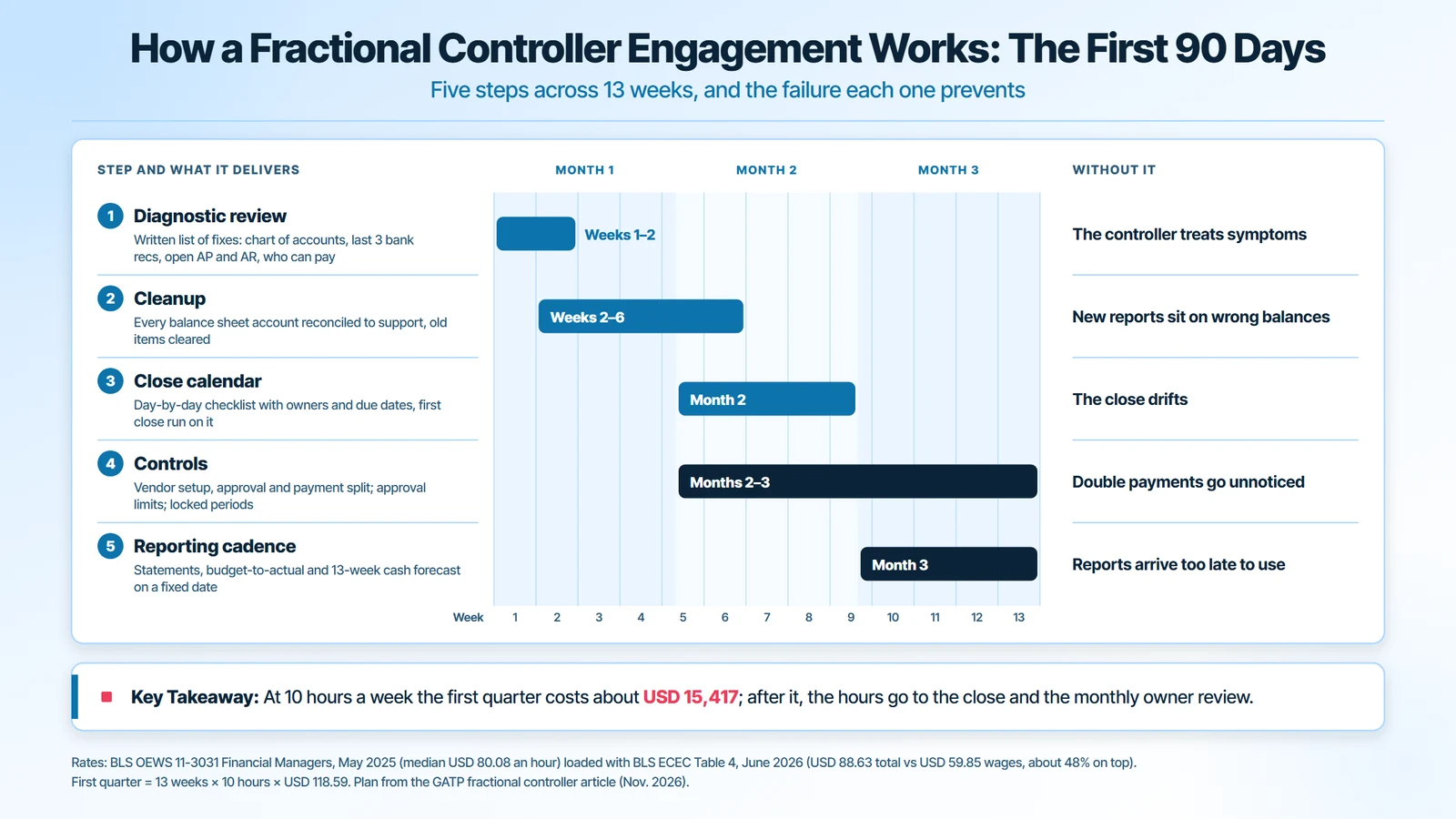
After the first quarter, most of the hours go to the close and the monthly review meeting with the owner. Cleanup hours drop away once the balances are right. At 10 hours a week, that first quarter costs about USD 15,417 at the median loaded rate.
How to Hire a Fractional Controller
Hiring a fractional controller starts with the scope, not the resume. Write down the close date you want, the reports you need and who reads them. Then test each candidate against that scope.
BLS puts the May 2025 median controller-class wage at USD 166,570, and says financial managers typically need a bachelor’s degree plus 5 or more years in a related role, such as accountant or financial analyst. A CPA license is not required for the job, but state boards of accountancy license CPAs, and the license is worth checking when lenders or auditors will read your statements.
Ask every candidate these six questions:
- Which accounting systems have you closed books in, such as QuickBooks Online, Xero, NetSuite or Sage Intacct?
- By which business day will statements arrive each month?
- Which controls will you put in place in the first 60 days?
- Who covers the close when you are unavailable?
- Which industries have you worked in at our revenue size?
- Do you price by the hour, by monthly retainer or by fixed scope?
An independent controller can be cheaper per hour, but the close stops when that person is sick or leaves. A firm costs a little more and keeps a team behind the named controller. We recommend a firm when lenders or investors depend on the monthly reports arriving on time.
Common Fractional Controller Mistakes to Avoid
Fractional controller engagements fail for predictable reasons, and each one has a simple fix. GATP’s accountants see these four repeatedly in businesses between USD 1 million and USD 10 million:
- Mistake 1: Hiring a controller to do bookkeeping. At USD 118.59 an hour, data entry is the most expensive use of controller time. Keep the bookkeeper on entries and the controller on review.
- Mistake 2: Skipping the cleanup. Reports built on unreconciled balances get restated later, often in front of a lender. Books that are months behind need catch-up bookkeeping before the first real close.
- Mistake 3: Leaving the vendor list open. Duplicate vendors and changed bank details are where double payments and payment fraud start. Review the list every month.
- Mistake 4: Tracking contractors against the old USD 600 level. For payments made in 2026 the threshold is USD 2,000. Update the tracking report so you file the forms you need and skip the ones you do not.
For one consulting firm, automated categorization, 1099 checks before filing and a clean vendor list helped cut a 20-day month-end close to 7 days, 65 percent faster, with 70 percent fewer 1099 corrections.
How Can GATP Help With Fractional Controller Work?
GATP’s accountants run the controller layer for US businesses through our outsourced accounting service. The work covers the month-end close, GAAP financial statements, variance analysis, rolling 13-week cash flow models and year-end W-2 and 1099 filings.
We work in QuickBooks Online, Xero, NetSuite and Sage Intacct, so the controller works inside your existing system. Onboarding takes as little as 5 business days, with a named point of contact.
Our fixed fee plans start at less than USD 250 a month for bookkeeping. The scope grows to controller-level close and reporting, and to multi-entity consolidation, without changing providers.
The Short Version
- A fractional controller runs the close, the statements and the controls part-time, on an hourly scope such as 5 to 20 hours a week.
- A median full-time controller costs about USD 246,668 a year with benefits; 10 hours a week costs about USD 61,667.
- The loaded hourly benchmark is USD 118.59 at the median and USD 89.34 to USD 156.62 across the middle half.
- The CFO ranks above the controller, and CFO-level hours cost about USD 152.35 against USD 118.59.
- For payments made in 2026, Form 1099-NEC reporting starts at USD 2,000.
Conclusion: Is a Fractional Controller Right for Your Business?
A fractional controller gives a business doing USD 1 million to USD 10 million a closed month, trusted statements and working controls for a fraction of the USD 246,668 a full-time controller costs. Your next decision is how many hours the close actually needs, because that number, not the title, sets the price.
Find out how many controller hours your close needs
We review your last month-end close, your bank reconciliations and who can approve and release payments. You get back the fixes in order, a close calendar and an estimate of the controller hours your business needs each month, within one week.
Fractional Controller FAQs
What Is a Fractional Controller?
A fractional controller is a part-time controller who closes your books, prepares financial statements and runs internal controls for a set number of hours each month. The role matches a full-time controller’s; only the hours change. The engagement is scoped by hours, for example 5 to 20 hours a week, through a firm or a self-employed consultant.
Is a Controller Higher Than a CFO?
No, a controller is not higher than a CFO; the CFO is the senior role. The controller makes sure the numbers are right and usually reports to the CFO. The CFO uses those numbers for strategy, capital and lender decisions. In a company without a CFO, the controller often reports straight to the owner or CEO.
How Much Does a Fractional Controller Cost Compared to a Fractional CFO?
A fractional controller costs less per hour than a fractional CFO, about USD 118.59 against USD 152.35 using May 2025 BLS medians with June 2026 benefit costs added. At 10 hours a week, that is about USD 5,139 a month for controller time and USD 6,602 for CFO-level time. For a growing business, we recommend more controller hours than CFO hours.
What Is an Outsourced Controller?
An outsourced controller is a controller provided by an accounting firm under a service agreement instead of hired as an employee. The firm owns the close, reconciliations and reporting for an agreed scope and fee. Outsourced usually means a firm and defined deliverables, while fractional means a share of one person’s time.
What Are Interim Controller Services?
Interim controller services place a temporary controller in a business for weeks to months, to cover a departure, an audit, an acquisition or a software migration. The interim controller keeps the close and controls running, then hands over to a permanent or fractional controller. Unlike fractional work, interim work is usually full-time or close to it.
Why Hire a Fractional Controller?
You hire a fractional controller to get controller-level accuracy and controls without paying for 2,080 hours a year. At the May 2025 median, a full-time controller costs about USD 246,668 a year with benefits, while 10 hours a week costs about USD 61,667. The trade-off is availability, because a fractional controller splits time across clients.