
An outsourced finance department is an external team that runs your company’s finance function under one contract. The work runs from daily bookkeeping to monthly reporting and CFO-level planning. You keep approvals and decisions, and the provider records, reconciles, closes and forecasts.
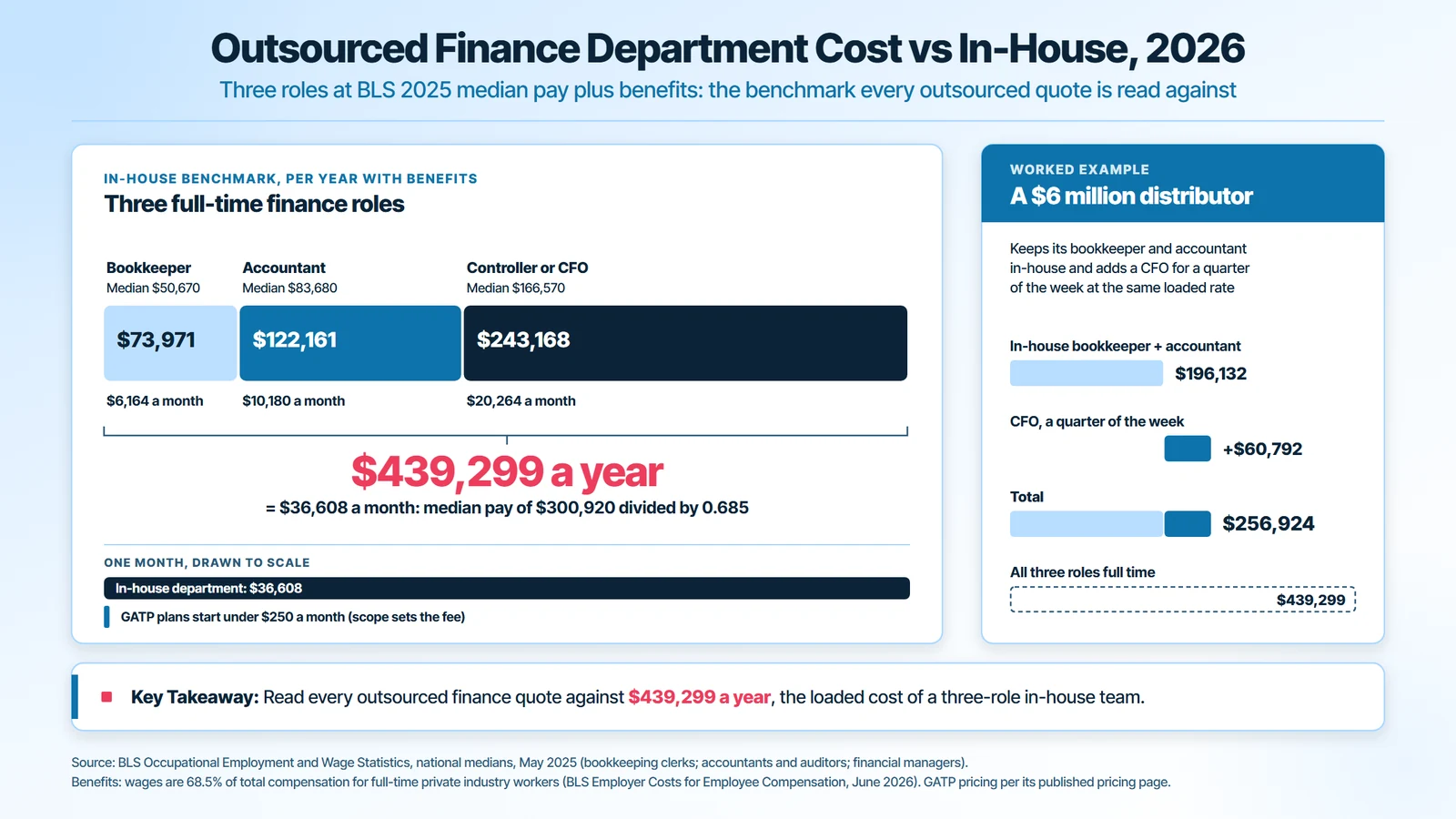
Most companies look for one somewhere between $1 million and $10 million in revenue. The bookkeeper is stretched, the close drifts past mid-month and a full-time controller looks expensive. Hiring all three layers in-house costs about $439,299 a year at 2025 median pay plus benefits.
A firm that provides outsourced accounting services can supply all three layers for a monthly fee. This guide covers what the department does, how it is structured and what it costs. It also covers the real risks, the latest adoption data and how to switch.
What Is Outsourced Finance?
Outsourced finance is an arrangement where a business hires an outside firm to run some or all of its finance work. The firm replaces or supports an internal finance team. An outsourced finance department is the complete version: every layer, one provider and one monthly calendar.
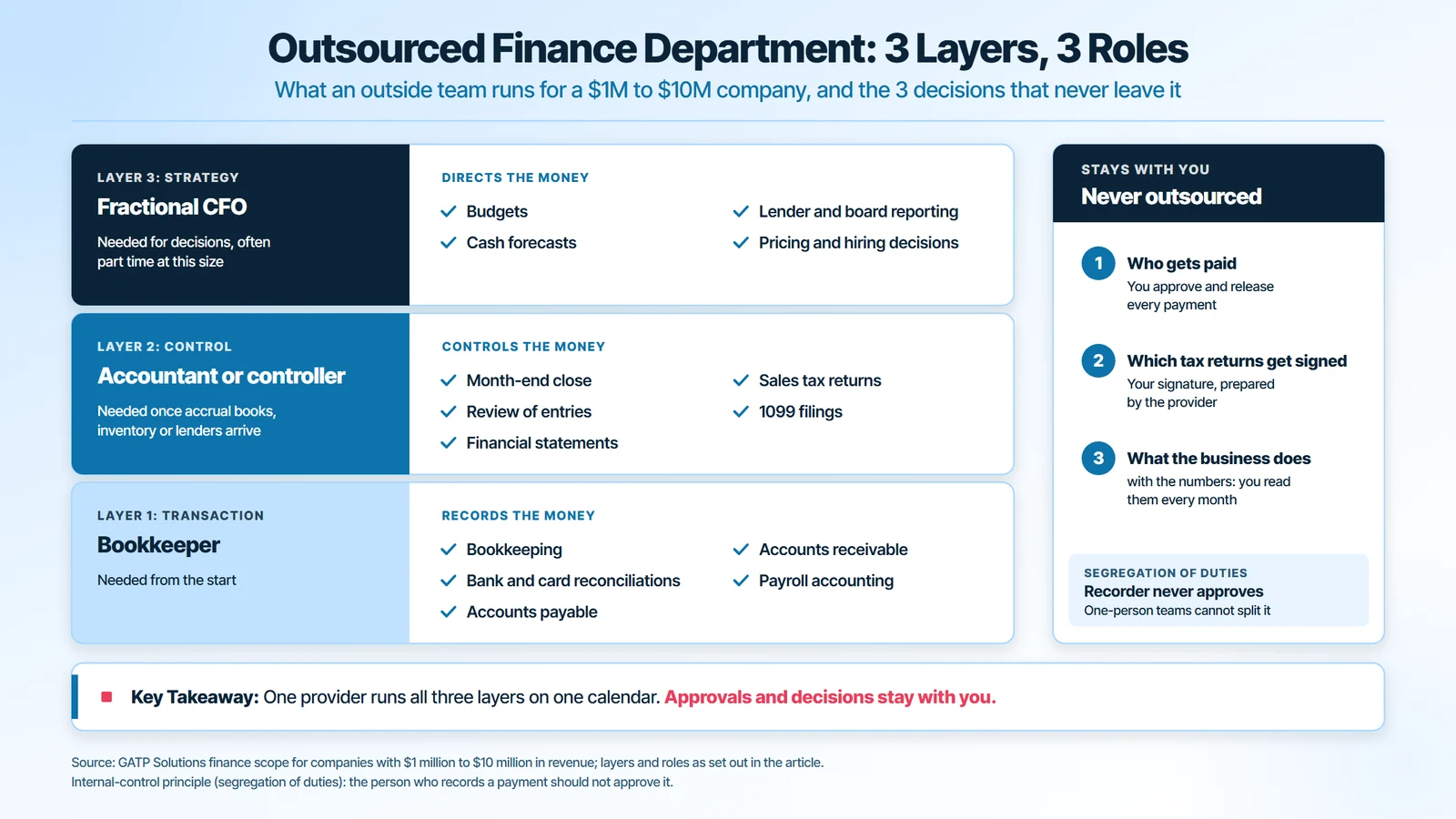
For a company with $1 million to $10 million in revenue, the work splits into three layers:
- Transaction layer: bookkeeping, bank and card reconciliations, accounts payable, accounts receivable and payroll accounting.
- Control layer: the month-end close, review of entries, financial statements, sales tax returns and 1099 filings.
- Strategy layer: budgets, cash forecasts, lender and board reporting, and pricing or hiring decisions, led by a fractional CFO.
Three decisions never leave the company: who gets paid, which tax returns get signed and what the business does with the numbers. A good provider builds its process around those approvals. The sections below take each layer in turn.
What Is Finance and Accounting Outsourcing?
Finance and accounting outsourcing is the industry name for the same model. A company contracts an outside provider to run defined finance processes on an agreed scope and schedule. The term covers a single process, such as accounts payable, or the whole department.
Association data shows which processes companies hand over first. In the 2025 outsourcing study by Financial Executives International:
- 47% of companies outsource basic accounting tasks.
- 41% outsource human resources and payroll processing.
- Companies under $100 million in revenue outsource payroll far more often: 49%, against 23% of larger companies.
Outsourcing one process fixes one bottleneck. A full outsourced finance department also fixes the handoffs between processes, which is where month-end delays often start.
What Does an Outsourced Finance Department Do?
An outsourced finance department performs the same finance department functions as an internal team. It records transactions, controls cash, closes the books, reports results, files on time and plans ahead. Only the employer of the people changes.
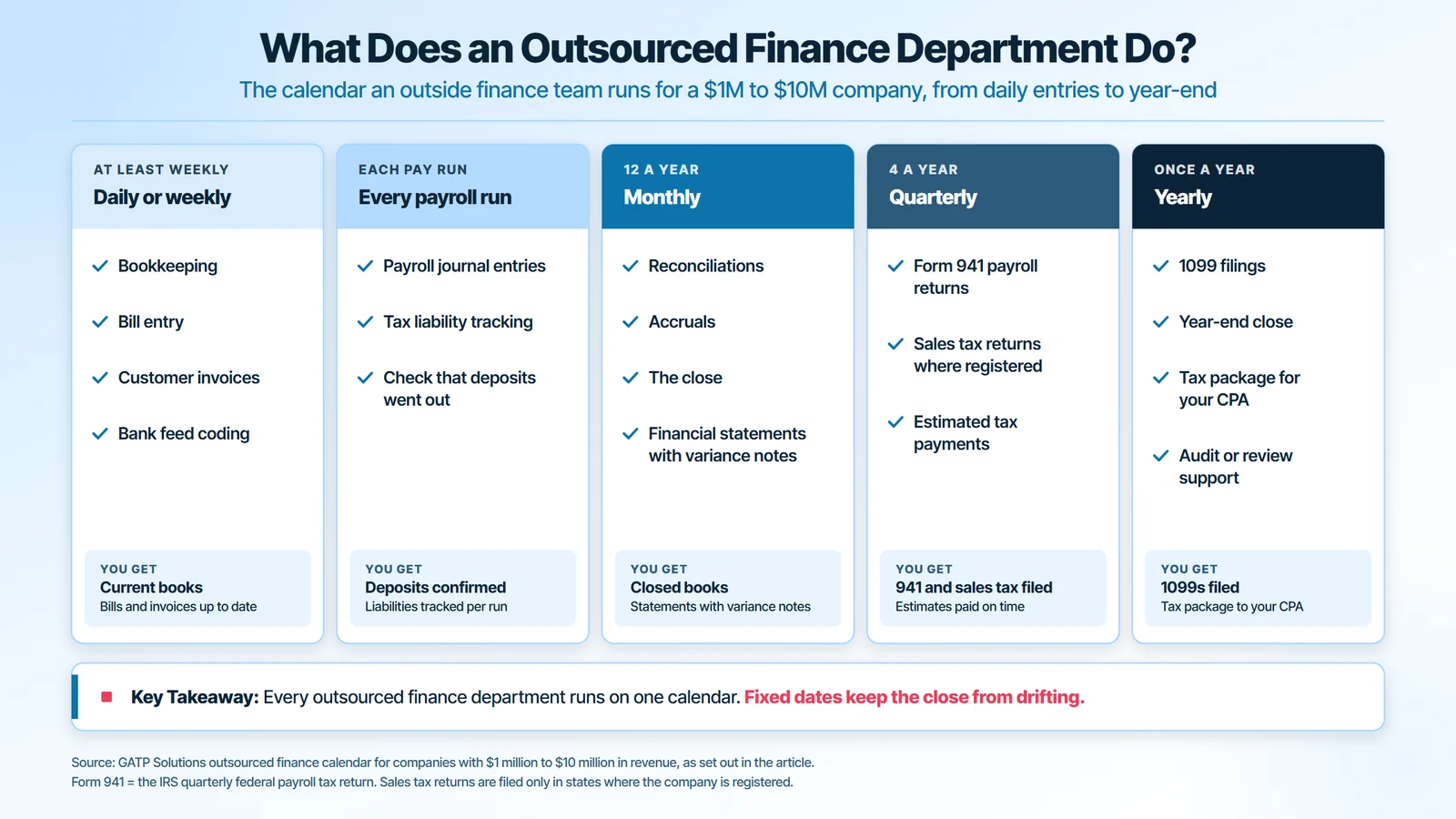
The clearest way to see the scope is by cadence. Here is the calendar a provider runs for a typical company in the $1 million to $10 million band:
- Daily or weekly: bookkeeping, bill entry, customer invoices and bank feed coding.
- Every payroll run: payroll journal entries, tax liability tracking and a check that deposits went out.
- Monthly: reconciliations, accruals, the close and financial statements with variance notes.
- Quarterly: Form 941 payroll returns, sales tax returns where you are registered and estimated tax payments.
- Yearly: 1099 filings, the year-end close, the tax package for your CPA and audit or review support.
Together these tasks make up the company’s financial operations. Some companies buy the transaction layer first through outsourced bookkeeping services and add the rest later. Others start with the busiest process, often accounts payable outsourcing or outsourced payroll services.
Outsourced accounts receivable follows the same logic: invoices go out on time and overdue balances get chased every week. Whichever process starts first, every path ends in the same calendar.
Month-End Close Process: Where Outsourcing Pays Off First
The month-end close process is the sequence that turns a month of transactions into locked, reviewed financial statements. Most of its delay comes from waiting for statements, receipts or an approval.
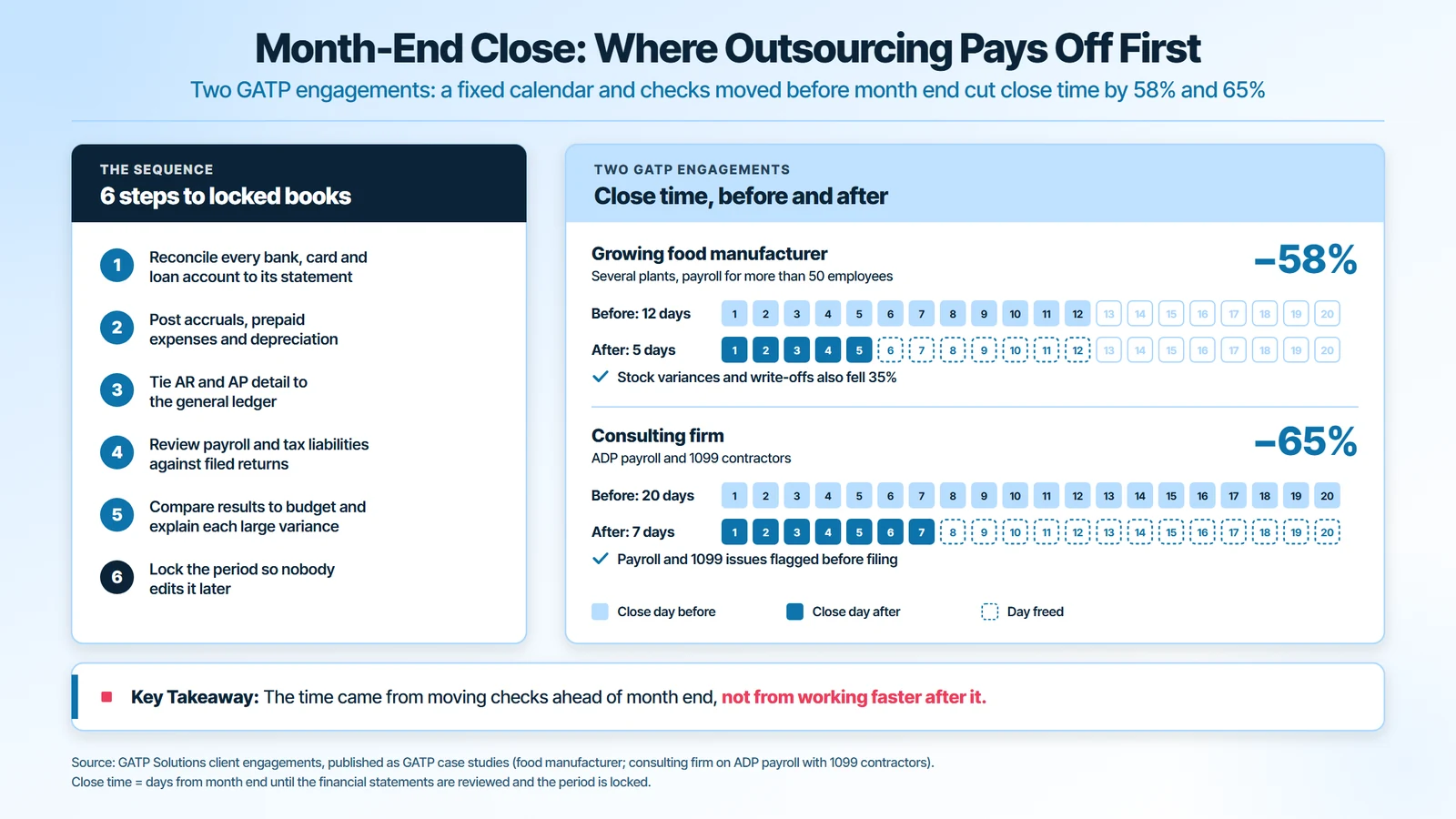
- Reconcile every bank, card and loan account to its statement.
- Post accruals, prepaid expenses and depreciation.
- Tie accounts receivable and accounts payable detail to the general ledger.
- Review payroll and tax liabilities against filed returns.
- Compare results to budget and explain each large variance.
- Lock the period so nobody edits it later.
GATP’s work for a growing food manufacturer with several plants and payroll for more than 50 employees shows the effect. A fixed monthly calendar and a close checklist cut the close from 12 days to 5, a 58% reduction. Stock variances and write-offs fell 35 percent.
A consulting firm running ADP payroll and 1099 contractors saw a bigger drop. Its close fell from 20 days to 7, a 65% cut, once payroll and 1099 issues were flagged before filing. The time came from moving checks ahead of month end, not from working faster after it.
Financial Reporting Services: What Leadership Should Get Each Month
Financial reporting services are the monthly package that tells owners what happened and what to do next. A complete package from an outsourced finance team holds:
- A profit and loss statement against budget and against the same month last year.
- A balance sheet with every account reconciled.
- A cash flow statement and a 13-week cash forecast.
- Aging reports for receivables and payables.
- One page of key figures, such as gross margin, cash on hand and days to collect.
Ask for the package on a fixed day each month. In the two GATP cases above, the close finished within 5 and 7 days of month end.
Outsourced FP&A: Budgets, Forecasts and the Fractional CFO Layer
Outsourced FP&A is the planning layer of the department. FP&A stands for financial planning and analysis: budgeting and forecasting, rolling cash forecasts, scenario models and the commentary behind them.
The consulting firm above now runs on a 90-day rolling cash flow forecast. A forecast like that shows a payroll shortfall weeks before it lands. You can buy the layer on its own as financial planning and analysis, or inside fractional CFO services that also cover lender talks, pricing and tax planning.
Tax Compliance an Outsourced Finance Team Owns in the US
US tax compliance for an outsourced finance team covers payroll tax deposits, information returns and sales tax. Each one has its own calendar:
- Payroll tax deposits: your schedule depends on a 4-quarter lookback. At $50,000 or less of tax, you deposit monthly, by the 15th day of the next month. Above that, you deposit semiweekly. A $100,000 liability on any day triggers a next-day deposit.
- Information returns: Form 1099-NEC and Form 1099-MISC for vendors and contractors, plus W-2 forms for staff.
- Sales tax: registration, collection checks and returns in every state where you have nexus.
The deposit rules come from IRS Publication 15 for 2026. A missed deposit draws penalties even when the provider caused it, which the risks section below explains.
Outsourced Finance Department Examples by Industry
Industry details change what the department does each week. Three common cases:
- E-commerce: Shopify and Stripe pay out net of fees and refunds. The team books gross sales, fees and refunds separately and ties each payout to the bank deposit.
- Real estate: the rent roll is mapped to the ledger by property. Security deposits sit as liabilities, and repairs are coded per property so each building shows its own profit.
- Clinics: insurance payments are matched to the claims they settle before they are booked. Payroll for clinical staff follows the deposit schedule above.
Finance Department Structure: Roles From Bookkeeper to CFO
Finance department structure is the set of roles that record, control and direct a company’s money. A company with $1 million to $10 million in revenue usually needs three finance department roles, each with a different job. The real question is how many of them must be full time.
- Bookkeeper: records transactions, reconciles accounts and manages payables and receivables. Needed from the start.
- Accountant or controller: runs the close, posts accruals, reviews the bookkeeper’s work and prepares statements. Needed once accrual books, inventory or lenders arrive.
- CFO: owns budgets, forecasts, financing and controls. Needed for decisions, and often part time at this size.
The layers also keep each other honest. Internal controls depend on segregation of duties: the person who records a payment should not approve it. A one-person finance team cannot split those duties, while a layered outsourced finance team can.
How Much Does It Cost to Outsource Accounting Services?
Staffing a three-role finance department in-house costs about $439,299 a year, which is the benchmark any outsourced quote should be read against. GATP’s fixed-fee plans start at less than $250 a month, and the Premium plan adds daily accounting, a monthly CFO session and federal and state tax filing.
The in-house figure uses national medians from the BLS Occupational Employment and Wage Statistics for May 2025. Wages are 68.5 percent of total compensation for full-time private industry workers, per BLS employer cost data for June 2026. So each salary is divided by 0.685 to add benefits.
Role (BLS occupation) | Median pay, May 2025 | With benefits, per year | With benefits, per month |
Bookkeeper (bookkeeping, accounting and auditing clerks) | $50,670 | $73,971 | $6,164 |
Accountant (accountants and auditors) | $83,680 | $122,161 | $10,180 |
Controller or CFO (financial managers) | $166,570 | $243,168 | $20,264 |
Three-role department | $300,920 | $439,299 | $36,608 |
A worked example shows how partial outsourcing compares. A $6 million distributor that keeps its bookkeeper and accountant in-house pays $196,132 a year with benefits. Adding a CFO for a quarter of the week at the same loaded rate costs $60,792 more, for $256,924 in total.
What Drives the Price of an Outsourced Finance Department
Providers price on workload and risk, not on revenue alone. The main drivers are:
- Monthly transaction volume across bank, card and payment accounts.
- The number of legal entities, and of states with payroll or sales tax.
- Payroll headcount and pay frequency.
- Bills and invoices handled each month.
- Inventory and cost of goods sold tracking.
- Accrual books instead of cash books.
- Cleanup of a backlog before regular work starts.
- How often you meet the CFO.
- Which tax returns the provider prepares.
Compare quotes on scope, not headline price: accounts reconciled, close date, reports delivered and returns filed. A cheap quote that leaves sales tax or 1099s unassigned costs more later.
Is Outsourcing Accounting a Good Idea?
Yes, outsourcing accounting is a good idea for most companies with $1 million to $10 million in revenue, provided you keep approvals and oversight in-house. The model works when the scope is written down and the owner still reads the numbers every month.
If you are asking “should I outsource my accounting?”, the hiring market points one way. In Personiv’s 2026 survey, 43% of finance leaders named senior accountants the hardest roles to fill. Companies averaged 17 open finance roles, against 5 a year earlier.
Keep these in-house even after you outsource:
- Payment approvals and bank administrator rights.
- Your own EFTPS login for federal tax payments.
- A monthly review of the profit and loss statement, cash and receivables.
- Signing tax returns and lender reports.
The wider trade-offs of in-house accounting versus outsourcing come down to control, cost and continuity. Outsourcing wins on continuity, because no single resignation stops the close.
Signs Your Business Needs an Outsourced Finance Department
The clearest sign is a close that keeps slipping. Watch for these signals:
- Statements arrive after the 15th of the following month.
- One bookkeeper holds every password and process.
- A lender, investor or buyer asks for accrual statements you cannot produce.
- You now collect sales tax or run payroll in several states.
- Cash surprises you, because no one forecasts it.
- You need CFO judgment a few days a month, not 40 hours a week.
Two or more signals usually mean the transaction layer works but the control and strategy layers are missing.
Can an Outsourced Finance Team Replace a Full Internal Finance Department?
An outsourced finance team can replace the full internal department for many companies under $10 million in revenue. Larger or more complex companies often use a hybrid model. An internal controller or CFO directs the work, and the provider runs the transaction and close layers.
The 2025 FEI data shows companies split on the question. 27% of respondents are increasing outsourcing to cover talent shortages, while 34% can still rely on internal teams. The hybrid model also adds scalability, because volume can grow without a new hire for each step.
What Are the Risks of Outsourcing Accounting?
The main risks of outsourcing accounting are tax liability you cannot hand off, weak segregation of duties, data exposure, slow answers and dependence on one provider. Each risk has a specific control:
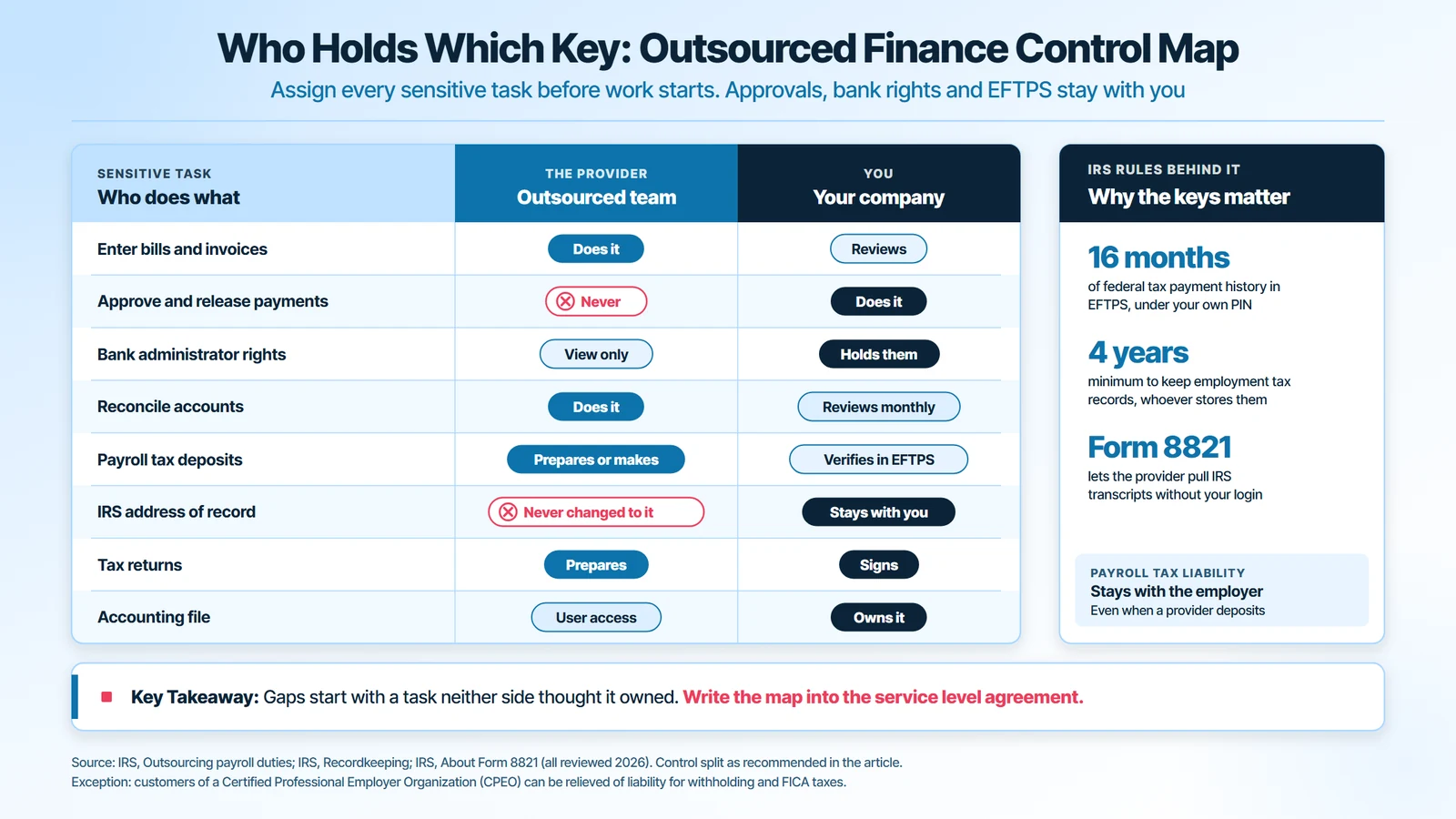
- Payroll tax liability stays with you. The IRS holds the employer ultimately responsible for federal tax deposits, even when a provider makes them. Owners can be held personally liable for certain unpaid taxes.
- Provider defaults go unseen. Enroll in EFTPS with your own PIN. It shows 16 months of payment history, so a missed deposit shows up fast.
- IRS letters go to the wrong place. The IRS advises employers not to change their address of record to the provider’s address.
- One party controls the cash. The provider enters and reconciles, and you approve and release payments in the bank.
- Logins get shared. Give the provider its own user in QuickBooks Online, Xero or NetSuite, and use Form 8821 for IRS records.
- Controls are unproven. Providers whose systems touch your reporting can show a SOC 1 report, the AICPA examination of controls relevant to your financial reporting.
- Records vanish at exit. Your contract should state that you own the accounting file and every record in it.
The liability rule comes from the IRS guidance on outsourcing payroll duties. One exception exists. Customers of a Certified Professional Employer Organization can be relieved of liability for withholding and social security and Medicare taxes.
Records rules apply after the relationship ends too. The IRS recordkeeping rules say to keep employment tax records for at least four years, whoever stores them.
Who Holds Which Key: A Control Map for an Outsourced Finance Team
A control map assigns every sensitive task to one side before work starts. Use this split as a starting point:
Task | Outsourced finance team | Your company |
Enter bills and invoices | Does it | Reviews |
Approve and release payments | Never | Does it |
Bank administrator rights | View only | Holds them |
Reconcile accounts | Does it | Reviews monthly |
Payroll tax deposits | Prepares or makes | Verifies in EFTPS |
IRS address of record | Never changed to it | Stays with you |
Tax returns | Prepares | Signs |
Accounting file | User access | Owns it |
Write the map into the service level agreement. Gaps start with a task neither side thought it owned.
Are 90% of CFOs Outsourcing Accounting Functions?
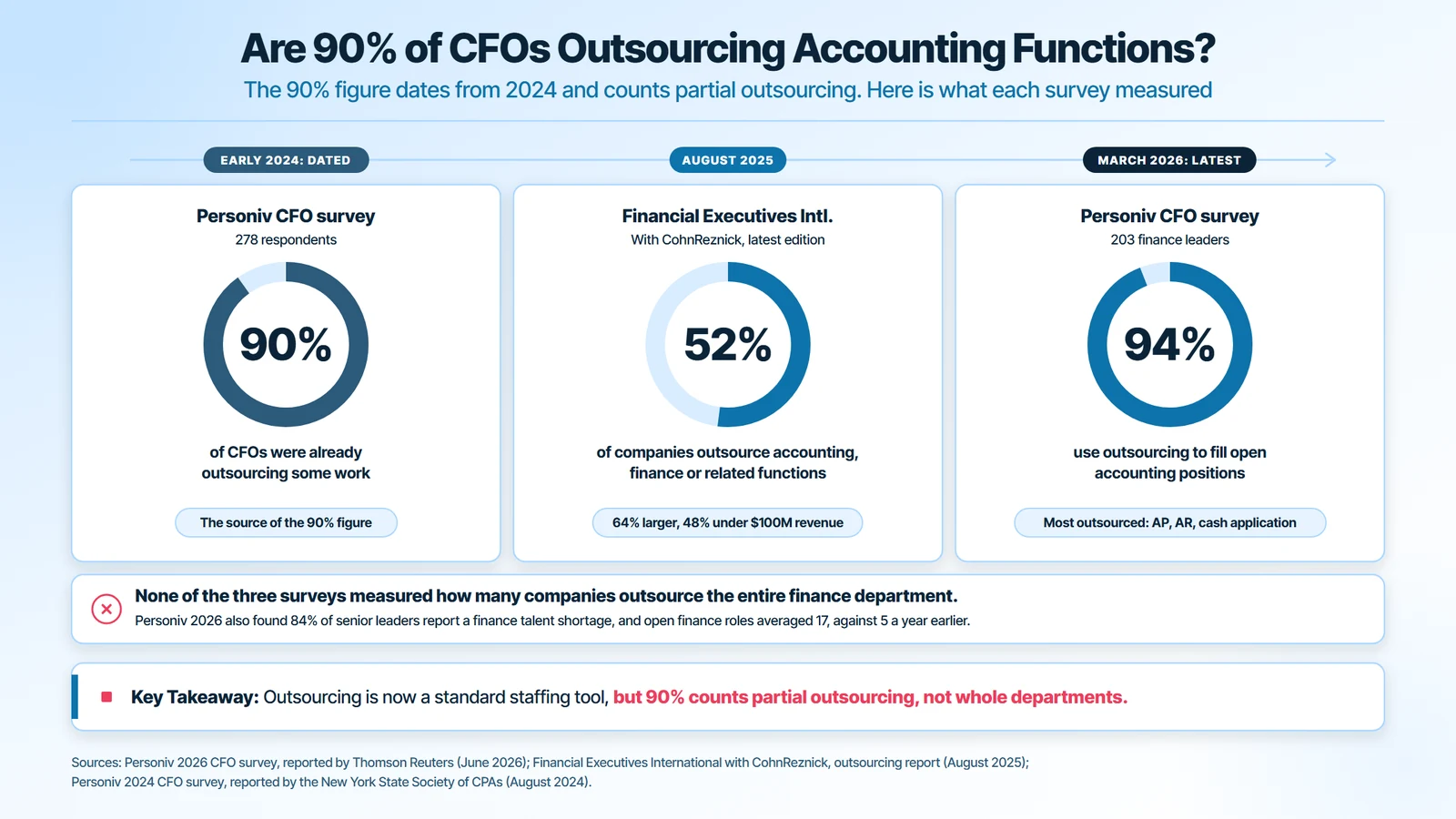
Most finance leaders now outsource some accounting work, but the 90% figure is dated and measures partial outsourcing, not whole departments. Here is what the latest surveys say:
- Personiv, March 2026: 94% of 203 finance leaders use outsourcing to fill open accounting positions. Accounts payable, accounts receivable and cash application are the most outsourced tasks.
- Financial Executives International, 2025: 52% of companies outsource accounting, finance or related functions. The share is 64% at larger companies and 48% at companies under $100 million in revenue.
- Personiv, early 2024, the source of the 90% figure: 90% of the CFOs among 278 respondents were already outsourcing some work.
Thomson Reuters reported the 2026 Personiv survey findings in June 2026. FEI published its outsourcing report with CohnReznick in August 2025, still its latest edition. The New York State Society of CPAs covered the 2024 survey that produced the 90% number.
None of the three surveys measured how many companies outsource the entire finance department. Together they show outsourcing is now a standard staffing tool, used most where hiring is hardest. Personiv’s 2026 data also found 84% of senior leaders report a finance talent shortage.
How to Transition to an Outsourced Finance Department
Transitioning to an outsourced finance department takes four phases: scope, access, catch-up and a first supervised close. If you are working out how to transition to outsourced bookkeeping and the layers above it, follow these steps in order:
- Write the scope by function and cadence. List every task from the calendar above and name its owner. Skipping this leaves sales tax or 1099s with nobody.
- Pick the provider. Use the questions in the next section. A rushed pick is the hardest mistake to undo.
- Grant access by role. Create a user for the provider in your accounting software, connect read-only bank feeds and sign Form 8821 for IRS records. Shared passwords break your audit trail.
- Fix opening balances. Reconcile every balance sheet account to the last closed month. Wrong starting numbers flow into every later report.
- Run one close side by side. Let the outgoing bookkeeper and the new team close the same month. Undocumented habits surface here, not after the handover.
- Lock the calendar. Set the close day, report day, payroll dates and deposit dates in writing. Without fixed dates, the close drifts.
- Review after 90 days. Check delivery against the scope and adjust it. Scope creep hides in unpriced extras.
Form 8821 lets a designee inspect or receive your confidential tax information for the tax types and periods you list. That access lets the provider pull IRS transcripts without your login, which keeps the books audit-ready.
How to Choose an Outsourced Finance Provider
The right provider can show you how it closes, who reviews the work and what it files. Ask six questions before you sign:
- Does a CPA review the close and the tax work, or only bookkeepers?
- Which close day will you commit to in writing?
- Who prepares, makes and verifies payroll tax deposits?
- Which states will you file sales tax and payroll returns in?
- What security controls and reports, such as a SOC 1, can you show?
- Do we keep the accounting file and all records if we leave?
Vague answers on deposits or file ownership are the two red flags that matter most, because both risks stay with you.
What Changed for Outsourced Finance Departments in 2026
Three 2026 changes affect what an outsourced finance team files and how it staffs the work:
- 1099-NEC and 1099-MISC threshold: reporting now starts at $2,000 for tax years beginning after 2025, up from $600. The IRS may adjust it for inflation from 2027.
- 1099-K threshold: payment apps and marketplaces report payments over $20,000 in more than 200 transactions.
- Hiring and automation: 63% of finance leaders now use AI and automation to reduce the need to fill roles, per Personiv’s 2026 survey.
The threshold details are in the Instructions for Forms 1099-MISC and 1099-NEC and on the IRS Form 1099-K page. Check that vendor files flag contractors at the new $2,000 level before year-end 1099 work starts.
Conclusion: When an Outsourced Finance Department Makes Sense
An outsourced finance department makes sense when your company needs all three finance layers but cannot keep them busy full time, against an in-house cost of about $439,299 a year. Keep approvals, bank rights and your EFTPS login in-house, write the scope and calendar down, and judge the provider by its close date.
Want to know what an outsourced finance department would change in your books? GATP’s CPAs will review your last month-end close, your payroll deposit history in EFTPS and your 1099 vendor list in a 30-minute call. You get the gaps we find and a scope sized to your transaction volume.
Frequently Asked Questions About Outsourced Finance Departments
What Does an Outsourced CFO Do?
An outsourced CFO leads the strategy layer of the finance department on a part-time basis. The role covers budgets, cash forecasts, lender and board reporting, pricing and financing decisions. The CFO relies on the bookkeeping and close layers below, so clean monthly statements come first. GATP’s plans schedule CFO sessions monthly or quarterly.
How Much Is an Outsourced CFO?
An outsourced CFO costs a share of a full-time finance executive. A median financial manager earns $166,570, or about $243,168 a year with benefits, based on BLS data. A fractional CFO bills for the hours or meetings you use, so the price follows the cadence. A monthly session costs more than a quarterly one.
Is a Virtual Finance Department the Same as an Outsourced Finance Department?
Yes, a virtual finance department and a fractional finance team describe the same model. An outside team runs your finance function remotely through cloud software, shared portals and video calls. The labels differ by provider, not by scope. Check the written scope, because one provider’s virtual finance department may exclude tax filing or the CFO layer.
Is Outsourced Finance Only for Small Businesses?
No, larger companies outsource finance work more often than smaller ones. In the 2025 FEI study, 64% of larger companies outsourced some finance work, against 48% of companies under $100 million in revenue. The top reason was the same at every size: 78% of respondents said outsourcing filled resource gaps.
Who Owns the Books When You Outsource the Finance Department?
You should own the books. The accounting file, bank feeds and document storage stay in your company’s name, and the provider works as a user. GATP works in QuickBooks Online and Xero for this reason, so clients keep their data if they leave. Confirm ownership in the contract before any work starts.
How Often Should Leadership Review Outsourced Financial Reports?
Leadership should review the financial reports every month, on a fixed date after the close. A quarterly review adds the budget comparison, the cash forecast and any lender covenants. Monthly review is what turns an outsourced finance department from record-keeping into control, because errors get caught while the month is still fresh.
Does an Outsourced Finance Department Handle Sales Tax?
Yes, most outsourced finance departments handle sales tax registration, collection checks and returns, but only in the states written into the scope. Each new state where you cross a nexus threshold adds a filing. Confirm who tracks those thresholds as sales grow, because an unregistered state builds liability every month.
Can an Outsourced Finance Team Work in Our Current Software?
Yes, an outsourced finance team should work in your current accounting software if it fits your size. QuickBooks Online and Xero are common choices in the $1 million to $10 million band. NetSuite suits multi-entity or inventory-heavy companies. A provider that insists on moving you to its own system makes leaving harder.

