Medical Practice CPA for Doctors, Physicians & Surgeons
- Written by: Palak Soni
- Reviewed by: Nikhar Mathur
- Updated on:
Key Takeaways:
- A medical practice CPA does more than prepare annual tax returns. They can support accounting, tax planning, cash flow, payroll, and financial reporting.
- Medical practices have unique financial challenges, including insurance reimbursements, Medicare and Medicaid payments, patient balances, claim delays, and adjustments.
- Revenue does not always equal available cash. Tracking accounts receivable and collection patterns is essential for maintaining healthy cash flow.
- Rising costs for labor, supplies, insurance, rent, technology, and other overhead can quickly affect practice profitability.
- Tax planning should happen throughout the year, not only during tax season. Business structure, deductions, retirement contributions, and estimated taxes all require attention.
- The right accounting support can differ between solo physicians, group practices, and multi-location medical practices.
- Doctors should review their practice’s actual financial performance rather than relying only on revenue figures or bank balances.
- A CPA’s pricing can depend on practice size, physician count, locations, transaction volume, payroll, tax complexity, bookkeeping, reporting, and advisory needs.
- New medical practices should establish separate business accounts, payroll systems, bookkeeping procedures, a chart of accounts, and a first-year budget from the beginning.
- Healthcare accounting experience is an important factor when choosing a CPA, especially for practices with complex compensation, reimbursement, or multi-location reporting needs.
- Doctors should ask potential CPAs about their healthcare experience, services, reporting frequency, fees, technology, data security, and who will manage the account.
- The best CPA relationship should help physicians understand their financial numbers and use that information to make better business decisions.
A medical practice CPA can mean the difference between simply tracking your practice’s money and actually understanding where it is going. A medical practice CPA helps doctors manage payroll, insurance payments, accounts receivable, practice expenses, taxes, equipment purchases, physician compensation, and cash flow while keeping financial records organized.
A busy practice can bring in strong revenue and still face cash shortages when expenses rise or insurance payments are delayed. A general accountant may handle routine records, while a CPA with medical-practice experience can help address the financial issues specific to healthcare. That matters in 2026, when 84% of medical groups reported higher operating costs, according to MGMA’s 2026 operating cost survey, with an average increase of about 11% among groups experiencing increases. The right financial support can help doctors manage taxes, control costs, plan cash flow, evaluate CPA fees, set up new practices, and avoid common accounting mistakes.
What Is a Medical Practice CPA?
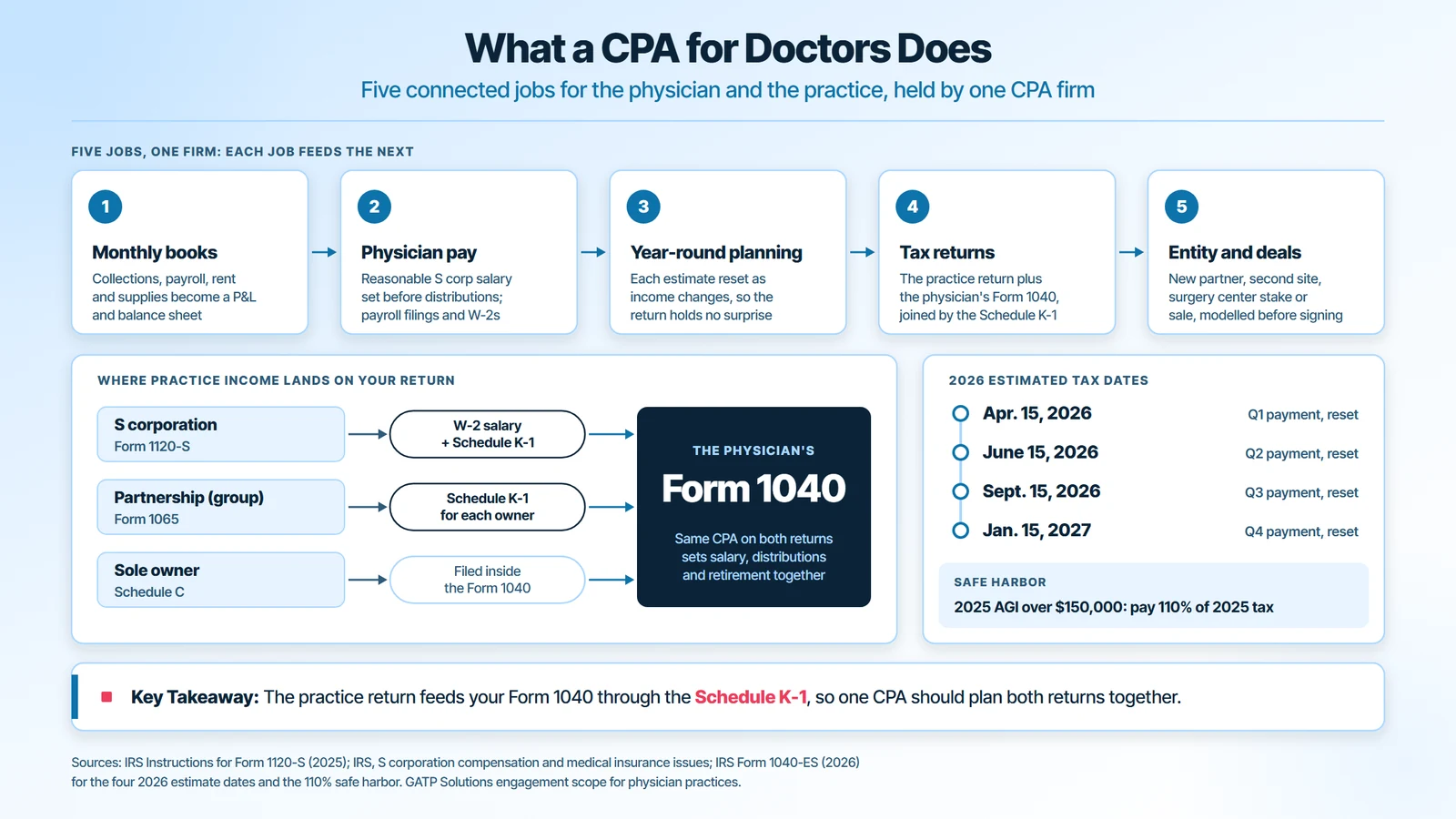
A medical practice CPA is a Certified Public Accountant who understands the financial needs of healthcare practices. A medical CPA does more than record income and expenses or prepare annual tax returns. They can help doctors understand their numbers, plan for taxes, manage cash flow, and make better financial decisions for the practice.
Medical practices have financial challenges that many ordinary businesses do not. Payments may come from insurance companies, Medicare, Medicaid, and patients, often at different times. Practices also deal with physician compensation, payroll, medical supplies, equipment, billing delays, and strict reporting needs. This makes healthcare accounting more specialized than basic business bookkeeping.
How Is a Medical Practice CPA Different From a General CPA?
A general CPA may have experience with many types of businesses, while a medical practice accountant understands issues that affect healthcare providers. This can include physician compensation, insurance reimbursements, practice expenses, equipment purchases, and the financial needs of different medical specialties.
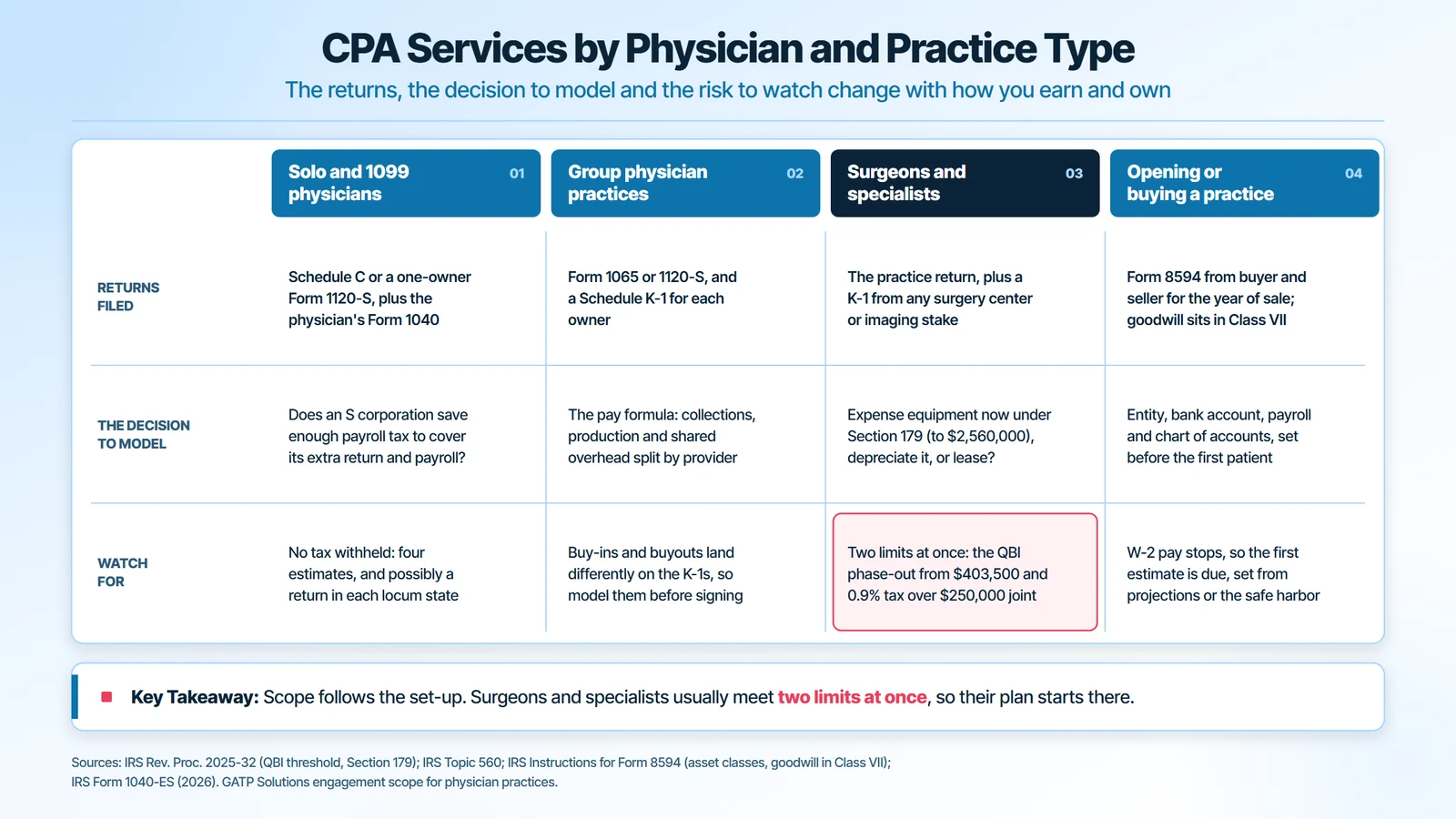
A physician CPA can work with solo doctors, group practices, surgeons, specialists, multi-location practices, and newly established medical practices.
CPA vs. Accountant vs. Bookkeeper vs. Tax Accountant vs. CFO
These roles can overlap, but they are not exactly the same:
- CPA: A licensed accounting professional who can provide tax, accounting, compliance, and financial planning services.
- Accountant: Handles financial records, reports, reconciliations, and other accounting tasks. Not every accountant is a CPA.
- Bookkeeper: Primarily records and organizes daily financial transactions, such as income, expenses, and bank activity.
- Tax accountant: Focuses mainly on tax preparation, tax compliance, and tax planning.
- CFO or financial advisor: Focuses more on high-level financial planning, forecasting, profitability, cash flow, and major business decisions.
A CPA can provide both compliance support and financial planning, which can be useful as a practice grows. The right level of support depends on the doctor’s needs, practice size, financial complexity, and growth plans.
Why Doctors Need a Medical Practice CPA
A medical practice has financial needs that go beyond basic bookkeeping. Doctors must manage different payment sources, rising operating costs, payroll, taxes, and business decisions while focusing on patient care. A CPA for doctors can help organize these areas, provide accurate financial information, and support better decisions as the practice grows.
Medical Practices Have Complex Revenue
Medical practices receive money from several sources, and payments may not arrive at the same time. Insurance companies, Medicare, Medicaid, patients, and self-pay services can all affect when cash reaches the practice. Claims may also face delays, denials, or adjustments, making revenue cycle management healthcare metrics important for keeping a close eye on collections. Key revenue factors include:
- Payer reimbursement schedules
- Outstanding claims
- Patient balances
- Claim denials
- Payment adjustments
Practice Costs Can Rise Quickly
Medical practices carry many ongoing expenses, and rising costs can quickly reduce profit. Staff wages, benefits, supplies, equipment, rent, malpractice insurance, technology, and vendor costs all require regular review. A medical practice CPA can help owners understand which expenses are increasing and how those changes affect the practice’s financial results. Common cost areas include:
- Employee compensation
- Medical supplies
- Equipment purchases
- Facility costs
- Insurance premiums
- Technology and software
- Vendor and administrative costs
Doctors Have Personal and Business Tax Decisions
Doctors face tax decisions that affect both their practice and personal income. Business structure, deductions, retirement contributions, physician compensation, and estimated tax payments can change the amount they owe. A CPA for medical professionals can help connect these decisions, while an accountant for physicians can keep financial records organized throughout the year. Important planning areas include:
- Business entity structure
- Tax deductions
- Retirement contributions
- Estimated tax payments
- Physician compensation
- Personal and business tax planning
What Does a Medical Practice CPA Do?
A medical practice CPA can handle much more than year-end taxes. From maintaining accurate records to managing payroll, taxes, cash flow, and financial reports, these services help doctors understand the financial side of their practice and make informed business decisions.
- Bookkeeping and Financial Records: Monthly bookkeeping keeps financial records current by tracking expenses, reconciling bank accounts, managing payables and receivables, and preparing healthcare financial reporting
- Tax Planning and Tax Filing: A CPA can prepare business and individual tax returns, plan estimated payments, identify deductions, and review entity-level tax considerations throughout the year.
- Payroll and Physician Compensation: Payroll support can cover employee wages, physician compensation, bonuses, payroll taxes, benefits, and contractor payments while keeping records organized and payments accurate.
- Cash Flow Management: Cash-flow support tracks money entering and leaving the practice, plans for large expenses, maintains cash reserves, and accounts for slow insurance collections.
- Financial Reporting: Regular reports such as profit and loss statements, balance sheets, cash-flow statements, accounts receivable reports, and expense reports show how the practice is performing.
Medical Practice CPA Services Doctors Should Look For
The right medical practice CPA services depend on the practice’s size, structure, specialty, financial needs, and stage of growth. Common accounting services for healthcare practices include:
- Medical practice bookkeeping
- Tax preparation
- Tax planning
- Payroll accounting
- Accounts payable and receivable
- Cash-flow management
- Financial reporting
- Budgeting and forecasting
- Practice profitability analysis
- Business entity planning
- Retirement and tax planning
- Practice purchase or sale support
- Financial due diligence
- CFO-level financial guidance
Doctors do not necessarily need every service. The appropriate mix depends on:
- Practice size
- Specialty
- Ownership structure
- Number of locations
- Growth stage
- Financial complexity
How a CPA for Doctors Helps Improve Practice Cash Flow
Strong revenue does not always mean a practice has enough cash available. A CPA for doctors can help track where money is coming from, where it is going, and when it is expected to arrive. This gives physicians a clearer view of their practice’s financial position and helps them plan ahead instead of reacting to cash shortages.
Where a Medical Practice CPA Can Help
- Track accounts receivable: Monitor outstanding amounts and identify balances that need attention.
- Review unpaid invoices and patient balances: Keep overdue amounts visible before they become larger collection problems.
- Monitor payer payments: Compare expected insurance, Medicare, and Medicaid payments with actual collections.
- Review collection patterns: Identify delays or changes in how quickly the practice receives payment.
- Compare revenue with expenses: See if rising costs are taking too much of the practice’s income.
- Plan payroll: Set aside enough cash for employee wages, taxes, benefits, and physician compensation.
- Manage recurring costs: Review regular expenses and identify areas that may need adjustment.
- Build cash reserves: Plan for slower collection periods and unexpected expenses.
- Prepare for equipment purchases: Consider the effect of major purchases on available cash before committing funds.
Why Revenue Alone Does Not Tell the Full Story
MGMA reported that 47% of medical groups had higher year-to-date revenue, while 36% reported lower revenue compared with the same period in 2025. This shows why looking only at revenue can give an incomplete picture of financial health.
A practice may report strong revenue but still have limited cash if insurance payments are delayed, patient balances remain unpaid, or operating costs rise.
Key Takeaway: Revenue is not the same as cash flow. A practice can show strong revenue while still struggling to pay bills when collections are delayed or expenses rise quickly.
A medical accountant or accountant for doctors can use regular financial data to help physicians spot these gaps earlier and make better decisions about spending, hiring, reserves, and future investments.
Medical Practice CPA Tax Planning for Doctors and Physicians
Tax planning for doctors should not start a few weeks before the filing deadline. A medical practice CPA can review income, expenses, business structure, and planned purchases throughout the year to help physicians prepare for tax obligations and make informed financial decisions.
Business Structure and Taxes
The way a medical practice is structured can affect taxes, ownership, and how income is reported. Common structures include:
- Sole proprietorship
- Partnership
- LLC
- S corporation
- Professional corporation
The right structure depends on the physician’s state, ownership setup, specialty, tax situation, and legal requirements. State rules can also be very different. California, for example, has specific rules involving professional corporations and licensed professionals, so doctors should not assume that a structure used successfully in another state will work the same way there.
A CPA for doctors can help review the financial and tax side of these choices, while the physician’s attorney can address the related legal requirements.
Common Tax Planning Areas
A tax accountant for doctors may review several areas throughout the year rather than waiting until tax season:
- Estimated tax payments
- Retirement contributions
- Business deductions
- Equipment purchases
- Employee benefits
- Health-related business expenses
- Depreciation
- Owner compensation
The goal is not simply to reduce the tax bill. Good planning also helps doctors avoid unexpected tax payments and make better decisions about spending, investments, and practice growth.
2026 Tax Considerations
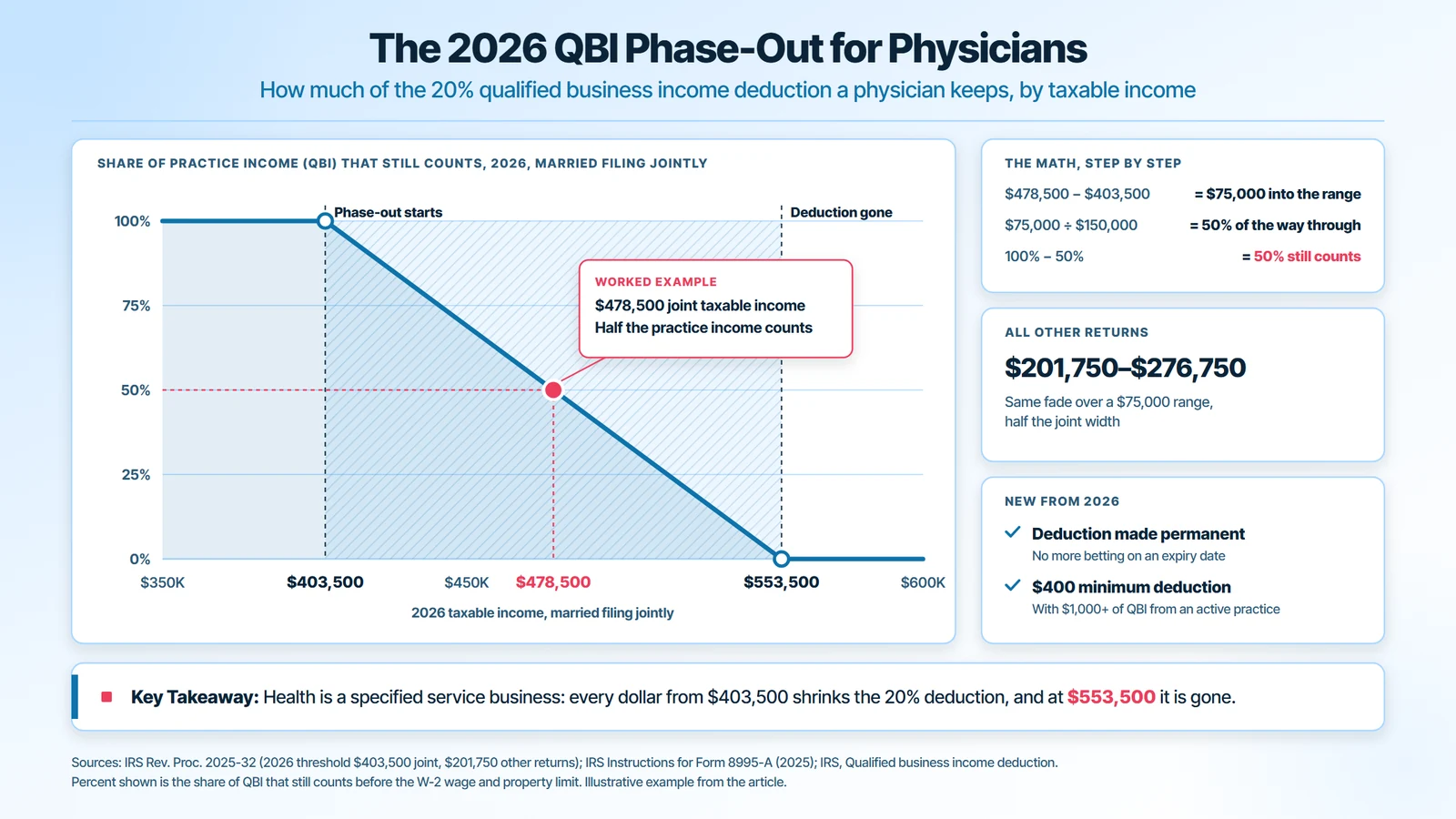
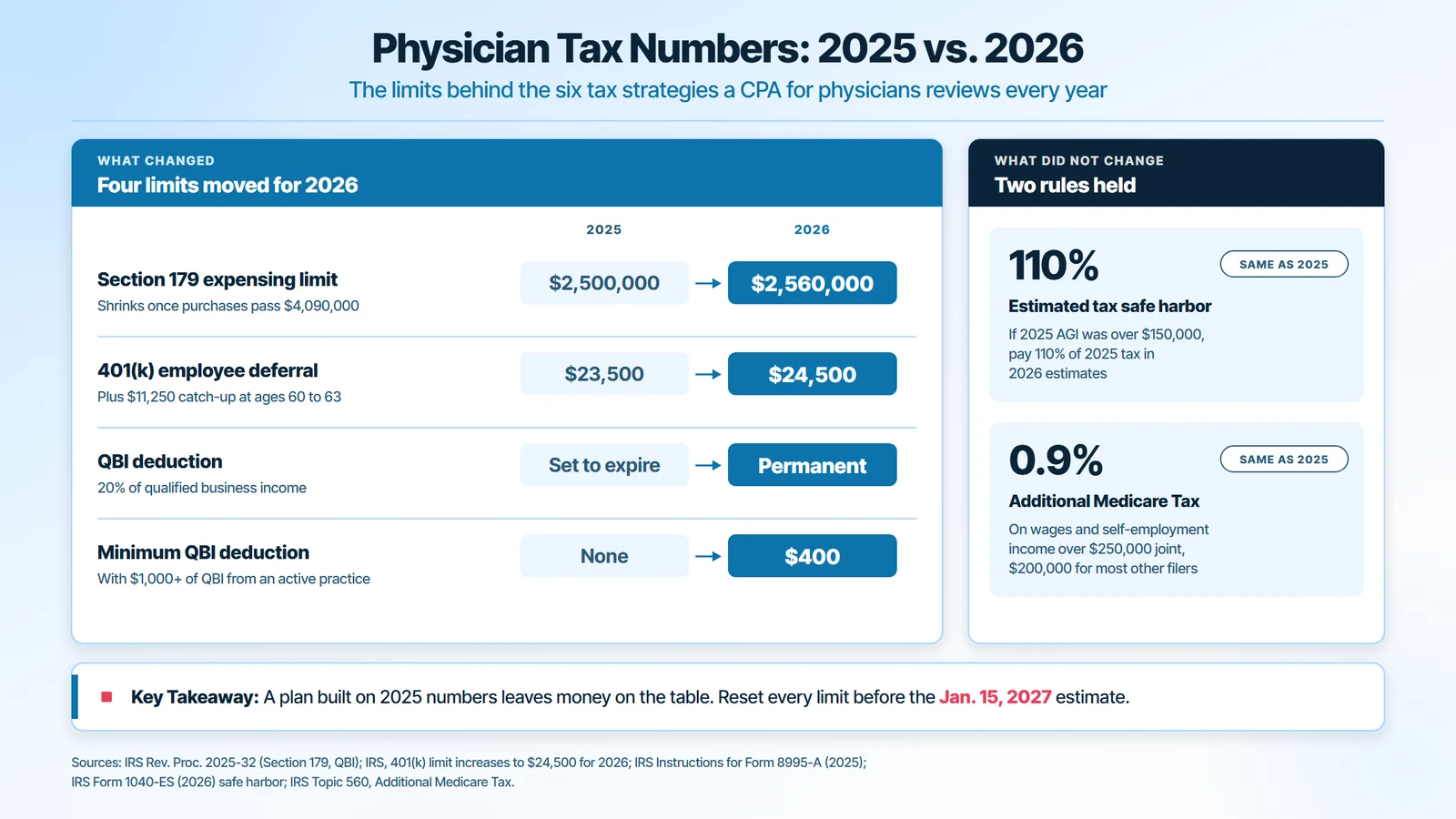
The IRS has issued its 2026 tax inflation adjustments, along with changes connected to the One Big Beautiful Bill Act. These updates affect several federal tax rules and should be considered during annual planning.
For physicians, the impact can vary based on income, business structure, deductions, and other personal and practice-specific factors. Physician tax advisors and a CPA for medical professionals can help explain which rules may apply and what should be reviewed during the year.
How a Medical Practice CPA Handles 2026 Medicare Payment Changes
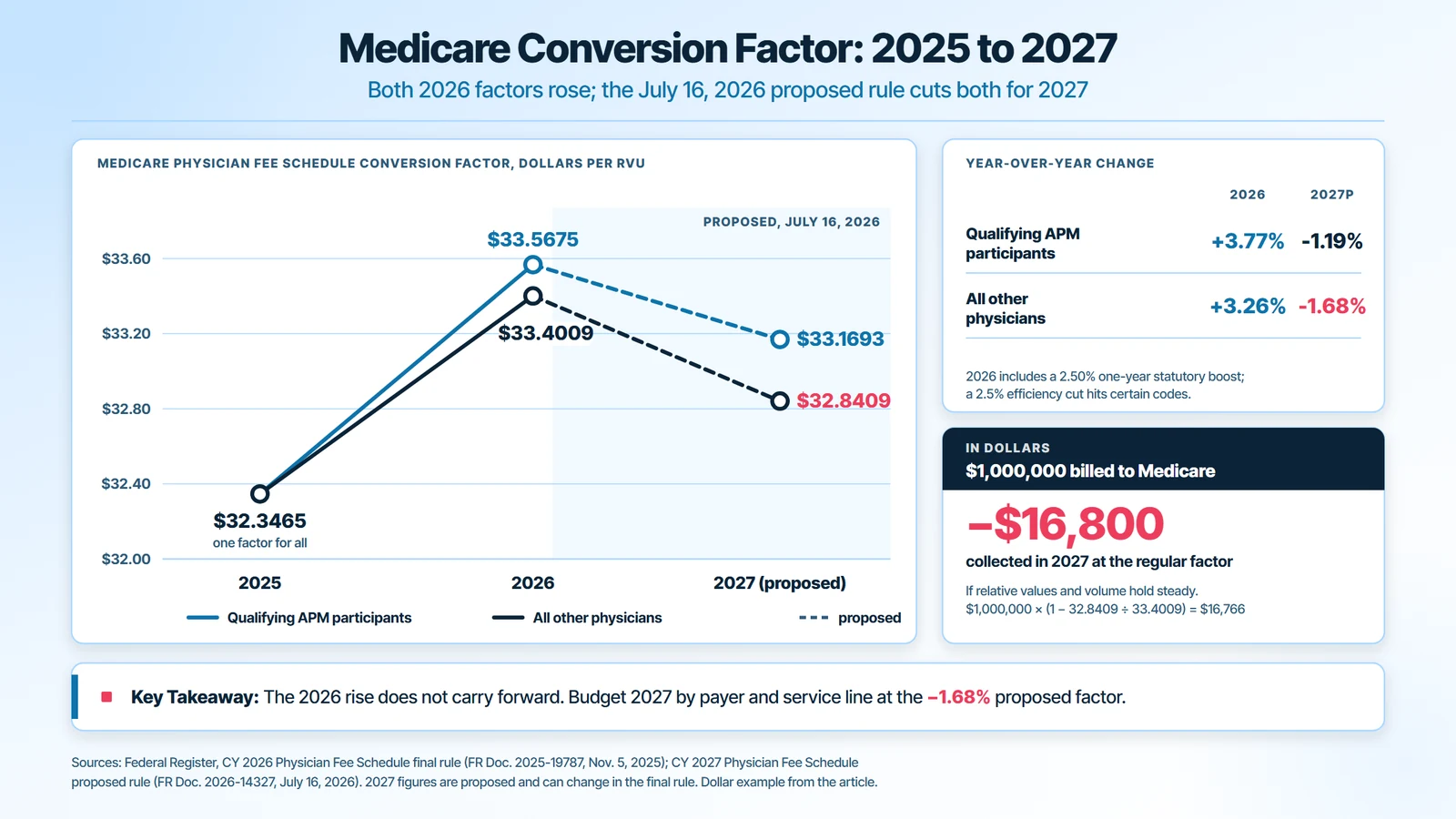
Medicare payment changes can affect how much a medical practice earns from the same services. For physicians who depend heavily on Medicare, even a small reimbursement change can affect cash flow, staffing decisions, and overall practice profitability. A medical practice CPA can help doctors look beyond the headline payment percentage and review what the changes mean for their own numbers.
What Changed in 2026?
CMS finalized different conversion-factor updates under the 2026 Medicare Physician Fee Schedule
- 3.77% increase for qualifying APM participants
- 3.26% increase for other physicians
The 2026 rule also includes changes related to practice expenses and efficiency.
These figures do not mean every physician or specialty will see the same financial result. The AMA has noted that some specialties and facility-based services may experience significant negative effects from the 2026 payment changes.
Why Practice-Level Numbers Matter
A higher Medicare payment does not automatically mean higher profit. A practice may receive more reimbursement while also dealing with higher labor, supply, rent, technology, and other operating costs.
Accounting data can help physicians compare:
- Medicare reimbursement
- Labor costs
- Medical supplies
- Rent and facility expenses
- Technology costs
- Other operating expenses
By reviewing these numbers together, a medical practice CPA can help physicians understand whether reimbursement changes are actually improving margins or being absorbed by rising costs. This can support decisions about staffing, pricing, service lines, equipment purchases, and future practice investments.
Medical Practice CPA for Solo Doctors vs. Group Practices
The accounting needs of a medical practice change as the business grows. An accountant for doctors can support a solo physician, while group and multi-location practices may need more detailed financial reporting, compensation planning, and cost tracking.
Practice Type | Key Accounting Needs | What to Monitor |
Solo Medical Practice | Personal and business tax planning, payroll, cash-flow management, retirement planning, monthly financial reporting | Owner income, practice expenses, cash reserves, tax obligations |
Group Practice | Multiple physician compensation, partner distributions, shared overhead, complex payroll, larger accounts payable, financial forecasting | Physician compensation, partner payments, shared costs, outstanding bills, profitability |
Multi-Location Practice | Location-level reporting, comparing profitability, shared expense tracking, centralized accounting, expansion planning | Profit by location, shared expenses, location performance, expansion costs |
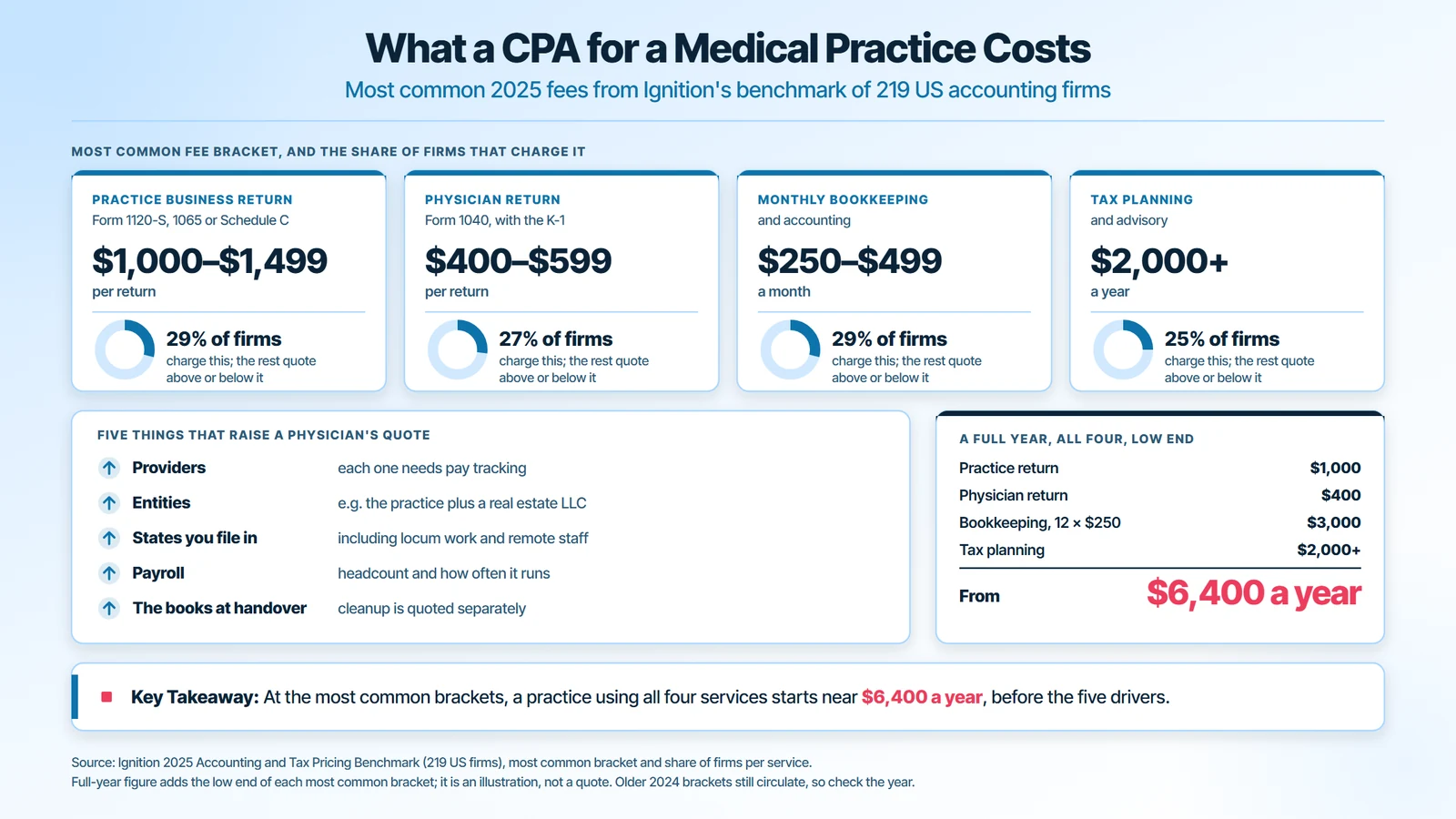
How Much Does a Medical Practice CPA Cost?
There is no single price for a medical practice CPA. Fees usually depend on how complex the practice is and how much financial support it needs.
Factors That Affect CPA Costs
- Practice size
- Number of physicians
- Number of locations
- Transaction volume
- Payroll size
- Tax complexity
- Bookkeeping needs
- Financial reporting needs
- CFO or advisory requirements
Common CPA Pricing Models
- Monthly fixed fee: A set monthly amount for agreed-upon services.
- Hourly billing: Payment based on the time spent on accounting or tax work.
- Annual tax-only fee: A separate fee for preparing annual tax returns.
- Monthly accounting package: Recurring bookkeeping, tax, payroll, and reporting services.
- Separate advisory services: Additional fees for forecasting, business planning, acquisitions, or other financial guidance.
Key takeaway: The cheapest accountant may not be the lowest-cost choice. Poor records can lead to missed tax planning opportunities, incorrect financial reports, cash-flow problems, and poor business decisions.
When Should a Doctor Hire a Medical Practice CPA?
Doctors do not have to wait for tax season or a financial problem before getting professional help. A CPA for medical practice startup can provide support at several important stages.
1. Before Starting a Medical Practice
The financial choices made before opening can affect how smoothly the practice operates later. An accountant for new medical practice can help doctors prepare for the key financial tasks that come with getting started:
- Business structure
- Startup budget
- Tax planning
- Accounting system
- Payroll setup
- Financial projections
2. When the Practice Starts Growing
Practice growth can bring higher revenue, but it also creates more employees, expenses, and financial activity. Hiring a CPA for doctors can help manage the financial areas that become more important during expansion:
- Hiring staff
- Adding physicians
- Adding locations
- Increasing patient volume
- Higher operating expenses
3. When Financial Problems Appear
Financial warning signs can become harder to correct when they are ignored. Reviewing the numbers with a CPA can help doctors identify concerns such as:
- Falling profit margins
- Cash shortages
- Unexpected tax bills
- Unpaid bills
- Poor collections
- Confusing financial reports
4. Before Buying or Selling a Practice
Buying or selling a medical practice requires a close review of its financial health before making a major commitment. A CPA can provide Virtual CFO services for medical practice transactions and help examine important areas, including:
- Financial due diligence
- Quality of earnings
- Valuation support
- Tax implications
- Working capital
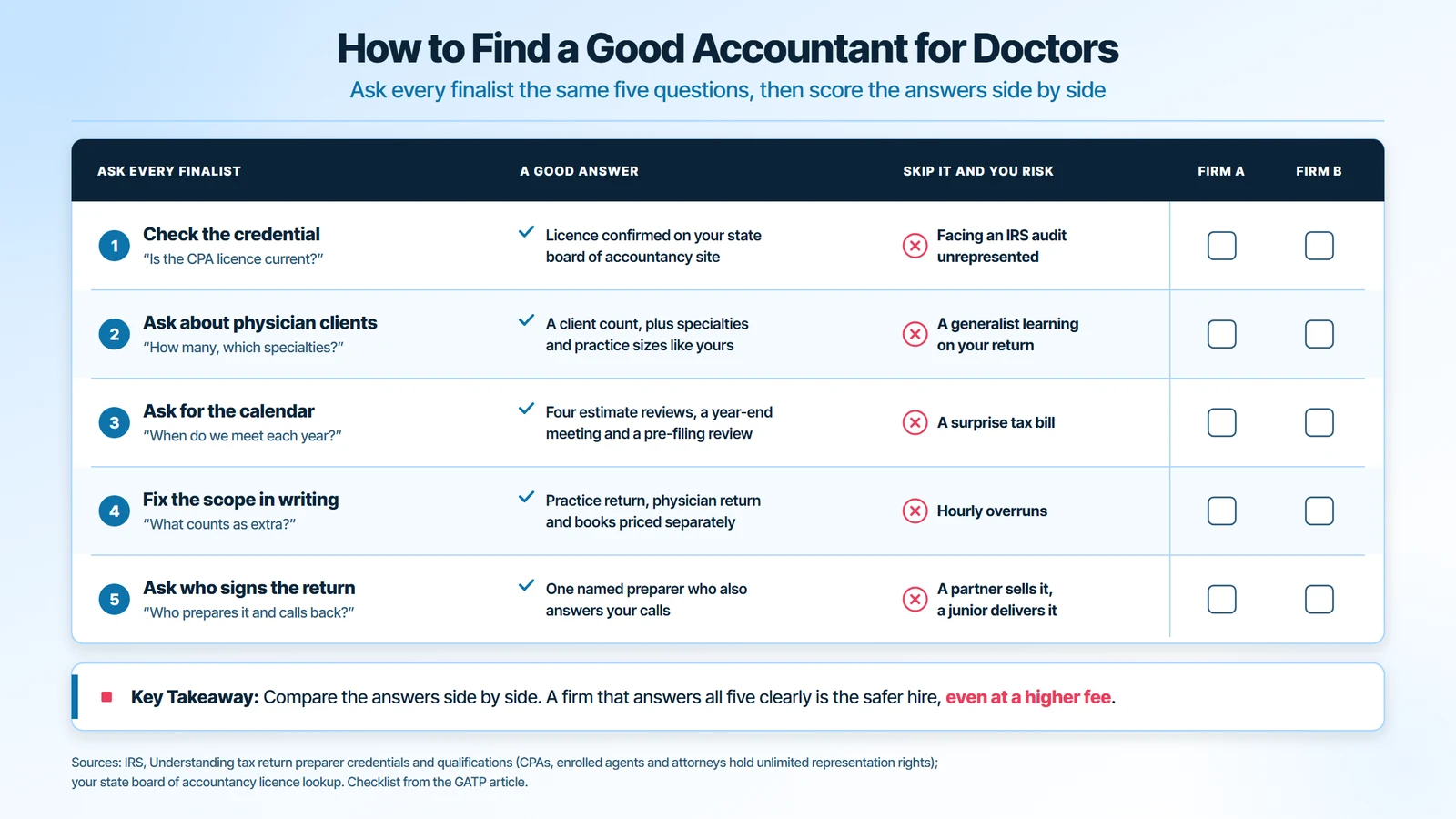
How to Choose the Right Medical Practice CPA
Choosing the right medical practice CPA means looking beyond tax preparation. Doctors should consider healthcare experience, available services, reporting, technology, security, and the level of financial guidance they can expect.
- Healthcare Accounting Experience: Look for a CPA who works with medical practices and understands physician compensation, multiple locations, and medical practice taxes. Ask about their experience with practices similar to yours before making a decision.
- Services Included: Confirm exactly what the CPA’s fees cover. Services may include bookkeeping, tax preparation, payroll, financial reporting, forecasting, and advisory support. Knowing what is included prevents confusion about responsibilities and additional costs.
- Financial Reporting Frequency: Ask how often you will receive financial reports. Regular reporting can help doctors monitor practice performance, identify changing expenses, and make decisions using current financial information rather than outdated numbers.
- Technology and Data Security: Financial workflows may sometimes involve information connected to patients, so ask how the CPA protects financial data and handles protected health information (PHI). Secure document sharing, accounting software, access controls, data backups, communication procedures, and HIPAA compliance should all be discussed.
- Support Beyond Tax Filing: A strong medical practice CPA should help physicians understand what their financial numbers mean, not simply prepare an annual tax return. Look for support with cash flow, profitability, forecasting, and important business decisions.
Common Accounting Mistakes Medical Practices Should Avoid
Small accounting mistakes can create larger financial problems for a medical practice. Strong doctors accounting starts with accurate records, regular reviews, and clear separation between personal and business finances.
- Mixing personal and business expenses: Keep separate bank accounts and cards for practice expenses to maintain clean records and make tax reporting easier.
- Waiting until tax season to review finances: Review financial records throughout the year so tax obligations and potential problems do not come as surprises.
- Ignoring accounts receivable: Monitor unpaid insurance claims and patient balances regularly to identify delayed collections and protect cash flow.
- Not tracking profitability by location: For multi-location practices, review each location separately to see which offices are performing well and where costs need attention.
- Failing to budget for taxes: Set aside money for estimated tax payments throughout the year instead of scrambling to cover a large tax bill later.
- Not reviewing physician compensation: Regularly review compensation, bonuses, and distributions to ensure they fit the practice’s financial position and agreements.
- Treating revenue as profit: Revenue only shows money earned. Physician accounting should also account for payroll, supplies, rent, taxes, and other operating costs.
- Ignoring rising operating costs: Review major expenses regularly so increases in wages, supplies, insurance, rent, or technology do not quietly reduce margins.
- Using outdated financial reports: Current reports give doctors a clearer picture of practice performance and support better decisions about spending, hiring, and growth.
- Making major purchases without cash-flow planning: Before purchasing expensive equipment or technology, check available cash and upcoming obligations to avoid creating unnecessary financial pressure.
Accounting for a New Medical Practice: What to Set Up First
Starting a medical practice involves financial decisions before the first patient arrives. Following a clear starting a medical practice accounting process can keep records organized, support tax planning, and give doctors better control over practice finances.
Step 1: Choose the Business Structure
Choose a structure based on ownership, taxes, and accounting needs. Options may include an LLC, partnership, S corporation, or professional corporation. State rules vary, and medical professionals may face restrictions on available structures.
Step 2: Open Separate Business Accounts
Keep practice money separate from personal finances from the beginning. Set up:
- Business bank account
- Business credit card
- Separate expense tracking
Step 3: Build a Chart of Accounts
Create categories for income, expenses, assets, and liabilities. A clear chart of accounts makes bookkeeping easier and helps financial reports show where the practice’s money is going.
Step 4: Set Up Payroll
Set up payroll before regular payments begin so wages, taxes, and compensation are recorded correctly.
- Employees
- Contractors
- Physician compensation
Step 5: Set Up Bookkeeping
Start monthly bookkeeping with the first financial transactions. Keeping records current is easier than trying to reconstruct months of missing transactions later.
Step 6: Create a First-Year Budget
Estimate expected income and expenses before opening. Include the costs most likely to affect the practice during its first year:
- Rent
- Equipment
- Staff
- Insurance
- Software
- Supplies
- Marketing
- Professional fees
An accountant for new medical practice or CPA for medical practice startup can help establish these systems, including accounting for doctors office needs.
Medical Practice CPA vs. General Accountant: What’s the Difference?
A general accountant may provide solid accounting support for many types of businesses. A medical practice accountant with healthcare experience may bring additional knowledge of the financial issues doctors commonly face. The key is not the job title alone, but the accountant’s experience with medical practices.
Area | General Accountant | Medical Practice CPA |
Physician Income | May manage business income and expenses | May understand physician compensation, distributions, and practice-owner income |
Practice Expenses | Tracks regular business expenses | May understand medical-specific costs and operating pressures |
Insurance Reimbursement | May have limited healthcare-specific experience | Familiarity with insurance payments, reimbursements, adjustments, and collection patterns |
Healthcare Payroll | Handles standard payroll requirements | May understand physician compensation, clinical staff, benefits, and healthcare payroll needs |
Practice Purchases | Can review general financial information | May help assess the financial impact of buying equipment or acquiring a practice |
Practice Sales | Can assist with standard financial records | May provide experience with financial due diligence and tax considerations |
Medical Equipment | Records equipment purchases and depreciation | Can consider equipment costs alongside practice cash flow and tax planning |
Multi-Location Reporting | Can prepare standard location-based reports | May provide healthcare-focused reporting to compare office profitability and shared costs |
Healthcare Financial Pressures | General business perspective | Familiarity with reimbursement changes, labor costs, supplies, insurance, and other healthcare pressures |
Industry Experience | Varies by accountant | Healthcare experience can be specifically verified before hiring |
Questions Doctors Should Ask Before Hiring a Medical Practice CPA
Choosing a medical practice CPA is easier when doctors know what to ask before signing an agreement. These questions can help compare experience, services, pricing, and the level of support provided.
- How many medical practices do you work with?
- Do you work with my specialty?
- Do you support solo and group practices?
- Do you provide monthly bookkeeping?
- Do you handle physician tax planning?
- Can you help with cash-flow forecasting?
- Can you support a practice acquisition?
- Do you provide financial reports?
- How are your fees structured?
- Who will actually manage my account?
Conclusion
A medical practice CPA can support doctors far beyond annual tax filing. Good accounting keeps financial records accurate, while tax planning helps prepare for upcoming obligations. Regular cash-flow reviews and financial reporting also give physicians a clearer view of how the practice is performing. This information can support better business decisions about spending, staffing, growth, and investments. The right CPA should understand both the medical and business sides of running a practice, including the financial pressures that come with healthcare. Before hiring one, focus on relevant experience, useful services, clear communication, and reporting that helps you make informed decisions.
Frequently Asked Questions
What is a CPA in healthcare?
A CPA in healthcare is a Certified Public Accountant who provides accounting, tax, and financial services to healthcare businesses and professionals. They may help with bookkeeping, tax planning, payroll, financial reporting, cash flow, and other financial needs specific to medical practices.
What is a CPA in the medical field?
A CPA in the medical field helps doctors, physicians, surgeons, and medical practices manage financial and tax matters. Their work may include tax preparation, accounting, payroll, financial reporting, tax planning, and business financial analysis.
What does hiring a CPA for doctors involve?
Hiring a CPA for doctors usually involves reviewing the practice’s accounting, tax, payroll, and financial needs. Doctors should ask about healthcare experience, services provided, reporting frequency, fees, communication, and experience with their specialty or practice structure.
What is the best accounting method for medical practices?
The appropriate accounting method depends on the practice’s structure, tax position, size, and financial needs. Cash and accrual accounting are common methods. A CPA can help determine which method meets applicable tax requirements and provides useful financial information.
What should doctors consider when starting medical practice accounting?
Starting medical practice accounting should include choosing a suitable business structure, opening separate business accounts, creating a chart of accounts, setting up payroll, establishing bookkeeping procedures, and preparing a first-year budget.
How can I find an accountant for a new medical practice?
Look for an accountant who has experience working with medical practices and understands healthcare-specific financial needs. Ask about startup support, bookkeeping, taxes, payroll, financial reporting, pricing, and experience with practices similar to yours.
What does a CPA for a medical practice startup do?
A CPA for a medical practice startup can help establish the financial foundation before the practice opens. This may include business structure considerations, tax planning, accounting systems, payroll setup, financial projections, budgeting, and ongoing bookkeeping.
Written By: Palak Soni, CA
Palak is a Chartered Accountant with 5+ years managing US GAAP accounting for 7-figure businesses at GATP Solutions. She runs month-end close, prepares audit-ready financial statements, and owns account reconciliations and internal controls across QuickBooks and Xero — the same work behind GATP's book clean-ups and outsourced-accounting engagements in real estate, e-commerce, and healthcare. Her focus is turning messy books into numbers founders can actually trust.
Reviewed By: Nikhar Mathur, CPA
Nikhar is a CPA and co-founder of GATP Solutions, an AI-powered accounting firm serving 200+ founders across the US, Canada, and Australia since 2012 and named to Future Firm's Top 50 Modern Accounting Firms (2025). He specializes in end-to-end accounting systems, cash-to-accrual conversions, and CFO-level reporting for real estate, e-commerce, and healthcare businesses. He reviewed this article for technical accuracy and US compliance.
Table of Contents
Let’s Get Your Practice Books Straight
You take care of patients. We’ll take care of the bookkeeping, payroll, and taxes behind them. No jargon, no pressure, just a quick chat to see if we’re a good fit.
You can subscribe to our newsletter and get notified about new articles
Ready to Stop Guessing Where the Money Went?
Plenty of doctors run a busy practice and still wonder where the cash went. GATP Solutions keeps your books current, your payroll clean, and your tax plan ready before the deadline. Book a free books review and we’ll tell you what to fix first.