
Picture this. It is April. Your tax preparer asks for your books. You open a shoebox of receipts, a messy bank app, and three months of unread emails. Your stomach drops. You do not know your real profit. You do not know how much tax you owe. You are guessing.
This is the most common pain point we see. Good small business bookkeeping fixes it. It turns that shoebox into clear numbers you can trust. This complete 2026 guide shows you how to do it, what it costs, and when to hand it off to an outsourced bookkeeping service. You will get real examples, a free template, and a simple decision framework. By the end, you will know your next step.
What Is Small Business Bookkeeping?
Small business bookkeeping is the practice of recording, sorting, and storing every financial transaction your business makes. That is the plain definition. Money comes in. Money goes out. You write it all down in one clean system.
Bookkeeping is not the same as accounting. Bookkeeping is the daily recording work. Accounting reads those records and draws conclusions. Your bookkeeper enters the numbers. Your accountant tells you what the numbers mean and files your taxes. You need both jobs done well.
So what does a bookkeeper do day to day? They record sales and expenses. They sort each transaction into the right category. They match your records against your bank statement. They chase unpaid invoices. They prepare monthly reports. In short, they keep your books current and correct.
This is the foundation of your financial health. Every loan, tax return, and big decision rests on it. A few core terms sit at the center: the general ledger, which is the master record of all transactions; the chart of accounts, which is the list of categories you sort money into; and the transaction, which is any single financial event. Get these right and everything else gets easier.
Why Bookkeeping Matters for a Small Business
Clean books are not busywork. They protect your business and help it grow. Here is why bookkeeping matters so much for a small business.
First, tax compliance. Accurate records mean an easy, honest tax return. They also mean you are ready if the tax authority ever asks questions. Messy books lead to missed deductions and penalty risk.
Second, cash flow visibility. Good books show you what you truly have and what you owe. This matters more than most owners think. The JPMorgan Chase Institute found that the median small business holds only about 27 days of cash buffer. That is roughly four weeks of runway if income stopped. You cannot manage a buffer you cannot see.
Third, loan and investor readiness. Banks and investors want clean financial statements. Without them, you cannot raise money or borrow well.
Fourth, better decisions. When your books are current, you can price, hire, and spend with facts instead of guesses.
The Federal Reserve’s 2025 Report on Employer Firms found that 51% of small employer firms cited uneven cash flow as a challenge (2024 Small Business Credit Survey). In our own client work, we see the same pattern from a different angle. Most new clients arrive at least two months behind on their books. Some are behind by a year. That gap is where the stress and the surprises live , and closing it is what bookkeeping clean-up is for.
Bookkeeping Basics: The Terms You Actually Need
You do not need an accounting degree. You do need a handful of terms. Here is bookkeeping for beginners, explained in plain words.
- Chart of accounts: Your master list of categories. Think income, rent, software, payroll, and so on.
- General ledger: The complete record of every transaction, sorted by account.
- Journal entry: A single recorded transaction, showing what changed and where.
- Double-entry: A method where every transaction hits two accounts. This keeps your books balanced.
- Debit and credit: The two sides of each entry. One increases an account. The other decreases a matching one.
- Accounts receivable: Money customers owe you.
- Accounts payable: Money you owe to others.
- Trial balance: A quick check that total debits equal total credits.
- Reconciliation: Matching your records to your bank statement so they agree.
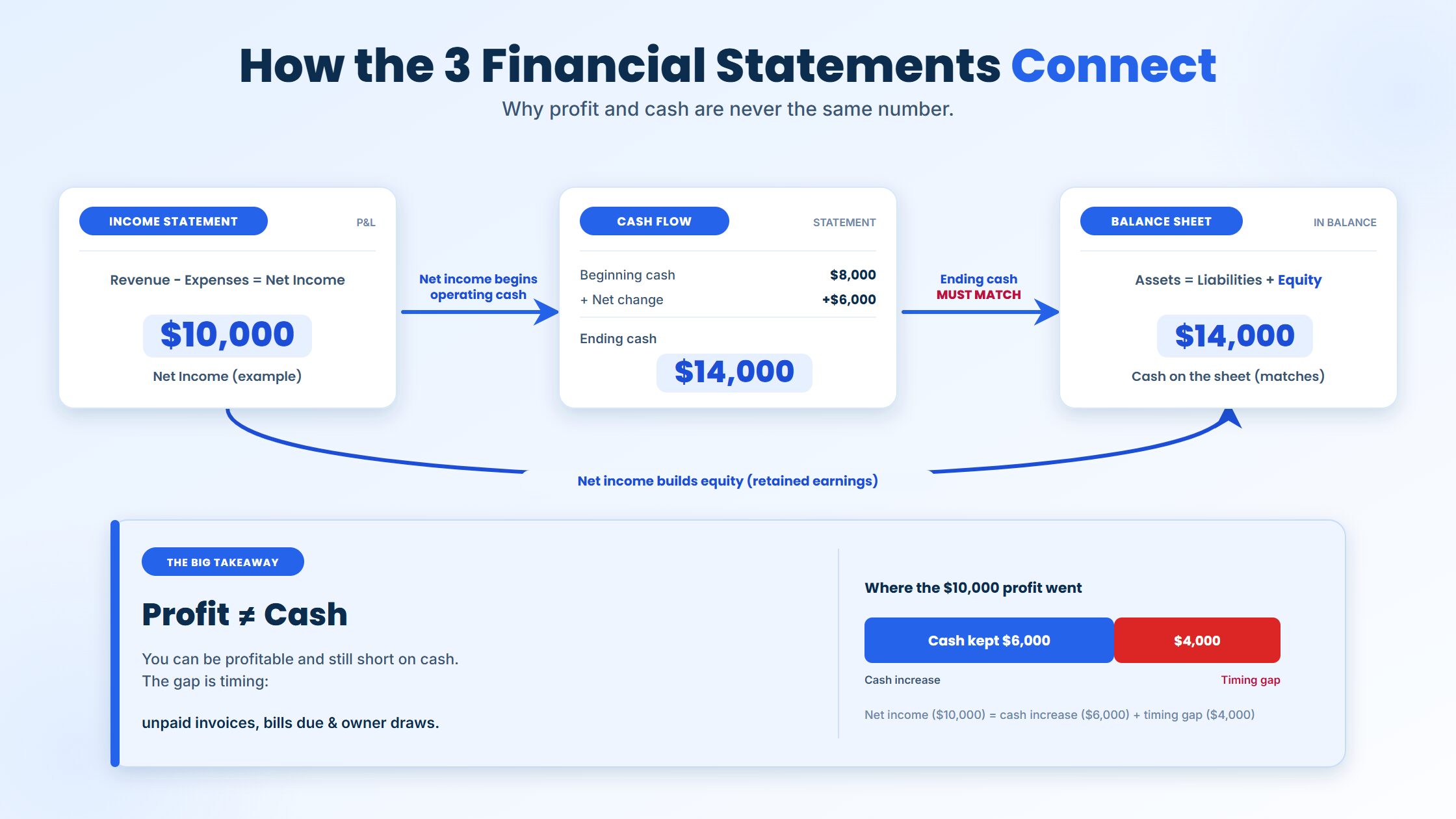
- The three financial statements: The profit and loss statement, the balance sheet, and the cash flow statement.
Learn these ten terms and the rest of bookkeeping starts to click. You will read your own reports with confidence.
Cash vs. Accrual: Choosing Your Bookkeeping Method
Every business picks a method. The two choices are cash basis and accrual basis. Your choice changes when income and expenses show up on your books. Pick the right one early, because switching later takes extra work.
Cash basis records money when it actually moves. You record income when the client pays. You record an expense when you pay it. Accrual basis records money when it is earned or owed, even if no cash has moved yet.
Here is a side-by-side view to make the choice clear.
| Method | How it records | Best for | Pros | Cons | 2026 IRS note |
| Cash basis | Income when received, expenses when paid | Service firms, freelancers, simple businesses | Simple to run, clear cash view | Hides unpaid invoices and bills | Allowed if average gross receipts stay under $32 million |
| Accrual basis | Income when earned, expenses when incurred | Inventory businesses, larger firms, most lenders | True profit picture, matches income to costs | More complex, needs more tracking | Required once you pass the $32 million receipts test |
Source: IRS Publication 538 (Accounting Periods and Methods); Internal Revenue Code Section 448(c). The $32 million figure is the 2026 inflation-adjusted limit.
Most small businesses pick cash basis at the start. It is simpler and it mirrors your bank account. As you add inventory, staff, and lenders, accrual often becomes the better fit. Many banks even ask for accrual statements.
The tax rule is worth knowing. Under Internal Revenue Code Section 448, a business can generally use the cash method if its average annual gross receipts stay under an inflation-adjusted limit. For 2026, that limit is $32 million (IRS Publication 538). Cross it, and the tax authority generally requires accrual. Switching methods means filing Form 3115 with your return.
How to Set Up Bookkeeping for a Small Business
Setting up a system sounds hard. It is not. Follow these steps in order and you will have simple bookkeeping for a small business running in an afternoon. This is how to set up bookkeeping for a small business the right way.
- Open a business bank account. Keep business money separate from personal money. This single step prevents the most common bookkeeping mess of all.
- Pick your method. Choose cash or accrual using the table above. Write it down.
- Build your chart of accounts. Create your category list. A sample starter set appears below.
- Choose software or a spreadsheet. Small and simple can start on a spreadsheet. Most owners graduate to software fast.
- Set a recording cadence. Decide when you will update your books. Weekly is the sweet spot.
- Connect your bank feeds. Link your bank and card so transactions flow in automatically. This cuts manual entry.
A sample starter chart of accounts for a service business looks like this:
- Income: Service revenue, Other income
- Cost of services: Subcontractors, Direct materials
- Operating expenses: Rent, Software subscriptions, Advertising, Office supplies, Bank fees, Insurance, Payroll
- Assets: Business checking, Equipment
- Liabilities: Business credit card, Loans
- Equity: Owner’s equity, Owner’s draw
Keep it short at first. Add accounts only when you need them. A bloated chart of accounts is harder to read, not easier.
How to Do Bookkeeping: The Monthly Process

Once you are set up, bookkeeping becomes a rhythm. Here is how to do bookkeeping for a small business, step by step, every month.
- Record and categorize transactions: Sort each item into the right account. Do this weekly so it never piles up.
- Reconcile bank and cards: Match your books to each statement. Fix any gaps. This step catches errors and fraud.
- Review accounts receivable and payable: See who owes you and who you owe. Chase late invoices. Schedule bills.
- Generate your statements: Produce your profit and loss statement, balance sheet, and cash flow statement.
- Close the month: Lock the period so past numbers stay fixed. Then start fresh.
A calendar keeps you honest. Use this simple schedule.
| Task | Monthly | Quarterly | Annually |
| Categorize transactions | Yes | ||
| Reconcile bank and cards | Yes | ||
| Review receivables and payables | Yes | ||
| Produce financial statements | Yes | ||
| Review estimated taxes | Yes | ||
| Payroll tax filings | Yes | ||
| Year-end close and tax prep | Yes | ||
| Review chart of accounts | Yes |
Your month-end checklist is short. Categorize everything. Reconcile every account. Review open invoices and bills. Print your three statements. Set aside your tax percentage. Then close the books.
A Real Example: One Month of Small Business Bookkeeping
Theory is easy. Numbers make it real. Here is an example of small business bookkeeping for one month, start to finish. Meet Marketing Agency, a small service business run by one owner.
Marketing Agency starts March with $12,000 in its business checking account. That is the opening balance. The owner uses cash basis. Here are the month’s transactions.
| Date | Description | Category | Money in | Money out |
| Mar 2 | Client payment | Service revenue | $8,500 | |
| Mar 4 | Software subscriptions | Software | $220 | |
| Mar 6 | Freelance designer | Subcontractors | $1,800 | |
| Mar 10 | Client payment | Service revenue | $6,200 | |
| Mar 12 | Co-working rent | Rent | $900 | |
| Mar 15 | Owner’s draw | Owner’s draw | $3,000 | |
| Mar 18 | Ad spend | Advertising | $1,500 | |
| Mar 22 | Client payment | Service revenue | $4,300 | |
| Mar 25 | Bank fee | Bank fees | $35 | |
| Mar 28 | Office supplies | Office supplies | $180 |
Now we reconcile. The bank statement shows an ending balance of $23,545. The $180 office supplies check has not cleared yet. Subtract that outstanding check, and the bank agrees with the books at $23,365. The account is reconciled.
Here is the resulting profit and loss statement for March.
| Profit and loss (March 2026) | Amount |
| Service revenue | $19,000 |
| Subcontractors | ($1,800) |
| Advertising | ($1,500) |
| Rent | ($900) |
| Software subscriptions | ($220) |
| Office supplies | ($180) |
| Bank fees | ($35) |
| Net profit | $14,365 |
Note that the owner’s draw of $3,000 is not on the profit and loss statement. A draw is not a business expense. It is the owner taking profit out and how you set a draw versus a salary has real tax consequences. That trips up many beginners.
Here is the balance sheet at month end.
| Balance sheet (Mar 31, 2026) | Amount |
| Business checking (assets) | $23,365 |
| Total liabilities | $0 |
| Owner’s equity (opening) | $12,000 |
| Net profit for the month | $14,365 |
| Owner’s draw | ($3,000) |
| Total equity | $23,365 |
Assets equal liabilities plus equity. Both sides land at $23,365. The books balance.
Here is the simple cash flow for March.
| Cash flow (March 2026) | Amount |
| Beginning cash | $12,000 |
| Cash received from clients | $19,000 |
| Cash paid for expenses | ($4,635) |
| Owner’s draw | ($3,000) |
| Ending cash | $23,365 |

Read those three reports together and you see the whole story the same three reports behind a structured financial and inventory system built for scale. Marketing Agency earned $14,365 in profit, paid the owner $3,000, and grew its cash to $23,365. That is what good books deliver. Clear answers, backed by numbers.
Bookkeeping Software vs. Spreadsheets vs. Templates
Now let us talk tools. You have three paths: a spreadsheet, dedicated software, or a hybrid template. Each fits a different stage.
A spreadsheet works when your business is tiny. Few transactions. One bank account. No staff. It is free and flexible. But it breaks down as volume grows. You lose bank feeds, easy reports, and error checks.
Software is the answer for most growing businesses. It connects to your bank, sorts transactions, and builds reports in seconds. So what is the best bookkeeping software for a small business? It depends on your needs. Here is a quick comparison of the top options for 2026.
| Software | Best for | Approx. monthly price (2026) | Standout feature |
| QuickBooks Online | US businesses that work with a CPA | $38 to $115 | Deep features and wide accountant support |
| Xero | Teams that need many users | $25 to $90 | Unlimited users on every plan |
| FreshBooks | Freelancers and service firms | $19 to $55 | Excellent invoicing and time tracking |
| Wave | Bootstrapped micro-businesses | $0; Pro about $16 to $19 | A genuine free tier for basics |
Source: QuickBooks, Xero, FreshBooks, and Wave official pricing pages, verified July 2026. QuickBooks Online ranges from $20 (Solopreneur) to $275 (Advanced); $38 to $115 covers the common small-business tiers.
Prices reflect published 2026 rates and can change. Intuit raised QuickBooks prices in mid-2025, and those higher rates carry into 2026 renewals, so confirm the current rate before you sign up.
The best software also automates the boring parts. Bank feeds pull in transactions. Receipt capture reads your photos. Rules sort repeat expenses on their own. That is how to automate bookkeeping for a small business without losing control.
Free Small Business Bookkeeping Template
Not ready for software? Start with a template. Our free small business bookkeeping template gives you a clean place to record income and expenses from day one. It is a simple, guided spreadsheet.
The template includes three parts. First, an income and expense log where you enter each transaction. Second, a category list that matches a standard chart of accounts. Third, a monthly summary that adds everything up for you. Enter your transactions and your totals appear on their own.
Here is how to use it. Set up your bank on the first tab. Enter each transaction as it happens, using the drop-down categories. Check the summary tab at month end. That is your instant profit and loss view. Reconcile it against your bank statement, and you are done.
This small business bookkeeping template answers the two most common searches at once. It is both a working tool and a clear example of small business bookkeeping in action. Owners who want a video walkthrough can request one when they download.
Download the free template below. Just add your email and we will send it straight to your inbox.

What Does Bookkeeping Cost? DIY vs. Outsourced
Let us talk money. The cost of small business bookkeeping falls into two buckets: doing it yourself or paying a pro. Here is the honest math for 2026.
| Option | Typical monthly cost | Time required | Best for |
| DIY with a spreadsheet | $0 | 5 to 15 hours | Very small, simple businesses |
| DIY with software | $19 to $115 | 4 to 10 hours | Owners who enjoy the numbers |
| Outsourced bookkeeping | $300 to $800 | About 1 hour | Growing firms under 150 monthly transactions |
| Full outsourced package | $800 to $2,500+ | About 1 hour | Firms with payroll, bills, and reporting |
DIY looks cheap. Software alone runs $0 to $115 per month. But look at the hidden cost. Your time.
Say your work is worth $150 an hour. You spend 8 hours a month on the books. That is $1,200 in lost billable time every month. Add software, and DIY quietly costs more than help. This is the opportunity-cost trap. Cheap on the invoice, expensive in reality.
Outsourced bookkeeping for a small business usually runs $300 to $800 per month at the basic tier see how our packages are priced. A full outsourced accounting package with payroll, bill pay, and monthly reporting runs $800 to $2,500 or more, based on your volume.. You trade a clear monthly fee for your hours back and fewer errors.
DIY or Outsource? The Decision
This is the question every owner asks. Can I do my own books, or should I hand them off? Here is a straight answer and a simple framework we call DIY-to-Delegate.
You can DIY when three things are true. Your business is simple. Your transaction volume is low. And you actually have the time and the interest. If you enjoy the numbers and your month-end takes an hour, keep going.
You should outsource when the opposite shows up. Ask yourself these questions.
- Are you more than a month behind, again?
- Do you dread the books each month?
- Have you missed a deadline or a deduction?
- Is your time worth more spent on sales or service?
- Are you adding payroll, inventory, or a lender?
If you answered yes to two or more, it is time to get bookkeeping help for a small business. The honest trade-off is real. DIY saves cash but costs time and risks errors. Outsourcing costs a fee but returns your hours and buys accuracy.
There is a middle path too. Some owners keep daily entry in-house and hire a pro for monthly review and reconciliation the full in-house versus outsourcing trade-off is worth reading before you decide. That blend works well for many entrepreneurs.
Bookkeeper vs. Accountant: Who Do You Need First?
Owners often mix up these two roles. They are different jobs. Knowing which you need saves money.
| Role | What they do | When to hire | Typical cost |
| Bookkeeper | Records transactions, reconciles, runs monthly reports | As soon as you have regular income and expenses | $300 to $2,500 per month |
| Accountant or CPA | Files taxes, plans strategy, reads the big picture | At tax time and for major decisions | Project or annual fees |
For most small businesses, the bookkeeper comes first. You need clean daily records before an accountant can add value. In fact, good bookkeeping makes your accountant cheaper, because they spend less time cleaning up.
Do you need a bookkeeper or an accountant? Often you need both, working together. A firm that offers both keeps your records and your tax strategy in one place. That is the model we run.
Bookkeeping by Entity Type and Industry
Your business type changes how you keep books. This is a gap most guides skip, so let us fill it.
A sole proprietor or single-member limited liability company reports business income on a Schedule C with their personal return. Money the owner takes out is a draw, not a wage. A partnership splits income among partners. An S corporation is different. The owner must run real payroll and take a reasonable salary, on top of any distributions. That changes your bookkeeping and your payroll setup.
If you pay contractors, note a change for 2026. You must issue a Form 1099-NEC only when you pay a contractor $2,000 or more in the year, up from the old $600 threshold. This applies to payments made on or after January 1, 2026 (One Big Beautiful Bill Act, Public Law 119-21). Track cumulative payments per contractor so you still catch anyone who crosses the line.
Industry matters just as much. Here are three quick, real examples of how bookkeeping shifts by field.
- E-commerce: A Shopify seller must reconcile Stripe payouts against actual sales. Payment processors hold fees and batch deposits. So the deposit rarely matches the order total. Good books map every payout back to its orders and fees.
- Real estate: A property manager tracks a rent roll and maps expenses to each property. Books must show profit per unit, not just a lump sum. Depreciation and capital improvements need their own tracking.
- Clinics: A medical or therapy practice must match insurance payments to billed claims the core of healthcare accounting. Billed revenue is not collected revenue. Payroll compliance for staff and contractors adds another layer.
Each field has its own traps. The right setup handles them from the start.
Recordkeeping and Retention: What to Keep and How Long
Books are not just for today. You must keep records in case the tax authority ever reviews your return. Most guides ignore this. Here are the rules, based on Internal Revenue Service guidance.
| Record type | How long to keep |
| Most income and expense records | At least 3 years |
| Records if you underreport income by more than 25% | 6 years |
| Records for a bad debt or worthless securities claim | 7 years |
| Employment and payroll tax records | At least 4 years |
| If you file a fraudulent return or no return | Keep records indefinitely |
| Property records (for depreciation and gains) | Until the limitation period ends after you sell |
Source: IRS, How long should I keep records? and IRS Publication 583.
Keep digital copies, not just paper. Photograph receipts and store them in the cloud, sorted by month. Digital records are easier to search and safer from loss. Clean, well-kept records are your best defense if you ever face an audit.
Common Small Business Bookkeeping Mistakes
We review a lot of books. The same mistakes show up again and again. Avoid these and you are ahead of most owners.
- Mixing personal and business money. The fix is one business bank account and one business card. Never pay personal costs from business funds.
- Falling behind. Books that pile up become books that never get done. The fix is a weekly 30-minute habit.
- Choosing the wrong method. A growing product business on cash basis can misread its profit. The fix is a quick method review each year.
- Skipping reconciliation. Unreconciled books hide errors and fraud. The fix is a monthly match against every statement.
- Keeping no tax reserve. A big tax bill with no savings is a crisis. The fix is setting aside a fixed percentage of every deposit.
- Only hiring at tax time. Waiting until April means a year of cleanup and missed planning. The fix is help throughout the year.
Here is what we see most in practice. The costliest mistake is not a wrong entry. It is silence. Owners avoid the books because they feel behind. The gap grows. Catching a backlog early is always cheaper than facing it late.
Small Business Bookkeeping Tips (Quick Wins)
Want fast improvement? Use these small business bookkeeping tips this week. Each one saves time or prevents errors.
- Automate your bank feeds. Let transactions flow in on their own.
- Book a weekly 30-minute session. Small and steady beats a yearly panic.
- Keep separate accounts. One business bank account and one business card, always.
- Digitize receipts. Snap a photo and file it in the cloud right away.
- Set aside your tax percentage. Move a fixed share of every deposit to a tax savings account.
- Close the month. Lock each period so your history stays clean.
Do these six things and easy accounting for a small business stops being a dream. It becomes your normal routine.
Our Guarantees to You
We know accuracy and timing are what keep you up at night. So we put our promises in writing. This is how we stand behind your small business bookkeeping.
Regulatory Compliance Assurance. We make sure your tax filings, payroll, and financial reports meet compliance standards. If an error on our part results in a financial penalty, we will cover the cost. Your risk becomes our responsibility.
Financial Reports Delivered on Schedule. We deliver your monthly, quarterly, and annual reports without delays. If we miss a compliance deadline due to our fault, we pay a 50% fee. On-time delivery is not a hope. It is a commitment.
Those two guarantees remove the fear that drives most bookkeeping stress. You get accurate books, on time, backed by real accountability.
Conclusion and Next Step
Let us bring it home. Small business bookkeeping is the habit of recording every dollar, sorting it well, and checking it monthly. Do that, and you gain clean books, easy taxes, and clear cash flow. You can start today with a spreadsheet or software. You can DIY while your business is simple. And you can outsource the moment the time cost outweighs the savings.
The decision is yours, and now you have the framework to make it. Grab the free small business bookkeeping template to start recording today. Or, if the books already feel like a burden, hand them off. Good bookkeeping for a small business should give you time back, not take it away.
We will review your current books and show you exactly what can be automated in the next 30 days. No pressure, just a clear plan.
Frequently Asked Questions
Can I do my own bookkeeping for my small business?
Yes. Many owners handle their own small business bookkeeping when the business is simple and volume is low. Use software or a template, reconcile monthly, and keep business money separate. As you grow, the time cost usually pushes owners to outsource.
What is small business bookkeeping?
It is the practice of recording, sorting, and storing every financial transaction your business makes. It tracks money in and money out. Those records become your financial statements and your tax return.
How much does bookkeeping cost for a small business?
DIY software runs about $19 to $115 per month. Basic outsourced bookkeeping runs about $300 to $800 per month. A full package with payroll and reporting runs $800 to $2,500 or more, based on your transaction volume.
What does a bookkeeper do for a small business?
A bookkeeper records transactions, sorts them into categories, reconciles your bank and cards, tracks invoices and bills, and prepares monthly reports. In short, they keep your books current and accurate.
Do I need a bookkeeper or an accountant?
Often both. A bookkeeper keeps your daily records. An accountant files taxes and advises on strategy. Most small businesses hire the bookkeeper first, because clean records make the accountant’s job faster and cheaper.
What’s the best bookkeeping method for a small business, cash or accrual?
Most small businesses start with cash basis because it is simpler and mirrors the bank account. Accrual gives a truer profit picture and is required once average gross receipts pass $32 million for 2026. Growing and inventory-based businesses often move to accrual.
Can I teach myself bookkeeping?
Yes. Learn the ten core terms, pick a method, set up software, and reconcile monthly. Start with a template and a weekly habit. Many owners run their own books for years before they hand them off.
Why is bookkeeping important for a small business?
It drives tax compliance, cash flow visibility, loan readiness, and better decisions. Without clean books, you are guessing. With them, you lead with facts. It is the foundation of your financial health.
How do I set up bookkeeping for a small business?
Open a business bank account, pick your method, build a chart of accounts, choose software or a spreadsheet, set a recording cadence, and connect your bank feeds. You can do all six steps in an afternoon.
How do I do bookkeeping step by step?
Each month, record and categorize transactions, reconcile your bank and cards, review receivables and payables, generate your three statements, then close the month. Repeat this simple cycle every month.
What is the best bookkeeping software for a small business?
It depends on your needs. QuickBooks Online suits businesses that work with a CPA. Xero suits teams needing many users. FreshBooks suits freelancers who invoice a lot. Wave suits bootstrapped micro-businesses on a zero budget.

