Key Takeaways
- The S corp tax deadline for calendar-year 2026 returns is Monday, March 15, 2027, for Form 1120-S and every shareholder’s Schedule K-1 (IRS).
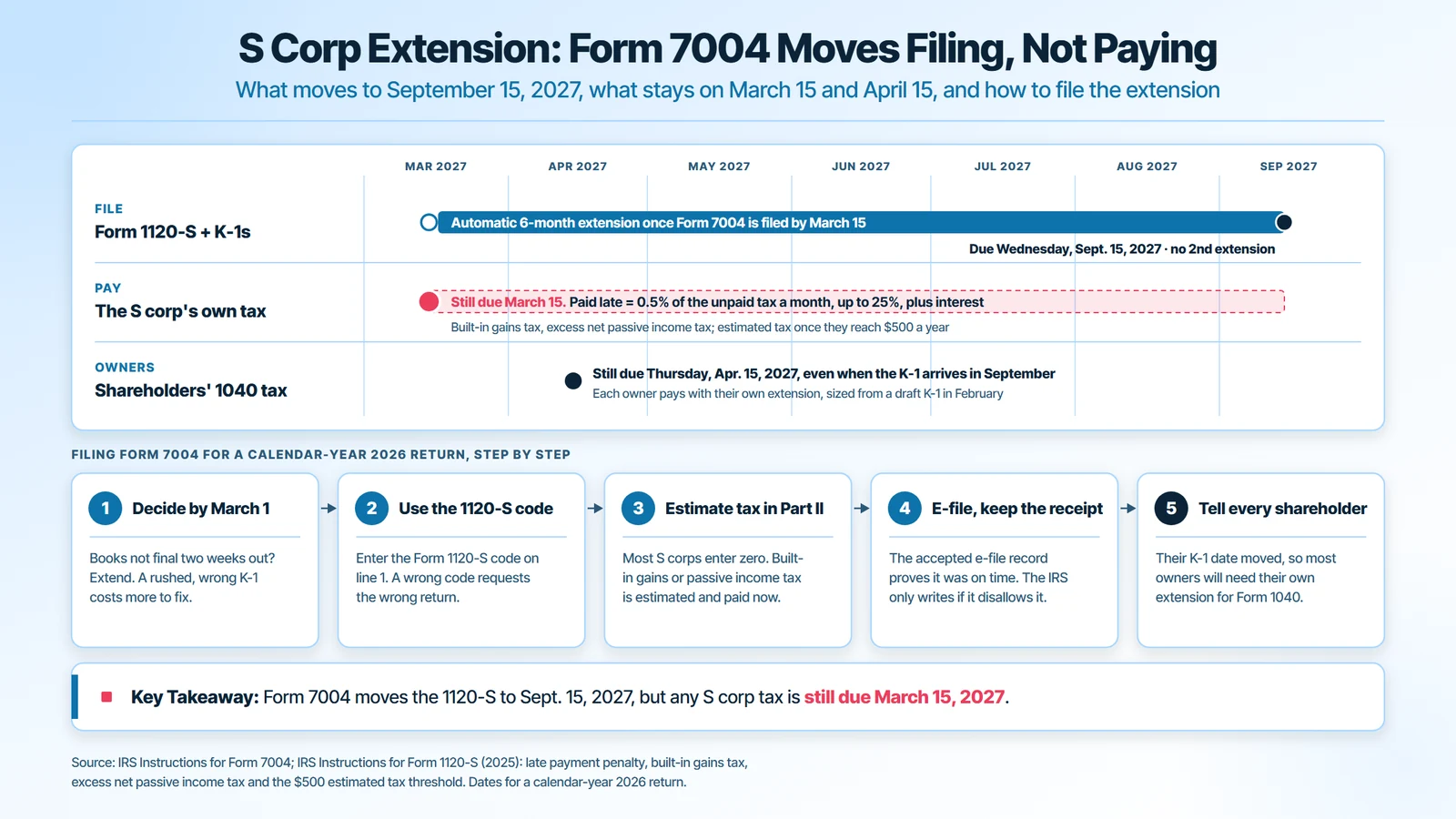
- Form 7004 filed by March 15, 2027 moves the S corp filing deadline 6 months to September 15, 2027, but it does not extend the time to pay any tax due (IRS Form 7004 instructions).
- The late filing penalty on an S corp return due in 2027 is $260 per shareholder per month, for up to 12 months (Rev. Proc. 2025-32), so a four-owner S corp filing 3 months late owes $3,120.
- Each Schedule K-1 that reaches a shareholder late can add a $340 penalty on top of the late filing penalty (2025 Form 1120-S instructions).
- The Form 2553 deadline for S corp status in calendar 2027 is March 15, 2027, which is 2 months and 15 days after the tax year starts (Form 2553 instructions).
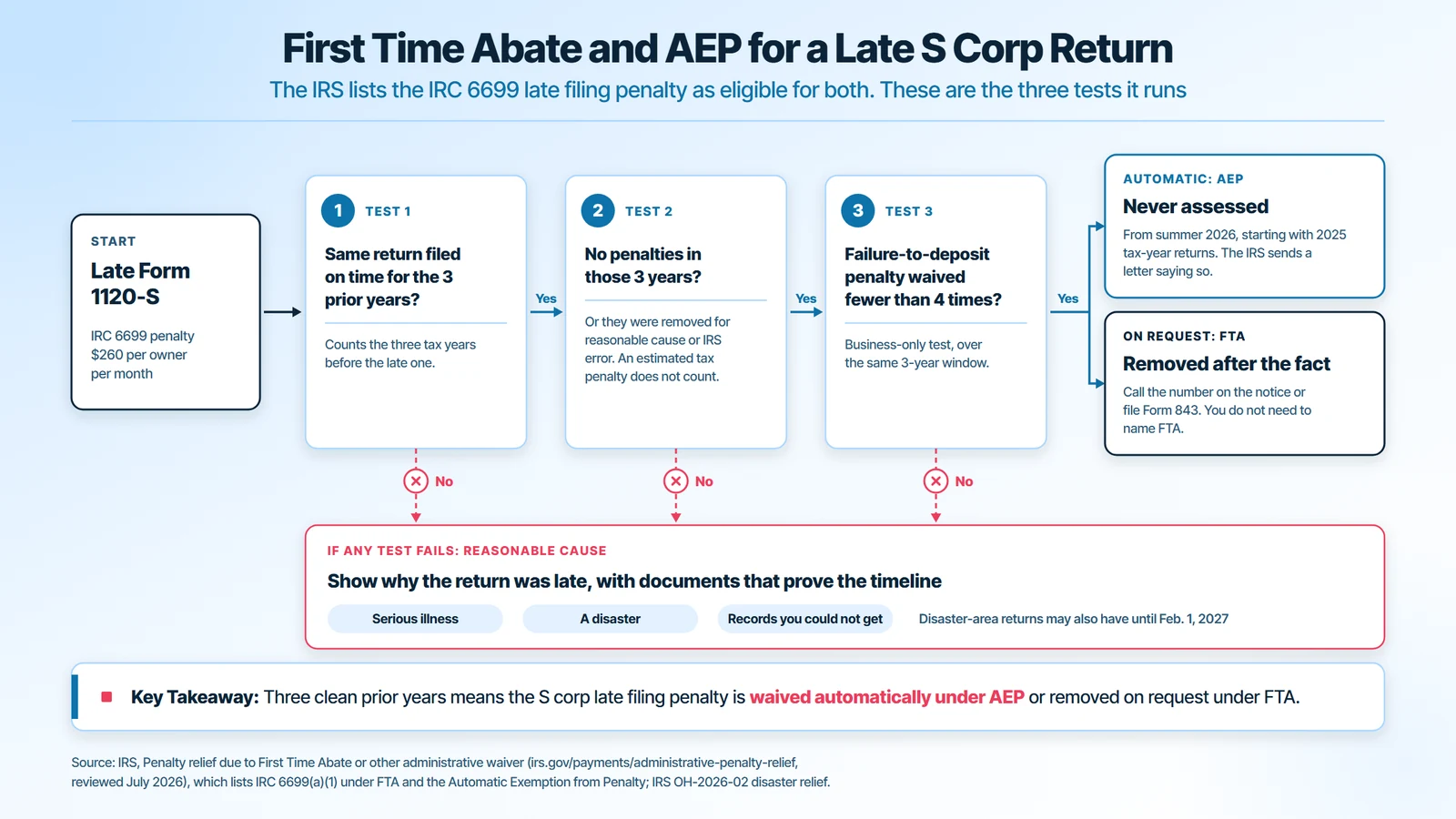
- The IRS lists the S corp late filing penalty under IRC 6699 as eligible for First Time Abate and for the Automatic Exemption from Penalty that began in summer 2026, when the prior three years were filed on time.
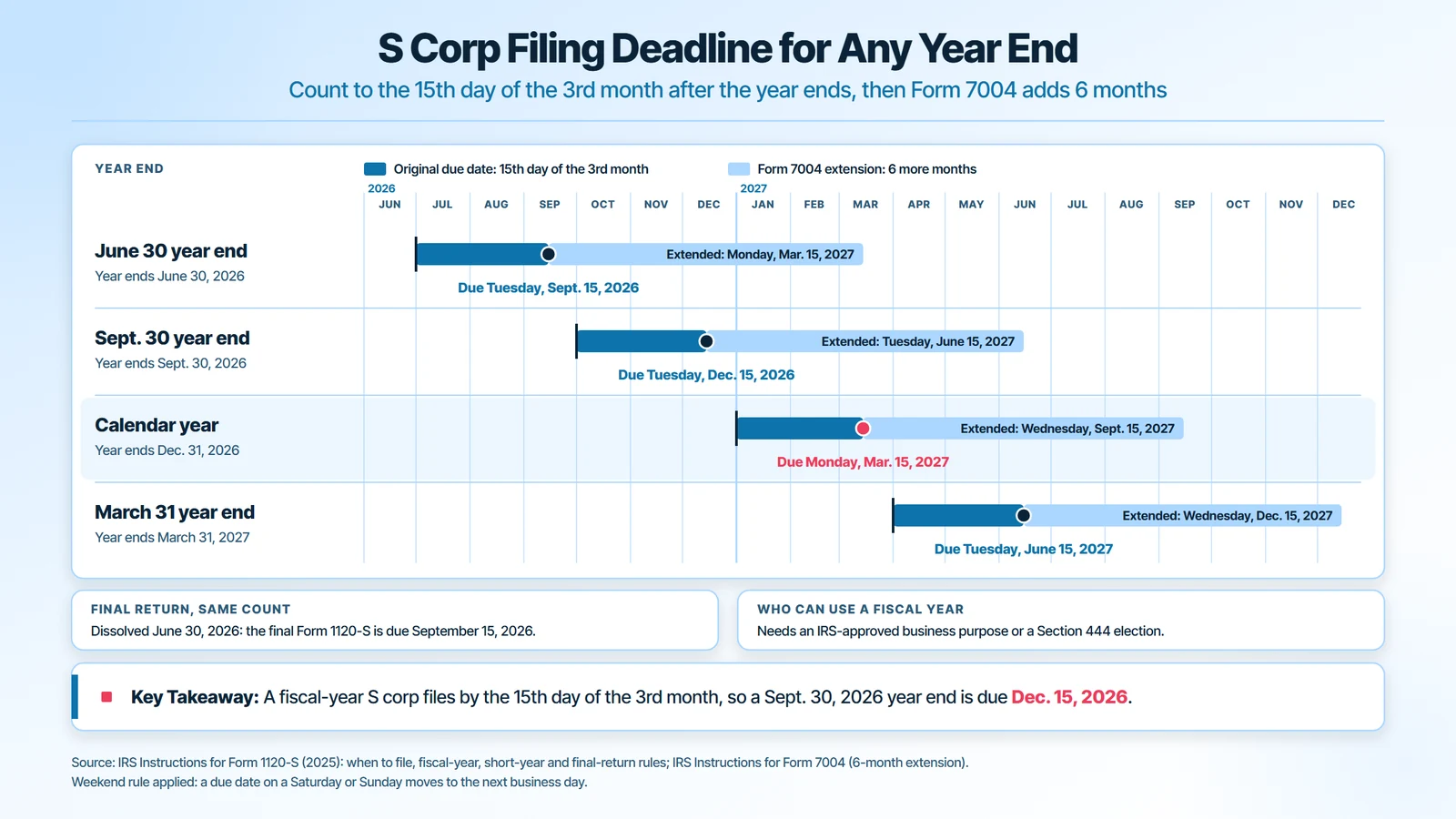
- A fiscal-year S corp files by the 15th day of the 3rd month after its year ends, so a September 30, 2026 year end is due December 15, 2026.
The S corp tax deadline is March 15, 2027, for calendar-year 2026 returns filed on Form 1120-S. The same day, every shareholder must have a Schedule K-1 in hand.
Miss it and the IRS charges $260 per shareholder for each month the return is late. A four-owner company that files in June instead of March has already paid $3,120 for nothing.
This guide gives you every date that matters for the 2026 return, the extension, the election and the payroll forms, plus what to do if a deadline slipped. If you want one team to own the dates, our business tax preparation covers the return end to end.
When Is the S Corp Tax Return Due in 2027?
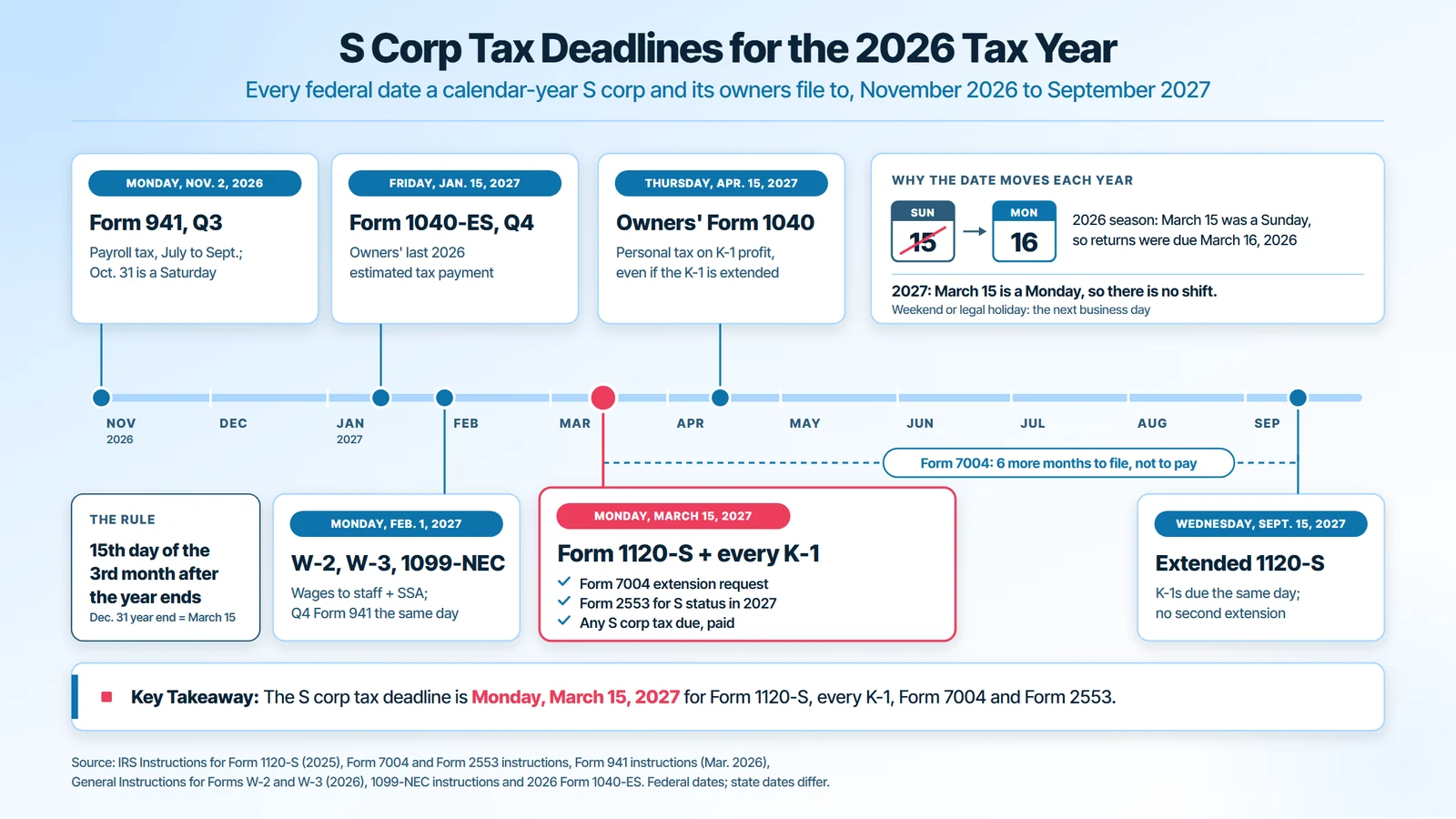
The S corp tax return for calendar year 2026 is due Monday, March 15, 2027. The rule in the Instructions for Form 1120-S is the 15th day of the 3rd month after the tax year ends. For a December 31 year end, that is March 15.
When the 15th falls on a Saturday, Sunday or legal holiday, the due date moves to the next business day. That is why the S corp tax filing deadline in 2026 was March 16, 2026: March 15 fell on a Sunday. In 2027 the 15th is a Monday, so there is no shift.
Here is the full calendar for a calendar-year S corp, with the weekday so you can plan the work back from it.
| What is due | 2025 tax year (filed in 2026) | 2026 tax year (filed in 2027) |
| Form 1120-S and Schedule K-1s | Monday, March 16, 2026 | Monday, March 15, 2027 |
| Form 7004 extension request | Monday, March 16, 2026 | Monday, March 15, 2027 |
| Extended Form 1120-S | Tuesday, September 15, 2026 | Wednesday, September 15, 2027 |
| Shareholders’ Form 1040 | Wednesday, April 15, 2026 | Thursday, April 15, 2027 |
| Form 2553 for S status next year | Monday, March 16, 2026 (for 2026) | Monday, March 15, 2027 (for 2027) |
Why March 15 Comes a Month Before April 15
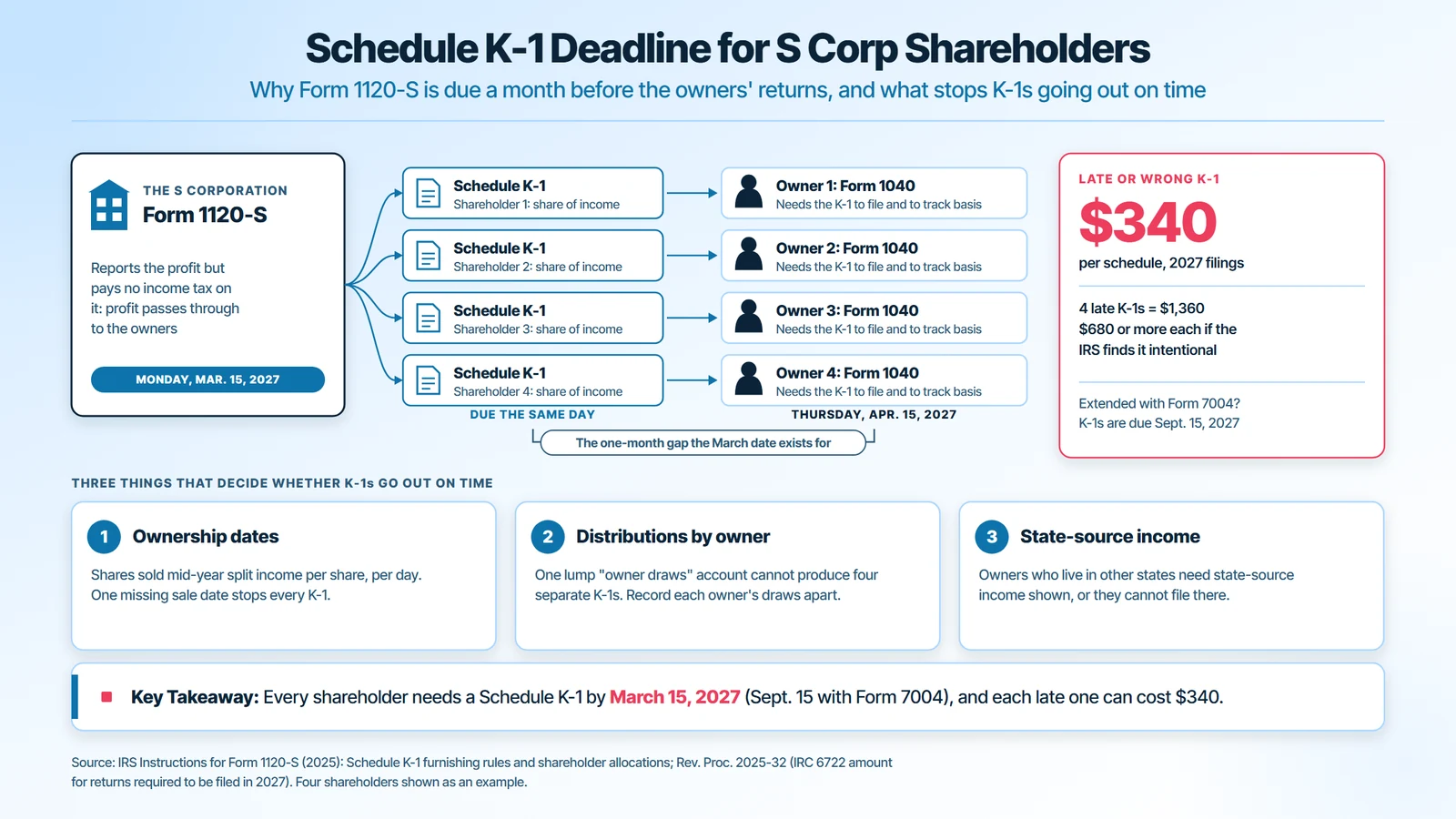
An S corporation is a pass-through entity. The company files Form 1120-S, but the profit is taxed on each owner’s personal return through Schedule K-1. The March date exists so owners get their K-1 before their own Form 1040 is due on April 15.
That one-month gap is the whole design. If the company files late, the owners file late or file blind. So the 1120-S due date is really the start of every shareholder’s tax season, not just a company filing.
In practice the March deadline pulls three jobs into January and February:
- Close the books for December. Bank, card and loan accounts reconciled, payroll tied to the W-2s.
- Confirm the shareholder list. Any sale, gift or new issue of shares during 2026 changes how income is split across K-1s.
- Agree the numbers with the owners. Distributions, shareholder loans and owner-paid expenses get classified before the return is drafted.
Is the Deadline Different for a Fiscal-Year S Corp?
A fiscal-year S corp uses the same formula with a different start point. Form 1120-S is due on the 15th day of the 3rd month after the fiscal year ends, and the extension adds 6 months. The weekend and holiday rule applies the same way.
Most S corporations must use a calendar year. A fiscal year needs a business purpose approved by the IRS or a Section 444 election, so this mostly affects seasonal businesses and companies that converted from a C corporation. Here is how the dates fall for three common year ends.
| Fiscal year ends | Form 1120-S due | Extended due date |
| June 30, 2026 | Tuesday, September 15, 2026 | Monday, March 15, 2027 |
| September 30, 2026 | Tuesday, December 15, 2026 | Tuesday, June 15, 2027 |
| March 31, 2027 | Tuesday, June 15, 2027 | Wednesday, December 15, 2027 |
Two more cases follow the same count:
- A company that dissolves files its final Form 1120-S by the 15th day of the 3rd month after the date it dissolved.
- A company whose S election ends mid-year files a short-year 1120-S, due with the short-year C corporation return, extensions included.
What Is the S Corp Extension Deadline, and How Do You File Form 7004?
The S corp extension deadline is the original due date, March 15, 2027, for a calendar-year 2026 return. Filing Form 7004 by that date gives an automatic 6-month extension, so the new S corp tax extension deadline is September 15, 2027.
The IRS does not approve it in writing. It only contacts you if the request is disallowed. Here is the sequence that works:
- Decide by March 1. If the books are not final two weeks out, extend. A rushed return with a wrong K-1 costs more to fix than the extension.
- Enter the form code for Form 1120-S on line 1. The code list sits on Form 7004 itself, and a wrong code requests the wrong return.
- Estimate any entity-level tax on Part II. Most S corps enter zero. Built-in gains or excess passive income tax must be estimated and paid now.
- E-file it and keep the acknowledgment. The accepted e-file record is your proof the request was on time.
- Tell every shareholder the K-1 date moved. They will likely need their own extension for Form 1040.
There is no second extension. Six months is the maximum for Form 1120-S, so September 15, 2027 is the hard stop for a 2026 calendar-year return.
Does an Extension Give You More Time to Pay the Tax?
No. Form 7004 extends the time to file, not the time to pay. Any tax the S corporation owes is still due by March 15, 2027, and the IRS charges a late payment penalty of half of 1 percent of the unpaid tax per month, up to 25 percent.
Most S corporations owe nothing at entity level, because profit passes to the owners. The exceptions are real, though:
- Built-in gains tax on assets a former C corporation sells.
- Excess net passive income tax when a former C corporation with old earnings earns too much rent, interest or dividends.
- Estimated tax, required when these taxes total $500 or more for the year.
The bigger cash risk sits with the owners. Shareholders still pay their personal tax by April 15, 2027, even when the K-1 arrives in September. The fix is simple: run a projection from the draft K-1 in February and have each owner pay with their own extension.
What Happens If You Miss the S Corp Tax Deadline?
Missing the S corp tax deadline triggers a penalty under IRC 6699 that grows with every shareholder and every month. It applies even when the company owes no tax, which is the part most owners do not expect.
The penalty runs from the due date, including any extension, until the return is filed. A late K-1 adds a second penalty. Below is how each one is counted on a return due in 2027.
How the Late Filing Penalty Is Calculated on a 2027 Return
For an S corp return required to be filed in 2027, the late filing penalty is $260 per shareholder for each month or part of a month the return is late. That figure comes from Rev. Proc. 2025-32. The amount for returns filed in 2026 was $255, so many pages still quote last year’s number.
The count stops at 12 months. Here is the arithmetic for a four-shareholder S corp:
| Scenario (4 shareholders) | Working | Penalty |
| Filed 3 months late | $260 x 4 x 3 | $3,120 |
| Four K-1s furnished late | $340 x 4 | $1,360 |
| Both together | $3,120 + $1,360 | $4,480 |
| Filed 12 or more months late | $260 x 4 x 12 | $12,480 |
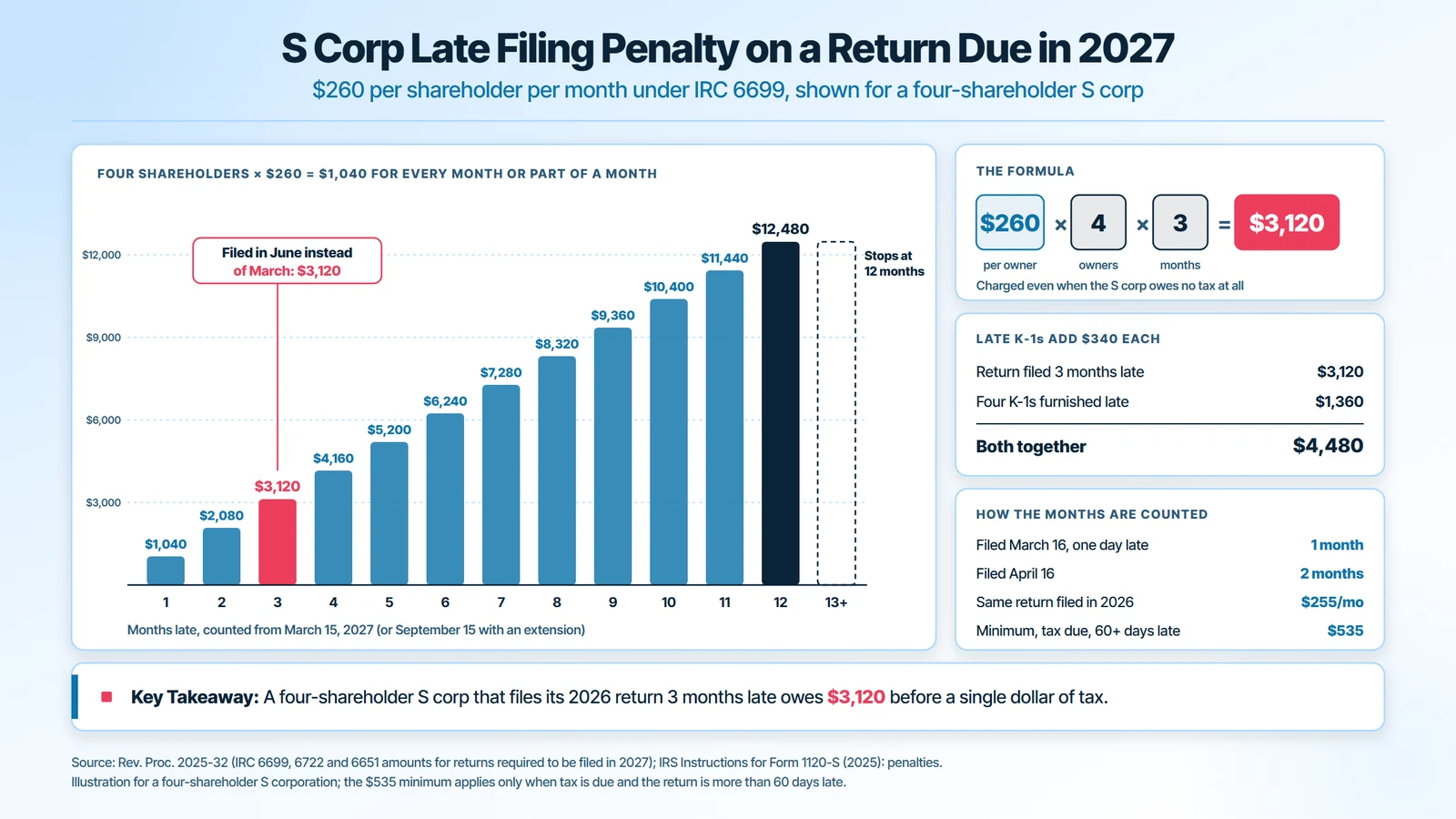
“Part of a month” matters. A return filed one day late counts as a full month. A return filed on April 16 counts as two months, because it crossed into a second month after March 15.
When Tax Is Due, the Penalty Adds 5 Percent a Month
When the S corporation does owe entity-level tax, the per-shareholder charge is only the start. A company that owes built-in gains tax and files in June pays four charges at once:
- Per-shareholder charge: $260 per owner per month, as above.
- Late filing charge on the tax: 5 percent of the unpaid tax for each month late, up to 25 percent.
- Minimum penalty: for a 2027 return more than 60 days late, the lesser of $535 or the full tax due, up from $525 for 2026 filings.
- Late payment charge and interest: half of 1 percent a month on unpaid tax, plus interest from the original due date.
The cheapest fix is the one in the extension section. Estimate the tax, pay it by March 15 and extend only the paperwork.
Is First-Time Penalty Abatement Available for a Late S Corp Return?
Yes. The IRS lists the S corporation late filing penalty under IRC 6699 as eligible for First Time Abate, on its penalty relief page. It is the cheapest way out of a late return, and many owners never ask for it.
To qualify, three conditions must hold:
- Clean history. The company filed the same return type on time for the three prior years.
- No penalties in that window. Or any penalty was later removed for reasonable cause or IRS error. An estimated tax penalty does not count against you.
- Deposit record. For businesses, the IRS did not waive a failure to deposit penalty four or more times in those three years.
First Time Abate is not automatic. You call the number on the notice or send Form 843, and you do not need to name FTA in the request. The IRS checks the account and decides.
From summer 2026, the IRS also runs an Automatic Exemption from Penalty, called AEP. It starts with 2025 tax year returns. When the history is clean, the penalty is never assessed in the first place, and you get a letter saying so.
If the history is not clean, reasonable cause is the fallback. Serious illness, a disaster or records you could not get are the usual grounds, with documents to prove the timeline.
When Must Shareholders Receive Their Schedule K-1?
Shareholders must receive their Schedule K-1 on or before the day Form 1120-S is required to be filed. For a calendar-year 2026 return, that is March 15, 2027, or September 15, 2027 if the company filed Form 7004.
The K-1 shows each owner’s share of income, deductions, credits and distributions. Owners need it for their Form 1040, and for basis. Basis decides whether a loss is deductible and whether a distribution is taxable, and our S corp basis calculator walks through that roll-forward.
Every late or wrong K-1 can cost $340 per schedule. If the IRS finds the failure was intentional, each one rises to $680 or more. Three things decide whether K-1s go out on time:
- Ownership dates. When shares change hands mid-year, income is split per share, per day. A missing sale date stops the K-1s.
- Distributions recorded by owner. A lump “owner draws” account cannot produce four separate K-1s.
- State items. Owners in other states need state-source income shown, or they cannot file there.
Send draft K-1s to owners two weeks before the deadline. Their questions surface the errors while there is still time to fix them.
When Is the Deadline to File an S Corp Election (Form 2553)?
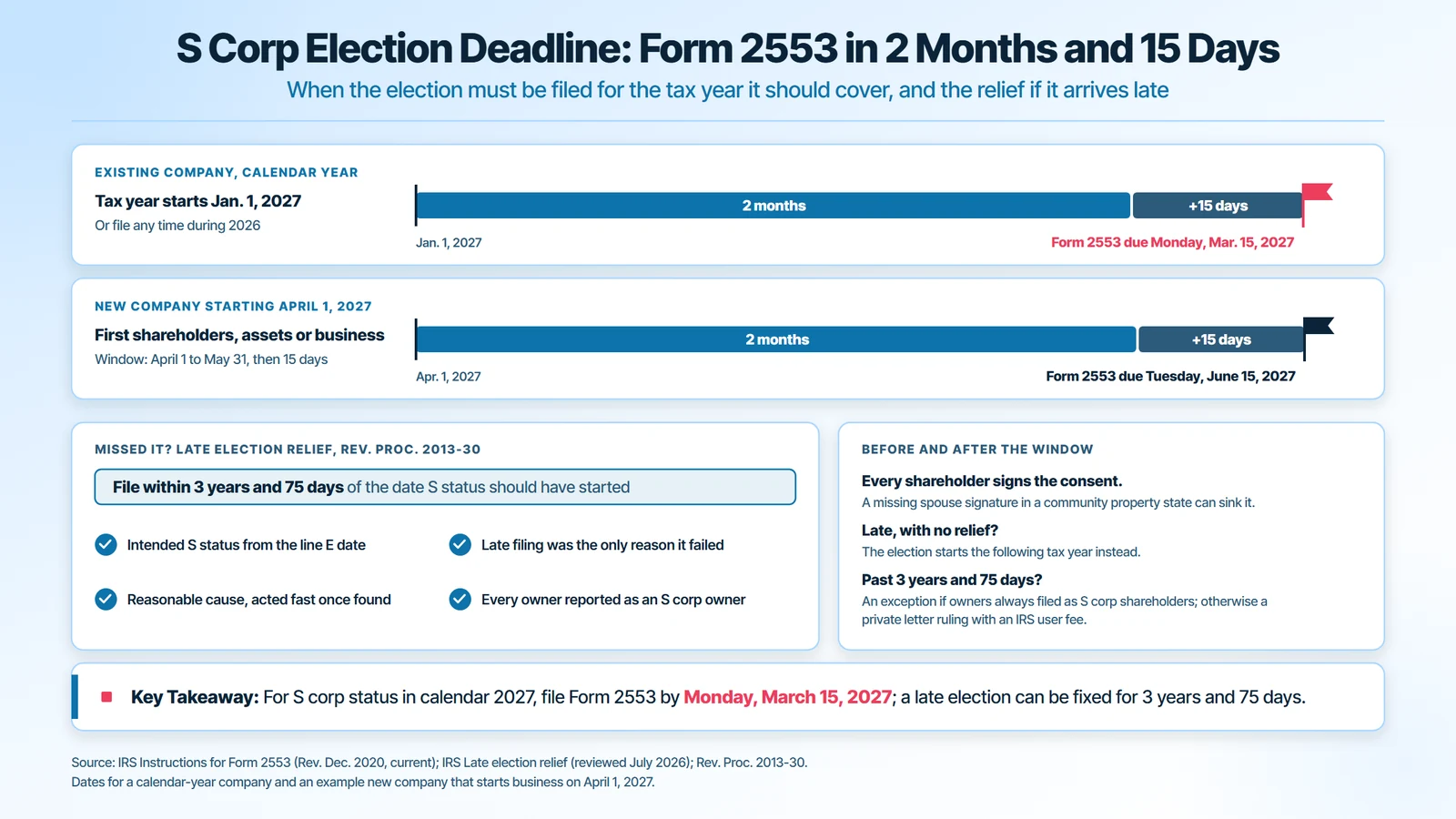
The S corp election deadline is 2 months and 15 days after the start of the tax year the election is meant to cover. For S status in calendar 2027, Form 2553 is due March 15, 2027. You can also file it any time during 2026 for a 2027 start.
The Instructions for Form 2553 count the 2 months from the day the tax year begins. For a new company, that is the day it first has shareholders, acquires assets or starts business. Here is how it plays out:
- Existing company, calendar year: tax year starts January 1, 2027, so the Form 2553 deadline is March 15, 2027.
- New company starting April 1, 2027: the 2-month window runs to May 31, then 15 days more, so the election is due June 15, 2027.
- Filed after the window: the election starts the following tax year, unless you qualify for late relief.
Every shareholder must sign the consent on Form 2553. A missing spouse signature in a community property state is a common reason an otherwise timely election fails.
Can You Still Elect S Corp Status After the Deadline?
Yes, usually. IRS late election relief under Rev. Proc. 2013-30 lets a company file a late Form 2553 within 3 years and 75 days of the date it wanted S status to start.
The conditions are strict, and all must be true:
- The company intended to be an S corporation from the date on line E of Form 2553.
- It failed to qualify only because the form was late, not because of an ineligible shareholder or a second class of stock.
- It has reasonable cause and acted quickly once the miss was found.
- Every shareholder reported income as if the election was in effect, for every year since.
You state the reasonable cause on the form or an attached statement. Shareholders sign statements confirming their returns were consistent. Past the 3 years and 75 days, an exception exists for corporations whose owners always filed as S corp shareholders. Otherwise the only route left is a private letter ruling, which carries an IRS user fee.
If you are reading this in late 2026 and missed the window for 2026, file now with the relief statement. Waiting turns a paperwork fix into a ruling request.
Other Small Business Tax Deadlines Every S Corp Owner Tracks
The 1120-S is one date in a calendar of small business tax deadlines. An S corp owner who pays themselves a salary also runs payroll filings, contractor forms and personal estimates. Each has its own business tax filing deadline and its own penalty.
For comparison, a C corporation files Form 1120 by the 15th day of the 4th month, so April 15 for a calendar year. Here are the dates for the next season:
| Form | What it covers | Next due date |
| Form 941 | Payroll taxes, July to September 2026 | Monday, November 2, 2026 |
| Form 1040-ES | Owners’ 4th estimate for 2026 | Friday, January 15, 2027 |
| Form W-2 and W-3 | 2026 wages, to employees and SSA | Monday, February 1, 2027 |
| Form 1099-NEC | Contractors paid $2,000 or more in 2026 | Monday, February 1, 2027 |
| Form 941 | Payroll taxes, October to December 2026 | Monday, February 1, 2027 |
| Form 1120-S | 2026 S corporation return | Monday, March 15, 2027 |
Our small business tax checklist lists the records to pull for each one.
Form 941 and Form W-2 Deadlines for Shareholder-Employees
An S corp owner who works in the business must take a reasonable salary through payroll. That salary puts the company on the payroll calendar, separate from the 1120-S.
Form 941 is due by the last day of the month after each quarter: April 30, July 31, October 31 and January 31. When that day is a weekend, it moves. October 31, 2026 is a Saturday, so the third-quarter Form 941 is due Monday, November 2, 2026.
The 2026 Form W-2 instructions set February 1, 2027 for filing 2026 Forms W-2 and W-3 with the Social Security Administration. Employees get their copies by the same date.
Two payroll habits protect the March deadline:
- Tie W-2 wages to the general ledger in January. Officer wages on the 1120-S must match the W-2s, and a gap holds up the return.
- Set the salary before year end. Our reasonable compensation and payroll tax calculator shows the payroll tax on each salary level, and our payroll tax filing team files the 941s on the quarter.
Shareholder Estimated Tax Payments on Form 1040-ES
S corp profit lands on the owner’s personal return, so the owner, not the company, usually pays estimated tax. Form 1040-ES sets four payment dates for 2026. The last one is January 15, 2027.
The 2026 schedule ran April 15, June 15 and September 15, 2026, then January 15, 2027. Owners with S corp income often fall short because salary withholding covers wages but not the K-1 profit on top.
A practical way to size it:
- Take year-to-date profit from the September books. Annualise it for the fourth quarter.
- Subtract the salary already run through payroll. Tax on wages is withheld.
- Estimate tax on the remaining K-1 profit. Pay that share by January 15, 2027.
The company can also pay its own estimated tax when built-in gains or passive income tax reaches $500 for the year. That is rare and separate from what owners pay.
State S Corp Tax Deadlines: California as the Example
State due dates often mirror the federal 15th-day-of-the-3rd-month rule, but each state sets its own forms, taxes and extension rules. California shows how different the state side can be.
The California Franchise Tax Board taxes S corporations at 1.5 percent of California-source income. It also charges an $800 minimum franchise tax, whether the company made money or not. Form 100S is due the 15th day of the 3rd month, and the extended date is the 15th day of the 9th month.
Three state items catch owners out:
- Entity-level tax. Some states tax the S corporation directly, California among them, so a state payment can be due even when the federal return shows zero.
- Payment versus filing. Like the IRS, California extends the filing date but not the payment date.
- Owners in other states. Nonresident shareholders may need composite returns or withholding where the company earns income.
Check each state where the company has nexus. Our state corporate tax filings follow each state’s calendar.
A March 15 Deadline Checklist for S Corp Owners
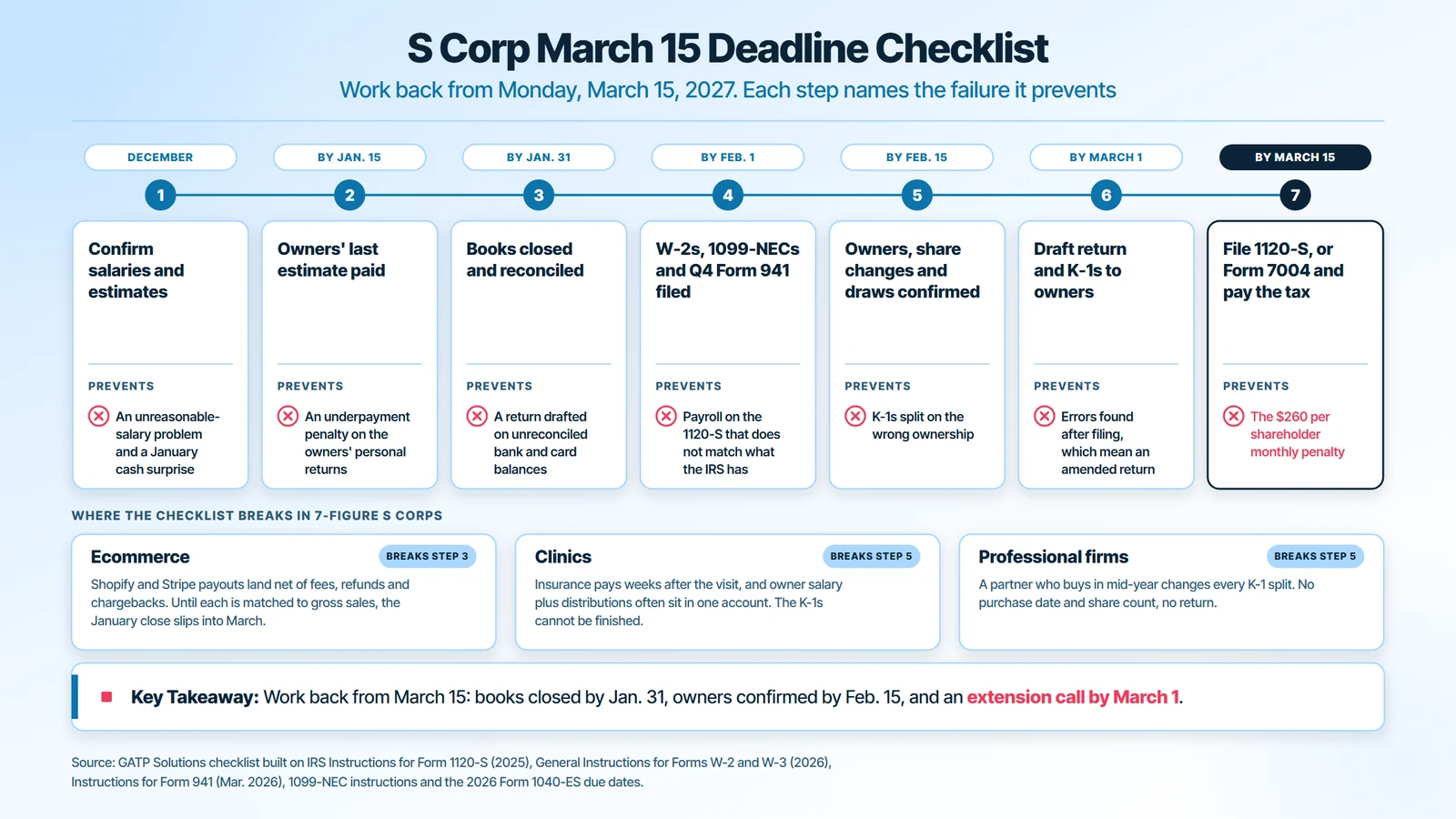
Most late S corp returns are late because the books, the owner details or the payroll were not ready in February, not because of the tax work. Work back from March 15, 2027. Each step names the failure it prevents:
- December: confirm salaries and estimates. Prevents an unreasonable-salary problem and a January cash surprise.
- By January 15: owners’ last estimate paid. Prevents an underpayment penalty on the personal returns.
- By January 31: books closed and reconciled. Prevents a return drafted on unreconciled bank and card balances.
- By February 1: W-2s, 1099-NECs and the Q4 Form 941 filed. Prevents payroll numbers on the 1120-S that do not match what the IRS already has.
- By February 15: shareholder list, share changes and distributions confirmed. Prevents K-1s split on the wrong ownership.
- By March 1: draft return and draft K-1s to owners. Prevents errors found after filing, which mean an amended return.
- By March 15: file Form 1120-S, or file Form 7004 and pay any tax due. Prevents the $260 per shareholder monthly penalty.
Give one person ownership of this list. End of the day, a deadline shared by four owners is a deadline nobody is watching.
Three Industry Examples of How the Deadline Slips
The checklist breaks in predictable places, depending on how the business earns money. These are the patterns we see most in 7-figure S corps:
- Ecommerce: Shopify and Stripe payouts. Payouts land net of fees, refunds and chargebacks, so bank deposits never equal sales. Until each payout is matched to its gross sales and fees, revenue on the 1120-S is a guess, and the January close slips into March.
- Clinics: insurance deposits and payroll. Insurance pays weeks after the visit, and owner-physicians often take salary plus distributions. If December payroll and owner distributions are booked to one account, the K-1s cannot be finished.
- Professional firms with a partner buy-in. A new owner who joined mid-year changes every K-1 split. Without the purchase date and share count on file, the return waits on the lawyers.
Each one is a books problem showing up as a deadline problem. Fix the monthly close and the March date stops being a fire drill.
What Changed for the S Corp Tax Deadline in 2026
The S corp tax deadline rule did not change in 2026, but the money and the relief around it did. Here is what is new for the return due in 2027:
- Higher late filing penalty. Proc. 2025-32 raised the per-shareholder monthly amount to $260 for returns filed in 2027, up from $255.
- Higher minimum penalty. The floor for returns more than 60 days late rose to $535, from $525.
- Automatic Exemption from Penalty. Since summer 2026, the IRS skips failure to file and failure to pay penalties on eligible returns when the prior three years were clean, starting with 2025 tax year returns.
- Disaster postponements into 2027. Under Section 7508A, the IRS moved deadlines for many 2026 disaster areas. In Ohio’s 2026 storm relief, S corporation returns with an extended due date in the covered window, including September 15, 2026, now have until February 1, 2027.
- Higher 1099 threshold. Under the One Big Beautiful Bill Act, the Form 1099-NEC instructions raise the reporting threshold to $2,000 for payments made after 2025, from $600.
If your company sits in a disaster county, check the IRS release for your county before treating a September 2026 date as missed.
Conclusion: The S Corp Tax Deadline for 2027
The S corp tax deadline for a calendar-year 2026 return is March 15, 2027, with K-1s due to owners the same day and Form 7004 extending to September 15, 2027. Books closed by January 31, ownership confirmed by mid-February and an extension decision by March 1 decide whether you make it.
Get your March 15 plan checked by a CPA firm. We review your December close, your shareholder list and how distributions are booked today. You get back whether Form 1120-S can be filed on time and whether an extension plus a tax payment makes more sense.
Our tax planning work then sets the estimates for your next business return. Thirty minutes, one clear answer. Book a 30-minute call.
FAQ: Other S Corp Tax Deadline Questions
Is There an Extension for S Corp Filing in 2026?
Yes. A 2025 calendar-year S corp that filed Form 7004 by March 16, 2026 had until September 15, 2026 to file. That date has passed. If you missed it, file now, because the $255 monthly penalty for 2026 filings keeps adding up. Companies in IRS disaster areas may have until February 1, 2027.
What Is the 5-Year Rule for an S Corp?
The 5-year rule says a company whose S election was terminated or revoked generally cannot elect again for five tax years without IRS consent. The wait runs from the first tax year the termination took effect. It matters when an owner revokes the election to save tax and later wants it back.
Can I Get a Second Extension for My S Corp Return?
No. Form 7004 gives one automatic 6-month extension, and that is the maximum for Form 1120-S. A calendar-year 2026 return cannot go past September 15, 2027 without penalty. If the return is still not ready, file on time with the best numbers and amend later.
Does an S Corp With No Income Still Have to File?
Yes. Every corporation with an accepted S election must file Form 1120-S each year while the election is in effect, even with no income or activity. A zero return filed late still draws the $260 per shareholder monthly penalty on a 2027 filing.
When Do You Submit a Corporate Tax Return?
It depends on the entity. A calendar-year S corporation submits Form 1120-S by March 15, and a partnership submits Form 1065 the same day. A C corporation submits Form 1120 by the 15th day of the 4th month, so April 15. All three can extend with Form 7004.
Does a New S Corp Election Change the First Filing Deadline?
No. The first Form 1120-S covers the first tax year the election is in effect and follows the normal 15th-day-of-the-3rd-month rule. A calendar-year company that started on April 1, 2027 files its first, short-year return by March 15, 2028. Do not file Form 1120-S for any year before the election takes effect.
Does E-Filing Change the S Corp Filing Deadline?
No. E-filing does not change the date, but it may be required. An S corporation that files 10 or more returns of any type in a calendar year, counting W-2s and 1099s, must e-file Form 1120-S. The e-file acceptance record is also the cleanest proof of an on-time filing.
What Is the Deadline for a Final S Corp Return When the Business Closes?
A dissolved S corporation files its final Form 1120-S by the 15th day of the 3rd month after the date it dissolved. Check the final return box and issue final K-1s. A company that closes on June 30, 2026 is due September 15, 2026.