Real estate accounting software is built to help investors, agents, developers, and property businesses manage their real estate accounting records in one place. Instead of tracking every property expense, payment, and transaction manually, the software organizes this information and turns it into useful financial reports.
For a small investor, accounting software for real estate investors can help track rental income, property expenses, mortgage payments, and cash flow. Larger businesses may need real estate investment accounting software that can handle multiple properties, LLCs, investors, and financial reports.
Unlike basic accounting tools, some real estate platforms also connect financial data with property operations. Depending on the software, this can include rent collection, tenant payments, owner statements, lease information, project costs, and property-level reporting.
What Can Real Estate Accounting Software Track?
Most platforms can help with:
- Property income: Rent, commissions, management fees, and other real estate revenue.
- Property expenses: Repairs, utilities, insurance, taxes, maintenance, and other costs.
- Bank transactions: Automatic bank feeds and transaction matching.
- Financial reports: Profit and loss statements, balance sheets, cash flow reports, and property-level results.
- Multiple properties: Separate financial activity for different properties or portfolios.
- Multiple entities: Tracking transactions across LLCs, partnerships, or other business entities.
- Tax information: Organizing financial data needed for tax preparation.
- Project costs: Useful for developers tracking construction and development spending.
The level of functionality varies widely. A simple platform may work well for a landlord with a few properties, while accounting software for real estate developers or commercial real estate accounting software needs much stronger reporting, project tracking, and multi-entity capabilities.
That difference matters when choosing the best real estate accounting software. More features do not always mean a better choice. The right system should match the size, structure, and financial needs of the real estate business.
What Makes the Best Real Estate Accounting Software?
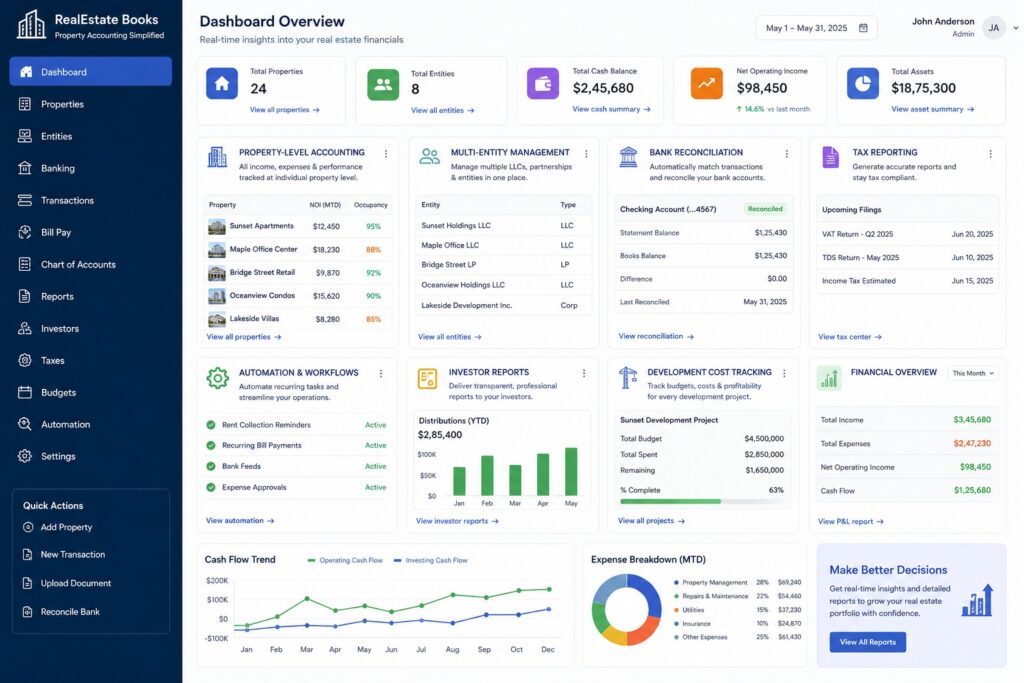
The best real estate accounting software should simplify financial tasks while giving you clear, accurate information. The right features depend on your property type, business size, number of entities, and reporting needs.
- Property-Level Accounting: Tracks income, expenses, profit, and cash flow separately for each property, making it easier to measure performance and identify properties that need attention.
- Multi-Entity Management: Keeps financial records for different LLCs or entities organized while allowing consolidated reporting when owners or accountants need an overall business view.
- Bank Reconciliation: Matches recorded transactions with actual bank activity, helping identify missing, duplicated, or incorrect entries before they affect financial reports.
- Tax Reporting: Organizes income and expenses into useful reports for tax preparation, while accounting professionals review the records and apply the correct tax treatment.
- Automation Features: Automates repetitive tasks such as transaction imports, payment matching, invoicing, and expense categorization, reducing manual work for growing real estate businesses.
- Investor and Owner Reporting: Provides clear information about income, expenses, cash flow, and property performance that owners can use to monitor investments and share with partners.
- Development Cost Tracking: Helps developers monitor construction costs, budgets, contractors, financing, and project spending through real estate development accounting software designed for development projects.
- Integrations: Connects accounting systems with banks, payment platforms, payroll, property management tools, and tax applications to reduce duplicate data entry and improve accuracy.
9 Best Real Estate Accounting Software Platforms
Choosing between accounting platforms can be difficult because each one focuses on different types of real estate businesses. Some are built for investors and landlords, while others support property managers, agents, developers, or larger multi-entity portfolios.
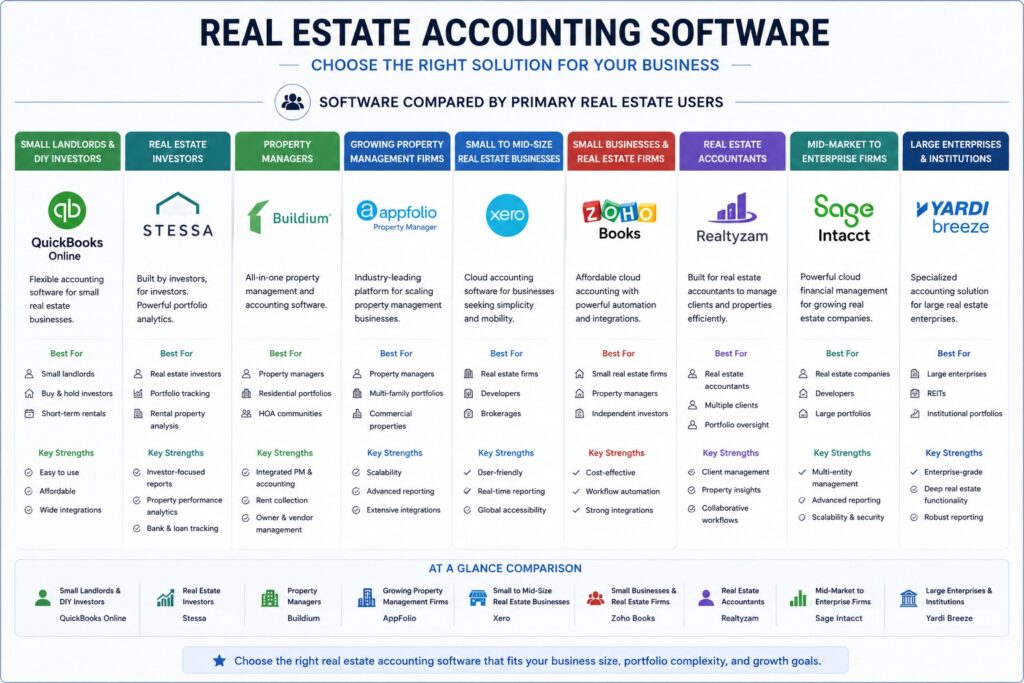
| Software Name | Ease of Use | Pros | Cons |
| QuickBooks Online | Moderate | Universal CPA acceptance; massive integration marketplace | No native real estate workflows or tenant portals |
| Stessa | Very High | 100% free basic tier; automated Schedule E tax mapping | Lacks front-end tenant management or lease signing |
| Buildium | Moderate | All-in-one ecosystem; strong trust accounting tools | Interface can feel dense for passive investors |
| AppFolio | Moderate | Enterprise AI invoice processing; modern design | Expensive; minimum unit requirements may limit smaller users |
| Xero | High | Unlimited users on standard plans; clean layout | Requires custom setups for property ledgers |
| Zoho Books | High | Deep workflow automation; excellent custom invoicing | Lacks native real estate analytics or rent tools |
| Realtyzam | High | Simple commission tracking; mileage logs | Designed mainly for sales agents |
| Sage Intacct | Low (Expert) | Strong multi-entity and dimensional reporting | High pricing and steep learning curve |
| Yardi Breeze | High | Strong commercial and property accounting features | Limited custom report editing on basic tiers |
1. QuickBooks Online
QuickBooks Online remains one of the biggest names in general business bookkeeping and is trusted by millions of businesses worldwide. Although it is not specifically built for property management, its flexibility allows real estate professionals to adapt it to their own business structure.
- Target User & Focus: Multi-entity investors, growing brokerages, and fix-and-flip businesses that work with external CPAs.
- Pricing & Scalability: Starts at approximately $30/month, while higher-tier Plus or Advanced plans are needed for class and location tracking across multiple properties.
- Tax Mapping & Compliance: Produces standard financial statements, including P&Ls and Balance Sheets, along with 1099 filings, but does not offer native IRS Schedule E automation.
- Operational Capabilities: Primarily functions as a financial general ledger and does not include native tenant portals, lease templates, or maintenance tracking.
- Automation & Feeds: Provide automated bank syncing, intelligent transaction rules, and detailed receipt capture features to reduce manual bookkeeping.
- Multi-Entity Tracking: Provides strong capabilities for separating different LLC parent companies while managing them through a centralized login structure.
2. Stessa
Stessa was created specifically to address the accounting challenges faced by residential rental property owners. Instead of adding general business features, it focuses on property performance, cash flow tracking, and tax-related organization.
- Target User & Focus: Passive real estate investors, single-family landlords, and short-term rental vacation hosts.
- Pricing & Scalability: Provides a highly capable, 100% free baseline tier, while paid plans add features such as automated receipt scanning and premium banking tools.
- Tax Mapping & Compliance: Automatically categorizes real estate transactions into IRS Schedule E tax categories, helping produce tax-ready financial information.
- Operational Capabilities: Primarily focuses on bookkeeping, while also offering light document storage and digital rent collection gateways.
- Automation & Feeds: Automatically tracks asset values and mortgage balances while categorizing transactions imported through connected bank accounts.
- Multi-Entity Tracking: Provides strong property-level separation, allowing users to calculate individual net operating income (NOI) across different real estate portfolios.
3. Buildium
Buildium connects everyday property management activities with professional double-entry accounting. From tenant-related tasks to contractor payments, it brings financial and property management functions together within one all-in-one software ecosystem.
- Target User & Focus: Active DIY landlords, property management companies, and mid-sized residential portfolios.
- Pricing & Scalability: Starts at roughly $62/month, with pricing increasing based on the exact number of units being managed.
- Tax Mapping & Compliance: Supports full 1099-MISC/NEC filing compliance and tenant ledger auditing to help maintain compliant property operations.
- Operational Capabilities: Offers tenant background screening, integrated tenant portals, online lease signing, maintenance ticketing, and other property management features.
- Automation & Feeds: Automates online rent payment collection and includes late fee enforcement rules directly within the accounting ledger.
- Multi-Entity Tracking: Designed to support complex trust accounting regulations while keeping security deposits separate from corporate operating funds.
4. AppFolio
AppFolio offers an enterprise-level cloud platform that combines modern workflows, artificial intelligence, and centralized digital operations. It is designed for larger organizations that need to manage substantial portfolios efficiently.
- Target User & Focus: Large-scale property managers, commercial asset operators, and corporate real estate developers.
- Pricing & Scalability: Uses a custom, quote-based pricing model with strict minimum monthly unit fees that can make it unsuitable for smaller landlords.
- Tax Mapping & Compliance: Provides corporate multi-entity consolidated reporting, internal audit logging, and bulk year-end data exports.
- Operational Capabilities: Includes AI-driven invoice scanning, large communication portals, vendor management, and centralized performance dashboards.
- Automation & Feeds: Uses proprietary AI assistants to read invoices, extract numerical information, and automatically draft accounting entries.
- Multi-Entity Tracking: Provides advanced multi-tier LLC management for complex capital structures and joint venture investor distributions.
5. Xero
Xero is a strong cloud-based alternative to QuickBooks, particularly popular among technology-focused entrepreneurs because of its clean and simple dashboard. Its broad API network also allows it to connect with external real estate industry systems.
- Target User & Focus: Modern property investors, technology-focused boutique brokerages, and international real estate asset owners.
- Pricing & Scalability: Starts at around $25/month, with standard plans allowing unlimited users without additional user-based pricing.
- Tax Mapping & Compliance: Provides standard business financial packages that can connect with professional accounting cloud software to support tax preparation.
- Operational Capabilities: Functions mainly as a financial general ledger, so external software add-ons are needed for lease-related operations.
- Automation & Feeds: Offers smooth daily bank reconciliation through a side-by-side matching system that helps reduce manual entry errors.
- Multi-Entity Tracking: Uses tracking categories to separate locations or project divisions without relying on complex sub-account structures.
6. Zoho Books
Zoho Books is a cost-effective and modular accounting solution that operates within the larger Zoho business application ecosystem. Its strong automation capabilities make it useful for businesses that want to create customized workflow rules.
- Target User & Focus: Independent real estate sales teams, solo agents, and highly cost-conscious real estate business startups.
- Pricing & Scalability: Includes a functional free tier for low-revenue businesses, with premium plans starting at around $15/month.
- Tax Mapping & Compliance: Automatically generates local corporate sales tax information, standard business balance sheets, and tax liability estimates.
- Operational Capabilities: Provides client-facing estimation tools, customized expense invoices, and client portals for tracking payments.
- Automation & Feeds: Offers an integrated automation engine that lets users create custom triggers, such as automatically emailing clients after a payment is received.
- Multi-Entity Tracking: Provides basic project separation, although completely separate legal LLC structures require multiple instances.
7. Realtyzam
Realtyzam focuses specifically on the financial needs of individual real estate sales agents rather than property management businesses. It functions as a digital ledger for tracking commissions, marketing expenses, and business mileage.
- Target User & Focus: Individual licensed real estate agents, solo brokers, and commission-based sales professionals.
- Pricing & Scalability: Costs around $14/month, making it an affordable option for agents managing lean personal business expenses.
- Tax Mapping & Compliance: Automatically provides the key figures needed for an independent contractor’s annual IRS Schedule C tax filing.
- Operational Capabilities: Does not include property management features and instead focuses on commission split calculations and listing promotion tracking.
- Automation & Feeds: Provides simple bank and card data syncing along with a quick-entry dashboard designed for users without accounting expertise.
- Multi-Entity Tracking: Built for individual sales professionals and does not support multi-entity property portfolio accounting.
8. Sage Intacct
Sage Intacct is a powerful corporate financial platform designed for complex real estate operations, syndications, and institutional investment funds. Rather than focusing on basic bookkeeping, it provides advanced financial controls and governance.
- Target User & Focus: Mid-market commercial real estate developers, REITs, and multi-state investment fund managers.
- Pricing & Scalability: Uses premium custom pricing models that can include customized implementation configurations and dedicated corporate accounting support teams.
- Tax Mapping & Compliance: Handles complex multi-state corporate allocations, dimensional reporting matrices, and tax K-1 schedule support.
- Automation & Feeds: Provides institutional bank data processing, detailed purchase order workflows, and automated intercompany balancing across entities.
- Multi-Entity Tracking: Provides an industry-leading solution for managing dozens of separate real estate LLCs while maintaining continuous financial consolidation.
9. Yardi Breeze
Yardi Breeze is a more streamlined and accessible version of Yardi’s established software platform. It gives mid-sized operators specialized commercial and mixed-use accounting features without requiring the complexity of a larger corporate system.
- Target User & Focus: Scaling mixed-use real estate developers, commercial office managers, and residential property owners.
- Pricing & Scalability: Starts at roughly $100/month for base configurations, with predictable monthly tracking fees.
- Tax Mapping & Compliance: Includes compliance checks for commercial leasing metrics and standard real estate operations auditing data.
- Operational Capabilities: Handles complex Common Area Maintenance (CAM) reconciliation, tenant billing, and property maintenance requests.
- Automation & Feeds: Supports direct tenant payments through ACH, online contractor invoice tracking, and automated property performance reporting.
- Multi-Entity Tracking: Keeps individual property assets visually and financially separated across different investment owners.
Which Real Estate Accounting Software Is Best for Your Business?
The right accounting software for real estate depends on your business model, portfolio size, number of entities, and reporting needs. A small investor may need simple property tracking, while developers and commercial operators often require stronger reporting, project management, and multi-entity capabilities.
Best Accounting Software for Real Estate Investors
Rental investors usually need property-level bookkeeping, income and expense tracking, cash flow visibility, and simple tax organization. The best accounting software for real estate investors should provide these features without unnecessary complexity or expensive enterprise tools. These options are worth considering:
- Stessa
- QuickBooks Online
- Buildium
Best Accounting Software for Real Estate Agents
Real estate agents generally need accounting tools that focus on commissions, marketing expenses, mileage, business costs, and bookkeeping for real estate agents. Accounting software for real estate agents should remain simple while providing enough reporting to manage an independent sales business. These platforms can fit those needs:
- Realtyzam
- QuickBooks Online
- Zoho Books
Best Accounting Software for Real Estate Developers
Developers often manage construction spending, financing, multiple projects, and separate legal entities. Accounting software for real estate developers should therefore provide stronger financial controls, detailed reporting, project cost tracking, and scalability as development operations become more complex. These options offer stronger capabilities:
- Sage Intacct
- Yardi Breeze
Best Commercial Real Estate Accounting Software
Commercial portfolios require more than basic bookkeeping. Businesses may need tenant billing, CAM calculations, property-level reporting, and multi-entity financial management. Commercial real estate accounting software should support these requirements while providing enough flexibility for larger and more complex portfolios. These platforms are suitable options:
- Yardi Breeze
- Sage Intacct
Best Accounting Software for Small Real Estate Business
Small real estate businesses usually benefit from affordable platforms that cover essential bookkeeping without unnecessary enterprise-level features. The best accounting software for small real estate business should be easy to use, scalable, and capable of supporting everyday financial reporting. These options can be a good starting point:
- Stessa
- QuickBooks Online
- Zoho Books
Accounting Software vs. Professional Accounting Services
Real estate accounting software can make bookkeeping faster and more organized, but software and professional accounting services serve different purposes. Software provides the tools to record and manage financial data, while accounting professionals review that information, correct problems, and help owners understand what the numbers mean.
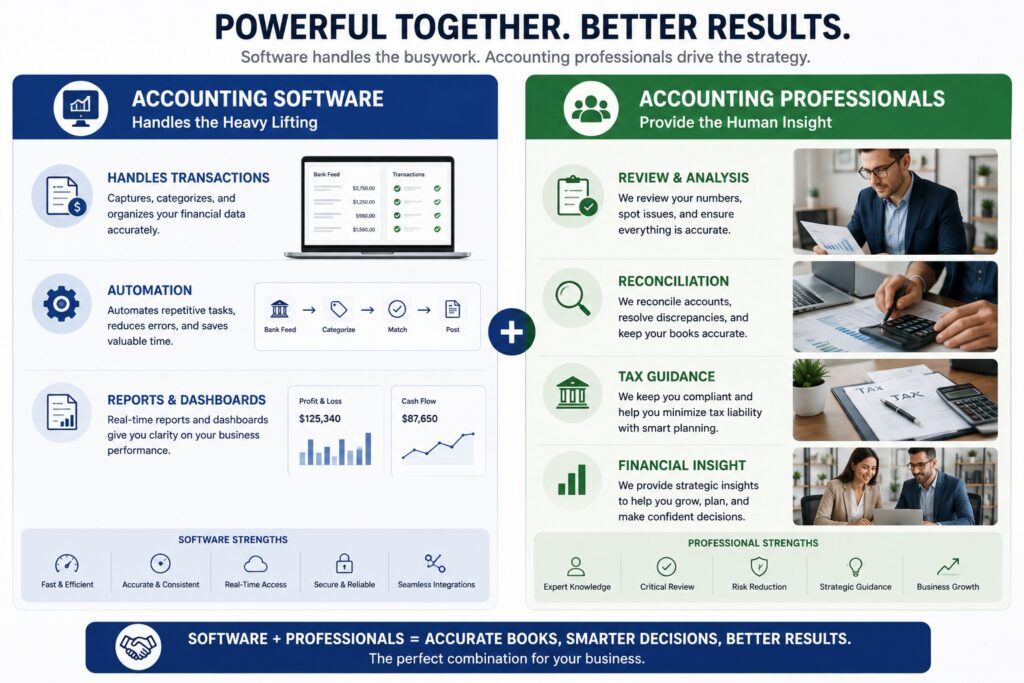
| Real Estate Accounting Software | Professional Accounting Services |
| Records and organizes financial transactions | Reviews and verifies financial records |
| Automates routine bookkeeping tasks | Handles complex accounting requirements |
| Creates standard financial reports | Interprets reports and explains financial results |
| Connects with bank accounts | Reconciles accounts and investigates discrepancies |
| Tracks income and expenses | Ensures transactions are classified correctly |
| Stores financial information | Maintains accurate and organized books |
| Supports tax preparation | Provides tax planning and professional guidance |
| Provides accounting data for decisions | Helps owners make informed financial decisions |
The difference becomes more important as a real estate business grows. Software can automate transactions and reports, but it cannot replace professional judgment when accounting issues become more complex.
For investors, developers, and multi-entity businesses, accounting services can provide the oversight needed to keep financial records accurate while software handles routine work.
When Software Alone Stops Being Enough
Real estate accounting software can handle many routine tasks, but growing businesses often face needs that require human review and professional judgment. More properties, entities, investors, and transactions can make software-only accounting harder to manage accurately.
- Managing Multiple LLCs: Multiple LLCs create separate books, bank accounts, transactions, and reporting requirements. Consolidating real estate LLCs can help simplify reporting, while professional oversight keeps records accurate, consistent, and properly reconciled.
- Handling Several Properties: Growing portfolios require detailed tracking of property income, expenses, loans, repairs, and profitability. Accounting professionals can review records and identify issues software may not flag.
- Preparing Investor Reports: Investors may need clear financial statements, cash flow information, and property performance reports. Professional accountants can help ensure these numbers are accurate and presented clearly.
- Managing Development Costs: Developers handle construction costs, financing, contractors, budgets, and project expenses. Accounting support helps classify these transactions correctly and keep project finances organized.
- Keeping Books Ready for Tax Season: Software organizes financial information, but accurate tax preparation still requires proper classification and review. Professional accountants can identify bookkeeping issues before tax filing.
- Understanding Business Performance: Software can display financial numbers, but it may not explain changing cash flow, rising expenses, or poor property performance. Professional accounting support adds useful financial insight.
Why Growing Real Estate Businesses Combine Software with Accounting Services
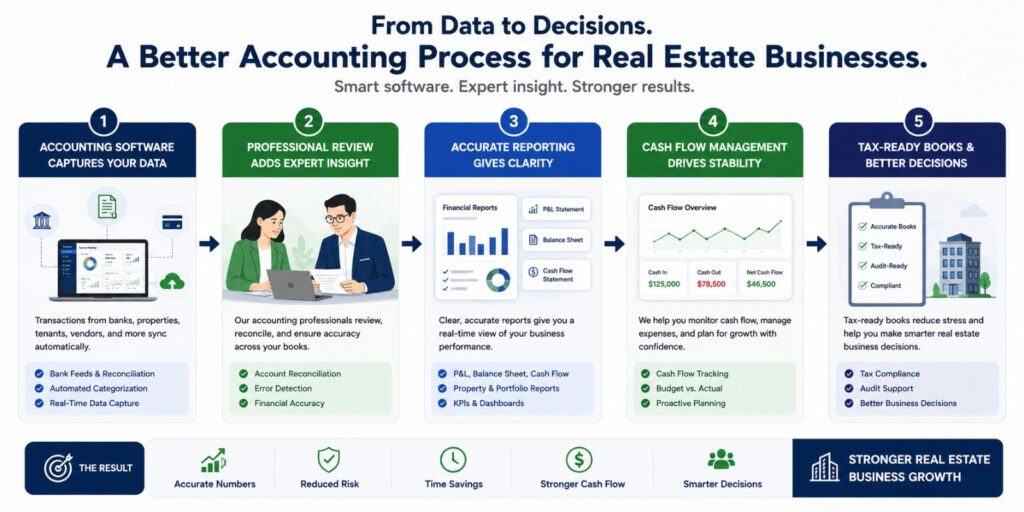
Software becomes more useful when it works alongside experienced accounting professionals. The system can handle routine financial tasks, while an accounting team reviews the books, manages complex transactions, and turns financial data into information business owners can actually use.
- Property-Level P&L: Accounting professionals can organize income and expenses by property, giving owners a clearer view of profitability and helping identify properties with unusual costs or weaker performance.
- Multi-Entity Reporting: Businesses with several LLCs need consistent records across entities. Professional accounting services can manage these books and prepare consolidated reports without losing the financial details of each entity.
- Cash Flow Management: Software can show current cash flow, while accountants can review trends, upcoming obligations, and operating expenses to help owners understand their financial position.
- Investor-Ready Financials: Professional accountants can review financial statements before they are shared with investors, helping ensure the numbers are accurate, complete, and presented in an easy-to-understand format.
- Month-End Close: A structured month-end process helps ensure transactions are recorded, accounts are reconciled, and financial reports are ready on time instead of leaving unresolved issues until tax season.
- Tax-Ready Books: Accounting services can review classifications, reconciliations, and supporting records throughout the year, helping keep the books organized and ready for tax preparation.
How GATP Solutions Goes Beyond Real Estate Accounting Software
The right real estate accounting software can organize transactions, automate routine tasks, and simplify financial reporting. But growing portfolios often need more than software. GATP Solutions combines accounting expertise with technology to help real estate businesses manage property-level P&L, multi-entity accounting, investor-ready financials, 1031 tracking, fund reporting, and ongoing bookkeeping.
For businesses managing multiple properties or entities, professional support can also help with reconciliations, month-end close, cash flow reporting, and tax-ready books. Software handles repetitive tasks, while experienced accountants review the numbers and provide the financial clarity needed to make better business decisions. Learn more about GATP Solutions and its real estate accounting services.
Conclusion
Choosing the best real estate accounting software comes down to your business structure, portfolio size, and financial needs. Stessa or QuickBooks may work well for smaller investors, while agents, developers, commercial operators, and multi-entity businesses may need more specialized platforms. Software can save time and organize financial data, but accurate accounting still requires proper setup, regular review, and professional judgment. As your real estate business grows, combining the right technology with experienced accounting support can make financial management more reliable and easier to scale. For help managing your real estate accounting, contact GATP Solutions.
Frequently Asked Questions
What is real estate accounting software?
Real estate accounting software helps investors, agents, developers, landlords, and property managers organize income, expenses, transactions, and financial reports. Depending on the platform, it can also support property-level accounting, rent collection, investor reporting, tax preparation, and multi-entity management.
Which real estate accounting software is best for investors versus agents?
Investors usually need property-level income and expense tracking, cash flow reporting, and tax organization. Stessa and QuickBooks Online can suit investors, while Realtyzam is designed specifically for agents who primarily need commission, mileage, expense, and tax tracking.
Can QuickBooks handle real estate accounting?
Yes. QuickBooks Online can handle general bookkeeping for many real estate businesses, including income, expenses, bank reconciliation, and financial reporting. However, it does not provide native tenant management, leasing, or maintenance features, so larger property operations may need additional software or professional support.
How much does real estate accounting software cost?
Pricing ranges from free basic plans to customized enterprise pricing. Stessa and some Zoho Books plans offer free options, while QuickBooks, Xero, Buildium, and Yardi Breeze have paid plans. AppFolio and Sage Intacct generally use pricing structures based on business requirements.
What software handles multi-entity and multi-property portfolios?
Several platforms can support multi-property or multi-entity accounting, but their capabilities differ. QuickBooks Online, Sage Intacct, AppFolio, and Yardi Breeze can support more complex structures, with Sage Intacct offering stronger capabilities for businesses managing numerous entities.
Is there free real estate accounting software worth using?
Yes. Free options can be useful for smaller investors with straightforward accounting needs. Stessa offers a free basic tier focused on rental property finances, while Zoho Books provides a free option for qualifying low-revenue businesses. More advanced needs may require paid software.
What can real estate accounting software not do on its own?
Software can automate transactions, organize records, and produce reports, but it cannot replace professional accounting judgment. It may not identify every classification issue, explain unusual financial results, manage complex accounting decisions, or provide strategic tax and financial guidance.
Which software fits real estate funds, developers, and commercial portfolios?
Complex real estate funds, developers, and commercial portfolios generally need stronger multi-entity reporting, project accounting, investor reporting, and financial controls. Sage Intacct and Yardi Breeze can support more advanced requirements, while larger operations may need specialized enterprise platforms.