The bookkeeper vs accountant difference is records versus judgment. A bookkeeper records, categorizes and reconciles daily transactions in the general ledger. An accountant adjusts those records, prepares financial statements and tax returns, and advises on decisions. Most businesses doing USD 1 million to USD 10 million a year need both jobs done, by one firm or two people.
Key Takeaways
- The difference: Bookkeeper vs accountant is records versus judgment. The bookkeeper records and reconciles, the accountant adjusts, reports and files, at 2025 median pay of USD 50,670 versus USD 83,680.
- Hourly cost: With June 2026 benefit costs added, a median bookkeeper costs a business about USD 35.48 an hour and a median accountant about USD 59.58.
- Taxes: Anyone with a PTIN, which costs USD 18.75, may prepare a federal return for pay. Only CPAs, enrolled agents and attorneys get unlimited IRS representation rights.
- Split model: At a USD 5 million company, 40 bookkeeper hours plus 10 accountant hours cost about USD 2,015 a month, against USD 2,979 if an accountant does all 50 hours.
- 2026 change: Form 1099-NEC reporting starts at USD 2,000 for payments made after December 31, 2025, up from USD 600.
- Titles: “Bookkeeper” and “accountant” are not licensed titles. A CPA is licensed by a state board. Since May 2025 the model law allows 150 semester hours, or a bachelor’s degree plus 2 years of experience, with the CPA Exam.
- Who needs both: Most businesses between USD 1 million and USD 10 million in revenue need both functions, from one firm or from two people.
What Is the Difference Between a Bookkeeper and an Accountant?
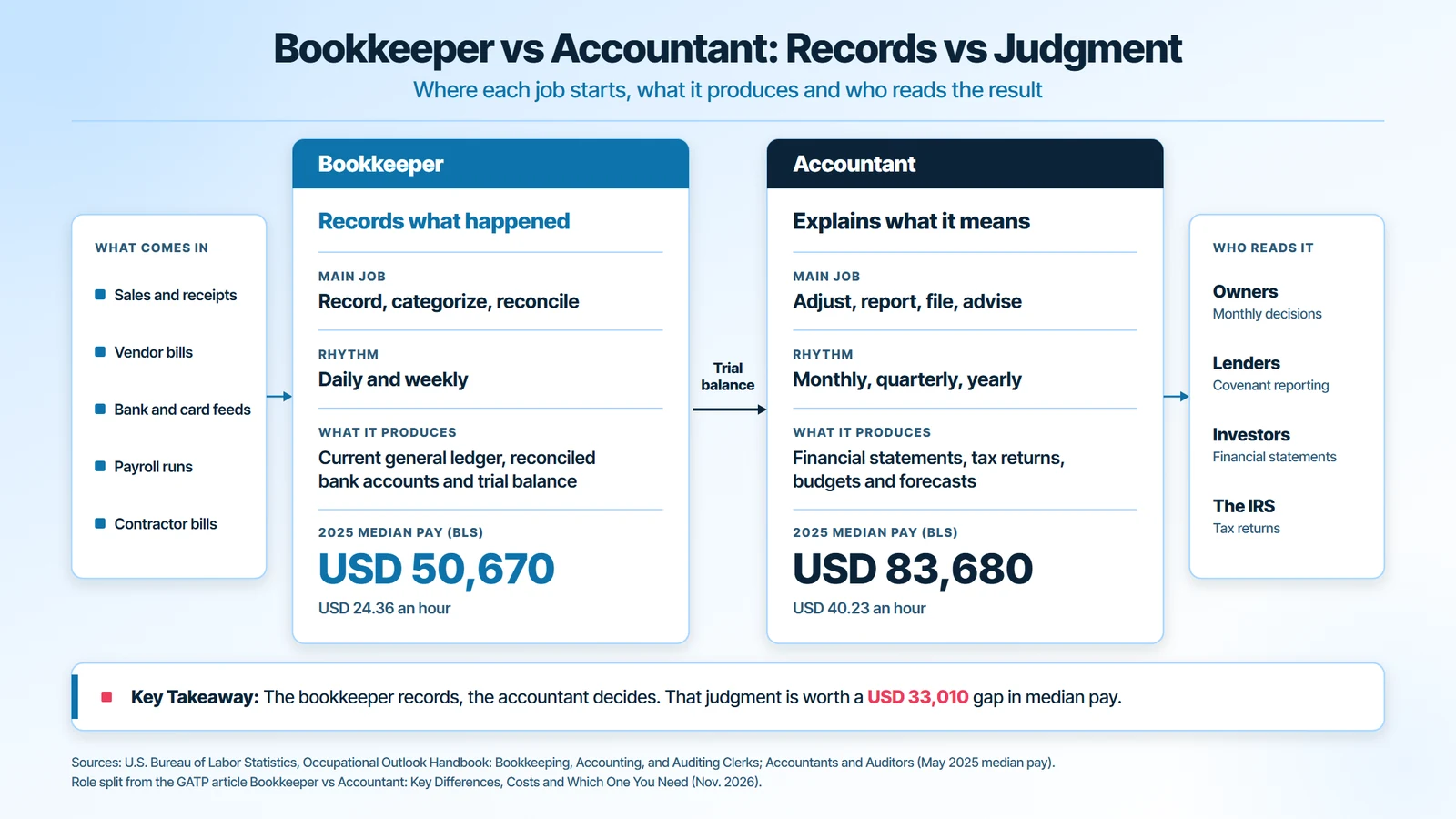
A bookkeeper records what happened, and an accountant explains what it means and reports it to owners, lenders and the IRS. Bookkeeping is the first stage of accounting. Accounting is everything that happens after the entries are in. If you run the business, you need both answers every month.
People search this as accounting vs bookkeeping, bookkeeping vs accounting, accountant vs bookkeeper or the difference between bookkeeping and accounting. The question underneath is the same: who does which part of the finance job, and what does each part cost?
The table below shows the difference between bookkeeper and accountant roles at a glance.
| Point | Bookkeeper | Accountant |
| Main job | Record, categorize and reconcile transactions | Adjust, interpret and report the records |
| Rhythm | Daily and weekly | Monthly, quarterly and yearly |
| Main outputs | Current general ledger, reconciled bank accounts, trial balance | Financial statements, tax returns, budgets, forecasts |
| Typical education (BLS) | Some college, no degree | Bachelor’s degree |
| License | None required | None required, unless a CPA |
| Skills | Accuracy, software, reconciliation | Accounting rules, tax, analysis |
| 2025 median pay (BLS) | USD 50,670 | USD 83,680 |
In a smaller company one person often does both jobs. The line still exists, because the work changes once an entry needs a rule or an estimate. That is why many owners buy outsourced bookkeeping for the weekly work and keep an accountant for the close and the return.
What Does a Bookkeeper Do Day to Day?
A bookkeeper keeps the general ledger complete and current, so every dollar in and out sits in the right account. The work repeats every week. Its value shows at month end, when your books either tie to the bank or they do not.
The IRS lets you choose any recordkeeping system that clearly shows income and expenses. It also expects employment tax records to be kept for at least four years. The bookkeeper is usually the person who keeps both promises.
A typical bookkeeper’s week covers these jobs:
- Sales and receipts: record invoices and customer payments, then age accounts receivable.
- Bills: enter vendor bills, code them to the chart of accounts and schedule accounts payable.
- Bank reconciliation: match every bank, card and payment-processor account to the ledger each month.
- Payroll: run payroll or post the payroll provider’s journal entries.
- Vendor files: collect Form W-9 and track which contractors need a Form 1099-NEC.
- Close prep: work the month-end close checklist and hand over a trial balance.
A full-charge bookkeeper handles every step through the trial balance, payroll included. Our guide to monthly bookkeeping walks through that monthly cycle in order.
What Changed in 2026 for Bookkeeping and 1099 Reporting?
Two federal thresholds moved, and both change what a bookkeeper tracks. The IRS now sets the Form 1099-NEC threshold at USD 2,000 for payments made after December 31, 2025. It was USD 600 before.
- Form 1099-NEC and 1099-MISC: fewer forms, but every contractor payment still needs tracking to know who crosses USD 2,000.
- Form 1099-K: payment apps and marketplaces send Form 1099-K once payments pass USD 20,000 and 200 transactions. Card processors still report card sales of any amount.
- Hiring supply: BLS projects bookkeeping clerk jobs to fall 6 percent from 2025 to 2035, while accountant jobs grow 5 percent.
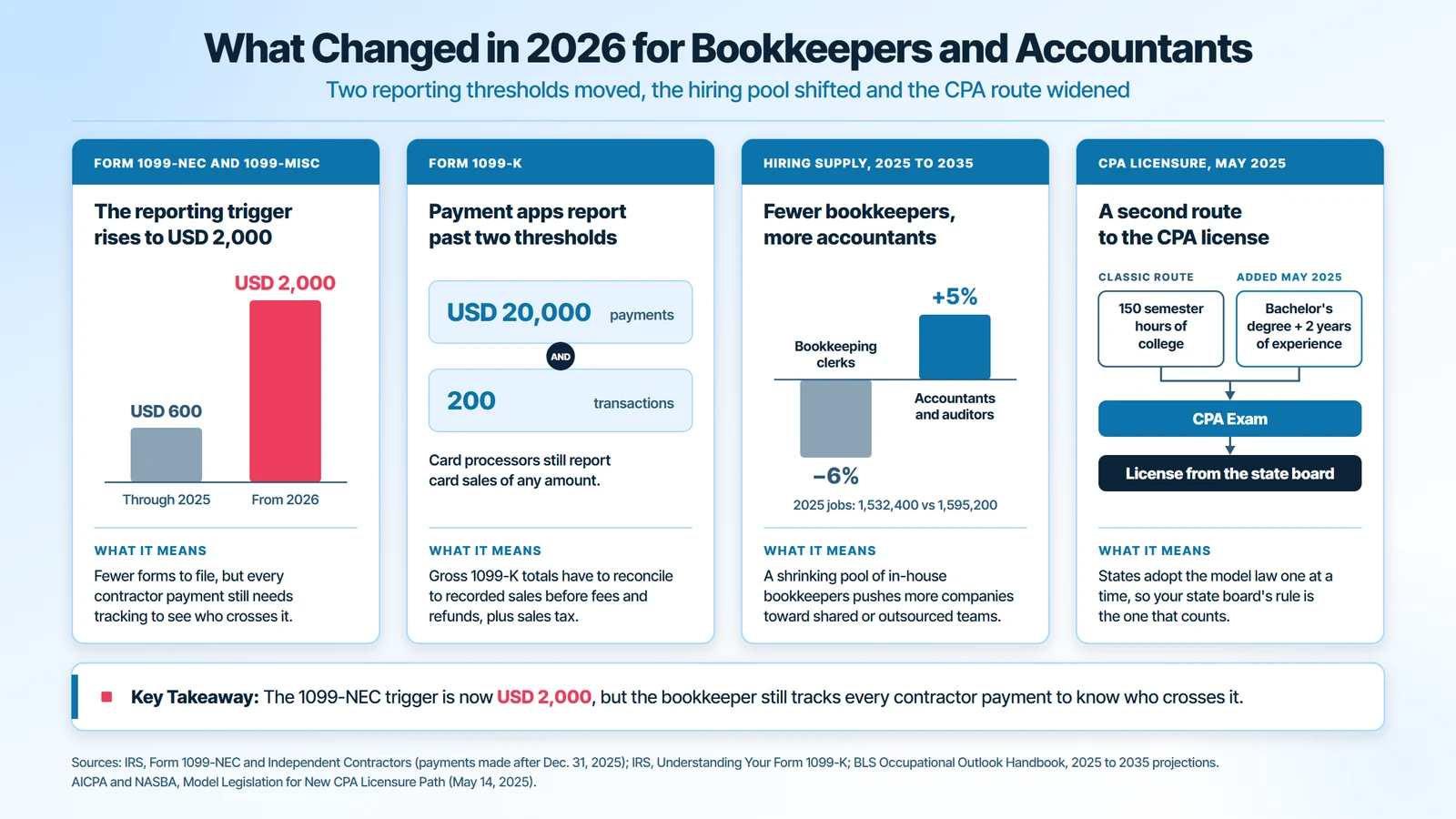
The last point matters to employers. A shrinking pool of in-house bookkeepers pushes more companies toward shared or outsourced teams.
What Does an Accountant Do That a Bookkeeper Does Not?
An accountant takes the bookkeeper’s trial balance and makes it correct under accounting rules, then reports and plans from it. The accountant decides; the bookkeeper records. A bookkeeper can tell you what was paid. An accountant can tell you whether it was an expense, an asset or a loan. That judgment is why accountants earned a median USD 83,680 in May 2025.
That judgment shows up in six jobs a bookkeeper does not usually own:
- Adjusting entries: accruals, prepaid expenses, depreciation and deferred revenue, so each month carries its own costs.
- Close review: checking the bank reconciliation, the payroll entries and the balance sheet before the month is locked.
- Financial statements: the income statement, balance sheet and cash flow statement a lender or investor reads.
- Tax preparation and planning: entity returns, estimated payments and the choices that change next year’s tax.
- Cash flow forecasting: cash forecasts that look 13 weeks ahead, budgets and what-if models for a hire or a loan.
- Controls: who approves bills, who releases payments and who can add an account.
For a company with a bank loan, the accountant also prepares covenant reporting. A missed covenant ratio is an accounting problem, even when every transaction was recorded correctly.
Where Does Bookkeeping End and Accounting Begin?
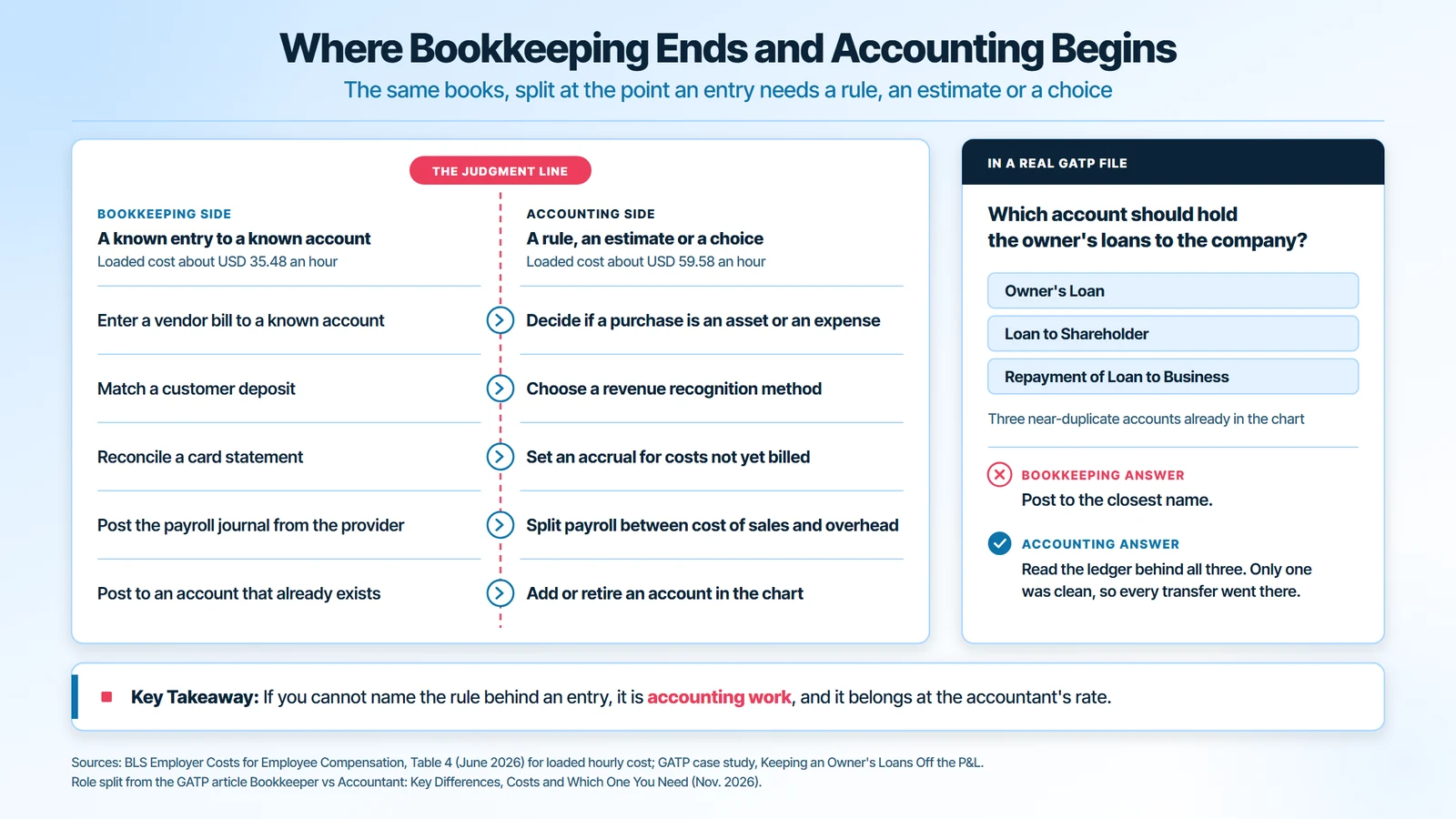
Bookkeeping ends where a judgment call starts. Once an entry needs a rule, an estimate or a choice between accounts, it is accounting work. Recording a known bill to a known account is bookkeeping. If you cannot name the rule behind an entry, it belongs to the accountant. Routine entries belong at the bookkeeper’s loaded rate of about USD 35.48 an hour, and judgment calls justify the accountant’s USD 59.58.
The line is easiest to see in a real file. In a GATP case study on keeping an owner’s loans off the P&L, an owner asked which account should hold his loans to the company. The chart of accounts already had 3 similar candidates: Owner’s Loan, Loan to Shareholder and Repayment of Loan to Business.
Posting to the closest name was the bookkeeping answer. The accounting answer read the general ledger behind all three accounts first. Only one was clean, so every transfer went there, and the two accounts with history stayed untouched.
The same split shows up across the books:
- Bookkeeping side: enter a vendor bill, match a deposit, reconcile a card statement.
- Accounting side: decide if a purchase is an asset, set an accrual, choose a revenue recognition method.
- Bookkeeping side: post the payroll journal from the provider.
- Accounting side: split payroll costs between cost of sales and overhead.
GATP Accountant’s Note: On a new file, the first check is the chart of accounts against the general ledger. Near-duplicate accounts usually mean someone picked the closest name instead of asking. The fix is a rule: the bookkeeper may post to existing accounts, and only the accountant adds or retires one.
Bookkeeper vs Accountant vs CPA: Who Can Do What?
A CPA is an accountant licensed by a state board of accountancy. Most bookkeepers and accountants hold no state license for their title. BLS describes the classic route as the CPA Exam plus 150 semester hours of college coursework, and notes that any accountant filing a report with the SEC must be a licensed CPA.
That route is no longer the only one. In May 2025 the AICPA and NASBA added a second path to the model accountancy law: a bachelor’s degree with an accounting concentration, 2 years of experience and the CPA Exam. States adopt it one at a time, so your state board’s rule is the one that counts.
The bookkeeper vs accountant vs CPA question matters most at tax time and audit time. The table shows what each role can do for you under federal rules.
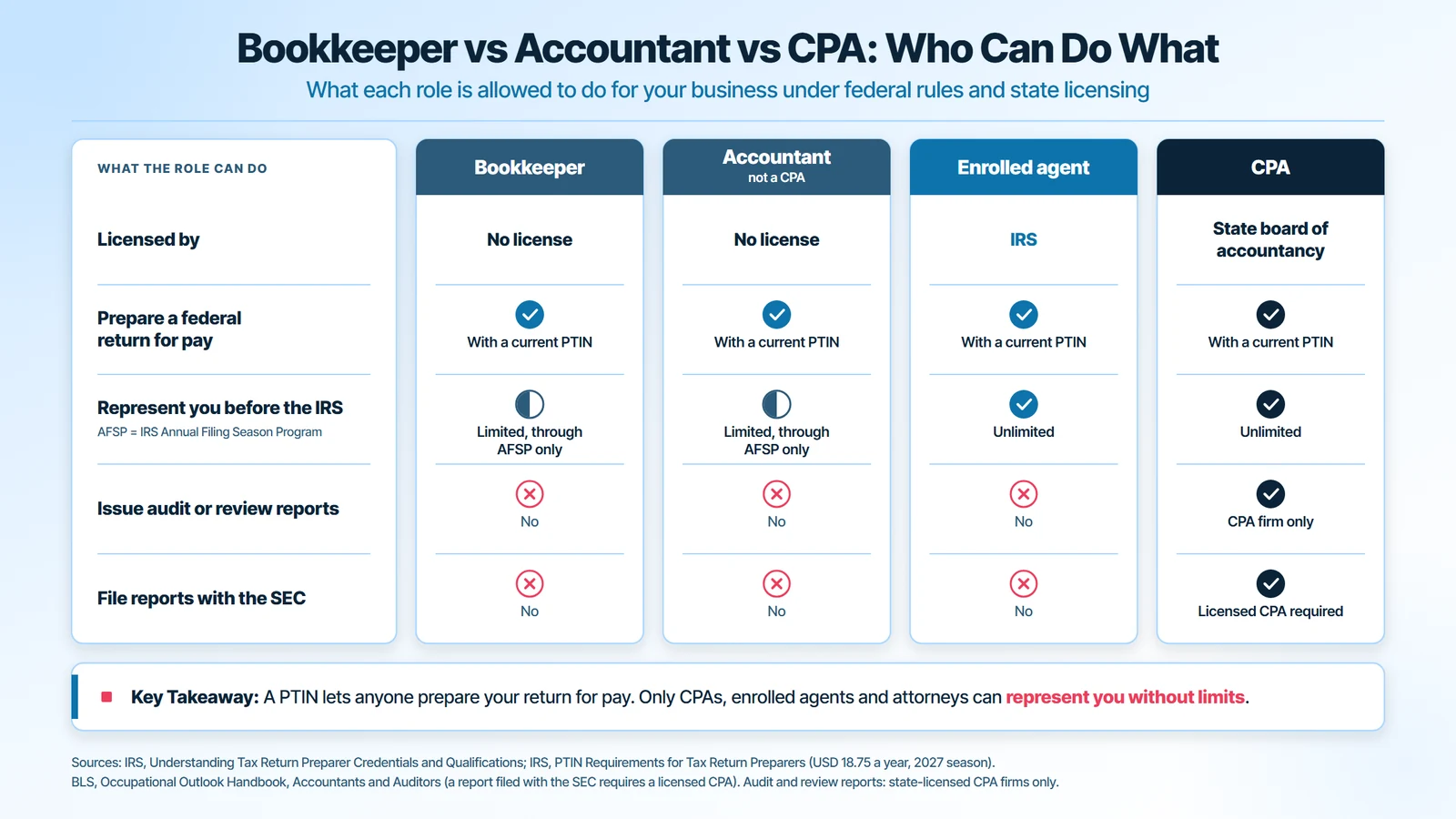
| Role | Licensed by | Prepare a federal return for pay | Represent you before the IRS |
| Bookkeeper | No license | Yes, with a PTIN | None, or limited through the Annual Filing Season Program |
| Accountant, not a CPA | No license | Yes, with a PTIN | None, or limited through the Annual Filing Season Program |
| Enrolled agent | IRS | Yes | Unlimited |
| CPA | State board of accountancy | Yes | Unlimited |
In the bookkeeper vs CPA comparison, the gap is not skill alone. It is legal standing when the IRS sends a letter.
Can a Bookkeeper File My Business Taxes?
Yes, a bookkeeper can prepare and sign your business return for pay if they hold a current PTIN. Under the IRS PTIN rules, anyone paid to prepare federal returns needs a valid PTIN, renewed every year for USD 18.75. The IRS is already processing 2027 PTINs.
The limit is representation. The IRS gives unlimited representation rights only to enrolled agents, CPAs and attorneys. A PTIN-only preparer cannot represent you at all. An Annual Filing Season Program participant can represent you only on returns they prepared and signed, and never in collection or appeals.
For an S corporation or partnership with several owners, that gap decides the hire. At USD 1 million to USD 10 million in revenue, we recommend business tax preparation by a CPA or enrolled agent, with the bookkeeper handing over clean books.
Is an Accountant Higher Than a Bookkeeper?
Yes, in most finance teams an accountant sits above a bookkeeper, and a controller sits above both. The usual ladder runs like this:
- Bookkeeper or accounts payable clerk
- Full-charge bookkeeper
- Staff accountant
- Senior accountant
- Controller
- Chief financial officer
Pay follows the same ladder. Rank is about scope, though, not talent. A full-charge bookkeeper at a 40-person company may know the books better than a new staff accountant.
What Does a Controller Do That a Bookkeeper Doesn’t?
A controller owns the whole close and signs off the numbers, while a bookkeeper executes the entries. The controller sets the close calendar and reviews every accrual. The controller also approves changes to the chart of accounts and designs controls over cash.
When the company faces an audit, a lender review or a sale, the controller manages it. Many USD 1 million to USD 10 million companies cannot justify a full-time controller. They buy controller-level review a few days a month instead.
What Is a Bookkeeper Not Allowed to Do?
A bookkeeper is not allowed to represent you before the IRS in an audit, appeal or collection matter, and cannot sign an audit opinion or file SEC reports as a CPA. Those limits come from federal rules and state licensing, not from job descriptions.
Here is what stays off a bookkeeper’s desk:
- IRS representation: reserved for CPAs, enrolled agents and attorneys, with limited rights for Annual Filing Season Program participants.
- Audit and review reports: only a CPA firm licensed by the state board can issue them.
- SEC filings: an accountant filing a report with the SEC must be a licensed CPA.
- Paid return preparation without a PTIN: not allowed for anyone, even though a PTIN costs only USD 18.75.
- Calling themselves a CPA: the title belongs to state-licensed accountants only.
Some limits are control rules rather than laws. A bookkeeper who enters bills should not also approve and release those payments. Splitting those duties is the cheapest fraud control a growing company can buy.
Is a Bookkeeper Cheaper Than an Accountant?
Yes. A median bookkeeper costs a business about USD 24.10 an hour less than a median accountant once benefits are added. If you pay the bookkeeper’s rate for routine hours and the accountant’s rate for judgment hours, you pay less for the same books.
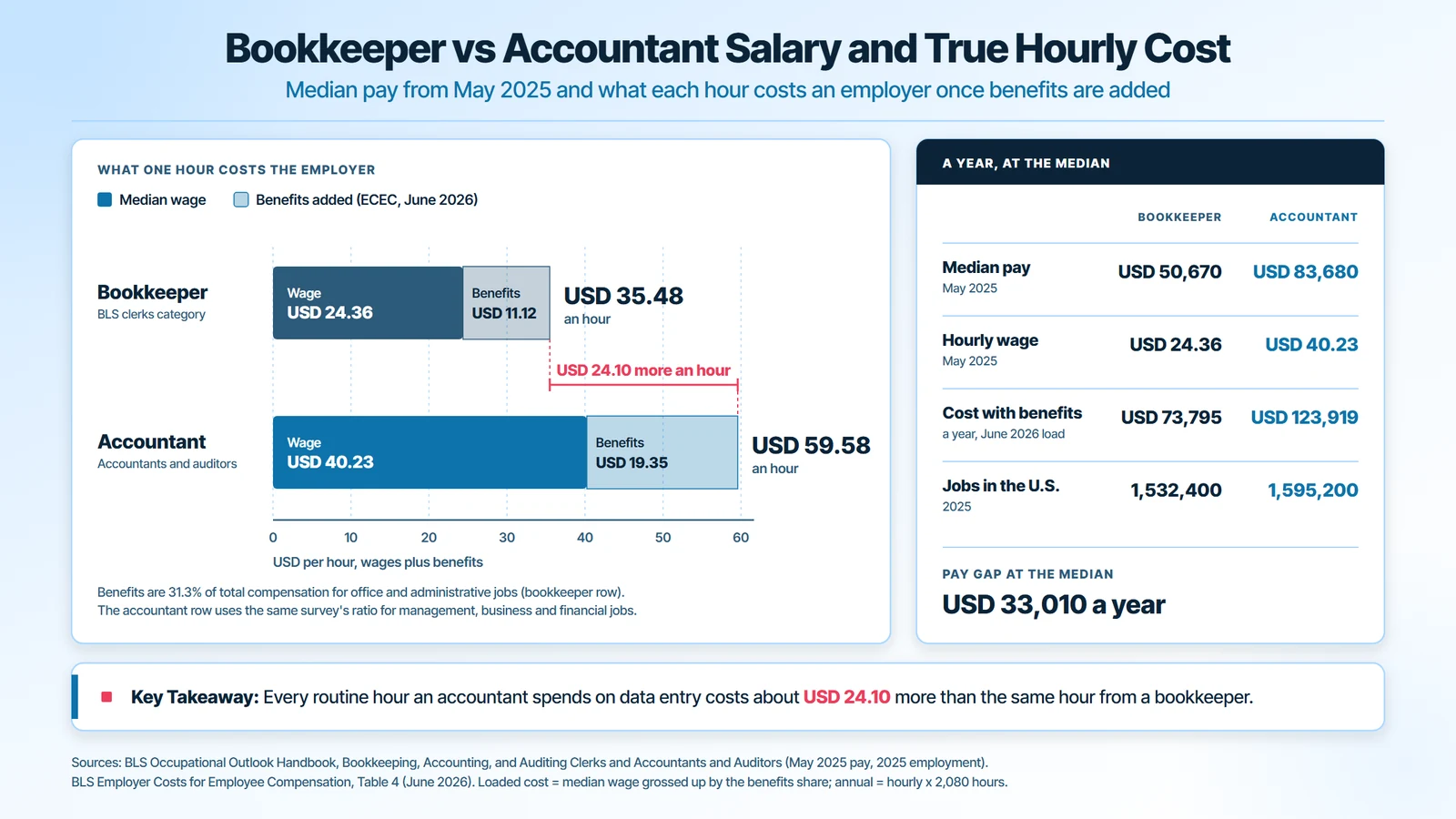
The wage data comes from BLS. Bookkeeping, accounting and auditing clerks earned a median USD 50,670 in May 2025, or USD 24.36 an hour. The June 2026 employer cost survey puts benefits at 31.3 percent of total compensation for office and administrative jobs. The accountant figures below use the same survey’s ratio for management, business and financial jobs.
For a wider price list by billing model, see the guide on how much a bookkeeper costs.
Who Gets Paid More, a Bookkeeper or an Accountant?
Accountants earned a median USD 83,680 in May 2025, against USD 50,670 for bookkeepers, a gap of USD 33,010 a year. That is the bookkeeper vs accountant salary gap at the median. The employer’s cost gap is wider once benefits are added:
- Hourly wage: USD 40.23 for accountants, USD 24.36 for bookkeepers.
- Hourly cost with benefits: about USD 59.58 for accountants, USD 35.48 for bookkeepers.
- Annual cost with benefits: about USD 123,919 for an accountant, USD 73,795 for a bookkeeper.
- Workforce size: 1,595,200 accountant and auditor jobs in 2025, against 1,532,400 bookkeeping clerk jobs.
Worked Example: Splitting the Work at a USD 5 Million Company
Say you run a USD 5 million company that needs 50 finance hours a month. Assume 40 hours are recording and reconciling, and 10 hours are review, adjusting entries and reporting.
| Setup | Hours and rate | Monthly cost |
| Bookkeeper share | 40 hours x USD 35.48 | USD 1,419 |
| Accountant share | 10 hours x USD 59.58 | USD 596 |
| Split model total | 50 hours | USD 2,015 |
| Accountant does everything | 50 hours x USD 59.58 | USD 2,979 |
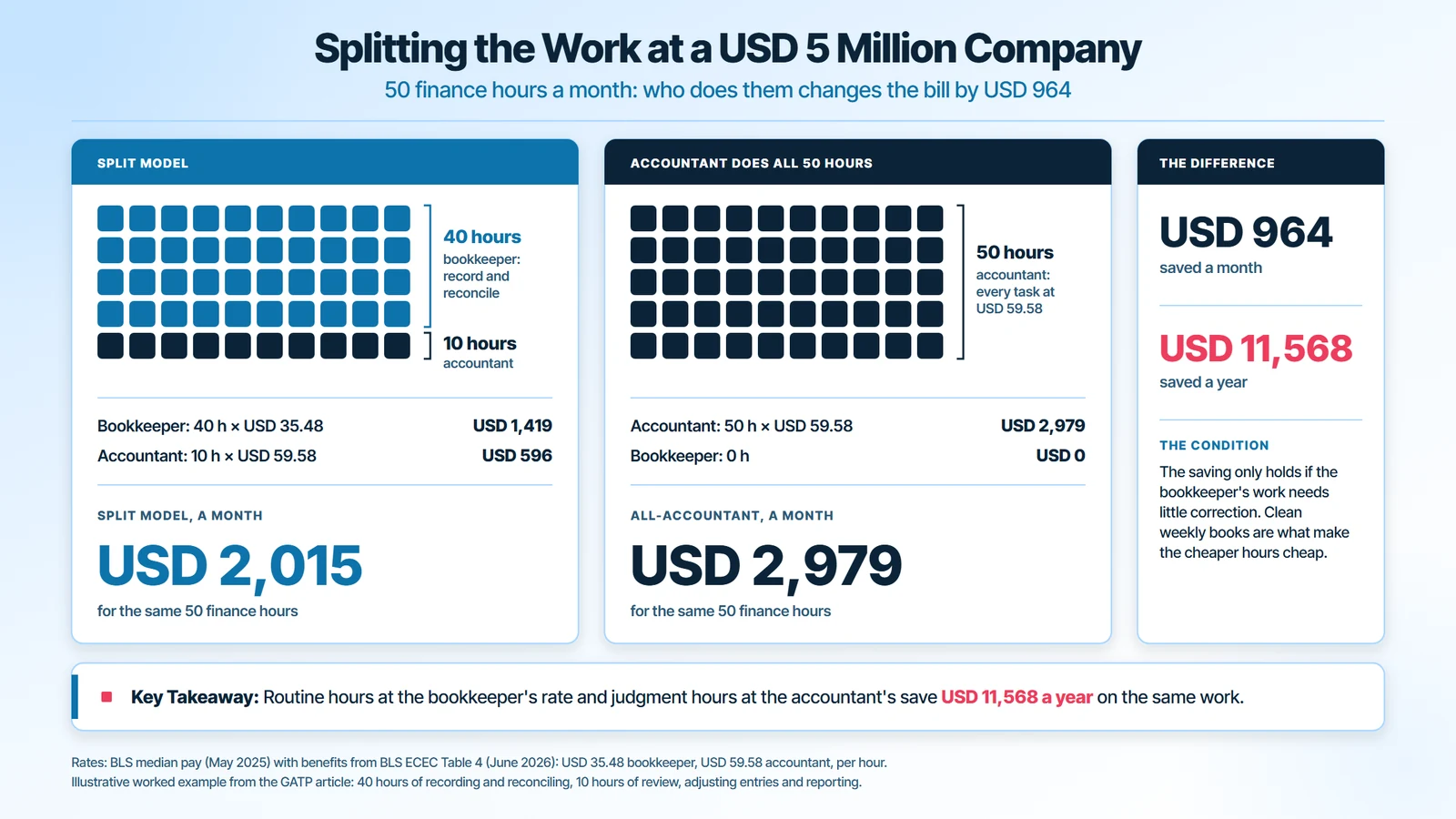
The split model saves USD 964 a month, or USD 11,568 a year. The saving disappears if the bookkeeper’s work needs heavy correction. Clean weekly books are what make the cheaper hours cheap.
Should I Hire a Bookkeeper or an Accountant?
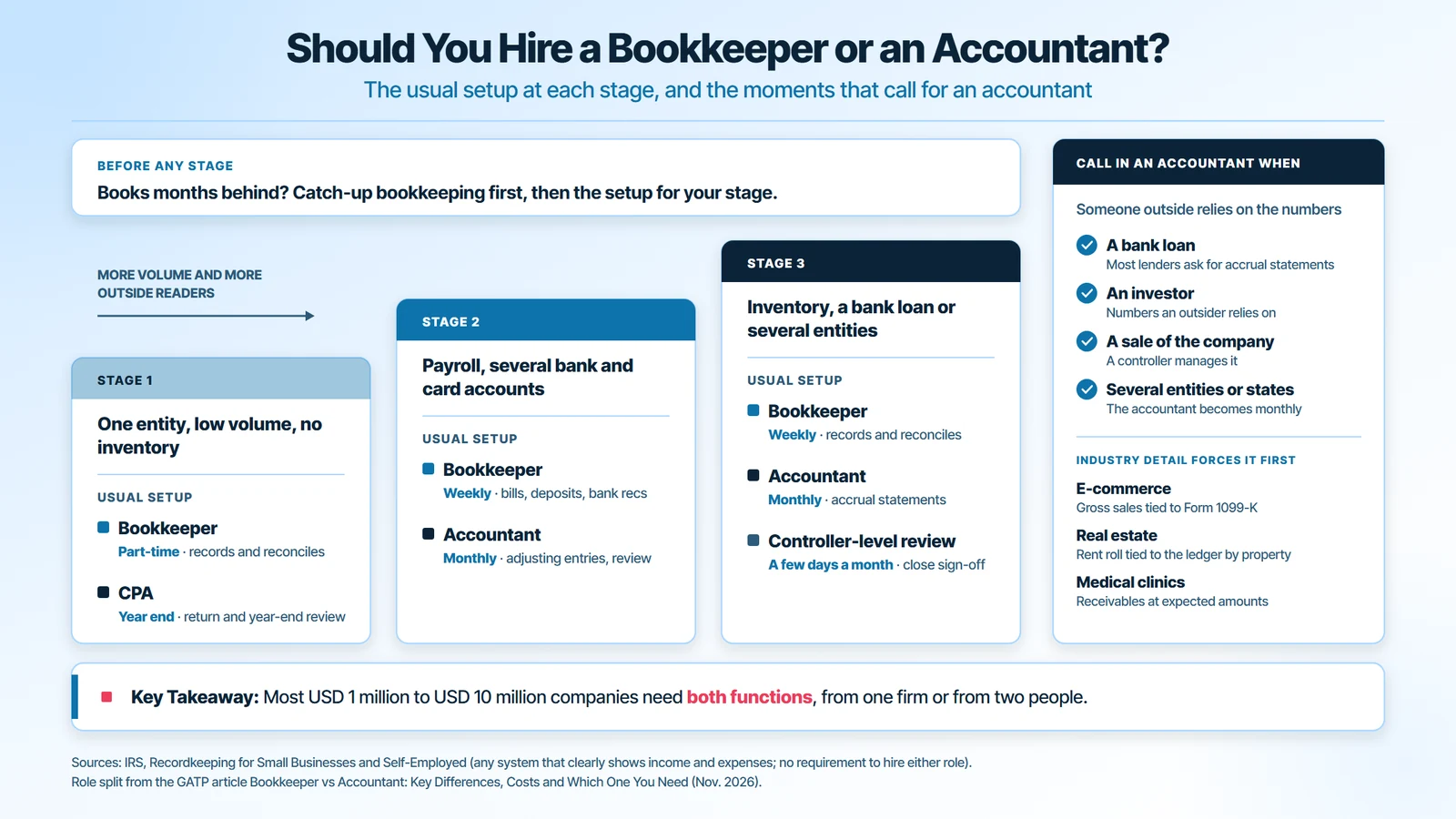
Hire a bookkeeper for recurring transaction work and an accountant for anything that needs a rule, a signature or a forecast. Most USD 1 million to USD 10 million companies need both. The table shows who owns each task and what breaks if you skip it.
| Task | Who owns it | What breaks without it |
| Categorize and reconcile transactions | Bookkeeper | Cash on the books never ties to the bank |
| Bills, invoices and collections | Bookkeeper | Late fees and slow collections |
| Contractor tracking for Form 1099-NEC | Bookkeeper | Missed or wrong information returns |
| Adjusting entries and month-end review | Accountant | Profit swings month to month for no real reason |
| Financial statements for a lender | Accountant | Covenant breaches found too late |
| Business tax return and planning | CPA or enrolled agent | No representation if the IRS asks questions |
The next decision is in-house or outside. Our comparison of in-house accounting vs outsourcing covers that trade-off.
How Do You Check a Bookkeeper’s or Accountant’s Credentials Before You Hire?
Check the credential behind the title, because neither “bookkeeper” nor “accountant” proves a license. Five checks cover most hires:
- CPA: look up the license on the state board of accountancy’s website and confirm it is active.
- Enrolled agent or credentialed preparer: search the IRS public directory of federal tax return preparers with credentials.
- PTIN: if the person will prepare a return for pay, ask for a current PTIN.
- Bookkeeper: ask for a sample month-end package with bank reconciliations, a trial balance and an open-items list.
- Scope in writing: name who adds accounts, who approves payments and who signs the return.
The written scope matters most. It is the split this article describes, turned into a rule both people can follow.
Do I Need Both a Bookkeeper and an Accountant?
Yes, almost every business with payroll and several bank accounts needs both functions, but not always two separate hires. One firm can cover both, or one in-house bookkeeper can work with an outside accountant.
| Your situation | Usual setup |
| One entity, low volume, no inventory | Part-time bookkeeper plus a CPA at year end |
| Payroll, several bank and card accounts | Bookkeeper weekly plus accountant monthly |
| Inventory, a bank loan or several entities | Bookkeeper, accountant and controller-level review |
| Books months behind | Cleanup first, then the setup above |
Does a Small Business Need a Bookkeeper and an Accountant?
A small business needs bookkeeping and accounting work done, but the IRS does not require it to hire either one. The law requires records that clearly show income and expenses. Who keeps them is your choice.
The answer changes with size and volume:
- Under a few hundred transactions a month: software plus a part-time bookkeeper and a year-end accountant is usually enough.
- Payroll and a loan: add monthly accountant review, because most lenders ask for accrual statements.
- Several entities or states: the accountant becomes a monthly need, not an annual one.
For firms sized for this stage, see our guide to accountants for small business.
When Does a Growing Business Need an Accountant, Not Just a Bookkeeper?
A growing business needs an accountant once its numbers feed a decision someone outside the company relies on. If you are taking on a bank loan, an investor, a sale or a multi-state filing, you have crossed that line.
Industry detail usually forces the move first:
- E-commerce: Shopify and Stripe payouts arrive net of fees and refunds. A bookkeeper matches deposits; an accountant reconciles gross sales to Form 1099-K and sales tax.
- Real estate: a rent roll must tie to the ledger by property. An accountant handles security deposits as liabilities and depreciation by building.
- Medical clinics: insurance payments land weeks after the visit. An accountant books receivables at expected amounts and checks payroll compliance for providers.
Common Mistakes When Splitting Bookkeeping and Accounting Work
Most problems come from a split nobody wrote down. If you write it down once, these four mistakes mostly disappear:
- Mistake 1, no owner for the chart of accounts: the bookkeeper adds accounts freely. Fix: only the accountant adds or retires accounts.
- Mistake 2, cash-basis books for a lender: most banks expect accrual statements. Fix: monthly adjusting entries by the accountant.
- Mistake 3, one person enters and pays bills: no second check on cash. Fix: separate entry from approval.
- Mistake 4, year-end only accountant review: errors pile up for 12 months. Fix: a monthly review, or catch-up bookkeeping before the return when the books are already behind.
How Can GATP Help With Bookkeeping and Accounting?
GATP runs both halves of the job under one team. Bookkeepers handle categorization, bank and card reconciliation, bills, payroll entries and contractor tracking. Accountants review the close, post adjusting entries and prepare the financial statements owners and lenders read.
Our outsourced accounting plans are fixed fee and start at less than USD 250 a month for basic bookkeeping. Federal and state tax filing sits in the Premium plan. That split mirrors the one in this article: routine work at the bookkeeping rate, judgment work by accountants.
The Short Version
- A bookkeeper records and reconciles; an accountant adjusts, reports, files and advises.
- 2025 median pay was USD 50,670 for bookkeepers and USD 83,680 for accountants.
- Anyone with a PTIN can prepare a return for pay, but only CPAs, enrolled agents and attorneys get unlimited IRS representation.
- A split of 40 bookkeeper hours and 10 accountant hours saves about USD 11,568 a year against an all-accountant setup.
- Most USD 1 million to USD 10 million companies need both functions, from one firm or two people.
Conclusion: Bookkeeper vs Accountant in 2026
A bookkeeper keeps the record accurate, and an accountant decides what the record means and reports it. Your next decision is how to split the hours, because sending routine work to a bookkeeper and judgment calls to an accountant saved USD 11,568 a year in the worked example.
Find out where your bookkeeping should stop and accounting should start
We review your chart of accounts, your last three bank reconciliations and who approves and releases payments. You get back a clear split of tasks between bookkeeper and accountant, the entries that need adjusting, and the hours each role needs a month. Thirty minutes, one clear answer.
Bookkeeper vs Accountant FAQs
Is a Bookkeeper the Same as an Accountant?
No, a bookkeeper is not the same as an accountant, although the jobs overlap. So is a bookkeeper an accountant? Not by title. A bookkeeper records and reconciles transactions. An accountant adjusts them, prepares statements and returns, and advises. In a small company one person may do both jobs, which is why the titles get mixed up.
Can a Bookkeeper Call Themselves an Accountant?
Yes, a bookkeeper can usually describe themselves as an accountant, because “accountant” on its own is not a licensed title in most states. Titles that signal a license, such as CPA or certified public accountant, are restricted by state accountancy laws. When you hire, ask what the person delivers each month and which credential you can verify.
Can a Bookkeeper Prepare Financial Statements?
Yes, a bookkeeper can prepare internal financial statements from the trial balance, and most accounting software prints them in one click. Those statements carry no adjusting entries unless someone posts them. A lender usually expects accrual-basis statements reviewed by an accountant, and an audit or review report must come from a licensed CPA firm.
Do Accountants Do Bookkeeping?
Yes, many accountants do bookkeeping, especially in small firms and outsourced teams. It is usually not the best use of their hours. An accountant’s time costs a business about USD 59.58 an hour with benefits, against about USD 35.48 for a bookkeeper, so routine entries cost more when an accountant makes them.
Is QuickBooks Bookkeeping or Accounting Software?
QuickBooks is accounting software that bookkeepers and accountants both use. The bookkeeper uses it to record transactions, reconcile accounts and run payroll. The accountant uses the same file to post adjusting entries, review the close and produce financial statements. The software holds both jobs; the person decides which job gets done.
Does a Bookkeeper Need a License or Certification?
No, a bookkeeper needs no federal or state license to keep books in the United States. Voluntary bookkeeping certifications exist and show training. A bookkeeper who prepares federal tax returns for pay must hold a PTIN, which costs USD 18.75 and is renewed every year.