Every year, thousands of commercial property owners and tenants are surprised by unexpected bills because of CAM reconciliation errors. A small mistake in calculations can lead to costly disputes, overpayments, and damaged business relationships.
If you’ve ever wondered what is CAM reconciliation, why your CAM charges changed, or how to verify them, you’re not alone. Understanding the CAM reconciliation process is essential for avoiding billing mistakes and keeping your finances accurate.
In this guide, you’ll learn what is included in common area maintenance, how to calculate CAM charges with a real worked example, and how a CAM reconciliation template can simplify the entire process for landlords, property managers, and tenants alike. CAM sits on top of the same books every rental property already runs on, so the landlord accounting basics behind those records apply here too.
Key Takeaways Box
- CAM reconciliation compares estimated CAM charges with actual expenses at year-end.
- Knowing what is CAM reconciliation helps prevent billing errors and disputes.
- The CAM reconciliation process ensures accurate and fair cost allocation.
- Common area maintenance includes shared expenses like security, landscaping, and utilities.
- A CAM reconciliation template simplifies calculations and reduces manual errors.
- Review NNN expenses annually to verify charges and avoid overpayments.
What is CAM Reconciliation?
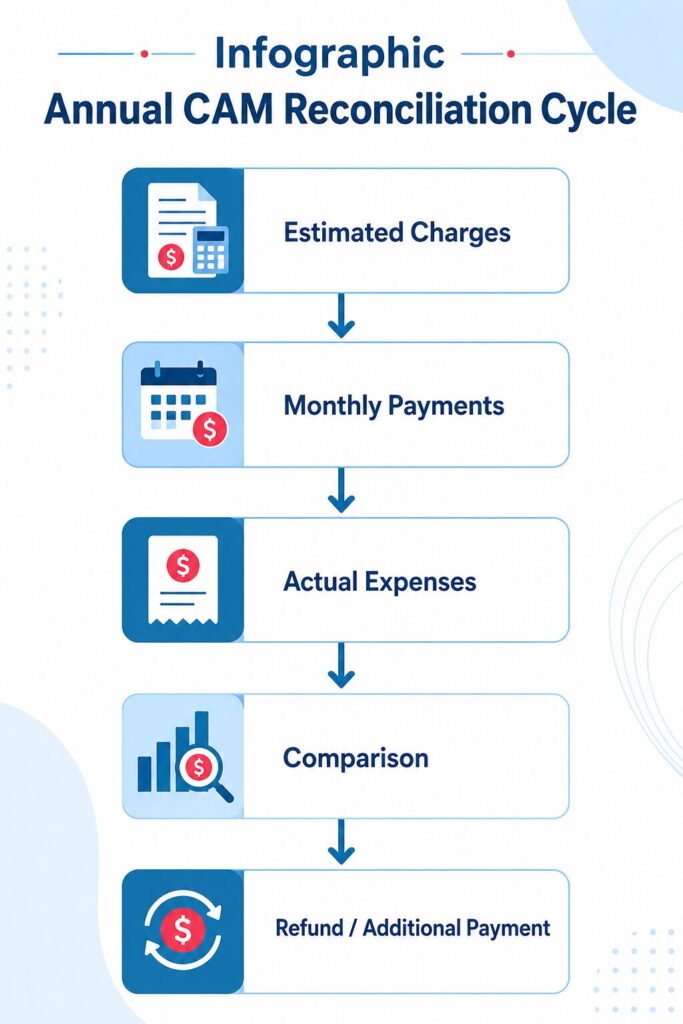
CAM reconciliation is the year-end process of comparing the estimated Common Area Maintenance (CAM) charges collected from tenants with the actual expenses incurred to maintain shared areas of a commercial property. If there is a difference, the landlord either issues a refund or bills the remaining balance to the tenant. Understanding what is CAM reconciliation is essential for landlords, property managers, and tenants because it ensures everyone pays their fair share. A proper CAM reconciliation process also helps verify NNN expenses, reduce billing disputes, and improve financial accuracy. Most of that accuracy is decided months earlier, in how commercial property management accounting is handled through the year.
CAM Reconciliation vs CAM Charges
| Aspect | CAM Charges | CAM Reconciliation |
| Meaning | Estimated monthly charges paid by tenants for common area maintenance. | Year-end comparison of estimated CAM charges with actual expenses. |
| Purpose | Covers expected maintenance costs throughout the year. | Identifies overpayments or underpayments and adjusts the final amount. |
| When It Happens | Collected monthly with rent. | Performed once a year after actual expenses are finalized. |
| Based On | Budgeted or estimated maintenance costs. | Actual maintenance expenses recorded during the year. |
| Outcome | Regular monthly payments by tenants. | Tenant receives a refund or pays the remaining balance (true-up). |
| Who Uses It | Landlords, property managers, and tenants. | Landlords, property managers, accountants, and tenants during year-end review. |
What is Included in Common Area Maintenance?
Common Area Maintenance (CAM) includes the shared expenses required to operate, maintain, and repair the common areas of a commercial property. Knowing what is included in common area maintenance helps landlords and tenants understand what costs can be recovered and ensures a fair CAM reconciliation at the end of the lease year.
- Landscaping and Lawn Care: Covers mowing, tree trimming, irrigation, seasonal planting, and other outdoor maintenance to keep shared spaces clean and attractive.
- Parking Lot Maintenance: Includes parking lot cleaning, sweeping, line painting, pothole repairs, lighting repairs, and snow or debris removal where applicable.
- Security Services: Expenses for security guards, CCTV systems, access control, alarm monitoring, and other measures that protect the property and its occupants.
- Common Area Utilities: Covers electricity, water, gas, and sewer costs for hallways, parking areas, elevators, restrooms, and other shared spaces.
- Cleaning and Janitorial Services: Includes routine cleaning of lobbies, hallways, staircases, public restrooms, windows, and other common areas.
- HVAC and Elevator Maintenance: Covers regular servicing, inspections, and preventive maintenance of heating, ventilation, air conditioning systems, and elevators used by all tenants.
- Trash Removal and Waste Management: Includes garbage collection, recycling services, dumpster maintenance, and disposal fees for shared areas.
- Property Insurance: Premiums paid to insure the building and common areas against risks such as fire, storms, or other covered events, depending on the lease terms.
- Real Estate Taxes: In many commercial leases, especially those with NNN expenses, tenants share a portion of the property’s real estate taxes as part of the annual CAM reconciliation.
- Property Management Fees: Reasonable fees charged for managing and maintaining the property, when specifically allowed under the lease agreement.
Looking for expert support with commercial property bookkeeping? Explore GATP Solutions’ Bookkeeping Services to maintain accurate CAM records and simplify year-end reconciliations
Understanding NNN Expenses and CAM
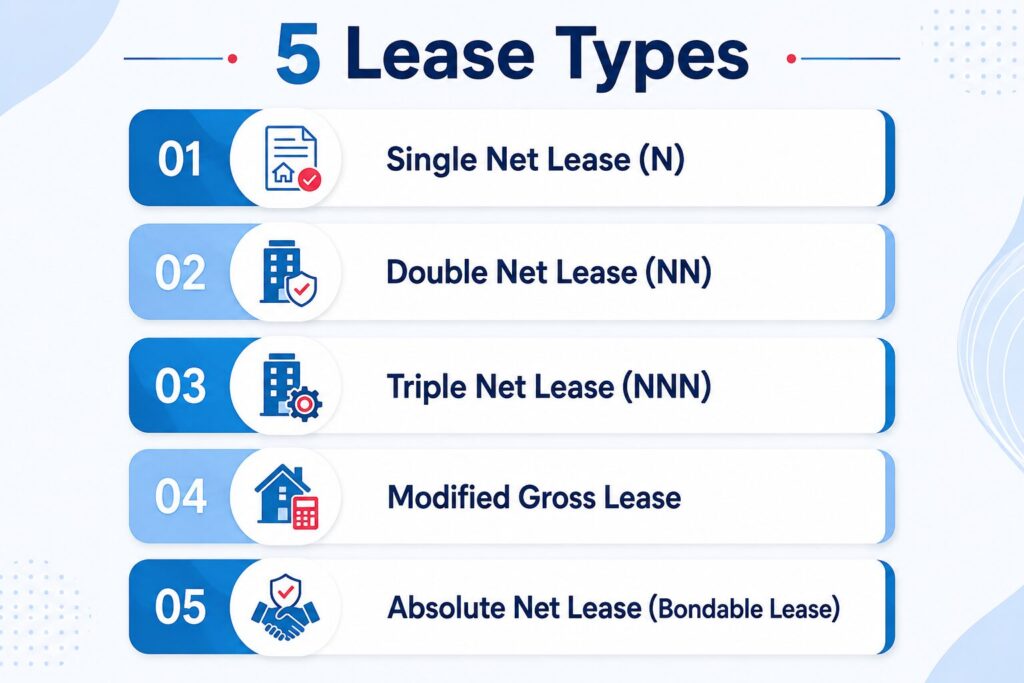
In commercial real estate, NNN expenses (Triple Net expenses) are the additional costs tenants pay on top of base rent. These expenses usually include Common Area Maintenance (CAM) charges, property taxes, and building insurance.
While tenants pay estimated CAM charges throughout the year, a CAM reconciliation is completed at the end of the lease year to compare estimated costs with the actual expenses. This process ensures tenants pay only their fair share and helps landlords recover eligible maintenance costs accurately.
Understanding how NNN expenses and CAM reconciliation work together can reduce billing errors, improve transparency, and prevent costly disputes between landlords and tenants with best cost segregation strategies.
How to Calculate CAM Charges
Calculating CAM charges helps determine how much each tenant should pay for maintaining shared areas in a commercial property. The calculation follows a structured CAM reconciliation process, ensuring expenses are allocated fairly based on the lease agreement and the tenant’s occupied space.
Formula
The basic formula to calculate CAM charges is:
Tenant CAM Charges = (Recoverable CAM Expenses × Tenant’s Pro-Rata Share) ± Year-End CAM Reconciliation
Where:
- Recoverable CAM Expenses: Total eligible common area maintenance costs after removing excluded expenses.
- Tenant’s Pro-Rata Share: The percentage of the building occupied by the tenant.
- Year-End CAM Reconciliation: The difference between estimated CAM charges already paid and the tenant’s actual share of expenses.
What is Gross-Up?
A gross-up is an adjustment used when a commercial property is not fully occupied. It estimates certain variable operating expenses as if the building were operating at a standard occupancy level, usually 90%–95%. This prevents tenants from paying higher CAM charges simply because the property had lower occupancy during the year. Gross-ups are generally applied only to variable expenses, such as utilities and janitorial services, not to fixed costs like property taxes or insurance.
What is Pro-Rata Share?
A pro-rata share is the percentage of common area expenses that each tenant is responsible for paying. It is usually calculated by dividing the tenant’s leased square footage by the building’s total rentable square footage. The larger the leased space, the higher the tenant’s share of common area maintenance costs.
Formula:
Pro-Rata Share (%) = Tenant’s Rentable Area ÷ Total Rentable Area × 100
What is a Controllable Cap?
A controllable cap is a limit on how much certain common area maintenance expenses can increase each year. It generally applies to controllable operating costs, such as landscaping, cleaning, and maintenance services, but does not apply to non-controllable expenses like real estate taxes, insurance premiums, or utility rate increases. These caps help tenants avoid unexpected increases in CAM charges.
Example
Suppose a commercial building has $120,000 in recoverable CAM expenses for the year, and a tenant occupies 10% of the total rentable area.
Calculation:
Total Recoverable CAM Expenses = $120,000
Tenant’s Pro-Rata Share = 10%
Estimated CAM Paid During the Year = $10,500
Tenant’s Actual CAM Share
$120,000 × 10% = $12,000
CAM Reconciliation
$12,000 − $10,500 = $1,500
In this example, the tenant owes an additional $1,500 after the CAM reconciliation because the estimated monthly CAM charges were lower than the actual common area maintenance expenses incurred during the year.
Check out our case study for a multi-property real estate firm.
CAM Reconciliation Process (Step-by-Step)
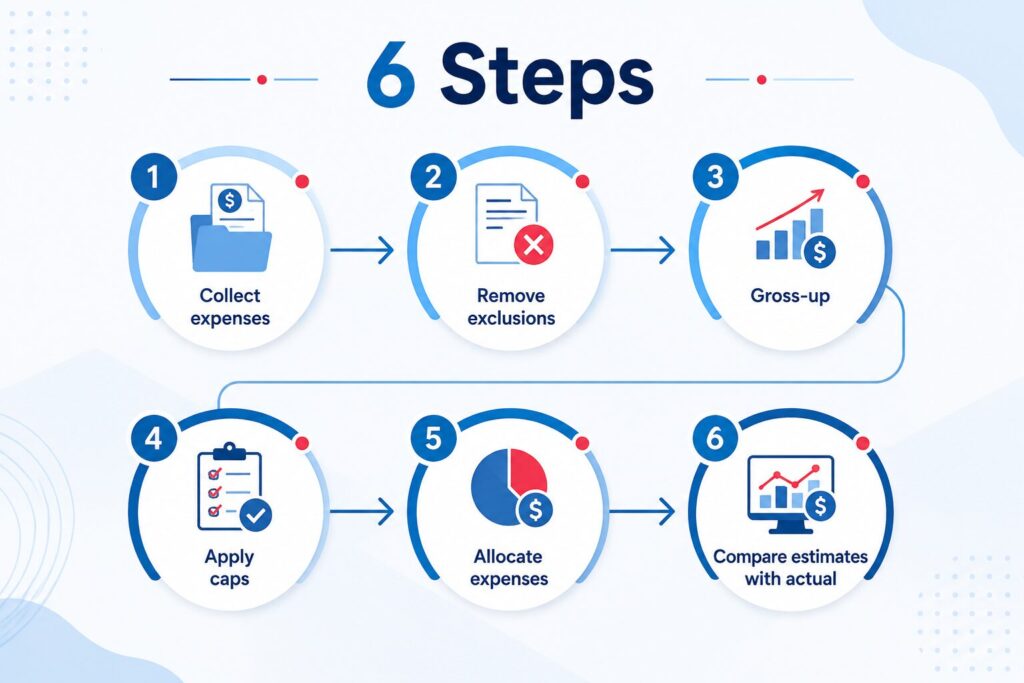
The CAM reconciliation process follows a series of steps to ensure tenants are charged only for eligible common area maintenance expenses. Following these steps improves accuracy, reduces disputes, and makes tenant CAM reconciliation easier for both landlords and property managers.
Step 1: Collect Actual Expenses
Start by gathering all expenses related to maintaining the property’s common areas for the entire financial year. These may include landscaping, parking lot maintenance, security services, common area utilities, janitorial services, HVAC maintenance, insurance, and real estate taxes. Having complete and accurate financial records is the foundation of a successful CAM reconciliation.
Step 2: Remove Non-Recoverable Expenses
Not every operating expense can be passed on to tenants. Review the lease agreement carefully and remove non-recoverable costs such as capital improvements, tenant-specific repairs, leasing commissions, marketing expenses, loan interest, and other landlord-only costs. This step ensures that only eligible common area maintenance expenses are included in the reconciliation.
Step 3: Apply Gross-Up Adjustments
If the building was not fully occupied during the year, apply a gross-up to eligible variable expenses such as utilities and janitorial services. This adjustment estimates costs as if the property had reached the occupancy level specified in the lease, usually between 90% and 95%. Gross-ups should never be applied to fixed costs like property taxes or insurance.
Step 4: Apply Controllable Caps
Many commercial leases limit annual increases in certain maintenance expenses through controllable caps. Before calculating each tenant’s share, apply these caps only to eligible controllable expenses, such as landscaping or cleaning services. This helps ensure the CAM reconciliation process follows the lease terms and prevents tenants from being overcharged.
Step 5: Allocate Expenses to Each Tenant
After making all necessary adjustments, calculate each tenant’s share using their pro-rata share of the building’s rentable area. This determines how much each tenant should contribute toward the total common area maintenance expenses based on the lease agreement and occupied space.
Step 6: Compare Estimated Payments with Actual Costs
Finally, compare the estimated CAM charges collected throughout the year with each tenant’s actual share of expenses. If a tenant has paid less than their actual amount, they will owe the remaining balance. If they have paid more, they receive a credit or refund. This final CAM reconciliation completes the annual true-up and ensures accurate billing.
If you’re looking to improve financial accuracy across your commercial properties, explore our guide on Bookkeeping for Real Estate Agents.
Full CAM Reconciliation Example (2026)
Now that you understand the CAM reconciliation process, let’s walk through a complete example using real numbers. This example shows how to calculate CAM charges, apply adjustments, and complete a tenant CAM reconciliation from start to finish in an easy-to-understand way.
Example Scenario
ABC Commercial Plaza is a shopping center with a total rentable area of 100,000 sq. ft. Tenant XYZ occupies 10,000 sq. ft., which means its pro-rata share is 10%.
Throughout the year, the landlord collected estimated CAM charges from all tenants. At year-end, the landlord performs the CAM reconciliation to compare estimated collections with the actual maintenance expenses.
Step 1: Calculate Total Actual Common Area Maintenance Expenses
| Expense Category | Annual Cost |
| Landscaping | $28,000 |
| Parking Lot Maintenance | $22,000 |
| Security Services | $35,000 |
| Common Area Utilities | $40,000 |
| Janitorial Services | $26,000 |
| HVAC Maintenance | $18,000 |
| Elevator Maintenance | $12,000 |
| Trash Removal | $9,000 |
| Property Insurance | $32,000 |
| Real Estate Taxes | $78,000 |
| Total Expenses | $300,000 |
Step 2: Remove Non-Recoverable Expenses
After reviewing the lease agreement, the landlord finds that some expenses cannot be charged to tenants.
| Excluded Expense | Amount |
| Building Renovation | $15,000 |
| Leasing Commission | $8,000 |
| Marketing Expenses | $7,000 |
| Total Excluded | $30,000 |
Recoverable CAM Expenses
$300,000 − $30,000 = $270,000
Only $270,000 is eligible for the CAM reconciliation.
Step 3: Apply Gross-Up Adjustment
During the year, the building’s average occupancy was 80%, but the lease states that eligible variable expenses should be grossed up to 95% occupancy.
Variable expenses include:
- Utilities
- Janitorial Services
- Trash Removal
| Variable Expense | Actual Cost | Grossed-Up Cost |
| Utilities | $40,000 | $47,500 |
| Janitorial | $26,000 | $30,875 |
| Trash Removal | $9,000 | $10,688 |
Additional Gross-Up = $14,063
Updated Recoverable CAM Expenses
$270,000 + $14,063 = $284,063
Step 4: Apply the Controllable Cap
The lease allows a 5% controllable cap on controllable operating expenses.
After reviewing the eligible costs, the landlord determines that $6,500 exceeds the allowable increase.
Adjusted Recoverable CAM Pool
$284,063 − $6,500 = $277,563
This becomes the final expense pool used for CAM reconciliation.
Step 5: Calculate the Tenant’s Pro-Rata Share
Tenant XYZ occupies 10% of the building.
Formula
Tenant CAM = Recoverable CAM Expenses × Pro-Rata Share
$277,563 × 10% = $27,756.30
Tenant XYZ’s actual share of the annual common area maintenance expenses is $27,756.30.
Step 6: Compare Estimated Payments with Actual Expenses
Throughout the year, Tenant XYZ already paid $25,000 in estimated CAM charges.
| Description | Amount |
| Actual CAM Share | $27,756.30 |
| Estimated CAM Paid | $25,000.00 |
| Balance Due (True-Up) | $2,756.30 |
Since the tenant paid less than the actual expenses, they must pay an additional $2,756.30 as part of the year-end CAM reconciliation.
Final CAM Reconciliation Summary
| Calculation Step | Amount |
| Total Actual Expenses | $300,000 |
| Less: Non-Recoverable Expenses | ($30,000) |
| Recoverable Expenses | $270,000 |
| Add: Gross-Up Adjustment | +$14,063 |
| Less: Controllable Cap Adjustment | ($6,500) |
| Final Recoverable CAM Pool | $277,563 |
| Tenant’s Pro-Rata Share (10%) | $27,756.30 |
| Less: Estimated CAM Paid | ($25,000.00) |
| Final CAM Reconciliation Amount Due | $2,756.30 |
Key Learning from This Example
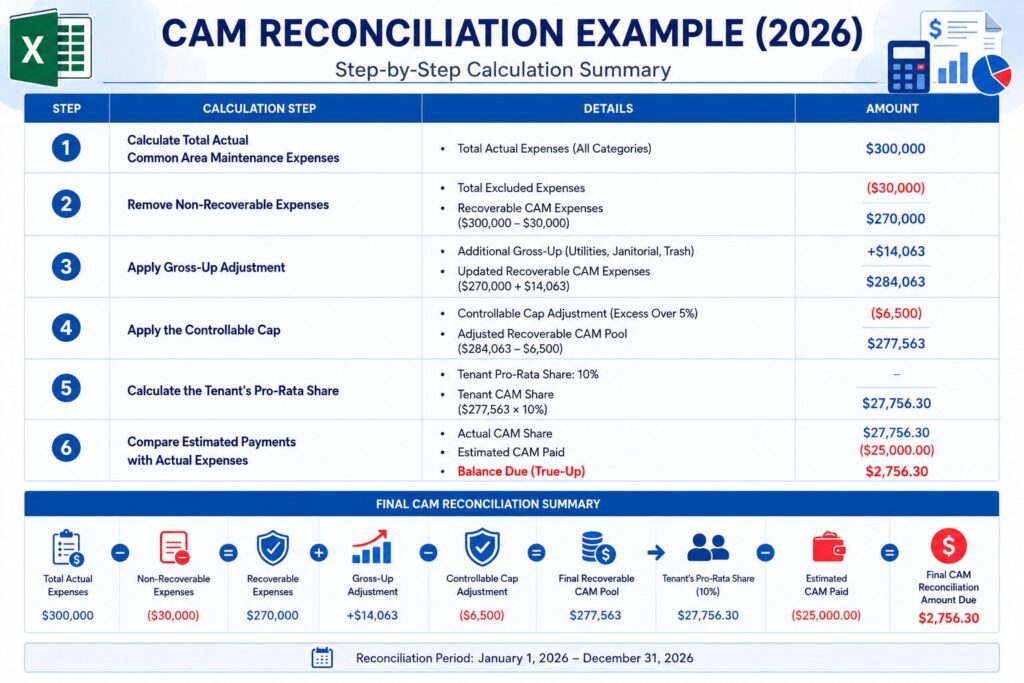
This example shows why CAM reconciliation is much more than simply adding maintenance expenses. Every calculation must follow the lease terms, including exclusions, gross-up adjustments, controllable caps, and the tenant’s pro-rata share. Even a small error in any of these steps can significantly change the final amount a tenant owes or is refunded. Maintaining accurate financial records throughout the year makes the CAM reconciliation process faster, more transparent, and easier for both landlords and tenants.
The 7-Step GATP CAM Review Framework
A successful CAM reconciliation is more than checking numbers—it requires reviewing every calculation against the lease terms. The 7-Step GATP CAM Review Framework helps landlords, property managers, and tenants identify errors early, improve accuracy, and complete the CAM reconciliation process with confidence.
1. Lease Check
Start by reviewing the commercial lease agreement. Verify which common area maintenance expenses are recoverable, whether NNN expenses apply, how CAM charges should be calculated, and if there are any exclusions, gross-up rules, or controllable caps. A clear understanding of the lease prevents costly billing mistakes later.
2. Expense Check
Review all expenses included in the CAM pool and ensure they are directly related to maintaining the property’s common areas. Compare invoices, vendor bills, and accounting records to confirm that every charge is accurate and properly documented. Maintaining organized financial records makes CAM reconciliation much more reliable.
3. Exclusions Check
Remove all costs that cannot legally be charged to tenants under the lease. These commonly include capital improvements, tenant-specific repairs, leasing commissions, marketing expenses, loan interest, and penalties. This step ensures that only eligible common area maintenance costs are included in the reconciliation.
4. Gross-Up Check
If the building was not fully occupied during the year, confirm that the gross-up adjustment has been applied correctly. It should only be used for eligible variable operating expenses, such as utilities and janitorial services, and must follow the occupancy percentage stated in the lease. Incorrect gross-ups are one of the most common CAM reconciliation errors.
5. Allocation Check
Verify that each tenant’s pro-rata share has been calculated correctly using the appropriate rentable square footage. Also, confirm that any move-ins, move-outs, or changes in occupied space during the year have been considered before allocating the final CAM charges.
6. Cap Check
Review whether the lease includes a controllable cap on annual maintenance expenses. Ensure the cap is applied only to eligible controllable costs and not to non-controllable expenses such as property taxes or insurance. Applying the cap incorrectly can significantly affect the final CAM reconciliation amount.
7. Deadline Check
Finally, check that the CAM reconciliation statement has been prepared and delivered within the timeline specified in the lease. Also review the tenant’s dispute period and audit rights. Missing important deadlines may limit the landlord’s ability to recover additional charges or the tenant’s ability to challenge incorrect billing.
CAM Reconciliation Deadlines Every Tenant Should Know
Meeting the deadlines in your lease is just as important as completing an accurate CAM reconciliation. Missing these timelines can affect a landlord’s right to recover costs or a tenant’s ability to dispute incorrect CAM charges or request a CAM audit.
- Statement Delivery Deadline: Most commercial leases require landlords to provide the annual CAM reconciliation statement within 90 to 120 days after the end of the lease or fiscal year. Some leases may allow up to 180 days, so always review your lease terms carefully.
- Tenant Dispute Window: After receiving the CAM reconciliation statement, tenants usually have 30 to 90 days to review the charges and raise any questions or disputes. Missing this deadline may mean accepting the charges as final.
- CAM Audit Period: Many leases give tenants 12 to 36 months to request a CAM audit if they believe there are billing errors. During this period, tenants can review supporting documents, invoices, and accounting records to verify the charges.
- Lease Year vs. Calendar Year: CAM reconciliation is generally based on the property’s lease year or fiscal year, not the calendar year. Understanding this difference helps tenants know when to expect reconciliation statements and avoid confusion.
- Late Statement Consequences: If a landlord delivers the CAM reconciliation statement after the deadline specified in the lease, they may lose the right to recover additional CAM charges. However, this depends entirely on the lease agreement and applicable local laws.
- Best Practice for Tenants: As soon as you receive a CAM reconciliation statement, review it carefully, compare it with your lease, and request supporting documents if any charges appear incorrect. Acting within the allowed timeframe protects your rights and helps resolve disputes more efficiently.
CAM and Tax Reconciliation
Although they are often billed together in commercial leases, CAM reconciliation and tax reconciliation are not the same. Common Area Maintenance (CAM) covers the costs of maintaining shared spaces, while tax reconciliation compares the estimated property taxes collected from tenants with the actual taxes paid by the landlord. In many NNN expenses leases, tenants are responsible for paying their share of both CAM expenses and property taxes, making it important to reconcile each separately.
During the year-end CAM reconciliation process, landlords also reconcile property taxes and, in many cases, building insurance. Unlike variable common area maintenance expenses, property taxes are fixed costs and are generally not subject to gross-up adjustments or controllable caps. Reviewing CAM and tax reconciliation separately helps ensure accurate billing, improves transparency, and allows tenants to verify that they are paying only their fair share under the lease agreement.
Tenant CAM Reconciliation Checklist
Before accepting a CAM reconciliation statement, tenants should carefully review the charges to ensure they are accurate and comply with the lease agreement. This simple checklist helps identify common errors, avoid overpayments, and complete a thorough tenant CAM reconciliation.
- Review Your Lease Agreement: Confirm what common area maintenance expenses are recoverable, how CAM charges are calculated, and whether your lease includes gross-up provisions, controllable caps, or exclusions.
- Verify Expense Categories: Check that every charge relates to maintaining the property’s shared areas. Look for expenses such as landscaping, security, utilities, and janitorial services, and ensure no unrelated costs have been included.
- Check for Non-Recoverable Expenses: Make sure capital improvements, tenant-specific repairs, leasing commissions, marketing expenses, loan interest, and other non-recoverable costs are not part of the CAM reconciliation.
- Confirm Your Pro-Rata Share: Verify that your share of common area maintenance expenses has been calculated using the correct rentable square footage stated in your lease.
- Review Gross-Up Calculations: If a gross-up has been applied, confirm that it only affects eligible variable expenses and follows the occupancy percentage specified in the lease agreement.
- Verify Controllable Caps: Ensure any annual cap on controllable CAM expenses has been applied correctly and only to eligible maintenance costs.
- Compare Estimated vs. Actual Charges: Compare the monthly CAM payments you made during the year with your final CAM reconciliation statement to verify the true-up amount.
- Request Supporting Documents: Ask for invoices, vendor bills, tax records, or expense reports if any charge appears unclear or unusually high. Supporting documentation is essential for a proper tenant CAM reconciliation.
- Review Deadlines: Check that the CAM reconciliation statement was delivered within the lease timeline and submit any disputes before your lease’s review period expires.
- Seek Professional Review if Needed: If the reconciliation is complex or involves significant NNN expenses, consider consulting an experienced accounting professional to verify the calculations before making the final payment.
Best Software for CAM Reconciliation (2026)
Choosing the right CAM reconciliation software can make a big difference in how quickly and accurately you manage year-end reconciliations. While many software solutions can automate calculations and generate reports, they still depend on one thing—accurate accounting data. Even the best software cannot identify lease-specific exceptions, incorrect expense allocations, or billing errors without expert review.
Popular CAM Reconciliation Software
| Software | Best For | Key Features |
| Yardi Voyager | Large commercial portfolios | CAM reconciliation, lease management, financial reporting |
| MRI Software | Enterprise real estate businesses | Automated reconciliations, lease accounting, reporting |
| AppFolio | Property management companies | Expense tracking, owner reporting, tenant management |
| Buildium | Small to mid-sized portfolios | Accounting, CAM tracking, maintenance management |
| QuickBooks + Expert Accountant | Growing businesses | Flexible bookkeeping, financial reporting, custom CAM reconciliation support |
The Right Software Is Only Half the Solution
Many landlords assume that buying expensive CAM reconciliation software will eliminate errors. In reality, software only processes the data you enter. If expenses are classified incorrectly, NNN expenses are allocated improperly, or lease terms are overlooked, the final CAM reconciliation can still be inaccurate.
That’s why successful commercial property owners combine reliable accounting software with experienced accounting professionals who understand lease agreements, common area maintenance, and year-end reconciliations.
Let GATP Solutions Handle the Complexity
Instead of spending hours learning complex software or worrying about costly reconciliation errors, let GATP Solutions do the heavy lifting for you.
Our team provides AI-powered bookkeeping, accounting, and financial expertise to ensure your CAM reconciliation process is accurate, transparent, and fully compliant with your lease terms. We help commercial property owners, real estate investors, and property managers:
- Review and reconcile CAM charges with confidence.
- Verify NNN expenses and eliminate billing errors.
- Maintain accurate financial records throughout the year.
- Prepare clear, audit-ready reconciliation reports.
- Save valuable time while reducing financial risk.
Technology is powerful, but expertise delivers accuracy. With GATP Solutions, you get the perfect combination of advanced accounting tools and experienced professionals, helping you complete every CAM reconciliation faster, smarter, and with complete peace of mind.
Need expert help with CAM reconciliation? Explore our Accounting Services and let GATP Solutions simplify your commercial property finances with AI-powered bookkeeping, accounting, CFO, payroll, and tax support.
Why Businesses Outsource CAM Reconciliation
As commercial properties grow, managing CAM reconciliation becomes more time-consuming and complex. Many landlords, property managers, and real estate investors outsource the process to reduce errors, save time, and ensure every common area maintenance charge is calculated accurately. It is the same call they end up making on accounting built for property managers generally: keep the routine work in-house until lease exceptions start costing real money.
- Improve Accuracy: Professional accountants review lease agreements, verify CAM charges, and ensure only eligible common area maintenance expenses are included in the reconciliation.
- Save Time: Outsourcing eliminates hours of manual calculations, document reviews, and spreadsheet management, allowing your team to focus on property operations and business growth.
- Reduce Costly Errors: Experts identify mistakes such as incorrect NNN expenses, duplicate charges, inaccurate pro-rata allocations, and missed exclusions before they become expensive disputes.
- Ensure Lease Compliance: Every commercial lease has different terms. An experienced team ensures the CAM reconciliation process follows lease-specific rules, including gross-ups, controllable caps, and recoverable expenses.
- Maintain Audit-Ready Records: Professional bookkeeping keeps invoices, expense reports, and financial records organized, making tenant CAM reconciliation and audits faster and more transparent.
- Gain Financial Insights: Outsourcing doesn’t just improve reconciliation—it provides better visibility into operating costs, helping property owners identify savings and make smarter financial decisions.
- Scale with Confidence: Whether you manage a single commercial property or a large real estate portfolio, outsourced accounting services can easily scale with your business without increasing your internal workload.
Final Thoughts
A well-executed CAM reconciliation is essential for ensuring landlords recover the right expenses while tenants pay only their fair share. By understanding what is CAM reconciliation, reviewing common area maintenance costs carefully, and following the correct CAM reconciliation process, businesses can avoid costly errors, improve transparency, and strengthen tenant relationships. Whether you manage a single commercial property or a large real estate portfolio, accurate reconciliation starts with reliable financial records. It does not end with them either, because once the true-up statements go out those balances sit in your ledger until accounts receivable management turns them into cash.
Need expert help with your CAM reconciliation? GATP Solutions provides AI-powered bookkeeping, accounting, tax, payroll, and CFO services tailored for real estate businesses. Contact our experts today to simplify your CAM reconciliation process, reduce financial risks, and keep your commercial property finances accurate, compliant, and stress-free.
Frequently Asked Questions
1. How to calculate common area maintenance charges?
Calculate common area maintenance charges by multiplying the tenant’s pro-rata share by recoverable CAM expenses, then completing the annual CAM reconciliation.
2. What are common area maintenance charges?
Common area maintenance charges are shared property expenses for landscaping, security, cleaning, parking, utilities, and repairs paid by commercial tenants.
3. What are NNN expenses?
NNN expenses include Common Area Maintenance (CAM), property taxes, and building insurance paid by tenants in a Triple Net (NNN) lease.
4. What are CAM charges in commercial real estate?
CAM charges in commercial real estate are costs tenants pay to maintain shared areas like parking lots, hallways, landscaping, and security.
5. What is included in CAM charges?
CAM charges typically include landscaping, parking lot maintenance, utilities, janitorial services, security, HVAC maintenance, insurance, and property taxes, depending on the lease.
6. What is CAM reconciliation in commercial real estate?
CAM reconciliation compares estimated CAM payments with actual common area maintenance expenses to determine whether tenants owe more or receive a credit.
7. What is the best CAM reconciliation template?
The best CAM reconciliation template tracks recoverable expenses, exclusions, gross-ups, pro-rata shares, and true-up calculations in one organized worksheet.
8. How to reconcile CAM charges?
To reconcile CAM charges, compare estimated payments with actual expenses, remove exclusions, apply lease adjustments, and calculate the final tenant balance.
9. What are CAM charges in a commercial lease?
In a commercial lease, CAM charges are the tenant’s share of maintaining common areas, calculated according to the lease agreement.
10. What does common area maintenance include?
Common area maintenance includes expenses for landscaping, lighting, parking lots, security, elevators, shared utilities, cleaning, and other common-area upkeep.