Key Takeaways
- Dental practice valuation does not follow one fixed formula. The right approach depends on the practice and the buyer.
- Smaller practices may be valued using collections or SDE, while larger and institutional transactions often focus on adjusted EBITDA.
- The traditional 70% of collections rule is only a starting point. 2026 private-sale benchmarks can vary around 60% to 85% of annual collections.
- Profitability matters more than collections alone. High revenue does not guarantee a high practice value if overhead is also high.
- Adjusted EBITDA helps buyers understand the practice’s repeatable operating earnings after appropriate normalization adjustments.
- Owner dependence, weak margins, messy financial records, payer concentration, staff turnover, and declining patient or hygiene numbers can reduce valuation.
- Selling to a DSO can provide liquidity and administrative support, but sellers should carefully review control, employment terms, rollover equity, and earnouts.
- Clean financial records make it easier to track profitability, calculate EBITDA, prepare for due diligence, and understand the numbers behind a sale.
- The cost of a dental practice valuation depends on the practice’s size, complexity, purpose, and level of financial analysis required.
- Preparing financials and operations before receiving an offer gives owners a clearer understanding of their practice’s value and stronger information for negotiations.
Dental practice valuation is not as simple as applying a fixed percentage to yearly collections. In 2026, dental practice valuation can change based on profit, practice size, owner involvement, buyer type, and financial records.
A practice may have strong collections but weak profitability after payroll, supplies, rent, and lab costs. Two practices with similar revenue can sell for very different prices. Private buyers and DSOs may also assess the same practice differently, while clean, normalized financials become increasingly important.
Recent ADA data shows average 2025 income of $215,320 for general-practice dentists and $346,520 for specialists, with average gross billings of $965,660 for general practitioners and $1.213 million for specialists. These figures show that revenue alone does not determine the value of a dental practice. Buyers also care about the profit and risk behind those numbers.
What Is Dental Practice Valuation?

Dental practice valuation is the process of estimating what a dental business could reasonably sell for in the current market. A dental office valuation looks beyond how much money comes into the practice and asks a bigger question: what the practice is actually worth and how much profit can it produce for a new owner?
Several numbers help answer that question:
- Revenue or collections: The total money collected from patients and insurance companies.
- Profit: What remains after paying normal business expenses.
- EBITDA: A way to measure operating earnings before interest, taxes, depreciation, and amortization.
- Business assets: Equipment, technology, furniture, supplies, and other physical items owned by the practice.
- Goodwill: The value tied to the practice’s reputation, patient base, location, staff, systems, and future earning potential.
A buyer is mainly paying for the future earnings the practice can generate, not just today’s equipment or last year’s collections. A dentist may have strong patient relationships, but those relationships alone do not guarantee the same revenue after the owner leaves. Systems, trained staff, recurring patients, and stable operations make the value of a dental practice easier to transfer to a new owner.
Why Collections Alone Do Not Tell the Full Story
Collections show how much money a practice brings in, but they do not show how much it keeps after operating costs. That difference can directly affect dental practice valuation.
Practice A
- Collections: $1.5 million
- Adjusted EBITDA: $400,000
Practice B
- Collections: $1.5 million
- Adjusted EBITDA: $200,000
Both practices collect the same amount, but Practice A produces twice the adjusted EBITDA. It may therefore be more attractive to a buyer because it generates more transferable profit. This is why buyers look beyond collections. A practice with lower revenue but stronger margins can sometimes be worth more than a larger practice with high expenses.
Revenue shows business size. Profit shows business strength.
Dental Practice Valuation Methods Buyers Use in 2026
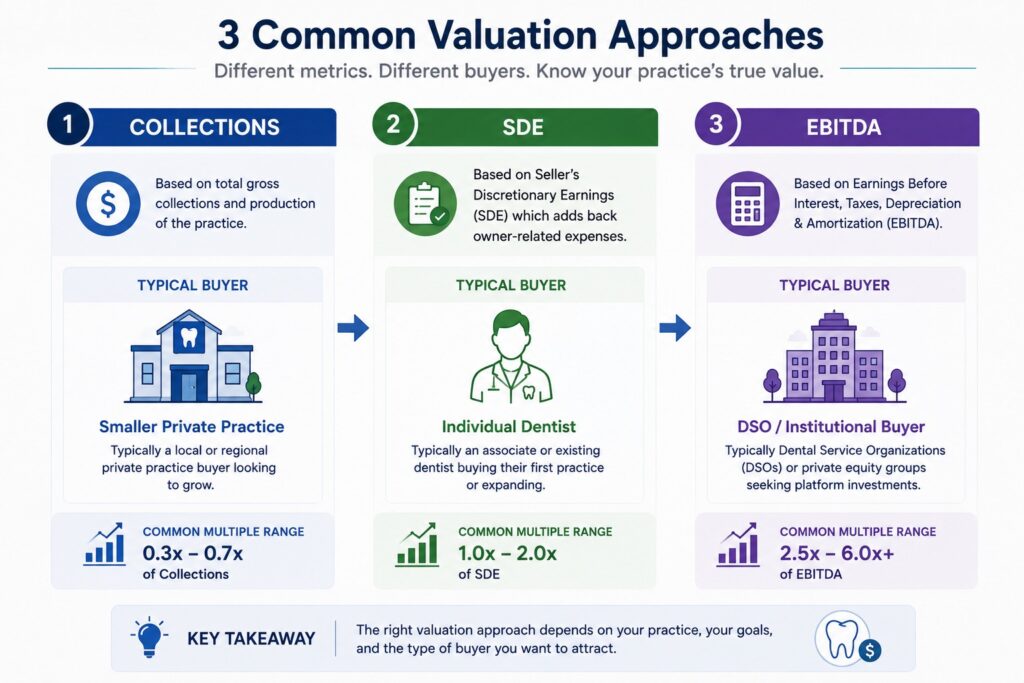
Different buyers can look at the same dental practice in very different ways. An individual dentist buying a smaller office may focus on collections or the income available to one owner, while a Dental Service Organization (DSO) or private equity-backed group may place more weight on normalized operating earnings. The size of the practice, its ownership structure, and the buyer’s investment model all influence which dental practice valuation methods receive the most attention.
Percentage of Collections Method
The percentage of collections method is a traditional starting point for estimating the value of a dental practice. Instead of analyzing every part of the practice’s financial performance, it uses annual collections as a quick way to establish an initial price range.
- Application: This method is most common for smaller, owner-operated and solo practices.
- Function: Transition brokers and other dental industry professionals often use collections as a quick benchmark when discussing a potential sale.
- Limitation: Collections show gross revenue, but they do not show how much profit remains after paying staff, rent, supplies, laboratory costs, technology, and other expenses.
- 2026 Benchmark: Current industry transaction sources commonly place general private-practice sales at roughly 60% to 85% of annual net collections, although the actual percentage can vary based on the practice and transaction.
The dental practice valuation rule of thumb is useful for getting an initial idea of value, but it should not be treated as a final selling price. Two practices with identical collections can have very different values when their overhead, profitability, patient base, and operations are different.
Seller’s Discretionary Earnings (SDE) Method
SDE takes a closer look at the financial benefit a practice can provide to one owner-operator. Rather than focusing only on what the practice collects, it considers the money generated for the owner after normal operating expenses and certain owner-related or discretionary costs are added back.
- Simple Definition: SDE reflects the financial benefit available to one full-time doctor, including eligible add-backs such as owner salary, personal perks, and certain one-time discretionary expenses.
- Best Suited For: This approach is generally used for smaller, single-doctor and owner-operated practices being purchased by individual dentists.
- Why Buyers Use It: It gives a prospective owner a clearer picture of the income the practice could provide after the transaction.
- 2026 Multiples: Current private-market references commonly place smaller practice transactions around 1.75x to 2.7x SDE, with the applicable multiple influenced by factors such as practice size, geographic demand, and patient retention.
EBITDA Multiple Method
EBITDA becomes more important when the buyer is a DSO, private equity group, or another institutional investor. These buyers generally want to understand the practice’s underlying operating performance without letting differences in financing, taxes, or accounting treatments distort the comparison.
- Acronym: EBITDA stands for Earnings Before Interest, Taxes, Depreciation, and Amortization.
- Simple Definition: In plain English, EBITDA dental practice valuation helps a buyer see the operating profit a clinic generates before interest, taxes, depreciation, and amortization are taken into account.
- Associate-Led Adjustment: Institutional buyers may calculate adjusted EBITDA by accounting for the cost of replacing the selling dentist’s clinical work. If the owner will leave after the transaction, a buyer may deduct a market-rate salary for an associate dentist who will take over that production. Industry sources commonly place this replacement cost around 25% to 30% of production, depending on the practice and circumstances.
- 2026 Multiples: Current market sources commonly show corporate and DSO buyers acquiring single-location practices at approximately 5x to 8x adjusted EBITDA, while larger, multi-location dental platforms can command approximately 9x to 11x+ EBITDA because of their scale and established infrastructure.
The final dental practice EBITDA multiple is influenced by more than the size of EBITDA. Institutional buyers may also review the practice through a Quality of Earnings (QofE) process and examine team continuity, patient retention, and the durability of hygiene revenue before deciding what multiple the business deserves.
How to Value a Dental Practice: A Simple Formula
To estimate a practice’s worth, buyers can use a dental practice valuation formula based on adjusted EBITDA and an appropriate market multiple. This gives the baseline Enterprise Value (EV) before the specific terms of the deal are applied.
Dental Practice Valuation Formula:
Adjusted EBITDA × Appropriate Market Multiple = Estimated Enterprise Value
The Formula in Action
For example:
- Adjusted EBITDA: $500,000
- Market Multiple: 6x
- Estimated Enterprise Value: $3,000,000
The $3 million figure is the estimated Enterprise Value, not necessarily the amount the owner receives at closing. The final payout depends on the deal structure and several net-to-seller adjustments.
What Can Change the Final Payout?
- Debt & Cash: Existing practice debt must be addressed as part of the transaction, while the treatment of cash depends on the deal structure.
- Working Capital Peg: The seller may need to leave enough inventory and accounts receivable to keep the practice operating normally after the transaction.
- Real Estate & Equipment: The treatment and condition of the building and equipment can affect the overall transaction, particularly when the property is sold or leased at market rates.
- Deal Structure: The consideration may be divided between cash at closing, rollover equity, often around 15%–20% reinvested in the DSO, and performance-based earnouts.
- Friction Costs: Taxes, professional fees, and broker fees can reduce the seller’s final proceeds, particularly in larger transactions.
Why Adjusted EBITDA Matters More Than Reported Profit
Reported profit does not always show the earnings a buyer considers sustainable under new ownership. Buyers therefore use normalization to adjust the financial statements and estimate the practice’s repeatable operating profit.
Common adjustments include:
- Personal Perks: Vehicles, travel, family cell phones, and other personal expenses run through the business.
- Facilities: Adjusting rent that is above or below the property’s market rate.
- One-Time Costs: Removing unusual expenses such as major legal fees or significant equipment repairs.
- Associate Adjustment: Subtracting a 25%–30% market salary to account for replacing the owner’s clinical production with an associate.
The purpose of these adjustments is to show the practice’s true, repeatable operating profit, giving the buyer a cleaner figure to use when assessing its value.
What Is the Average Dental Practice Profit Margin?
There is no single average dental practice profit margin that applies to every practice. Profitability depends on several factors, including the practice’s specialty, insurance mix, location, fixed costs, staffing, and how efficiently the practice operates.
As a general benchmark, healthy general dental practices often maintain a gross profit margin of around 35% to 40%, which means roughly 60% to 65% of revenue may go toward overhead. The actual margin can vary significantly based on:
- Specialty & Insurance Mix: Fee-for-service and cosmetic practices can have different margins from practices that depend heavily on PPO insurance plans.
- Fixed Costs: Rent, laboratory fees, and dental supply costs can have a major effect on the bottom line, particularly in higher-cost markets.
- Labor & Efficiency: Staffing expenses and the productivity of the hygiene department can directly affect profitability.
The American Dental Association (ADA) provides useful context for the broader economics of dental practices. ADA data reported that general-practice dentists had average net income of $215,320, while its multi-year analysis found that revenues increased by only 1.4% compared with a 4.9% increase in expenses.
This gap matters for dental practice valuation. Buyers do not look only at growing collections. If revenue is increasing while profit margins are shrinking, the practice may be becoming less efficient. When expenses rise faster than fees or collections, the resulting pressure on profit can also affect what a buyer is willing to pay.
What Cuts Your Dental Practice Valuation?
A high-revenue dental practice can still receive a disappointing offer if buyers see too much risk. These issues can directly affect dental practice valuation and reduce the value of a dental practice during a sale.
- Too Much Dependence on the Owner: If patients come mainly for the owner and there is no associate structure, buyers may worry that revenue will decline after the owner leaves.
- Weak or Falling Profit Margins: Growing collections do not guarantee higher value. If expenses rise faster than revenue, shrinking margins can make the practice less attractive to buyers.
- Messy Financial Records: Unreconciled accounts, mixed personal and business expenses, poor categorization, missing documents, cash-basis timing issues, and no clean monthly P&L can weaken buyer confidence. Strong healthcare accounting practices can help keep these financial records organized and easier to review.
- Heavy Dependence on One Payer: Low reimbursement rates, high Medicaid concentration, unfavorable PPO contracts, or major changes in payer mix can create revenue risk for prospective buyers.
- High Staff Turnover: Frequent turnover among dentists, hygienists, or key staff can disrupt operations, affect patient relationships, and create additional hiring and training costs.
- Old Equipment and Deferred Maintenance: Outdated equipment or postponed repairs can require significant spending after closing, giving buyers a reason to reduce their offer.
- Falling Patient or Hygiene Numbers: Declining new-patient flow, recall rates, hygiene production, treatment acceptance, or patient retention can signal weaker future revenue and reduce confidence in projected earnings.
- Owner’s Personal Expenses Mixed Into the Books: Personal expenses recorded as business costs can make reported profits difficult to assess and complicate a buyer’s dental office valuation during financial review.
Dental Practice Valuation and Selling to a DSO
When selling a dental practice to a DSO, the valuation approach can differ significantly from a sale to an individual dentist. A Dental Service Organization manages the non-clinical side of dental practices, including human resources, procurement, billing, marketing, and regulatory compliance.
An individual dentist may focus on Seller’s Discretionary Earnings (SDE), while a DSO generally places greater emphasis on normalized EBITDA. The practice is evaluated as a business investment, so the buyer pays close attention to its recurring earnings and future operating potential.
According to 2026 market data, DSO transaction multiples can vary based on the size and structure of the dental organization:
- Single/Small Practices: Typically trade between 5x and 8x adjusted EBITDA.
- Multi-Location Groups: Can receive premium pricing of approximately 8x to 11x EBITDA.
- Regional Platforms: Larger networks with integrated infrastructure can command 11x+ multiples from private equity buyers.

Should You Sell Your Dental Practice to a DSO?
Selling to a DSO is not automatically better than a private sale. The decision comes down to the balance between immediate financial liquidity, continued involvement, and professional independence.
Potential Benefits:
- Scale: Access to institutional capital, technology, and broader business resources.
- Relief: Reduced responsibility for back-office functions such as billing, HR, procurement, and other administrative work.
- Growth: Operational support and resources that can help expand patient acquisition and practice operations.
Potential Concerns:
- Loss of Autonomy: Corporate oversight may influence areas such as clinical pacing, material choices, and staffing decisions.
- Complex Deal Structures: The transaction may include rollover equity and performance-based earnouts, rather than being paid entirely in cash at closing.
- Employment Tie-Ins: Sellers may be required to remain with the practice under 3-to-5-year employment contracts, often with production requirements. This can mean transitioning from practice owner to an employee within the acquiring organization.
What Does a Dental Practice Valuation Cost?
The cost of dental practice valuation has no universal price. It depends on the practice’s size, complexity, number of locations, purpose of the valuation, CPA involvement, type of valuation, and the level of financial analysis required.
The work generally falls into three tiers:
- Quick Internal Estimate: A basic calculation used to get an early idea of what the practice may be worth.
- Professional Dental Practice Appraisal: A more detailed assessment of the practice’s financial and operational position.
- Formal Valuation: A comprehensive valuation prepared for a transaction, financing, dispute, or tax purpose.
There is also an important difference between broker and independent appraiser valuations. A broker may offer a “free” valuation as part of a potential practice sale, but it can come with contractual expectations or lock-ins. An independent certified appraiser typically charges an upfront fee and provides a valuation without tying the owner to a brokerage agreement. The right option depends on why you need the valuation and how detailed the analysis must be.
Dental Practice Valuation Rule of Thumb: Is 70% of Collections Still Valid?
The traditional 70% benchmark is no longer a definitive standard. Using a percentage of collections can still provide a quick starting point, but it should not be treated as a universal rule for every practice.
Current 2026 transaction data places the broader private-sale benchmark at approximately 60% to 85% of annual collections. Where a practice falls within that range depends on several factors:
- Practice Metrics: Specialty, geographic demand, and payer mix, including the balance between PPO and fee-for-service patients.
- Infrastructure: The condition of tangible assets, including digital technology and the age and quality of clinical equipment.
- The Overhead Penalty: Collections show top-line revenue but do not account for operating efficiency. Two practices can generate identical collections while the one with higher overhead receives a lower valuation percentage.
These limitations make the traditional dental practice valuation rule of thumb less useful as a practice grows. Corporate DSO buyers generally focus more heavily on normalized EBITDA, while individual buyers may place greater weight on Seller’s Discretionary Earnings (SDE).
Ultimately, gross collections are only part of the picture. Cash flow profitability and the quality of the underlying business determine where a practice is likely to fall within the valuation range.
How to Increase Your Dental Practice Value Before Selling
Maximizing your value of dental practice requires shifting your focus from top-line collections to operational efficiency, sustainable earnings, and clean financial reporting. Small improvements made before a sale can make your financial position easier for buyers to understand and evaluate.
Clean Up Your Financial Statements
Clean financial statements give buyers greater confidence in the numbers they are reviewing. Start organizing your books well before going to market, especially with healthcare accounting services that keep reconciliations and financial reporting consistent, so fewer accounting issues become negotiation points.
- Reconcile all bank and credit card accounts monthly.
- Clean up old transactions and outstanding accounts receivable.
- Separate personal expenses entirely from business operations.
- Maintain consistent account categories across all profit and loss (P&L) statements.
Know Your True EBITDA
Understanding your normalized EBITDA helps you present a clearer picture of recurring earnings and prevents legitimate adjustments from being overlooked during the valuation and negotiation process.
- Normalize owner compensation to true market rates.
- Remove one-time costs such as legal fees or major equipment repairs.
- Identify and track recurring operating expenses accurately.
Reduce Owner Dependence
A practice that depends heavily on the owner’s clinical work can present greater risk to buyers. Building a capable team and consistent systems can make operations easier to transition.
- Build a stable associate dentist team secured by robust non-compete agreements.
- Document clinical workflows and strengthen front-office administrative processes.
- Ensure patient relationships belong to the brand, not just one person.
Improve Your Revenue Mix
A stronger revenue mix can support more predictable earnings and make the practice more attractive during a dental practice valuation. Buyers want to see consistent production and collections.
- Strengthen Hygiene: Aim for hygiene to drive 40% or more of total production, creating predictable, recurring revenue.
- Track production data by individual provider to demonstrate team efficiency.
- Monitor collection rates and closely manage your PPO-to-fee-for-service payer mix.
Prepare Before You Need to Sell
The best time to address financial and operational weaknesses is months or years before a buyer asks for them. CFO guidance for dental practices can help owners monitor financial performance, plan cash flow, and prepare the numbers needed for a future transaction. Early preparation gives you more time to improve performance before negotiations begin.
Why Clean Accounting Can Change the Value of Your Dental Practice
Accounting is not just about filing taxes at the end of the year. For a dental practice preparing for growth or a future sale, proper dental bookkeeping helps the owner understand actual performance and present reliable numbers to potential buyers.
Clean accounting helps a dentist:
- See Actual Profitability: Understand how much the practice really earns after operating expenses.
- Calculate Adjusted EBITDA: Identify legitimate adjustments and calculate the earnings buyers may use for valuation.
- Track Overhead: Monitor where money is being spent and identify costs affecting profit margins.
- Identify Unusual Expenses: Separate one-time or unusual costs from normal recurring expenses.
- Prepare Buyer-Ready Reports: Keep financial statements organized and easier for buyers and their advisors to review.
- Support Due Diligence: Provide accurate records to verify revenue, expenses, assets, and financial adjustments.
- Compare Locations: Review the performance of individual offices and identify stronger or weaker locations.
- Forecast Cash Flow: Understand future cash needs, upcoming expenses, and available funds.
Build a Financial Foundation With GATP Solutions That Support Your Dental Practice’s Value
A dental practice can have strong collections and still have financial records that make profitability difficult to understand. GATP Solutions helps address this problem by keeping bookkeeping, monthly financial reporting, healthcare accounting, and tax support organized, so practice owners can see what is actually happening with their numbers.
That clarity becomes especially useful when you need to understand EBITDA, overhead, cash flow, and location-level performance. With ongoing financial reporting and CFO guidance, owners can spot unusual expenses, monitor profitability, and make decisions based on current financial information instead of waiting until a sale is already underway.
The same financial foundation can make sale preparation less difficult. Organized books and consistent reports give buyers and their advisors clearer information to review during due diligence. For a practice considering a future transaction, having these records in order early can make it easier to understand and support the financial performance behind its dental practice valuation.
Conclusion
Dental practice valuation is not one fixed percentage or a single formula. Collections matter, but so do profit margins, adjusted EBITDA, owner dependence, payer mix, staff stability, operating systems, and the quality of your financial records. A rule of thumb can provide a starting point, but it should not be treated as your final value.
DSO buyers may focus heavily on EBITDA, while individual buyers may look more closely at SDE and the income available to an owner. Clean accounting gives you a clearer picture of these numbers before a buyer reviews them. Prepare your financials before you receive an offer. For help getting your accounting in order, contact GATP Solutions.
Frequently Asked Questions
1. How much is a dental practice worth?
There is no single answer. In 2026, smaller private practices may be valued using collections-based benchmarks, while larger or institutional transactions often use EBITDA multiples. Actual value depends on profitability, location, specialty, buyer type, patient base, and overall business risk.
2. Should I sell my dental practice to a DSO?
A DSO sale can provide liquidity, administrative support, and access to larger resources, but it can also affect clinical independence and control. Review the purchase price, employment terms, rollover equity, earnouts, and post-sale responsibilities before deciding.
3. How do I calculate EBITDA for a dental practice?
The basic formula is:
Net Income + Interest + Taxes + Depreciation + Amortization = EBITDA
A transaction may use adjusted or normalized EBITDA, which can include legitimate add-backs and adjustments for owner expenses, one-time costs, and other items that do not represent normal ongoing operations.
4. How much profit does a dental practice make?
Profitability varies significantly by practice type, specialty, location, overhead, and payer mix. ADA income data provides useful industry context, but it should not be treated as a universal profit figure for every dental practice.
5. Is buying a dental practice worth it?
It can be, but the decision depends on the numbers. Review the existing patient base, cash flow, equipment, location, financing, debt service, patient retention, growth potential, and purchase price compared with normalized earnings before buying.