
A medical practice valuation usually lands at about 2 to 3 times seller’s discretionary earnings for a small practice, and about 4 to 6 times EBITDA once the price tops $2 million. Medical practices sold on BizBuySell from 2021 to 2025 closed at a median of 2.05 times owner earnings.
The gap between those two kinds of multiple is where owners lose money. If a buyer rejects a $42,000 add-back at a 4 times multiple, $168,000 comes off the price. The owners who get paid on the higher number usually kept their medical practice accounting clean long before a buyer asked.
This guide covers the formula, the three methods, 2026 EBITDA multiples, and how to prepare for a sale.

What Is Medical Practice Valuation?
Medical practice valuation is the process of estimating what a physician practice is worth to a buyer, a partner or a court. It turns earnings, assets and risk into one value range. Revenue alone never sets the number.
Two practices that each collect $1,500,000 a year can be worth very different amounts. The one with steady profit, many active patients and more than one producing provider is worth more. The one that depends on a single physician is worth less.
Healthcare Practice Valuation vs. Market Value: What’s the Difference?
A healthcare practice valuation usually estimates fair market value. That is the price a typical informed buyer and seller would agree on, with neither forced to act. It assumes no special benefit to any one buyer.
Market value in a real deal is the price one buyer actually pays. A health system or private equity platform may pay more because the practice fills a gap in its network. That premium belongs to the buyer’s plan, so an appraiser will not count it in fair market value.
When a Practice Needs a Valuation
Owners order a valuation at a few predictable moments. Each one calls for a different level of detail.
- Selling the practice: sets the asking price and the floor for negotiation.
- Partner buy-in or buyout: fixes the price of each ownership share.
- Bank financing: lenders size a loan against supportable earnings.
- Divorce, estate or dispute: a court needs a defensible number from an independent appraiser.
- Private equity offer: tests whether the headline multiple matches the practice’s real earnings.
A formal medical practice appraisal for a court or the IRS is a full report that weighs all 3 methods. A lighter calculation of value is often enough for internal planning.
How Much Is a Medical Practice Worth in 2026?
A typical small medical practice is worth about half a million dollars. The median medical practice sale price on BizBuySell was $537,000 in 2025, down from $565,000 in 2024. Larger groups sell at EBITDA multiples instead, covered in the next sections.
BizBuySell’s data comes from medical practices listed and sold on its marketplace. Most are single-site family, primary care and specialty practices. The table shows the median deal from 2021 to 2025.
| Medical practices sold, 2021 to 2025 | Median |
|---|---|
| Sale price (all five years) | $485,000 |
| Revenue | $790,052 |
| Owner earnings (seller’s discretionary earnings) | $227,196 |
| Price to owner earnings | 2.05 times (middle half: 1.46 to 2.94) |
| Price to revenue | 0.62 times |
| Days on market | 205 |
Source: BizBuySell medical practice valuation benchmarks, practices sold 2021 to 2025.
What Is the Formula for Valuing a Medical Practice?
The formula for valuing a medical practice is normalized earnings times a market multiple. Small practices use seller’s discretionary earnings. Larger practices use EBITDA.
- Small practice: value = seller’s discretionary earnings × SDE multiple.
- Larger practice: value = normalized EBITDA × EBITDA multiple.
- What the seller keeps: value, minus debt, plus or minus the working capital adjustment, minus escrow and fees.
The formula is simple. The fight is over the two inputs. Buyers test every dollar of earnings, then pick a multiple that reflects risk.
Medical Practice Valuation Methods: Income, Market and Asset Approaches
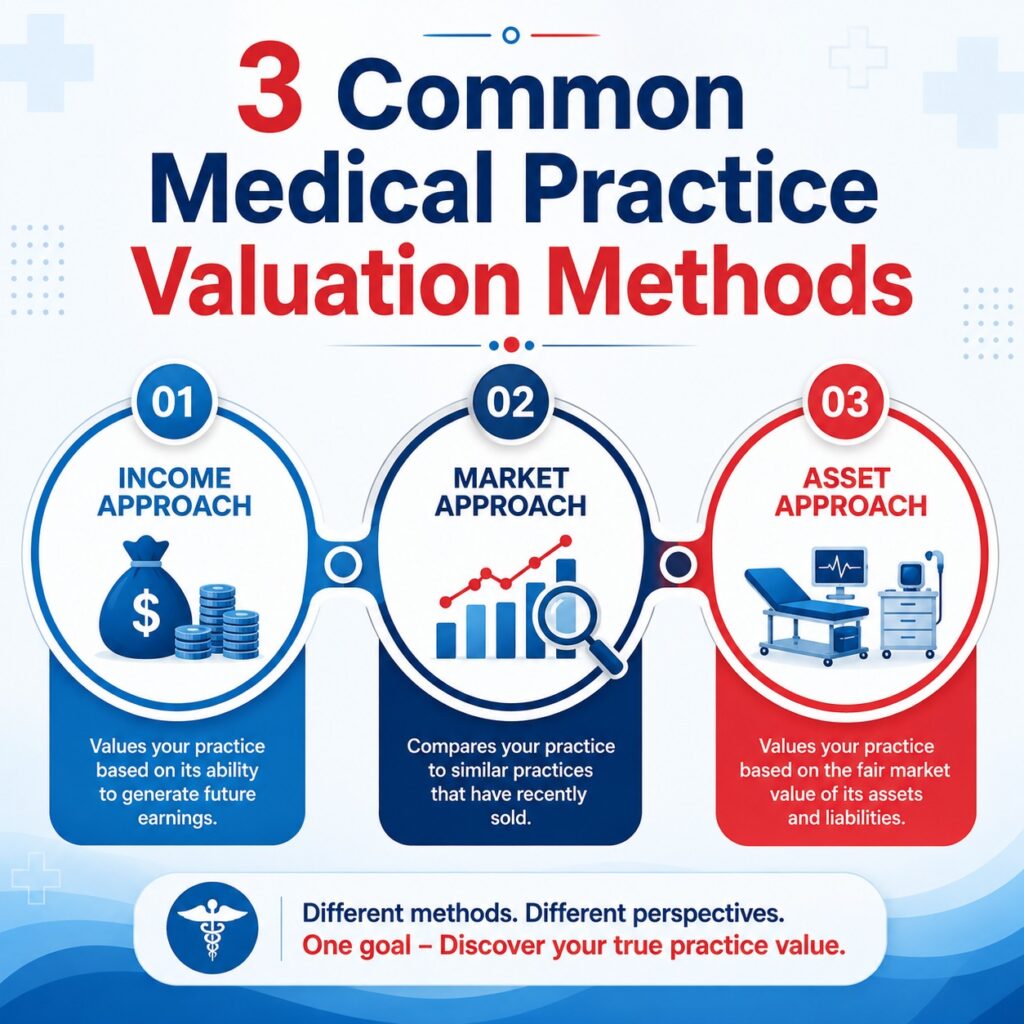
Appraisers use three medical practice valuation methods. Most reports run 2 or 3 of them and reconcile the results. The weight each gets depends on the purpose and the data available.
| Method | How it works | Best fit | Weak spot |
|---|---|---|---|
| Income approach | Discounts expected cash flow to today, or capitalizes one year of earnings | Profitable practices with a steady history | Small changes in the discount rate swing the value |
| Market approach | Applies multiples from comparable practice sales | Sale planning and buyer offers | Private deals rarely disclose their earnings definitions |
| Asset approach | Adds up equipment, receivables and other assets, then subtracts liabilities | Low-profit or closing practices | Ignores goodwill, so it undervalues a profitable practice |
In a sale, the market approach usually leads, because buyers think in multiples. The income approach checks it. Capitalizing $375,000 of earnings at a 25% rate gives $1,500,000, the same as a 4.0x multiple. The asset approach sets a floor when profit is thin.
EBITDA vs. SDE: The Earnings Number Buyers Actually Price
EBITDA is earnings before interest, taxes, depreciation and amortization. Seller’s discretionary earnings, or SDE, goes one step further. It also adds back the full pay of one owner.
The choice depends on who does the work after the sale. If the buyer is a physician who will replace the owner, SDE fits. If the buyer must hire a physician at market pay, EBITDA fits. Using the wrong one inflates or shrinks the value.
Add-Backs Buyers Accept and Reject
Normalization adjusts reported profit to what the practice will earn under a new owner. Each adjustment is called an add-back. Buyers accept the ones that come with paper.
- Accepted: owner pay above or below the market rate for the role, with a market survey behind it.
- Accepted: rent paid to the owner’s own real estate company, adjusted to market rent.
- Accepted: a true one-time cost, such as an electronic health record migration, with invoices.
- Accepted: personal costs run through the practice, if each is listed and traceable.
- Rejected: any adjustment with no invoice or contract behind it.
- Rejected: a cost called one-time that shows up every year.
- Rejected: staff cuts the practice cannot actually run without.
Buyers also make negative adjustments. If the owner is underpaid, or the practice is short-staffed, earnings go down. Practices that already separate legitimate tax deductions for doctors from personal spending have far less to defend at this stage.
Worked Example: One Practice, Two Earnings Figures
Take a practice with $2,400,000 in revenue. It reports $365,000 of pre-tax profit after paying the owner a $250,000 salary. The books also show these items.
| Line | Amount |
|---|---|
| Reported pre-tax profit | $365,000 |
| Owner salary | +$250,000 |
| Personal vehicle and family phone plans | +$18,000 |
| One-time electronic health record migration | +$42,000 |
| Rent above market ($14,000 paid, $11,500 market, 12 months) | +$30,000 |
| Depreciation and interest | +$80,000 |
| Seller’s discretionary earnings | $785,000 |
| Market pay for a replacement physician | −$410,000 |
| Normalized EBITDA | $375,000 |
At the BizBuySell median of 2.05 times, the SDE view prices the practice at $1,609,250. At 4.0 times EBITDA, the EBITDA view gives $1,500,000. The two land close because each multiple fits its own earnings base.
Now say the buyer rejects the $42,000 migration add-back for lack of invoices. Normalized EBITDA falls to $333,000. At 4.0 times, the price drops to $1,332,000. That one missing folder cost the seller $168,000.
EBITDA Multiple Medical Practice in 2026
The EBITDA multiple medical practice buyers pay rises with deal size. In the second quarter of 2026, businesses priced at $5 million to $50 million sold for a median 5.8 times EBITDA. Businesses priced at $2 million to $5 million sold for 4.0 times.
These figures come from the IBBA and M&A Source Market Pulse survey of business brokers and advisors. The survey covers all industries, not only healthcare. Below $2 million, it reports multiples of SDE, because owner pay is still inside the earnings.
| Purchase price | Earnings basis | Median multiple, Q2 2026 | Median multiple, Q2 2025 | Typical medical practice |
|---|---|---|---|---|
| Under $500,000 | SDE | 2.0x | 2.3x | Solo physician, one site |
| $500,000 to $1 million | SDE | 2.8x | 2.8x | Solo or two-provider practice |
| $1 million to $2 million | SDE | 3.1x | 3.0x | Small group with mid-level providers |
| $2 million to $5 million | EBITDA | 4.0x | 3.9x | Multi-provider group |
| $5 million to $50 million | EBITDA | 5.8x | 5.5x | Multi-site specialty group |
Source: IBBA and M&A Source Market Pulse, Q2 2026 highlights, released August 2026. The last column is a guide to which practices usually fall in each band.
What Multiple of EBITDA Do Medical Practices Sell For?
Medical practices that sell for more than $2 million usually trade at about 4 to 6 times normalized EBITDA. Smaller practices trade at about 2 to 3 times SDE. Healthcare EBITDA multiples follow the same size ladder as the rest of the market.
Three things move a practice up or down inside its band:
- Provider depth. A group with several producing providers keeps its revenue when one leaves.
- Payer mix. A balanced mix of commercial plans holds margin better than one dominant payer.
- Clean books. Monthly accrual financials and documented add-backs let a buyer bid with confidence.
What Changed in Medical Practice Multiples in 2026
Larger deals got pricier in 2026. The median EBITDA multiple for businesses priced at $5 million to $50 million rose to 5.8x in Q2 2026, up from 5.5x a year earlier. The smallest deals went the other way, from 2.3x to 2.0x SDE.
Small practice prices also eased. The BizBuySell median medical practice sale price fell to $537,000 in 2025, after peaking at $565,000 in 2024. Buyers are paying up for scale and discounting single-owner risk.
Medical Practice Valuation Multiples by Specialty
Many websites print one EBITDA multiple per specialty. Treat those as broker estimates. None of them disclose the deals behind the number, and no public dataset reports physician practice multiples by specialty.
What is reliable is the direction each specialty pushes. The table shows the common pressures.
| Specialty group | Lifts the multiple | Holds it down |
|---|---|---|
| Family and internal medicine | Large recurring patient panels | Thin margins, panels tied to the owner |
| Pediatrics | Steady well-child visit volume | Lower rates on a Medicaid-heavy payer mix |
| Dermatology | Cash-pay cosmetic revenue beside insured visits | Patients loyal to one physician’s name |
| Orthopedics, gastroenterology, ophthalmology | Procedures plus imaging or surgery center income | Payer concentration and costly equipment |
A specialty label never sets the price alone. A well-run family practice with clean records can outsell a specialty clinic with falling profit. Dental practices follow the same logic, though the methods used to value a dental practice weigh hygiene revenue and recall schedules differently.
Why Hospital Buyers Cannot Pay for Referrals
A hospital or health system buying a practice cannot price in the patients the physician will refer to it. Under the Anti-Kickback Statute, paying for referrals in federal health care programs is a crime.
So hospital offers are built to fair market value, backed by an independent appraisal. A private equity buyer can pay for growth it plans to create. It still cannot pay for referrals either.
What Raises or Lowers the Value of a Medical Practice?
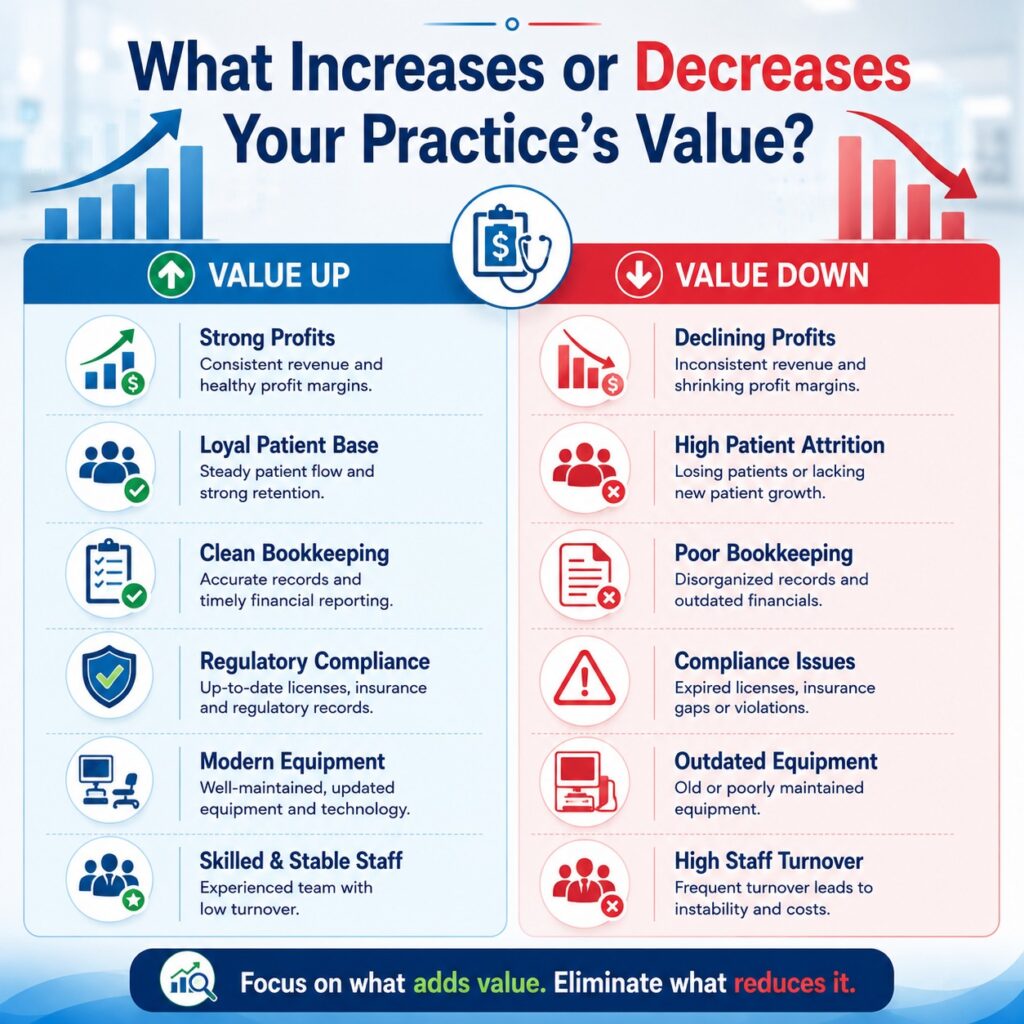
Buyers raise or cut the multiple based on how safe the future earnings look, usually after reading 3 years of statements. Each factor below answers one question: will the revenue stay after the owner leaves?
| Factor | Raises value | Lowers value |
|---|---|---|
| Profit trend | Three years of steady or rising profit | Falling or erratic profit |
| Owner dependence | Several providers share the patient load | One physician produces most revenue |
| Patient base | High return-visit rate, new patients each month | Shrinking active patient count |
| Payer mix | Spread across several commercial plans | One payer drives most collections |
| Financial records | Monthly accrual statements that tie to tax returns | Cash-basis books with personal costs mixed in |
| Compliance | Clean billing and coding audits | Open payer recoupments or legal claims |
| Staff and systems | Stable team, current equipment and software | High turnover, equipment due for replacement |
Each factor a buyer marks as a risk can cost a full turn of multiple. On the worked example above, one turn is $375,000.
Goodwill ties these together. Enterprise goodwill belongs to the practice and transfers with it. Personal goodwill belongs to the physician’s own reputation, so a buyer pays less for it unless the physician signs on to stay.
Can a Medical Practice Valuation Calculator Give You a Real Number?

A medical practice valuation calculator gives a starting range, not a price. It multiplies the earnings you type in by an average multiple. A buyer accepts neither input until it is tested.
Use a calculator for scenario work. Run it 3 times: once with reported profit, once with documented add-backs, and once with a lower multiple. For the example practice, that spread runs from $1,332,000 to $1,609,250.
A calculator cannot see the things that move the multiple:
- Whether the add-backs have invoices behind them.
- How much revenue depends on the owner.
- Payer concentration and open recoupments.
- Working capital, debt and escrow that cut cash at closing.
A professional physician practice valuation tests all of these and puts the support in writing. That written support is what holds the price through due diligence.
What Buyers Test in Due Diligence: Earnings, Accrual Books and Working Capital
After a letter of intent, the buyer’s accountants rebuild the earnings from the source records. This is where agreed prices most often slip. Three reviews do most of the damage.
The Quality of Earnings Review
A quality of earnings review tests whether reported profit is real and will repeat. The buyer’s team works line by line through these areas:
- Revenue timing: whether collections land in the month the care was given.
- Accounts receivable: aging, write-offs and the true collection rate.
- Payer mix: how much revenue rides on each payer contract.
- Provider productivity: visits and collections per provider against pay.
- Add-backs: the invoice, contract or payroll record behind each one.
Each item it cannot verify comes out of normalized EBITDA. At a 5 times multiple, every $10,000 removed costs $50,000 of price.
Cash-Basis Books and Form 3115
Many practices keep cash-basis books, while buyers price on accrual numbers. Accrual books show earned but unpaid revenue, accrued payroll and prepaid costs in the right month.
Switching the tax method for a federal return takes Form 3115. Under the Form 3115 instructions, a positive Section 481(a) adjustment is usually spread over 4 tax years. A negative one is taken in the year of change.
Make the switch at least two years before a sale. Two full years of accrual statements let a buyer compare like with like. A last-minute switch looks like an attempt to dress up the numbers.
The Net Working Capital Peg
Net working capital is current operating assets minus current operating liabilities. For a practice, it is mostly patient receivables minus payables and accrued payroll. Buyer and seller agree on a normal level, called the peg.
At closing, actual working capital is compared to the peg. Each dollar short comes off the price. Each dollar over is usually added back.
Receivables are where this goes wrong. One multi-entity medical group GATP worked with carried $800,000 to $980,000 of receivables each month. Voided invoices were still sitting in QuickBooks as open balances, and billed invoices were missing from the books.
A peg built on that ledger would overstate working capital. After a weekly healthcare accounts receivable reconciliation, each invoice tied to the billing portal. Fixing that before a sale protects the seller from a post-closing price cut.
How to Value a Medical Practice for Sale: A 24-Month Plan

Knowing how to value a medical practice for sale starts 24 months out. A sale planned for 2028 rests on the books you close in 2026. The steps below build the records a buyer will price. Each one names what breaks if it is skipped.
| When | What to do | What breaks if skipped |
|---|---|---|
| 24 months out | Separate personal spending, switch to accrual books, start an add-back file | Add-backs with no paper trail get rejected |
| 18 months out | Set owner pay and related-party rent at market rates | The buyer sets them, usually against you |
| 12 months out | Reconcile three years of statements to tax returns, order a valuation | Gaps surface during due diligence instead |
| 6 months out | Clean receivables, review payer and staff contracts | The working capital peg comes in low |
| 90 days out | Build the data room and a working capital baseline | Diligence drags and the buyer retrades |
A medical practice CPA can own this work across the full 24 months, not just the weeks before a letter of intent. Ongoing financial planning and analysis turns clean records into the forward numbers a buyer will price.
Mistakes That Lower a Medical Practice Valuation
- Mixing personal and practice spending. Every mixed charge becomes an add-back to prove.
- Calling recurring costs one-time. Buyers check three years and reverse them.
- Leaving voided invoices in receivables. The working capital true-up takes them back after closing.
- Anchoring on a specialty multiple from a website. Buyers price your earnings, not an average.
- Planning taxes after the letter of intent. By then, the deal structure is mostly fixed.
Tax Implications of Selling a Medical Practice
The tax implications of selling a medical practice depend on how the price is split across assets. In an asset sale, the buyer and the seller both report that split to the IRS on Form 8594.
Form 8594 sorts assets into seven classes. Equipment and furniture usually sit in Class V. Goodwill and going concern value sit in Class VII. The split matters because each class is taxed differently.
- Goodwill: usually long-term capital gain for the seller. Under IRS Topic 409, most long-term gain is taxed at no more than 20%.
- Equipment: gain up to past depreciation is usually taxed as ordinary income.
- Buyer’s side: the buyer amortizes goodwill over 15 years under Section 197, per the Form 4562 instructions.
Buyers want more of the price on fast-write-off assets. Sellers want more on goodwill. For a practice run as a C corporation, personal goodwill held by the physician can also avoid a second layer of corporate tax, if it is documented before the sale.
Selling a medical practice without a tax plan can cost more than a weak multiple. Our CPAs model the allocation before the letter of intent is signed.
Conclusion: What Your Medical Practice Is Worth
Medical practice valuation comes down to normalized earnings times a multiple: about 2 to 3 times SDE for a small practice, and about 4 to 6 times EBITDA above $2 million. The three things that move it most are documented add-backs, accrual books and low dependence on one physician.
Find out what a buyer will actually pay for your practice.
Our CPAs rebuild your normalized EBITDA, sort every add-back into accepted or at risk, and test your receivables against a working capital peg. You get a value range and the fixes that raise it. Contact GATP Solutions to start.
Frequently Asked Questions About Medical Practice Valuation
How much does a professional medical practice valuation cost?
A professional medical practice valuation costs more when the report must stand up in court. A calculation of value for planning takes less work than a full conclusion of value for a dispute, an estate or the IRS. Multiple locations, related-party leases and messy books add hours, so clean records lower the fee as well as raising the value.
How often should a medical practice be valued?
A medical practice should be valued whenever ownership may change, and every two to three years otherwise. Partner admissions, buyouts, divorce, estate planning and loans all need a current number. A regular valuation also shows which value drivers moved since the last one, while there is still time to act on them.
Is goodwill included in a medical practice valuation?
Goodwill is included in a medical practice valuation whenever the practice earns more than a fair return on its equipment and other assets. It usually makes up most of the price of a profitable practice. Enterprise goodwill transfers with the practice. Personal goodwill depends on the physician staying, so buyers pay less for it without an employment agreement.
Does a solo practice sell for less than a group practice?
A solo practice usually sells at a lower multiple than a group practice. In the Q2 2026 Market Pulse survey, deals under $500,000 sold for about 2.0 times SDE. Deals of $5 million to $50 million sold for 5.8 times EBITDA. Buyers pay more when revenue does not depend on one physician.
Can I use a revenue multiple to value my practice?
A revenue multiple gives only a rough check on a medical practice’s value. Medical practices sold on BizBuySell from 2021 to 2025 went for a median 0.62 times revenue. Revenue says nothing about margin, payer mix or owner pay, so buyers set the actual price on earnings.
Do I need audited financial statements to sell my practice?
Most medical practice sales do not require audited financial statements. Buyers rely on a quality of earnings review instead. What they do need is monthly statements that tie to the tax returns, supported add-backs and clean receivables. Missing support slows due diligence and gives the buyer room to cut the price.
What is the difference between the sale price and what the seller receives?
The sale price is the value of the whole practice, while the seller receives what is left after the closing adjustments. Debt is paid off first. The working capital true-up adds or subtracts. Escrow, seller notes, earnouts and fees then delay or reduce cash at closing, so two offers at the same price can pay very differently.
Can a hospital pay more for my practice than a private buyer?
A hospital can pay a strong price, but it cannot pay for your future referrals. The Anti-Kickback Statute bars paying for referrals in federal health care programs. Hospital offers are therefore built on fair market value from an independent appraisal, which can cap the price below what a growth-focused private buyer would offer.