Your business can be making more sales while your books still show the wrong profit. The problem may be your inventory accounting. Inventory accounting is more than counting the products sitting in your warehouse. It helps you track what your inventory is worth, how much it costs you, and how those costs affect your profit. When inventory records are wrong, your accounting for inventory can also affect the balance sheet, cost of goods sold (COGS), gross profit, cash planning, and tax reporting. In this guide, we’ll explain “what is inventory in accounting”, the main inventory accounting methods, inventory costs, journal entries, and common adjustments. You’ll also see simple examples that make inventory in accounting easier to understand and apply to your business.
Key Takeaways
- Inventory accounting tracks what your goods are worth.
- Inventory is usually a current asset.
- FIFO, LIFO, and weighted average are common methods.
- Inventory costs include purchase and related costs.
- When goods sell, their cost moves to COGS.
- Physical counts help verify inventory records.
- Inventory reserve accounting covers damaged or obsolete stock.
- Accurate records improve profit and cash planning.
What Is Inventory Accounting?
Inventory accounting is the process of tracking the cost and value of the goods a business buys, stores, and sells. In simple terms, it helps answer three basic questions: What do we have? What did it cost us? And how much did we earn after selling it?
In accounting for inventory, goods held for sale are generally recorded as an asset because they can bring money to the business when sold. This is the basic inventory meaning in accounting: products or materials the business owns and expects to sell or use in making products for sale.
When the goods are sold, their cost is no longer kept as an asset. It moves to cost of goods sold (COGS), which is an expense used to calculate profit. This is why accurate inventory in accounting matters. If inventory records are wrong, COGS and profit can also be wrong.
The Simple Inventory Accounting Flow
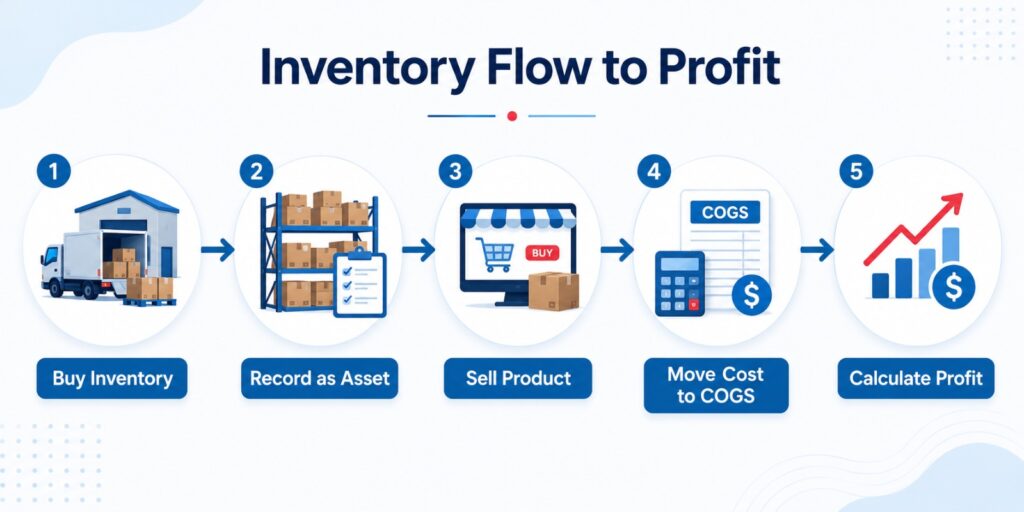
For example, if a business buys a product for $20 and later sells it for $35, the $20 cost becomes COGS when the product is sold. The difference, before other expenses, contributes to the business’s gross profit. Good accounting inventory records also help a business track stock levels, check physical inventory, spot errors, and make better decisions about purchasing and cash flow.
Accurate inventory records become even more important as businesses grow, making reliable eCommerce accounting services useful for keeping inventory, COGS, and sales records in sync.
What Is Inventory in Accounting?
Inventory in accounting means the products or materials a business owns and plans to sell or use to make products for sale. In simple terms, it is the stock that helps a business earn revenue.
Understanding the inventory meaning in accounting is important because inventory is generally recorded as an asset while the business still owns it. Once the goods are sold, their cost is usually moved from inventory to cost of goods sold (COGS). This helps the business calculate its gross profit correctly.
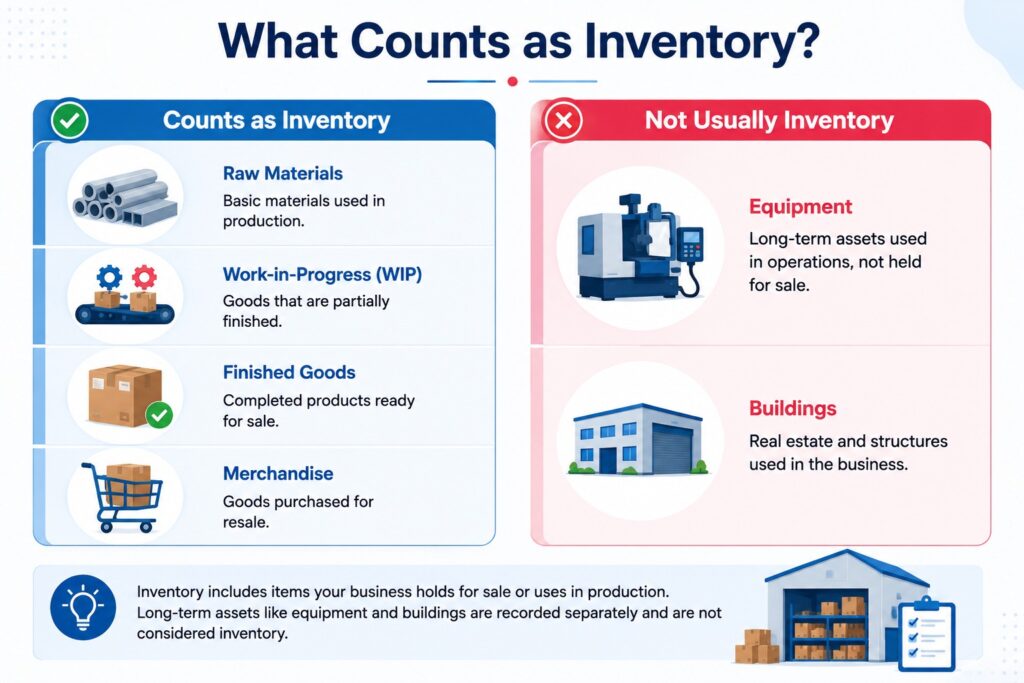
What Counts as Inventory?
Depending on the business, inventory can include:
- Products ready to sell: Finished products waiting for customers.
- Raw materials: Materials used to make products.
- Work in progress: Products that are still being made.
- Finished goods: Completed products ready for sale.
- Merchandise: Goods purchased from suppliers and resold.
- Production materials: Certain materials directly used in making products.
What Is Not Usually Inventory?
Items such as office supplies, equipment, buildings, and other long-term assets are generally not treated as inventory. Their accounting treatment depends on how the business uses them and the applicable accounting rules.
Types of Inventory in Accounting
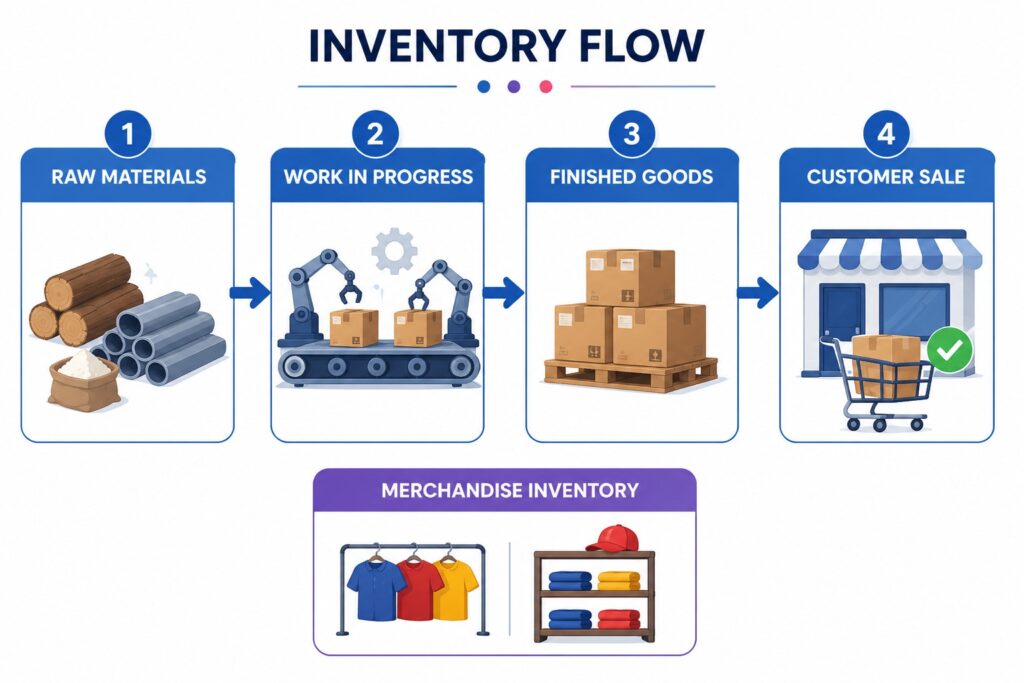
Understanding the types of inventory in accounting helps you see where products and materials fit in your business records. The type of inventory depends on whether an item is waiting to be used, being made, ready for sale, or supporting daily operations.
Raw Materials
Raw materials are basic materials a business buys and uses to make its products. They have not yet gone through the production process. Tracking raw materials helps businesses know how much stock is available and when they need to order more.
Example: A clothing company keeps fabric and buttons as raw materials.
Work in Progress
Work in progress (WIP) refers to products that have started production but are not finished yet. Their value may include materials, labor, and other production costs added during manufacturing. Keeping WIP records helps businesses understand the cost of unfinished products.
Example: Half-assembled furniture waiting for final finishing is work in progress.
Finished Goods
Finished goods are products that have completed production and are ready to be sold to customers. These goods remain part of inventory until they are sold. Once sold, their recorded cost generally moves from inventory to cost of goods sold (COGS).
Example: Packed shoes ready to be shipped to customers are finished goods.
Merchandise Inventory
Merchandise inventory includes products a business purchases from another company and resells without making significant changes. Retailers and wholesalers commonly use this type of inventory. Accurate records help them track what they paid for products and what remains available for sale.
Example: A retailer buys electronics from a manufacturer and resells them to customers.
MRO / Operating Supplies
Maintenance, repair, and operating (MRO) supplies support a business’s daily work but are not necessarily products held for sale. Depending on their purpose, value, and accounting policy, these supplies may be tracked separately from inventory intended for resale or production.
Example: Cleaning supplies used to maintain a warehouse may be tracked separately from products held for sale.
Inventory Accounting Methods
An inventory accounting method decides how a business assigns costs to the products it sells and the products still in stock. The method you use can change your COGS, ending inventory, and reported profit, so choosing the right approach matters. Common inventory methods in accounting include FIFO, LIFO, weighted average, and specific identification.
1. FIFO (First-In, First-Out) Method
FIFO assumes that the oldest inventory purchased is sold first. Under this method, COGS generally reflects the costs of earlier purchases, while ending inventory is valued using the costs of more recent purchases.
Formulas
Cost of Goods Sold
COGS = Sum of (Units Sold * Oldest Available Unit Cost)
Ending Inventory
Ending Inventory = Sum of (Remaining Unsold Units * Newest Unit Cost)
Where,
- COGS: Cost of Goods Sold recognized on the income statement.
- Units Sold: Quantity of inventory items sold during the accounting period.
- Oldest Available Unit Cost: Purchase price of the earliest available inventory batch.
- Ending Inventory: Dollar value of unsold inventory reported as a balance sheet asset.
- Remaining Unsold Units: Quantity of inventory items still on hand at the end of the period.
- Newest Unit Cost: Purchase price of the most recently acquired inventory batch.
Step-by-Step Example
Assume the business has two inventory batches:
- Batch A: 100 units at $10 each
- Batch B: 150 units at $12 each
- Units sold: 120
- Units remaining: 130
Under FIFO, the oldest inventory is assigned to COGS first.
Step 1: Use Batch A First
Batch A contains 100 units at $10 each. Because FIFO uses the oldest inventory first, all 100 units are assigned to the sale.
100 units * $10 = $1,000
Step 2: Use the Remaining Units From Batch B
After using all 100 units from Batch A, another 20 units are needed to reach the total of 120 units sold.
120 – 100 = 20 units
These 20 units come from Batch B at $12 each.
20 units * $12 = $240
Step 3: Calculate Total FIFO COGS
Add the costs assigned to the units sold.
COGS = $1,000 + $240 = $1,240
Step 4: Calculate FIFO Ending Inventory
After selling 20 units from Batch B, 130 units remain in inventory. These remaining units are valued at $12 each.
Ending Inventory = 130 units * $12 = $1,560
2. LIFO (Last-In, First-Out) Method
LIFO assumes that the newest inventory purchased is sold first. Under this method, COGS generally reflects more recent acquisition costs, while ending inventory may retain older historical costs.
LIFO Formulas
Cost of Goods Sold
COGS = Sum of (Units Sold * Newest Available Unit Cost)
Ending Inventory
Ending Inventory = Sum of (Remaining Unsold Units * Oldest Unit Cost)
Where,
- COGS: Cost of Goods Sold recognized on the income statement.
- Units Sold: Quantity of inventory items sold during the accounting period.
- Newest Available Unit Cost: Purchase price of the most recently acquired available inventory batch.
- Ending Inventory: Dollar value of unsold inventory reported on the balance sheet.
- Remaining Unsold Units: Quantity of inventory items still on hand at the end of the period.
- Oldest Unit Cost: Purchase price of the earliest inventory batch.
Step-by-Step Example
Using the same inventory quantities:
- Batch A: 100 units at $10 each
- Batch B: 150 units at $12 each
- Units sold: 120
- Units remaining: 130
Under LIFO, the newest inventory is assigned to COGS first.
Step 1: Use Batch B First
Batch B contains 150 units at $12 each, which is enough to cover all 120 units sold.
120 units * $12 = $1,440
Therefore:
COGS = $1,440
Step 2: Calculate the Remaining Inventory From Batch A
None of Batch A was sold because the entire sale was covered by Batch B.
100 units * $10 = $1,000
Step 3: Calculate the Remaining Inventory From Batch B
Batch B originally contained 150 units. After selling 120 units, 30 units remain.
150 – 120 = 30 units
The remaining Batch B inventory is valued at $12 per unit.
30 units * $12 = $360
Step 4: Calculate Total LIFO Ending Inventory
Add the remaining inventory values from both batches.
Ending Inventory = $1,000 + $360 = $1,360
3. Weighted Average Cost (WAC) Method
The Weighted Average Cost method combines the costs of all inventory available for sale and calculates a single average cost per unit. That average cost is then used to calculate both COGS and ending inventory.
Formulas
Weighted Average Cost Per Unit
Weighted Average Cost per Unit = Total Cost of Goods Available for Sale / Total Units Available for Sale
Cost of Goods Sold
COGS = Units Sold * Weighted Average Cost per Unit
Ending Inventory
Ending Inventory = Unsold Units * Weighted Average Cost per Unit
Where,
- Weighted Average Cost per Unit: Average acquisition cost assigned to each inventory unit.
- Total Cost of Goods Available for Sale: Combined cost of beginning inventory and purchases during the accounting period.
- Total Units Available for Sale: Combined number of units in beginning inventory and purchases.
- COGS: Cost of Goods Sold recognized on the income statement.
- Units Sold: Total quantity of inventory units sold to customers.
- Ending Inventory: Dollar value of inventory remaining at the end of the period.
- Unsold Units: Number of inventory units remaining in stock at period-end.
Step-by-Step Example
Assume the business has:
- Total inventory cost: $2,800
- Total units available: 250
- Units sold: 120
- Units remaining: 130
The business first calculates one average cost per unit.
Step 1: Calculate Weighted Average Cost Per Unit
Divide the total inventory cost by the total number of units available.
Unit Cost = $2,800 / 250 = $11.20 per unit
Step 2: Calculate COGS
Multiply the 120 units sold by the weighted average cost of $11.20.
COGS = 120 units * $11.20 = $1,344
Step 3: Calculate Ending Inventory
Multiply the 130 remaining units by the same weighted average cost.
Ending Inventory = 130 units * $11.20 = $1,456
4. Specific Identification Method
The Specific Identification method assigns the exact purchase cost to each individual inventory item sold. Instead of assuming an order in which inventory is sold, the business tracks specific items using identifiers such as serial numbers, VINs, RFID tags, or other unique identification numbers.
This method is particularly useful when inventory items are unique, high-value, or individually identifiable.
Formulas
Cost of Goods Sold
COGS = Sum of (Specific Units Sold * Their Actual Invoice Cost)
Ending Inventory
Ending Inventory = Sum of (Specific Unsold Units * Their Actual Invoice Cost)
Where,
- COGS: Cost of Goods Sold recognized on the income statement.
- Specific Units Sold: Individually identified inventory items sold during the accounting period.
- Actual Invoice Cost: Exact historical purchase price assigned to each specific item.
- Ending Inventory: Dollar value of the specific inventory items remaining on hand.
- Specific Unsold Units: Individually identified inventory items that remain in stock at period-end.
Step-by-Step Example
Assume the inventory records show that the 120 units sold consisted of:
- 70 units from Batch A at $10 each
- 50 units from Batch B at $12 each
Because the specific items sold are known, their actual costs can be assigned directly to COGS.
Step 1: Identify the Inventory Sold
The accounting records confirm that 70 units came from Batch A and 50 units came from Batch B.
70 + 50 = 120 units sold
Step 2: Calculate Specific COGS
Calculate the exact cost of the units sold from each batch.
70 units * $10 = $700
50 units * $12 = $600
Therefore:
COGS = $700 + $600 = $1,300
Step 3: Calculate the Remaining Inventory From Batch A
Batch A originally contained 100 units. After selling 70 units, 30 units remain.
100 – 70 = 30 units
The remaining Batch A inventory is worth:
30 units * $10 = $300
Step 4: Calculate the Remaining Inventory From Batch B
Batch B originally contained 150 units. After selling 50 units, 100 units remain.
150 – 50 = 100 units
The remaining Batch B inventory is worth:
100 units * $12 = $1,200
Step 5: Calculate Total Ending Inventory
Add the remaining inventory values from both batches.
Ending Inventory = $300 + $1,200 = $1,500
Important: The method a business can use depends on its accounting framework, business circumstances, and applicable rules. A business should use an appropriate method consistently rather than switching methods simply to change reported profit.
How Inventory Accounting Methods Affect Profit
Selecting an inventory accounting approach directly shapes COGS and asset values. Because purchase costs fluctuate, accounting for inventory using different methods impacts gross profit, taxes, and net income.
- Cost of Goods Sold (COGS) Allocation: Different inventory accounting methods dictate which cost batch is recorded at sale. Selling 10 units yields $100 COGS under FIFO versus $120 under LIFO.
- Balance Sheet Asset Valuation: Unsold inventory in accounting records reflects remaining costs. FIFO leaves recent higher costs on the balance sheet, while LIFO leaves older historical costs.
- Gross Profit and Net Income Variance: COGS directly impacts reported earnings. Higher COGS reduces gross profit and net income, while lower COGS inflates earnings during periods of rising prices.
- Tax Liability and Cash Flow: Higher COGS lowers reported short-term taxable income. This reduces immediate tax obligations and helps preserve valuable operating cash flow during inflationary periods.
- Reporting and Decision Consistency: Choosing an appropriate method depends on business needs and tax rules. Consistent application ensures accurate, reliable financial tracking across accounting periods.
What Costs Are Included in Inventory Accounting?
Accurately tracking expenses when accounting for inventory ensures true financial statements. Total inventory accounting cost includes purchase prices plus direct expenses needed to prepare goods for sale.
- Purchase Cost: The base supplier price paid for goods, including directly related expenses like import duties and freight needed to transport items.
- Conversion Costs: Expenditures incurred by manufacturers turning raw materials into finished goods, including direct labor and a share of factory overhead.
- Landed Costs: Total direct expenses required for imported products, including customs fees, shipping insurance, and freight to bring goods to the warehouse.
- Exclusionary Overhead Rules: Not all shipping or overhead costs belong in inventory in accounting; treatment depends on specific accounting rules and company policies.
- Valuation Impact: Accurately tracking these costs prevents misstating assets and ensures precise profit calculations across various inventory accounting methods.
Periodic vs. Perpetual Inventory Accounting
Businesses can track inventory in two main ways: periodic and perpetual inventory accounting. Both methods help a business understand its inventory and COGS, but they update records differently. The main difference is how often inventory records change when products are purchased or sold.
| Feature / Comparison Aspect | Periodic Inventory System | Perpetual Inventory System |
| Primary Mechanism | Updates inventory balances and cost records at set, scheduled intervals via manual physical counts. | Continuously records and updates stock levels and costs automatically as purchases and sales occur. |
| Update Frequency | Periodically (e.g., monthly, quarterly, or annually). | Real-time / Instantaneous with every transaction. |
| COGS Calculation Method | Calculated at period-end using:
$\text{Beginning Inventory} + \text{Purchases} – \text{Ending Inventory}$ |
Recorded automatically for each individual item at the exact moment of sale. |
| Inventory Visibility | Limited between counting cycles; inventory balances are estimated until the next physical count. | Continuous, up-to-date visibility into precise stock levels and inventory valuations across all channels. |
| Role of Physical Counts | Primary driver; essential for determining ending inventory and calculating COGS. | Reconciliatory tool; essential for auditing system data and identifying physical discrepancies. |
| Discrepancy & Shrinkage Tracking | Discrepancies (theft, damage, loss) are absorbed into COGS, making exact causes harder to isolate. | Discrepancies are highlighted during physical audits by comparing actual stock against real-time system logs. |
| Technology Requirements | Low; can be managed using basic spreadsheets or manual record-keeping tools. | High; requires integrated Point-of-Sale (POS) systems, barcode scanners, or ERP software. |
| Implementation & Cost | Simple setup with low initial investment and minimal ongoing software costs. | Higher setup investment and ongoing tech maintenance, offset by increased automation and insight. |
| Ideal Business Fit | Small businesses, low-volume operations, or companies with simple, specialized product lines. | High-volume retailers, e-commerce brands, growing businesses, and multi-location operations. |
Inventory Accounting Journal Entries
Inventory accounting journal entries show how a business records inventory purchases, payments, sales, and changes in stock. Understanding these entries makes accounting for inventory easier and helps keep inventory in accounting records accurate. Below are simple examples of the most common entries businesses may need.
1. Buying Inventory
Suppose a company buys $5,000 of inventory on credit. Because the business now owns more inventory, the inventory asset increases. At the same time, it owes the supplier money, so accounts payable increases.
| Account | Debit | Credit |
| Inventory | $5,000 | — |
| Accounts Payable | — | $5,000 |
In simple words: Inventory goes up, so we debit it. The amount owed to the supplier also goes up, so we credit accounts payable.
2. Paying the Supplier
When the company pays the $5,000 it owes, accounts payable decreases and cash also decreases.
| Account | Debit | Credit |
| Accounts Payable | $5,000 | — |
| Cash | — | $5,000 |
In simple words: The debt to the supplier is cleared, so accounts payable is debited. Cash leaves the business, so cash is credited.
3. Selling Inventory
Now suppose the company sells inventory for $8,000, and the inventory originally cost the company $5,000.
There are two accounting entries because the sale creates revenue and also removes the sold inventory from the books.
Sales entry:
| Account | Debit | Credit |
| Cash / Accounts Receivable | $8,000 | — |
| Sales Revenue | — | $8,000 |
COGS entry:
| Account | Debit | Credit |
| Cost of Goods Sold | $5,000 | — |
| Inventory | — | $5,000 |
The first entry records the money earned from the sale. The second removes the product’s $5,000 cost from inventory and records it as COGS, or cost of goods sold. This is an important part of accounting for inventory because inventory changes from an asset into an expense when the goods are sold.
4. Inventory Adjustment
A physical stock count may show that the business has fewer or more units than its accounting records show. This can happen because of damage, theft, counting mistakes, shipping errors, or missing transactions.
For example, if the books show $10,000 of inventory but the physical count supports only $9,500, the business may need a $500 inventory adjustment, depending on the reason and applicable accounting rules.
| Account | Debit | Credit |
| Inventory Adjustment / Expense | $500 | — |
| Inventory | — | $500 |
In simple words: The adjustment brings the accounting record closer to the actual inventory on hand.
5. Damaged or Obsolete Inventory
Not every product remains worth its original cost. Inventory may become damaged, outdated, expired, or difficult to sell. In these situations, inventory reserve accounting may be used to recognize the expected reduction in value, based on the applicable accounting framework.
For example, if a business estimates that $1,000 of inventory is no longer recoverable at its recorded value, it may record an appropriate reserve or write-down.
| Account | Debit | Credit |
| Inventory Write-Down Expense | $1,000 | — |
| Inventory Reserve / Allowance | — | $1,000 |
In simple words: The reserve recognizes that some inventory may not provide the value originally expected.
Important: The exact journal entry for inventory adjustments, reserves, and write-downs can vary based on the accounting framework, facts, and company policy. Businesses should apply the rules that govern their financial statements rather than using one entry for every situation.
What Is Inventory Reserve Accounting?
Inventory reserve accounting helps businesses reduce the recorded value of inventory when some products may no longer be worth their original cost.
This may apply to:
- Damaged products
- Outdated products
- Expired products
- Slow-moving stock
- Products that may sell for less than their recorded cost
For example, if $10,000 of inventory is now expected to be worth only $7,000, the business may need to recognize a $3,000 reduction, depending on the applicable accounting rules.
Ignoring old or damaged inventory can make inventory in accounting, assets, and profit look higher than they really are. Regular inventory reviews help keep financial records accurate.
Consignment Inventory Accounting Explained
Consignment inventory accounting deals with goods that one business sends to another for sale while keeping ownership until the goods are sold. The supplier owns the inventory, while the other business stores and sells it. Therefore, knowing who owns the goods and when ownership changes is key to recording the inventory correctly.
What Is Consignment Inventory?
Consignment inventory accounting applies when a supplier sends goods to another business to sell, but the supplier keeps ownership until the goods are sold. The selling business has possession of the goods but does not necessarily own them.
Who Records the Inventory?
Ownership is the key point in consignment inventory accounting:
- Consignor: The supplier and owner of the goods.
- Consignee: The business that holds and sells the goods.
The consignee generally does not record consigned goods as its own inventory because it does not own them. The consignor continues to account for the inventory until the agreed sale or ownership-transfer conditions are met.
Simple Example
A supplier sends a retailer 100 units at $20 each, giving the inventory a value of $2,000. The retailer holds the products but does not own them.
If the retailer sells 20 units, the cost of those units is:
20 * $20 = $400
At that point, the applicable agreement and accounting rules determine when the sale is recognized and how the consignor and consignee record the transaction. The key is to identify who owns the goods and when ownership transfers.
How to Calculate Ending Inventory
Ending inventory is the value of goods a business still has at the end of an accounting period. It is important in inventory accounting because ending inventory affects COGS and, in turn, reported profit.
Basic Formula
Ending Inventory = Beginning Inventory + Purchases − COGS
First, calculate the goods available for sale:
Goods Available for Sale = Beginning Inventory + Purchases
Then, if you know ending inventory, you can calculate COGS:
COGS = Goods Available for Sale − Ending Inventory
Simple Example
Suppose a business starts with $10,000 of inventory and buys another $25,000 during the year.
Goods Available for Sale = $10,000 + $25,000 = $35,000
If COGS is $22,000:
Ending Inventory = $35,000 − $22,000 = $13,000
So, the business should have $13,000 of ending inventory based on these figures. A physical inventory count can then help check whether the accounting records match the actual stock.
Full Inventory Accounting Example
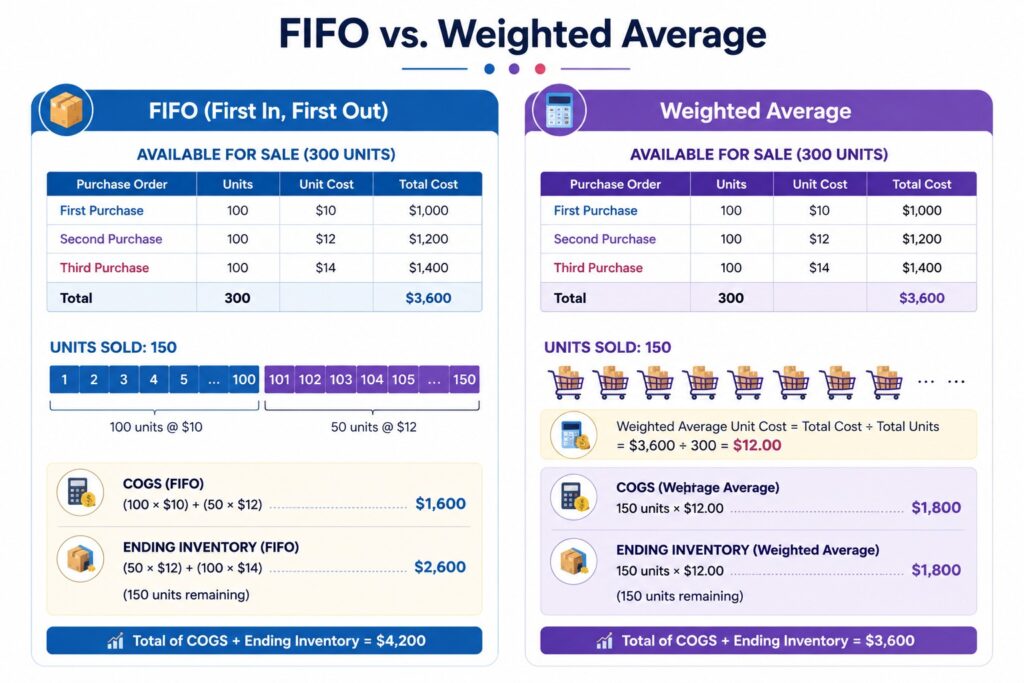
Let’s use one simple example to see how different inventory accounting methods can produce different COGS and ending inventory values.
A company starts the month with:
- 100 units * $10 = $1,000
It then buys:
- 200 units * $12 = $2,400
So, the company has:
- 300 units available
- Total inventory cost = $3,400
During the month, it sells 150 units, leaving 150 units in inventory.
FIFO
Under FIFO, the oldest inventory costs are treated as sold first.
- 100 units * $10 = $1,000
- 50 units * $12 = $600
- COGS = $1,600
- Remaining 150 units * $12 = $1,800 ending inventory
Weighted Average
First, calculate the average cost per unit:
$3,400 / 300 = $11.33 per unit
Then apply that average cost to the 150 units sold and the 150 units remaining:
- 150 units * $11.33 = $1,700 COGS
- 150 units * $11.33 = $1,700 ending inventory
What Does This Show?
The business sold the same 150 units, but the two inventory accounting methods produced different COGS and ending inventory amounts. This can affect reported profit, which is why businesses need to choose an appropriate method and apply it consistently.
Inventory Reconciliation: How to Match Books With Physical Stock
Inventory reconciliation means checking whether the inventory shown in your accounting records matches the stock you actually have. Regular checks can help find missing, damaged, returned, or unrecorded goods and keep inventory accounting records accurate.
Simple Inventory Reconciliation Process
- Run an inventory report: Get the quantity and value shown in your accounting or inventory system.
- Count physical inventory: Count the actual products in your warehouse or store.
- Compare the numbers: Check the physical count against the system records.
- Find differences: Look for missing, damaged, returned, or unrecorded goods.
- Investigate the cause: Check receiving records, shipped orders, returns, and other stock movements.
- Record adjustments: Make the appropriate accounting adjustment for confirmed differences.
- Recheck the balance: Make sure the final inventory records match the verified physical stock.
A physical count is still important even when a business uses a perpetual inventory system. Cornell’s guidance emphasizes physical inventory controls and adjusting the general ledger to the actual physical inventory balance.
Quick Reconciliation Checklist
- Count stock
- Check receiving records
- Check shipped orders
- Check returns
- Identify damaged goods
- Compare system and physical quantities
- Record adjustments
Regular reconciliation becomes easier when accurate bookkeeping services keep inventory purchases, sales, returns, and adjustments properly recorded.
Inventory Management Accounting: Why the Two Must Work Together
Inventory management accounting combines two connected tasks. Inventory management tells you what stock you have and where it is, while inventory accounting tells you what that stock is worth in your books. Both are needed for accurate costs, profits, and financial records.
This becomes more important for growing eCommerce businesses using Shopify, Amazon, multiple warehouses, or 3PLs. Each platform may track sales and stock differently, making it harder to keep inventory records aligned. Good inventory management accounting helps connect purchases, sales, stock levels, and COGS.
When businesses sell through several channels, keeping financial data connected is equally important. Accurate multi-channel ecommerce accounting helps businesses maintain clearer records across Amazon, Shopify, and other sales channels, reducing mismatches between inventory and accounting records.
Inventory Accounting in 2026: From Spreadsheets to Real-Time Data
Modern inventory accounting is moving beyond manual spreadsheets toward real-time data integration. Connected systems provide instant visibility across sales channels, warehouses, and fulfillment networks.
- Real-Time Data Integration: Connected systems offer instant visibility into stock levels, sales, and valuation, significantly reducing manual updates and human errors.
- AI-Assisted Forecasting: Machine learning tools analyze demand patterns to improve inventory planning, helping businesses predict customer needs and optimize purchasing decisions.
- Agentic Commerce Support: Automated AI shopping agents require accurate product, pricing, and stock records to deliver seamless, real-time purchasing experiences.
- Essential Human Oversight: While technology accelerates accounting for inventory, physical stock counts, clean data, and human review remain vital for financial accuracy.
How GATP Solutions Helps eCommerce Businesses Manage Inventory Accounting
Growing inventory can quickly make your books harder to manage. If you’re selling across Shopify, Amazon, or other channels, keeping inventory, COGS, sales, and cash flow in sync takes more than a spreadsheet.
GATP Solutions helps growing eCommerce businesses manage these moving parts with accounting support built around Shopify, Amazon, and DTC brands. Its services include inventory accounting and multi-channel reconciliation, helping businesses keep their sales and financial records aligned as they grow. Explore AI-powered accounting services for 7-figure businesses to see how GATP can support your growing business.
If managing inventory records is taking time away from running your business, the right accounting support can help you keep your books organized and make better financial decisions.
Final Thoughts
Good inventory accounting is about more than tracking products. It helps you know what your inventory is worth, calculate COGS correctly, understand your real profit, and make better purchasing and cash-flow decisions. By using the right inventory accounting methods and regularly reconciling physical stock with your books, you can reduce costly errors as your business grows.
Whether you sell through Shopify, Amazon, a physical store, or multiple channels, strong accounting for inventory helps keep your financial records clear and reliable. Good inventory management accounting also helps you spot damaged, missing, or outdated stock before it affects your bottom line.
Need expert support? GATP Solutions provides AI-powered bookkeeping, accounting, payroll, tax, and Virtual CFO services for growing businesses. Contact us today for a free consultation and get the support you need to keep your inventory, COGS, and financial records accurate.
Frequently Asked Questions
What does inventory mean in accounting?
Inventory means products or materials a business owns and expects to sell or use in making products for sale.
What is merchandise inventory in accounting?
Merchandise inventory includes goods purchased from suppliers and held for resale to customers without significant changes or further processing.
How do you find average inventory accounting?
Calculate average inventory by adding beginning and ending inventory, then dividing the total by two for the period.
What is a perpetual inventory system in accounting?
A perpetual inventory system continuously updates inventory records whenever purchases, sales, returns, or other inventory transactions occur during normal business operations.
How do you record inventory in accounting?
Record inventory purchases by debiting the Inventory account and crediting Cash or Accounts Payable, depending on whether payment is immediate.
What is inventory in accounting definition?
Inventory is physical property held for sale or materials used to produce goods that a business intends to sell.
8. What is an inventory reserve in accounting?
An inventory reserve records an estimated reduction in inventory value when goods become damaged, obsolete, expired, or otherwise less valuable.
What does inventory mean in accounting?
Inventory is an asset representing goods a business owns and expects to sell or use in production during normal operations.
How do you record inventory shrinkage in accounting?
Record inventory shrinkage by reducing the Inventory account and recognizing the appropriate expense or loss for missing or unusable stock.
What is ending inventory in accounting?
Ending inventory is the value of unsold goods remaining at the end of an accounting period, based on accounting records and applicable valuation methods.